
$1.340
+0.144 (+10.74%)Zum Schluss
BIVI-News









BIVI-Events
BioVie Enters Agreement to Sell 2.96 Million Shares to Institutional Investor
BioVie announced that it has entered into a securities purchase agreement with a single healthcare focused institutional investor for the purchase and sale of 2,962,500 shares of common stock at a purchase price of $1.60 per share in a registered direct offering priced at-the-market under Nasdaq rules. In addition, in a concurrent private placement, the company will issue and sell unregistered common warrants to purchase up to 2,962,500 shares of common stock. The common warrants will have an exercise price of $1.70 per share, will be exercisable six months following their issuance and will expire five and a half years from the issuance date. The gross proceeds from the Offering are expected to be approximately $4.74M, before deducting placement agent commissions and other Offering expenses. The company intends to use the net proceeds from the Offering for working capital and general corporate purposes. The closing of the Offering is expected to occur on or about November 5, subject to the satisfaction of customary closing conditions. A.G.P./Alliance Global Partners is acting as the sole placement agent for the Offering.
BioVie Presents Bezisterim Parkinson's Trial Results at ANA Annual Meeting
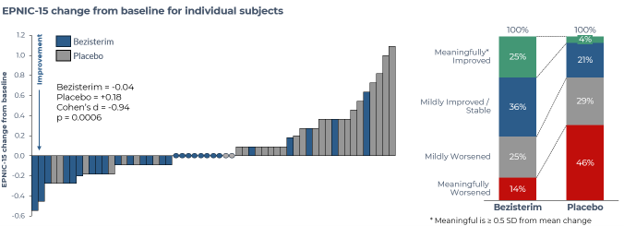
BioVie announced the presentation of results from the Phase 2 SUNRISE-PD clinical trial evaluating bezisterim in early Parkinson's patients at the 151st Annual Meeting of the American Neurological Association, or ANA, held October 17-20 in San Diego, California. Patients received bezisterim or placebo for 12 weeks. The study assessed motor symptoms, non-motor symptoms, activities of daily living, sleep, inflammatory biomarkers, and overall clinical benefit using a Composite Benefit Score, a fit-for purpose measure designed to capture changes across multiple domains of Parkinson's disease. Patients with higher systemic inflammation at the start of the trial - defined as above-median platelet counts above 230 10/L - demonstrated the strongest response to bezisterim. In this prespecified subgroup, which represents approximately half of the trial population, bezisterim-treated patients experienced significant improvements in the Movement Disorder Society-Unified Parkinson's Disease Rating Scale Part I scores, Part III scores, and Total Scores. In the overall modified intent-to-treat population, efficacy outcomes generally favored bezisterim across multiple measures. The CBS also demonstrated a large treatment effect favoring bezisterim. Patients receiving bezisterim were 6.25-fold more likely to achieve clinically meaningful improvement on the CBS than patients receiving placebo, corresponding to a 525% relative increase and a 21-percentage-point absolute difference. Conversely, the risk of clinically meaningful worsening was approximately 70% lower with bezisterim than with placebo, representing a 32-percentage-point absolute risk reduction. Bezisterim was well tolerated, with a favorable safety profile compared with placebo. Treatment-emergent adverse events occurred in 39.3% of bezisterim-treated participants and 51.7% of placebo-treated participants. No severe or serious adverse events were reported in either group, and only one potentially treatment-related adverse event was reported in each treatment arm.
BioVie Presents Long COVID Study Results at AAN Annual Meeting
BioVie announced the presentation of results from the Phase 2 ADDRESS-LC study evaluating bezisterim in patients with Long COVID at the 151st Annual Meeting of the American Neurological Association. 203 patients received bezisterim or placebo for 12 weeks, and no single endpoint was designated as primary. Among the most fatigued half of patients at baseline, mean improvement in PROMIS Fatigue at Week 12 was 8.93 points with bezisterim compared with 5.30 points with placebo, p=0.02. The trial did not achieve statistical significance on any endpoint in the overall intent-to-treat population; statistically significant results were observed only in pre-specified subgroup analyses.
BioVie Announces Phase 2 ADDRESS-LC Trial Results
BioVie announced topline results from the company's Phase 2 ADDRESS-LC trial evaluating its investigational drug candidate bezisterim, an oral drug that crosses the blood-brain barrier and is believed to reduce inflammation and improve insulin sensitivity, in Long COVID. In pre-specified subgroup analyses submitted to the FDA prior to data unblinding, patients with greater baseline burden on one or more symptoms demonstrated statistically significant improvements on multiple clinically coherent endpoints. Bezisterim's safety and tolerability profile was similar to placebo. When the full Intent-to-Treat population of 203 patients is evaluated without segmentation, bezisterim shows numerical trends favoring treatment over placebo across nearly all individual endpoints, as reflected in the Cohen's d effect sizes. Cohen's d quantifies the magnitude of difference between treatment and control groups, and a positive value indicates that the treatment effect was greater in the bezisterim arm than in the placebo arm. In this heterogenous ITT population, no individual endpoint reached statistical significance, likely because patients with low baseline symptom burden had little room to improve, which may have diluted the overall signal. Twenty-one of the 22 endpoints showed numerical trends favoring bezisterim. In pre-specified subgroup analyses, differential treatment effects emerged when focusing on patients with high baseline symptom burden. Despite reducing sample size, the treatment effect sizes more than doubled compared to the ITT population, as seen with higher Cohen's d values, and the endpoints that reached statistical significance increased suggesting a coherent explanation for the clinical improvements. The most severe half of patients with fatigue symptoms showed statistically significant improvements on five endpoints, along with trends in post-exertional malaise and sleep. Patients with high post-exertional malaise experienced statistically significant improvements across malaise, fatigue, and objective cognitive measures. And patients who entered the trial with substantial objective cognitive impairment demonstrated statistically significant improvements on four clinically coherent objective cognitive endpoints. These subgroup findings are exploratory and require confirmation in an adequately powered prospective study. Bezisterim's safety and tolerability were similar to placebo. Overall, 41.6% of bezisterim patients experienced at least one treatment-emergent adverse event compared to 55.9% for placebo. The most frequently reported drug-related adverse event was headache, experienced by 4% of bezisterim-treated patients vs. 4.9% for placebo. No serious adverse events were reported in the bezisterim arm. The safety findings are particularly important given the extensive concomitant medication use observed in the trial population.
BioVie Completes Last Treatment Visit of ADDRESS-LC Phase 2 Trial
BioVie announced that the last on-treatment visit of its ADDRESS-LC Phase 2 trial evaluating bezisterim for the treatment of neurological symptoms of Long COVID has been completed. The Phase 2 study is fully funded by a grant from the U.S. Department of War.
Ähnliche Artikel
- How to Rebalance a Concentrated Stock Portfolio in 2026: Mag7 Drift, Tax-Aware Trims, and Practical Rebalance a concentrated stock portfolio in 2026: Mag7 drift risk, 5pp bands, tax-aware trims, RSP/IWM diversifiers, and single-name caps.
- Small Cap Stocks Investing Guide 2026: Russell 2000, Fed Hikes, and the Financing TradeSmall-cap stocks investing guide 2026: Russell 2000 vs S&P, IWM rate sensitivity, floating-rate debt, Fed hikes, valuation discounts, and a practical checklist.
- Santa Claus Rally and the Year-End Stock Market: Investor Guide for Late 2026Santa Claus rally explained: 7-day window stats since 1950, Nov–Dec seasonality, post-midterm 2026 setup, and a risk-managed year-end investing playbook.
Diese Seite dient nur der Recherche und ist keine Anlageberatung. Modelle können falsch liegen. Vergangene Wertentwicklung ist kein Indikator für die Zukunft.