

How to Rebalance a Concentrated Stock Portfolio in 2026: Mag7 Drift, Tax-Aware Trims, and Practical
Rebalance a concentrated stock portfolio in 2026: Mag7 drift risk, 5pp bands, tax-aware trims, RSP/IWM diversifiers, and single-name caps.

Key Takeaway
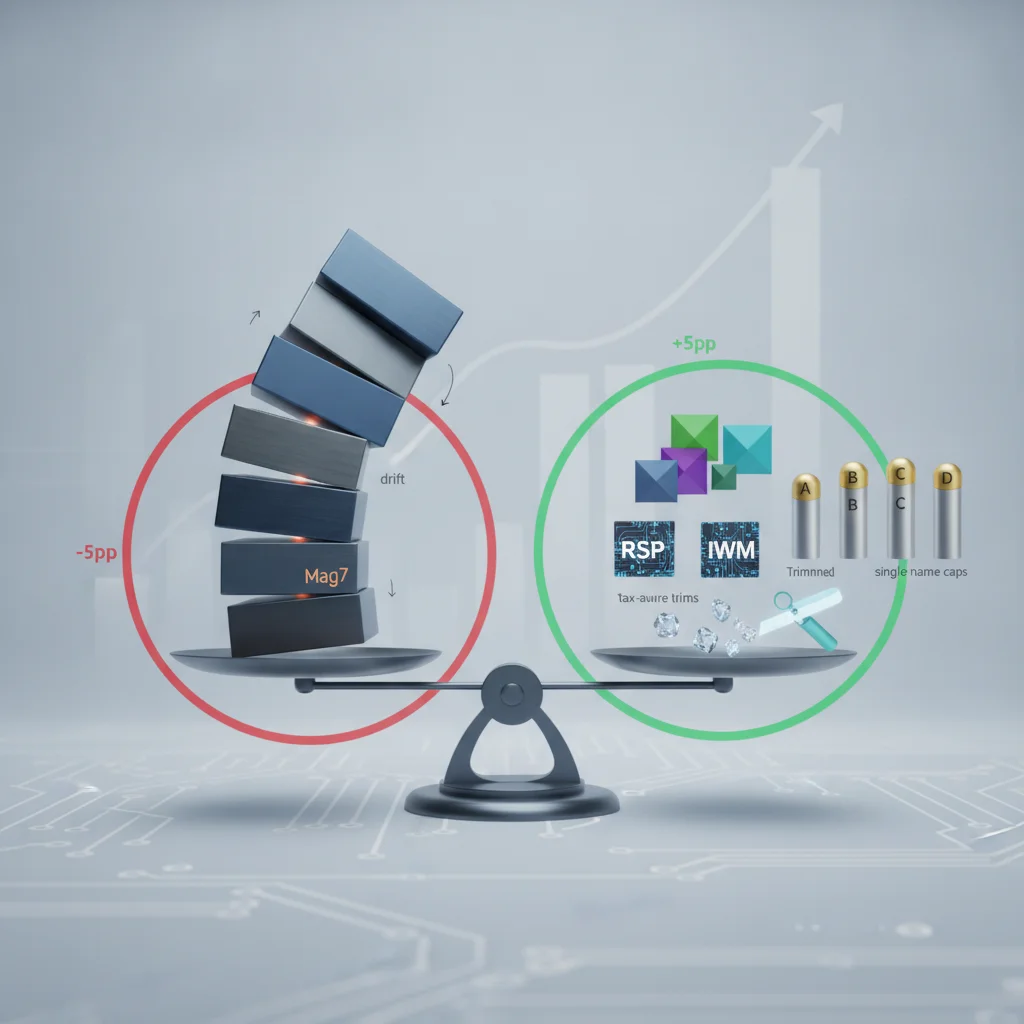
Concentration is the silent risk that arrives dressed as success. When a handful of mega-cap winners inflate inside an otherwise sensible equity mix, the portfolio you end up holding is no longer the risk profile you chose—even if every ticker still looks familiar. Rebalancing a concentrated stock portfolio is therefore not a confession that the winners were wrong; it is the deliberate act of restoring the volatility, drawdown, and single-name exposure you actually underwrote.
Through early November 2026, that problem sits in plain sight. The Magnificent Seven still account for roughly 34.5–34.9% of the S&P 500 and often push the top-10 share toward the high thirties, while QQQ keeps Mag7 near 38%. Yet the group no longer moves as one bloc: Amazon’s strong YTD advance and Tesla’s deep lag illustrate dispersion inside the same “mega-cap” label. Meanwhile IWM’s roughly +14.4% YTD total-return edge over SPY and QQQ hints that leadership may be broadening, which is exactly when investors who rode concentration higher need a playbook for trimming and reallocating without abandoning U.S. equities.
This guide is that playbook. It shows how to measure concentration, write rules before you trade, rebalance in a tax-aware order, use tools such as equal-weight indexes and small-cap satellites to dilute mega-cap tilt, and automate reviews so you do not thrash daily. The goal is risk control first—return chasing second.
Why 2026 Concentration Feels Different
Mag7 weight inside SPY and QQQ
Index math does the quiet work. When a few names compound faster than the median stock, capitalization-weighted benchmarks automatically raise their own concentration. By late October 2026, Mag7’s share of SPY sat near 34.5–34.9%, with the broader top-10 often in the 38–40% range. In QQQ the Mag7 footprint near 38% means a Nasdaq-100 sleeve is, for practical purposes, a concentrated growth bet even when the ticker count looks diversified. Holding SPY plus QQQ plus a few Mag7 singles does not triple your diversification; it often stacks the same factor three times.
Dispersion inside the Mag7
Concentration risk used to feel like one trade. In 2026 it feels like seven. ETF.com’s August snapshot captured the split: Amazon roughly +23% year to date while Tesla sat near −28%. That dispersion matters because “trim Mag7” is no longer a single decision. Selling the laggard to fund the leader can make concentration worse; trimming only the winner while leaving the lagging name untouched can leave you with a portfolio of yesterday’s narratives. The rebalancing question becomes name-by-name: which weights drifted, which theses still hold, and which positions now dominate liquid net worth more than the thesis justifies.
Broadening leadership as a rebalancing signal
Year-to-date total returns through about November 3, 2026 framed IWM near +14.43%, QQQ near +11.93%, and SPY near +11.49%. After the October peaks, approximate drawdowns of roughly −9.8% for QQQ, −8% for IWM, and −3.2% for SPY reminded investors that concentrated growth can give back gains faster than the broad market. When small caps lead for stretches and mega-caps wobble, the opportunity cost of remaining hyper-concentrated rises. Rebalancing into underweights is not market timing; it is admitting that the portfolio’s risk budget drifted while you were celebrating winners.
Measure Concentration Before You Rebalance
Look-through holdings, not ticker count
Start with look-through exposure. List every Mag7 name that appears in SPY, QQQ, growth ETFs, and individual stock positions, then sum the economic weight. An investor who owns 8% NVDA directly, another 3% via QQQ, and a further slice via SPY may already sit well above any informal single-name cap. The same exercise for Apple and Microsoft often reveals that “three positions” are really one correlated mega-cap sleeve. Count economic exposure, not line items.
Single-name share of liquid net worth
Next, express each large position as a percent of liquid net worth—brokerage, IRA/401(k) equities, and taxable stock accounts—not of the stock sleeve alone. A 12% NVDA weight inside equities can be a 20%+ weight of liquid wealth once bonds and cash are excluded from the denominator incorrectly, or far less once you include the full balance sheet. The right question for concentrated stock portfolio rebalancing is whether a 40–50% drawdown in that name would force lifestyle or tax decisions you refuse to take. If the answer is yes, the position size is the problem regardless of the narrative.
Sector and factor overlap with QQQ and SPY
Finally, map sector and factor overlap. Technology and communication services already dominate capitalization-weighted U.S. indexes. Adding more Mag7 singles on top of QQQ is rarely “stock picking”; it is leveraging the same growth/quality/momentum cluster. If your look-through tech weight sits far above your written target, rebalancing means funding underweights—financials, industrials, equal-weight large caps, or small caps—rather than adding another mega-cap “diversifier.”
Write the Rules First
Target weights and what “done” means
Write targets before you open the ticket screen. Specify equity-versus-bond, U.S.-versus-international if relevant, and—inside equities—maximum single-name caps, Mag7 look-through caps, and satellite sleeves. Define “done” as returning inside those bands, not as maximizing the next quarter’s relative return. Vanguard’s practical framing is useful here: rebalancing’s purpose is risk control, not return maximization. That sentence alone prevents most emotional mistakes when a winner keeps winning after you trim.
The hybrid calendar and ~5 percentage-point drift band
A hybrid rule works for many households: review on a fixed calendar (often annually, sometimes semi-annually) and trade when any major sleeve drifts by roughly five percentage points from target. The five-point band is not magic; it is a common practical threshold that avoids daily noise while catching meaningful concentration. Annual review without a drift trigger can let a winner run too far; daily threshold checks without a calendar can produce tax churn. Combining both keeps the process boring—and boring is the point.
Document the sell and buy list in advance
When drift hits the band, you should already know which underweights receive cash and which overweights are eligible for sale. Prefer funding underweights with new contributions and dividends first. Only then authorize sells, starting in tax-advantaged accounts. Writing that order down turns rebalancing from a mood into a procedure.
Investors who want the calendar and drift checks without relying on memory can attach a recurring review to a Scheduled Task so the alert fires when the review date arrives or when a sleeve crosses the band—then decide with a human still in the loop.

Tax-Aware Playbook for Trimming Winners
Retirement accounts first for sells
When sells are required, start inside IRAs, 401(k)s, and similar wrappers where realizing gains does not create a current tax bill. Moving weight from an overweight Mag7 holding to RSP, a value complement, or IWM inside a retirement account restores risk without funding the IRS. Taxable accounts should be last in line for discretionary trims unless a hard risk limit has already been breached.
New cash and dividends as the first rebalancing tool
In taxable accounts, prefer rebalancing with new cash and reinvested dividends directed to underweights. That approach raises the underweight sleeve without crystallizing gains on the winner. Over a few contribution cycles, many portfolios can walk concentration back toward target without a large taxable event—especially if the investor is still in accumulation.
Gain budgets when taxable trims are unavoidable
If a position is simply too large for risk tolerance, set an annual gain budget: the maximum realized gain you are willing to recognize this year for rebalancing. Pair sells with available losses where legitimate, stage trims across tax years when the overrun is extreme, and avoid letting tax avoidance become an excuse for permanent concentration. Risk that can force a distressed sale later is usually more expensive than a planned capital-gains bill now.
Tools That Reduce Mega-Cap Tilt Without Leaving U.S. Equities
Equal-weight S&P 500 as a structural diversifier
RSP is the blunt instrument that still works. Equal-weighting compresses Mag7’s combined footprint to roughly ~1.4% of the fund versus more than 30% in SPY—illustrative, not a promise of future relative returns, but a clean way to keep large-cap U.S. exposure while dialing down single-name and mega-cap factor risk. Swapping a slice of SPY or QQQ into RSP is often cleaner than trying to short seven names individually.
Quality dividend and value complements
Funds in the SCHV or VIG style do not eliminate mega-caps, but they typically reduce pure growth concentration and add cash-flow discipline. Used as a complement—not a total replacement—they can pull look-through weights away from the most crowded growth names while keeping the portfolio inside U.S. equities. The point is balance of cash-flow regimes, not a value-versus-growth religious war.
Small-cap satellites with a budget
IWM’s 2026 leadership stretch is a reminder that small caps can earn a deliberate satellite role when your core is mega-cap heavy. Treat that sleeve as sized and capped. A 5–15% small-cap satellite funded by Mag7 trims can diversify factor exposure; an unbounded chase into small caps after a hot tape simply replaces one concentration with another. Size the satellite the way you size any active risk: with a written maximum.
For investors who want a rules-based satellite without managing every ticker, a sized sleeve via Copy Trade—with an explicit budget cap and stop discipline—can sit beside the index core so concentration risk is controlled at the sleeve level rather than by improvisation.

Single-Stock Winners: Caps, Staged Trims, and Falsifiers
Position caps for NVDA, AAPL, and MSFT
Single-name winners need hard caps expressed as percent of liquid net worth and percent of the equity book. Whether the cap is 5%, 8%, or 10% matters less than enforcing it. NVDA’s valuation and narrative can justify optimism and still fail a size test; Apple’s balance-sheet quality does not make an oversized weight safe; Microsoft’s platform strength does not exempt it from look-through overlap with QQQ and SPY. Caps convert admiration into risk management.
Stage the trim instead of all-or-nothing exits
Staged trims reduce regret and tax spikes. Selling one-third of the overweight now, one-third at the next calendar review if still above the band, and leaving a core that fits the cap keeps you invested in the thesis while shrinking the blow-up risk. All-or-nothing exits after a pullback often lock in the worst of both worlds: you held the concentration through the peak and sold after the drawdown.
Write falsifiers for each oversized name
Every oversized position should carry falsifiers: the fundamental or market conditions that would force a faster cut. Examples include sustained free-cash-flow deterioration, a broken product cycle, regulatory overhang that changes the terminal multiple, or a look-through weight that breaches the household’s maximum even after other sleeves are adjusted. Falsifiers prevent “one more quarter” from becoming a strategy.
Automation Without Overtrading
Calendar checks beat daily thrash
Daily portfolio staring creates fake urgency. A scheduled monthly or quarterly concentration report—single-name weights, Mag7 look-through, distance from bands—gives you the information without inviting micro-trades. Most meaningful concentration problems develop over months, not sessions. Match the review frequency to how fast your contributions and market moves can actually move weights.
Systematic rules, human judgment
Automation should surface breaches and draft the rebalance ticket; judgment should still approve tax lots and thesis checks. Tools such as Autonomous Trading can encode band logic and execution preferences, while Conversational Trading helps you interrogate allocation questions—“What is my look-through NVDA weight if I hold SPY, QQQ, and this lot?”—before you click sell. The combination keeps discipline high and discretion where taxes and life constraints live.
What not to automate
Do not automate emotional averaging into a name that already breaches your cap. Do not automate daily threshold rebalancing in a taxable account without a gain budget. Do not automate a full exit from a core holding solely because a headline printed. Automate measurement and calendar discipline; keep irreversible risk and tax decisions behind a human gate.
Conclusion
Concentrated stock portfolio rebalancing in 2026 is less about calling the top in Mag7 and more about refusing to let winners quietly rewrite your risk budget. Measure look-through exposure and single-name shares of liquid net worth, write target weights and roughly five-point drift bands, prefer new cash and tax-advantaged sells, and use RSP, quality-dividend complements, and capped small-cap satellites to dilute mega-cap tilt without abandoning U.S. equities. Cap the individual winners, stage the trims, and attach falsifiers so size never hides behind narrative.
Turn the playbook into a process: set a Scheduled Task for calendar and drift reviews, keep a budget-capped satellite in Copy Trade if you want active exposure beside the core, and use Autonomous Trading or Conversational Trading when you need rule-based execution support or a clear answer on allocation math. Rebalancing will not maximize every bull leg—but it will keep the portfolio you intended to own.

FAQs
What is concentrated stock portfolio rebalancing?
It is the process of restoring target weights when a few winners—often Mag7 or other mega-caps—inflate beyond your risk budget. The aim is risk control: reducing single-name and factor concentration while keeping the long-term asset allocation you chose.
How often should investors rebalance a concentrated portfolio?
Many investors do well with an annual or semi-annual review plus a roughly five percentage-point drift threshold. Hybrid calendar-and-threshold rules catch meaningful concentration without daily tax churn or emotional trading.
Should I rebalance in taxable or retirement accounts first?
Prefer new cash and dividends to fund underweights in taxable accounts, and execute necessary sells first inside tax-advantaged accounts when possible. That order restores risk while minimizing avoidable capital-gains bills.
How does RSP help with Magnificent Seven concentration?
Equal-weight S&P 500 exposure compresses Mag7’s combined weight to roughly ~1.4% versus more than 30% in SPY, offering a structural way to keep U.S. large-cap exposure with less mega-cap tilt. Treat the figures as illustrative and size the sleeve to your targets.
What position size caps make sense for single-stock winners?
Caps should be written as percent of liquid net worth and percent of the equity book—commonly in a mid-single-digit to low-double-digit range depending on risk tolerance. Enforce the cap with staged trims and falsifiers rather than waiting for a perfect exit price.
Related articles
- Small Cap Stocks Investing Guide 2026: Russell 2000, Fed Hikes, and the Financing TradeSmall-cap stocks investing guide 2026: Russell 2000 vs S&P, IWM rate sensitivity, floating-rate debt, Fed hikes, valuation discounts, and a practical checklist.
- Santa Claus Rally and the Year-End Stock Market: Investor Guide for Late 2026Santa Claus rally explained: 7-day window stats since 1950, Nov–Dec seasonality, post-midterm 2026 setup, and a risk-managed year-end investing playbook.
- AppLovin Q3 2026 Deep Dive: Beaten-Down S&P Dog Meets Axon Next-Gen Beat-and-Raise—and a $3.2B BuybaAppLovin Q3 2026: $2.185B rev (+55%), EPS $4.30 vs ~$4.03–4.04 Street, Adj EBITDA $1.842B (84%). Beat own guide $100M; Q4 $2.365–2.395B; auth +$3.2B; AH +22–24%.
- Nvidia Earnings & Fed Jackson Hole: The Two Market Catalysts Defining August 2026Nvidia's Q2 earnings and Fed Chair Warsh's Jackson Hole speech are the two biggest market catalysts this week. Here's what investors need to know.
- Gold Price Forecast August 2026: Why Gold Hit a 3-Month High and What's NextGold prices reached a 3-month high above $4,700 in August 2026. Discover expert forecasts, key drivers, and investment strategies for precious metals in 2026.
- NVIDIA Q2 Earnings Preview August 2026: AI Chip Leader Faces High ExpectationsNVIDIA reports Q2 FY27 earnings on August 26, 2026. Wall Street expects $93-95B revenue driven by AI accelerator demand and Blackwell ramp. Stock analysis.