

Gold Price Forecast August 2026: Why Gold Hit a 3-Month High and What's Next
Gold prices reached a 3-month high above $4,700 in August 2026. Discover expert forecasts, key drivers, and investment strategies for precious metals in 2026.

Key Takeaway
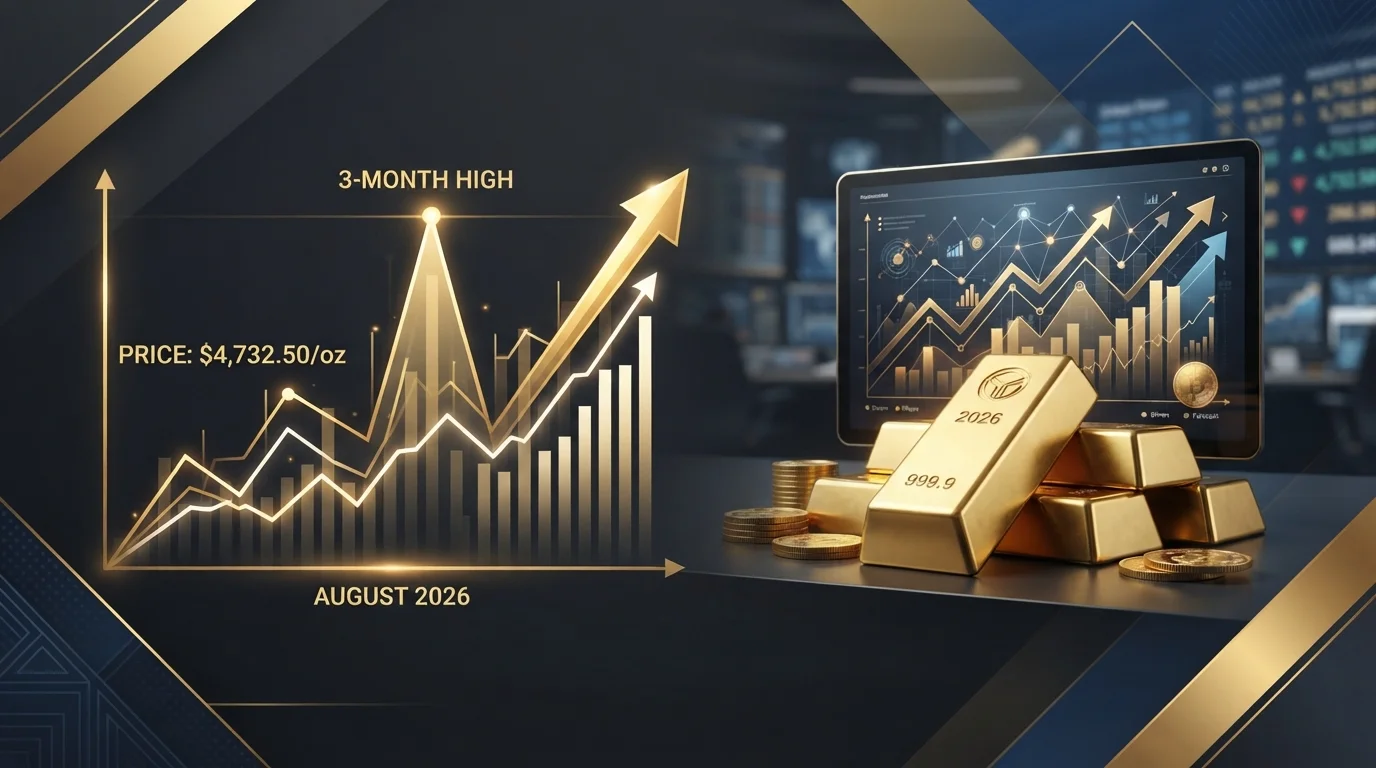
Gold prices have surged to their highest level in three months, breaking above the $4,700 per ounce mark in late August 2026 as a combination of dollar weakness, geopolitical tensions, and shifting Federal Reserve policy expectations create a perfect storm for precious metals. This rally marks a significant turning point after a mostly stagnant summer, with analysts now projecting continued upward momentum through the remainder of the year.
The precious metals market is experiencing renewed investor interest as traditional safe-haven assets regain their appeal amid uncertainty surrounding Iran sanctions, energy market volatility, and questions about the trajectory of U.S. monetary policy. J.P. Morgan's research team has set an ambitious year-end target of $6,000 per ounce, suggesting substantial upside potential remains even after the recent gains. For investors seeking portfolio diversification and inflation protection, understanding the key drivers behind this gold rally is essential for making informed allocation decisions.
Why Gold Prices Are Surging in August 2026
Dollar Weakness Provides Tailwinds
The primary catalyst behind gold's recent ascent has been pronounced weakness in the U.S. dollar, which has declined against major currencies as markets reassess the Federal Reserve's policy trajectory. When the dollar weakens, gold becomes less expensive for holders of other currencies, typically boosting demand and pushing prices higher. This inverse relationship has been particularly pronounced in recent weeks as Treasury yields have retreated from their highs.
The dollar's decline accelerated following softer-than-expected economic data releases, including weaker jobs reports and moderating inflation prints. These data points have shifted market expectations regarding Federal Reserve policy, with traders now pricing in potential rate cuts rather than the additional hikes that were anticipated earlier in the year. Lower interest rates reduce the opportunity cost of holding non-yielding assets like gold, making the precious metal more attractive to institutional and retail investors alike.
Geopolitical Tensions Drive Safe-Haven Demand
The escalation of tensions between the United States and Iran has added significant risk premium to gold prices. Treasury Secretary Scott Bessent's announcement of what he termed the "toughest sanctions in history" against Iran has raised concerns about potential disruptions to global energy supplies and broader geopolitical instability. Historically, such periods of heightened uncertainty have driven investors toward safe-haven assets, with gold benefiting as a store of value during turbulent times.
The situation in the Middle East remains fluid, with the potential for further escalation posing ongoing risks to global markets. While oil prices have experienced volatility in response to these developments, gold has maintained its upward trajectory, suggesting that investors are positioning for potential prolonged uncertainty rather than a quick resolution. This sustained safe-haven demand provides underlying support for gold prices even during periods of short-term consolidation.
Inflation Concerns Persist Despite Recent Data
While recent inflation data has shown signs of moderation, concerns about long-term price pressures continue to support gold investment. The Federal Reserve has maintained interest rates in the 3.50% to 3.75% range, with inflation remaining above the central bank's 2% target for the fifth consecutive year. This persistent inflationary environment, combined with concerns about potential energy price shocks stemming from Middle East tensions, has reinforced gold's appeal as an inflation hedge.
Investors are increasingly recognizing that the inflation experienced over the past several years may not be entirely transitory, as was initially suggested by central bankers. Structural factors including supply chain reconfigurations, labor market tightness, and elevated government spending continue to pose upside risks to prices. In this context, gold's historical role as a preserver of purchasing power becomes increasingly relevant for portfolio construction.
Expert Gold Price Forecasts for 2026 and Beyond
J.P. Morgan's Bullish $6,000 Target
J.P. Morgan Global Research has emerged as one of the most bullish forecasters in the precious metals space, with analysts expecting gold to reach $6,000 per ounce by year-end 2026. This ambitious target implies significant upside from current levels and reflects the firm's view that multiple supportive factors will continue to drive gold prices higher over the coming months.
The investment bank's analysis suggests that even the $6,000 target may prove conservative if certain scenarios materialize, with $6,300 per ounce becoming a possibility for 2027. Their forecast is predicated on continued dollar weakness, sustained central bank buying, and ongoing geopolitical tensions that support safe-haven demand. For investors, this represents one of the most optimistic institutional forecasts in the market.
CoinCodex Algorithm Predictions
Algorithmic forecasting platform CoinCodex has also turned bullish on gold, predicting that prices could advance by nearly 5% over the next week alone, reaching $4,856.72 by August 31, 2026. Their longer-term models suggest gold could trade in a range between $4,329.64 and $6,283.41 through the end of the year, with average prices expected to reach $4,586.68 in August and $5,120.41 in September.
These algorithmic forecasts incorporate technical indicators, historical patterns, and macroeconomic variables to generate price projections. While no forecasting method is infallible, the convergence of algorithmic and fundamental analyst predictions toward higher gold prices adds credibility to the bullish case. Investors should view these forecasts as directional indicators rather than precise price targets.
EIA and Energy Market Connections
The Energy Information Administration's forecast for Brent crude oil at $87 per barrel, citing prolonged constraints in the Strait of Hormuz, highlights the interconnected nature of commodity markets. Energy price volatility often correlates with gold price movements, as both respond to geopolitical developments and inflation expectations. The IEA's prediction of a 4.3 million barrel per day drop in global oil supply by 2026 underscores the potential for sustained commodity price pressures.
For investors seeking to automate their commodity trading strategies, consider using Alphio AI's copy trading feature to mirror successful traders and smart money wallets in the precious metals space.

Central Bank Gold Buying Reshapes the Market
Record-Breaking Official Sector Demand
Central banks around the world have been net buyers of gold for several consecutive years, with 2024 and 2025 marking record-breaking levels of official sector purchases. This trend has continued into 2026, with emerging market central banks in particular diversifying their foreign exchange reserves away from dollar-denominated assets. China, Turkey, India, and several other nations have been among the most active buyers, adding hundreds of tonnes to their reserves.
This sustained central bank demand provides a fundamental floor under gold prices, as these institutions typically purchase gold as a long-term strategic asset rather than for short-term trading purposes. The diversification away from U.S. Treasuries and toward gold reflects broader concerns about dollar hegemony, sanctions risks, and the desire for assets that are not liabilities of any single government. This structural demand dynamic is likely to persist regardless of short-term price fluctuations.
De-Dollarization Trends Accelerate
The movement toward de-dollarization in international trade and reserves has gained momentum in recent years, with gold benefiting as a neutral reserve asset that carries no counterparty risk. Countries seeking to reduce their dependence on the U.S. dollar have increasingly turned to gold as an alternative store of value, particularly in regions facing Western sanctions or concerned about the weaponization of the global financial system.
This trend extends beyond central banks to include sovereign wealth funds and government investment vehicles, all of which have shown increased appetite for gold allocation. While the dollar remains the dominant global reserve currency, the gradual shift toward a more multipolar reserve system supports ongoing demand for gold as a portfolio diversifier and risk mitigator.
Investment Strategies for Gold in Late 2026
Physical Gold vs. ETFs: Making the Right Choice
Investors seeking gold exposure have multiple options, each with distinct advantages and considerations. Physical gold in the form of coins and bars provides direct ownership and eliminates counterparty risk, but comes with storage and insurance costs. Exchange-traded funds like SPDR Gold Shares (GLD) offer convenient exposure with high liquidity, though they involve management fees and rely on the financial infrastructure.
For most investors, a combination of physical gold for long-term wealth preservation and ETFs for trading flexibility represents a balanced approach. The choice between these options should depend on individual circumstances, including investment time horizon, risk tolerance, and the importance of physical possession. During periods of financial system stress, physical gold's lack of counterparty risk becomes particularly valuable.
Mining Stocks Offer Leveraged Exposure
Gold mining stocks provide leveraged exposure to gold prices, with the potential for outsized gains when precious metals rally. Major producers like Newmont Corporation (NEM) and Barrick Gold (GOLD) offer established operations with diversified asset bases, while junior miners present higher-risk, higher-reward opportunities. The VanEck Gold Miners ETF (GDX) provides diversified exposure to the sector.
However, mining stocks carry additional risks beyond gold price movements, including operational challenges, geopolitical risks in mining jurisdictions, and management execution. Investors should conduct thorough due diligence on individual companies or opt for diversified ETFs to mitigate company-specific risks. The correlation between mining stocks and gold prices, while positive, is not perfect and can break down during certain market conditions.
Dollar-Cost Averaging for Long-Term Accumulation
Given the volatility inherent in gold prices, dollar-cost averaging represents a prudent strategy for investors looking to build positions over time. By purchasing fixed dollar amounts at regular intervals, investors can smooth out the impact of price fluctuations and avoid the risk of making large purchases at temporary market peaks. This approach is particularly suitable for investors with long-term investment horizons.
The current environment, with gold having already appreciated significantly from its summer lows, may warrant a phased approach to entry rather than immediate full allocation. However, attempting to time short-term corrections in a strongly trending market can result in missed opportunities. A disciplined dollar-cost averaging program helps remove emotion from investment decisions and ensures consistent participation in the market.
For those interested in automating their investment strategies, Alphio AI's agentic trading capabilities can help automate portfolio management with AI-powered strategies tailored to precious metals exposure.

Silver and Platinum: The Other Precious Metals
Silver's Industrial and Monetary Dual Role
Silver has outperformed gold on a percentage basis during the recent rally, hitting its highest level in two months alongside gold's three-month high. This outperformance reflects silver's dual nature as both a precious metal and an industrial commodity, with applications in solar panels, electronics, and medical devices driving structural demand growth. The gold-to-silver ratio, which measures relative valuation between the two metals, remains elevated by historical standards, suggesting silver may offer better value.
Investors should be aware that silver's industrial component makes it more volatile than gold, with prices often experiencing larger percentage moves in both directions. During periods of strong economic growth, silver can outperform gold due to industrial demand, while during severe risk-off episodes, gold's pure safe-haven status may result in relative outperformance. A diversified precious metals allocation including both gold and silver can capture the benefits of each metal's unique characteristics.
Platinum and Palladium Market Dynamics
The platinum group metals have experienced divergent fortunes, with platinum benefiting from automotive demand recovery and supply constraints, while palladium faces headwinds from the transition toward electric vehicles and substitution by platinum in catalytic converters. These supply and demand dynamics create distinct investment cases for each metal, with platinum appearing relatively undervalued compared to its historical relationship with gold.
Investors interested in the full spectrum of precious metals should consider the specific industrial drivers affecting platinum and palladium, which differ significantly from the primarily investment-driven demand for gold. The platinum market, in particular, may offer asymmetric upside potential if automotive demand continues to recover and supply disruptions persist in major producing regions.
Risks and Challenges for Gold Bulls
Potential for Dollar Strength Reversal
While the current environment favors gold, investors must remain cognizant of risks that could reverse the precious metal's fortunes. A sudden strengthening of the U.S. dollar, perhaps driven by safe-haven flows during a global economic downturn or shifts in relative monetary policy, could exert downward pressure on gold prices. The dollar's reserve currency status means it retains significant safe-haven appeal during periods of acute stress.
Additionally, if inflation proves more transitory than currently feared and the Federal Reserve maintains higher interest rates for longer than markets expect, the opportunity cost of holding gold would increase. Higher real interest rates have historically been negative for gold prices, as they increase the relative attractiveness of yield-bearing assets.
Profit-Taking and Technical Corrections
After a rapid ascent, gold markets often experience periods of consolidation or correction as short-term traders take profits and momentum slows. Technical indicators suggest gold is approaching overbought territory following the August rally, which could presage a pullback even within a broader uptrend. Such corrections, while potentially sharp in percentage terms, typically represent buying opportunities for investors with longer time horizons.
Investors should be prepared for volatility and avoid overleveraging their positions, as gold can experience significant drawdowns even during bull markets. Position sizing and risk management remain essential components of any precious metals investment strategy, regardless of how compelling the fundamental case may appear.
Cryptocurrency Competition for Safe-Haven Flows
Although this analysis focuses on traditional precious metals, it is worth noting that digital assets have increasingly competed with gold for safe-haven and inflation-hedge investment flows. Bitcoin and other cryptocurrencies have attracted significant capital that might otherwise have flowed into gold, particularly among younger investors more comfortable with digital stores of value.
However, gold's millennia-long track record as a store of value, lack of technological risk, and physical tangibility continue to appeal to many investors, particularly during periods of extreme market stress when cryptocurrency exchanges may experience operational issues. The two asset classes may ultimately coexist, serving different investor preferences and risk profiles.
Conclusion
Gold's surge to a three-month high above $4,700 per ounce reflects a confluence of supportive factors including dollar weakness, geopolitical tensions, and persistent inflation concerns. With institutional forecasts calling for prices to reach $6,000 or higher by year-end, the precious metal appears well-positioned for continued gains through the remainder of 2026. Central bank buying and de-dollarization trends provide structural support that extends beyond short-term market dynamics.
For investors, the current environment presents both opportunities and challenges. While the fundamental case for gold remains compelling, the rapid price appreciation suggests that disciplined entry strategies and proper position sizing are essential. A diversified approach incorporating physical gold, ETFs, and potentially mining stocks can capture upside while managing risk.
As markets navigate an increasingly complex geopolitical landscape and uncertain monetary policy trajectory, gold's role as a portfolio diversifier and wealth preserver appears as relevant as ever. Whether the ambitious price targets materialize or not, maintaining some allocation to precious metals remains a prudent strategy for investors seeking to protect their portfolios against tail risks and currency debasement.
Ready to enhance your precious metals trading strategy? Explore Alphio AI's automation features to set conditional workflows and execute trades based on your preferred technical indicators. For a more interactive trading experience, try Alphio's conversational trading to execute trades via natural language commands.


FAQs
Why has gold price increased in August 2026?
Gold prices have surged due to a combination of U.S. dollar weakness, escalating geopolitical tensions between the U.S. and Iran, and shifting expectations around Federal Reserve policy. The dollar's decline makes gold cheaper for foreign currency holders, while safe-haven demand has increased amid uncertainty over sanctions and potential supply disruptions.
What is the gold price forecast for the rest of 2026?
J.P. Morgan forecasts gold reaching $6,000 per ounce by year-end 2026, with potential to hit $6,300 in 2027. Algorithmic models from CoinCodex predict gold could trade between $4,329 and $6,283 through year-end, with average prices expected around $5,120 in September 2026.
Is gold a good investment right now?
Gold can be a valuable portfolio diversifier and inflation hedge, particularly given current geopolitical tensions and persistent inflation above the Fed's 2% target. However, after the recent rally to 3-month highs, investors should consider dollar-cost averaging rather than making large lump-sum investments, and maintain appropriate position sizes within a diversified portfolio.
How do central banks affect gold prices?
Central banks have been net buyers of gold for several consecutive years, with 2024 and 2025 marking record-breaking purchase levels. This sustained demand from official sector buyers provides a fundamental floor under gold prices and reflects broader trends toward reserve diversification away from U.S. dollar assets.
Should I invest in physical gold or gold ETFs?
Physical gold offers direct ownership without counterparty risk but involves storage and insurance costs. Gold ETFs like GLD provide convenient, liquid exposure but carry management fees. Most investors benefit from a combination: physical gold for long-term wealth preservation and ETFs for trading flexibility. Your choice should depend on investment horizon, risk tolerance, and the importance of physical possession.
Related articles
- Stock Market Surges After 2026 Midterms: What the Democratic Sweep Means for Your PortfolioThe stock market rallied after Democrats won the 2026 midterms. Discover what the election means for investors, tech stocks, and the S&P 500 outlook.
- Stock Market Surges After 2026 Midterms: What the Democratic Sweep Means for Your PortfolioThe stock market rallied after Democrats won the 2026 midterms. Discover what the election means for investors, tech stocks, and the S&P 500 outlook.
- Oil Prices Surge Above $105 Amid US-Iran Conflict: Energy Investment Opportunities in November 2026Oil prices climb past $105 as US strikes Iran's Qeshm Island. Discover energy investment opportunities, top oil stocks, and market outlook for November 2026.
- NVIDIA Stock Earnings August 2026: AI Chip Leader's Next CatalystNVIDIA's Q2 FY2027 earnings preview: AI chip demand surge, Blackwell ramp, and $93-95B revenue forecast. Wall Street price targets and investment outlook for August 2026.
- Nvidia Earnings August 2026: Q2 Preview & AI Chip Demand AnalysisNvidia reports Q2 FY2027 earnings on August 26, 2026. Wall Street expects $92-95B revenue driven by AI accelerator demand and Blackwell platform ramp. Stock analysis and investment outlook.
- Gold Price Forecast XAU/USD: Can Gold Hit New Highs in August 2026?Gold price forecast for August 2026: XAU/USD surges past $4,600 as Fed rate cut odds rise. Analysis of key drivers, technical levels, and investment outlook.