

Oil Prices Surge Above $105 Amid US-Iran Conflict: Energy Investment Opportunities in November 2026
Oil prices climb past $105 as US strikes Iran's Qeshm Island. Discover energy investment opportunities, top oil stocks, and market outlook for November 2026.

Key Takeaway
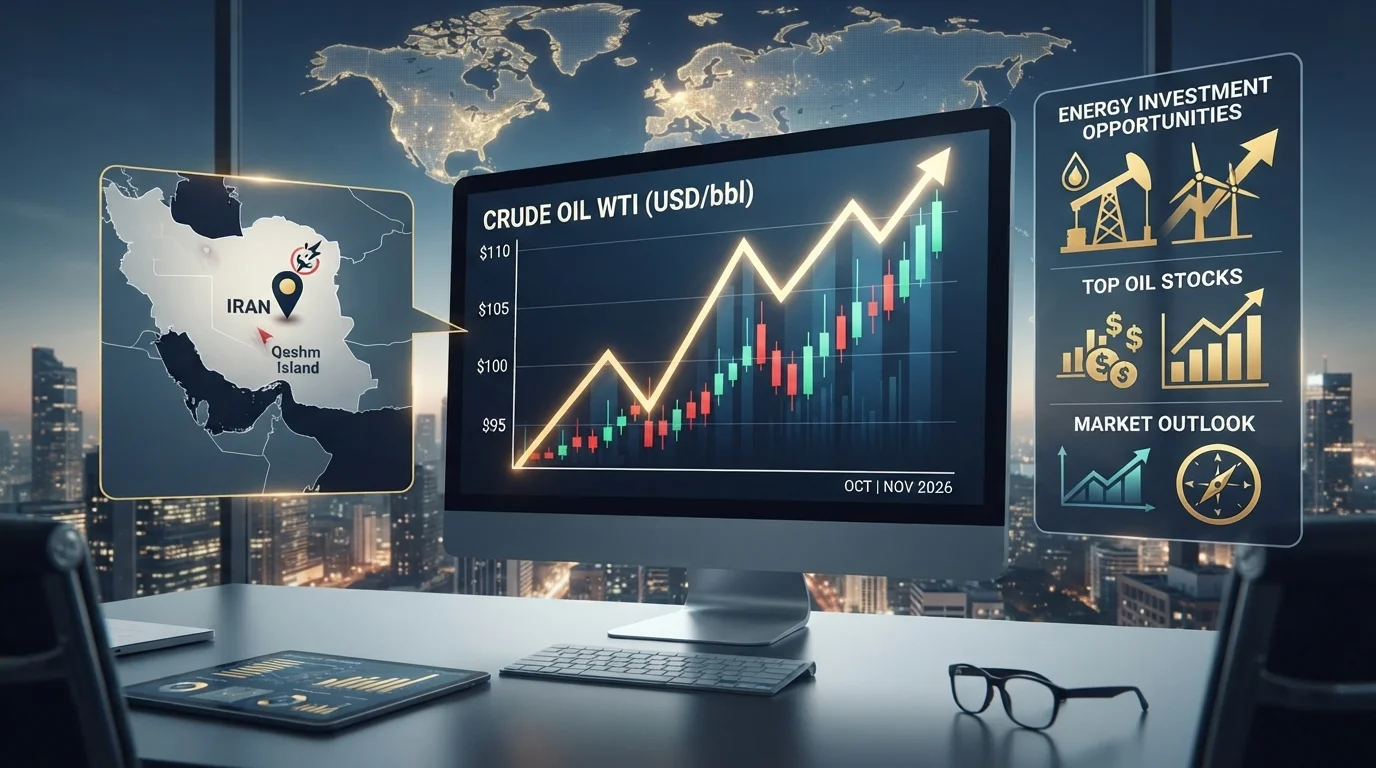
Oil prices have surged past the critical $105 per barrel threshold in early November 2026, driven by escalating geopolitical tensions after the United States conducted military strikes on Iran's Qeshm Island in the strategically vital Strait of Hormuz. The conflict, now entering its eighth month, has created what the International Energy Agency characterizes as the largest supply disruption in the history of the global oil market, with over 20% of the world's seaborne oil trade passing through the imperiled waterway. Brent crude futures climbed above $105 per barrel while West Texas Intermediate crude traded near $97, reflecting persistent market anxiety about further escalation despite diplomatic overtures from both Washington and Tehran. For investors, this environment presents both significant risks and compelling opportunities across the energy sector, as major oil producers like ExxonMobil and Chevron have outperformed broader markets while specialized refiners and energy infrastructure companies navigate volatile crack spreads and supply chain disruptions.
The complexity of the current situation extends beyond simple supply-and-demand mechanics. Houthi rebels aligned with Iran continue targeting Saudi energy infrastructure, including recent strikes on the Ras Tanura oil terminal and Abha International Airport, while the Reserve Bank of Australia's unexpected rate hike to 4.85% signals that central banks remain vigilant about inflationary pressures stemming from elevated energy costs. Investors seeking exposure to the energy sector must weigh the potential for diplomatic resolution against the risk of further military escalation, with Wall Street analysts increasingly divided on whether the current price levels represent a sustainable new normal or a temporary spike driven by fear premium.
Understanding the 2026 Iran War and Its Impact on Global Oil Supply
The Origins of the Conflict
The 2026 Iran war traces its origins to failed nuclear negotiations in Geneva and a preceding 12-day air conflict in 2025 that left tensions between Iran, the United States, and Israel at a generational high. When diplomatic channels collapsed in early 2026, the region descended into a sustained military confrontation that has now persisted for eight months, with Iran signaling potential disruptions to the Strait of Hormuz as a strategic deterrent against further strikes on its territory. The closure of this critical chokepoint, through which approximately 21 million barrels of oil flow daily, has reverberated through global energy markets with consequences that analysts increasingly compare to the 1973 oil crisis.
The recent US strike on Qeshm Island, reported by The Wall Street Journal and confirmed by multiple defense officials, represents a tactical escalation that markets initially greeted with a sharp spike in crude prices. Qeshm Island sits at the entrance to the Strait of Hormuz, making it a strategically significant target that underscores the vulnerability of regional energy infrastructure. While both the US and Iranian presidents have signaled openness to diplomatic solutions in recent days, Iranian officials have publicly stated that any deal to end the war remains far off, suggesting that supply risks will persist through the remainder of 2026 at minimum.
Supply Disruption Magnitude
The scale of supply disruption stemming from the Iran war and associated regional instability has been unprecedented in modern energy markets. Beyond the direct closure of the Strait of Hormuz, Houthi rebels in Yemen have conducted sustained attacks on Saudi energy facilities, including a recent claimed strike on the Ras Tanura terminal that handles an outsized share of global oil exports. Saudi Aramco facilities in Jizan have also come under repeated ballistic missile and drone attacks, while civilian infrastructure including airports in Riyadh and Abha have sustained damage from Houthi projectiles.
The cumulative effect of these disruptions has removed millions of barrels per day from available global supply at a time when demand recovery from earlier economic slowdowns remains robust. Goldman Sachs recently raised its year-end Brent crude forecast to $105 per barrel from $90, citing heightened escalation risk and persistent supply uncertainty. The bank's analysts noted that markets are increasingly pricing in the possibility of prolonged conflict rather than a near-term diplomatic breakthrough, fundamentally altering the risk calculus for energy investments across the entire supply chain.
Oil Price Analysis: Why Brent Crude Holds Above $105
The Fear Premium and Market Psychology
Current oil prices reflect a significant geopolitical risk premium that analysts estimate at $15-25 per barrel above what supply-demand fundamentals alone would justify. Brent crude's ability to sustain levels above $105, even during periods of diplomatic optimism, demonstrates that traders are unwilling to discount the possibility of further escalation. This psychological dynamic creates a floor under prices that persists as long as military hostilities continue, regardless of inventory levels or demand signals from major economies.
The volatility surrounding oil prices in recent sessions illustrates this tension perfectly. On Monday, November 2nd, Brent crude dropped more than 6.5% to as low as $105.55 amid hopes for a diplomatic breakthrough, only to rebound sharply on Tuesday following confirmation of the Qeshm Island strike. This whip-saw price action reflects genuine uncertainty among market participants about whether the conflict is approaching resolution or entering a more dangerous phase. For investors in energy equities, understanding this psychology is crucial because it means that even positive diplomatic developments may only provide temporary price relief rather than a sustained downtrend.
Comparing Current Conditions to Historical Energy Crises
The parallels between today's market dynamics and the 1970s energy crises have become increasingly apparent to historians and commodity strategists alike. Like the Arab oil embargo of 1973, the current disruption stems from geopolitical conflict in the Middle East rather than purely economic factors, creating supply shortages that monetary policy cannot easily address. The International Energy Agency's characterization of the current situation as the largest supply disruption in global oil market history underscores the severity of what markets are pricing.
However, important differences distinguish the current environment from historical precedents. The United States has emerged as the world's largest oil producer since the shale revolution, providing a domestic supply buffer that did not exist during previous crises. Additionally, strategic petroleum reserves in consuming nations remain substantial, offering a potential release valve if prices spike to economically damaging levels. The presence of these buffers may explain why Brent has stabilized around $105 rather than climbing toward the $147 peak seen during the 2008 commodities super-cycle, despite arguably more severe underlying supply constraints.
Top Energy Stocks to Consider in the Current Environment
ExxonMobil: Capitalizing on Higher Crude Prices
ExxonMobil has emerged as a leading beneficiary of elevated oil prices, with the stock gaining significant ground throughout 2026 as the energy sector outperformed broader indices. The company's integrated business model, spanning upstream exploration and production through downstream refining and chemicals, provides natural hedging against the volatility that has characterized recent months. Exxon's upstream operations generate outsized cash flows when crude prices hold above $100 per barrel, while its refining segment benefits from widened crack spreads despite intermittent disruption to feedstock supplies.
The company's balance sheet strength, built through years of capital discipline following the 2014-2016 oil downturn, positions it well to navigate uncertainty while returning substantial capital to shareholders. ExxonMobil has maintained its dividend aristocrat status with over 40 years of consecutive annual dividend increases, currently offering yields exceeding 2.5% that look increasingly attractive in a higher interest rate environment. Analysts at major investment banks have highlighted Exxon's ability to generate free cash flow at oil prices well below current levels, suggesting that the current pricing environment could accelerate debt reduction and share buyback programs.
For investors evaluating energy exposure, ExxonMobil's scale and diversification offer a relatively conservative entry point into a sector that typically carries significant volatility. The company's ongoing investments in Permian Basin production growth and Guyana offshore developments provide visible production increases that should support earnings even if geopolitical premiums eventually fade from current oil prices.
Chevron: Operational Excellence Meets Shareholder Returns
Chevron represents another compelling opportunity within the supermajor space, having gained more than 50% in 2026 and trading near $235 per share at the time of writing. The company's operational performance in recent quarters has exceeded expectations, driven by strong production growth in the Permian Basin and continued ramp-up of its Australian LNG assets. Chevron's disciplined capital allocation approach, which prioritizes return on capital employed over production growth at any cost, has resonated with investors who remember the sector's previous boom-bust cycles.
Chevron's dividend yield of over 3.3%, supported by 36 years of consecutive increases, provides an income component that differentiates it from growth-oriented energy investments. The company's recent acquisitions in the renewable fuels space also suggest a longer-term strategic pivot that could position it favorably as energy transition dynamics continue evolving. While some pure-play oil investors may view this diversification as a dilution of focus, others see it as prudent risk management in an industry facing long-term structural headwinds.
The analyst community remains generally constructive on Chevron, with recent upgrades citing the company's ability to sustain dividends and buybacks even if oil prices retreat toward $80 per barrel. This margin of safety is particularly valuable in the current environment, where the gap between sustainable fundamentals and geopolitical premium remains difficult to quantify with precision.
Energy Sector ETFs and Diversified Exposure
For investors seeking broader energy sector exposure without concentrating risk in individual names, the Energy Select Sector SPDR Fund offers diversified access to the largest US energy companies. The fund's holdings span integrated oil majors, independent producers, refiners, and energy equipment and services companies, providing exposure to different segments of the energy value chain that may respond differently to evolving market conditions.
The volatility that has characterized energy markets in 2026 underscores the value of diversification for risk-averse investors. While individual companies may face company-specific challenges ranging from operational disruptions to regulatory changes, a sector-wide approach captures the thematic upside of elevated oil prices while mitigating idiosyncratic risk. Investors should note, however, that sector ETFs carry their own concentration risks, as energy remains a relatively small component of the overall S&P 500 index.
Central Bank Responses and Macroeconomic Implications
Australia's Surprise Rate Hike Signals Global Inflation Concerns
The Reserve Bank of Australia's decision to raise its cash rate by 25 basis points to 4.85% on November 3rd, bringing borrowing costs to an 18-year high, highlights the inflationary pressure that elevated energy prices continue exerting on global economies. The RBA's board was divided on the decision, with three members dissenting in favor of holding rates steady, indicating genuine uncertainty about whether the current economic environment warrants further tightening. Governor Michele Bullock defended the move by arguing that "pain now" would prevent worse outcomes later, explicitly linking the decision to persistent inflation that energy costs have exacerbated.
Australia's experience is instructive for investors watching other major central banks, including the Federal Reserve and European Central Bank. Energy-driven inflation has proven more persistent than policymakers anticipated when they initially began tightening cycles in 2022, and the latest surge in oil prices threatens to reverse recent progress toward inflation targets. The RBA's decision to hike despite slowing economic growth suggests that central banks may prioritize price stability over near-term growth support, a dynamic that could pressure equity valuations across sectors while supporting energy stocks that benefit from higher commodity prices.
Impact on Consumer Spending and Economic Growth
Sustained oil prices above $100 per barrel carry significant implications for consumer spending patterns and overall economic growth trajectories. Every sustained $10 increase in crude prices typically translates to higher gasoline and heating costs that reduce disposable income available for other expenditures. In the United States, where midterm election results are being tallied this week, both major political parties have identified energy costs as a priority concern, with bipartisan attention focused on pharmaceuticals, housing, and AI data centers as sectors requiring policy intervention regardless of electoral outcomes.
The airline industry has already shown sensitivity to oil price movements, with shares rallying during Monday's brief crude price decline and retreating as prices rebounded. Transportation-dependent sectors including shipping, logistics, and tourism face margin compression that may not be fully recoverable through fuel surcharges, particularly if elevated prices persist into 2027. Investors evaluating energy sector opportunities should consider these downstream effects, as sustained high oil prices could eventually create demand destruction that undermines the very commodity prices driving current energy stock outperformance.
Investment Strategies for the Current Oil Market
Trading the Volatility: Short-Term Opportunities
The heightened volatility in oil markets has created meaningful short-term trading opportunities for active investors comfortable with risk. The wide price swings seen over the past week, with Brent crude moving more than 7% between Monday and Tuesday sessions, reward disciplined traders who can identify technical levels and sentiment extremes. Options markets on oil futures and energy equities have seen increased activity as participants position for both further escalation and potential diplomatic breakthroughs.
For those with access to sophisticated trading tools, the AI-powered copy trading feature at Alphio can help identify energy sector opportunities that may not be immediately apparent from headline price movements alone. The screener's ability to analyze technical patterns across thousands of securities simultaneously provides an edge in volatile markets where traditional fundamental analysis may lag price action.

Short-term traders should remain cognizant, however, that geopolitical markets can gap dramatically on unexpected news, creating risks that stop-loss orders may not effectively mitigate. Position sizing and risk management become particularly important when trading instruments with binary event risk tied to diplomatic negotiations or military developments.
Long-Term Positioning for Energy Transition Uncertainty
Beyond the immediate geopolitical drivers, energy investors must continue grappling with the long-term transition toward renewable and low-carbon energy sources. The current oil price spike, while supportive of near-term energy stock performance, also accelerates incentives for alternatives including electric vehicles, renewable power generation, and hydrogen infrastructure. European energy majors like Shell and BP have accelerated their transition strategies in response to price volatility, while US peers have generally maintained more traditional portfolios focused on hydrocarbon returns.
Investors with multi-year time horizons should consider how the current environment fits into longer-term energy demand trajectories. While the International Energy Agency continues to project peak oil demand within the next decade, the path to that peak remains highly uncertain and depends on policy decisions, technological advances, and economic growth patterns that are difficult to predict. A barbell approach combining exposure to traditional energy companies benefiting from current prices with select positions in transition-oriented names may offer the most robust risk-adjusted returns over extended periods.
The autonomous trading capabilities at Alphio delivers weekly-updated long-only recommendations that can help investors navigate these complex sector dynamics with data-driven insights rather than emotional reactions to headline news.

Alternatively, conversational trading through Alphio lets you execute trades and manage positions via natural language chat, making it easier to react quickly to breaking geopolitical developments.

Geopolitical Risk Assessment: Scenarios for Investors
Diplomatic Resolution Scenario
A negotiated settlement to the Iran war, while appearing distant based on recent statements from both sides, would likely trigger a significant repricing in oil markets. Analysts estimate that a comprehensive deal reopening the Strait of Hormuz and ending Houthi attacks on Saudi facilities could remove $20-30 per barrel from current prices, returning Brent crude toward the $75-80 range that prevailed before the conflict escalated. Under this scenario, energy stocks with the highest leverage to oil prices would face the steepest corrections, while companies with strong balance sheets and low production costs would weather the transition more gracefully.
The timing of any diplomatic resolution remains highly uncertain. Current contacts between US and Iranian officials, confirmed by both governments, suggest that back-channel communications continue even as public rhetoric remains combative. Historical precedents from previous Middle East conflicts suggest that sudden breakthroughs can occur when neither side sees advantage in continued fighting, though the current situation involves multiple actors including Israel and Houthi rebels whose interests may not align with a simple bilateral US-Iran agreement.
Escalation Scenario
Conversely, further escalation involving direct strikes on Iranian nuclear facilities or sustained closure of the Strait of Hormuz could drive oil prices substantially higher, potentially retesting the $147 record from 2008 or exceeding it given today's tighter spare production capacity. Saudi Arabia and the United Arab Emirates maintain limited excess capacity that could partially offset lost Iranian and Iraqi exports, but a full Strait closure would overwhelm these buffers and create genuine physical shortages in importing nations.
Under an escalation scenario, energy equities would likely continue outperforming even as broader markets struggled with stagflationary implications. Refiners with access to non-Middle East crude supplies would command premium valuations, while companies with significant Middle East exposure might face operational disruptions or asset impairments. Investors should stress-test their portfolios against both resolution and escalation scenarios, ensuring that position sizing reflects genuine uncertainty rather than directional conviction.
Conclusion
The oil market in November 2026 presents investors with a classic geopolitical dilemma: elevated prices driven by genuine supply disruption create compelling near-term opportunities in energy equities, while the possibility of either diplomatic resolution or further escalation introduces binary risks that defy precise quantification. ExxonMobil and Chevron, as the largest US integrated oil majors, offer relatively conservative exposure to current price levels through their diversified operations and strong shareholder return programs. The broader energy sector has outperformed dramatically in 2026, with gains that reflect both fundamental earnings improvements and multiple expansion driven by investor rotation into inflation-resistant assets.
For investors considering new positions, the current environment demands careful attention to position sizing and risk management. The gap between sustainable oil prices supported by supply-demand fundamentals and the geopolitical premium currently embedded in $105+ Brent crude is substantial, meaning that a swift resolution to the Iran war could trigger meaningful corrections. Conversely, further escalation involving the Strait of Hormuz could send prices substantially higher, rewarding those with exposure while punishing underweight positions.
Rather than attempting to predict the unpredictable path of diplomatic and military developments, investors may benefit from systematic approaches that identify opportunities across market conditions. Alphio's AI-powered copy trading lets you mirror successful traders and smart money wallets in real time, while agentic trading automates portfolio management with strategies that adapt to volatile energy markets. For hands-on investors, conversational trading enables executing trades via chat when news breaks, and automation tools let you set conditional workflows based on oil price thresholds and sector momentum.
Ultimately, the energy sector's outperformance in 2026 reflects real supply constraints and earnings power that extend beyond temporary geopolitical premiums. Companies that have maintained capital discipline through the cycle, built strong balance sheets, and positioned themselves for sustained production growth are likely to reward shareholders regardless of how the Iran conflict resolves. The key for investors is distinguishing between temporary price spikes and durable competitive advantages that will generate returns across multiple commodity price environments.
FAQs
Why are oil prices so high in November 2026?
Oil prices have surged above $105 per barrel due to the ongoing Iran war and associated supply disruptions in the Middle East. The US strike on Iran's Qeshm Island, Houthi attacks on Saudi energy infrastructure, and the closure of the Strait of Hormuz have created the largest supply disruption in global oil market history according to the International Energy Agency.
Which energy stocks are best positioned for high oil prices?
ExxonMobil and Chevron are two leading energy stocks benefiting from elevated crude prices. ExxonMobil offers over 40 years of dividend increases and strong upstream cash flow generation above $100 oil. Chevron has gained over 50% in 2026 and offers a 3.3%+ dividend yield with disciplined capital allocation across its integrated operations.
How does the Iran war affect global oil supply?
The Iran war has disrupted oil supply through multiple channels: direct closure of the Strait of Hormuz through which 20% of global oil trade passes, Houthi attacks on Saudi Aramco facilities including the Ras Tanura terminal, and broader regional instability that has reduced production and exports from several Gulf countries. The cumulative effect has removed millions of barrels per day from global supply.
What happens to oil prices if the Iran conflict is resolved?
Analysts estimate that a comprehensive diplomatic resolution could remove $20-30 per barrel from current prices, returning Brent crude toward the $75-80 range. This would likely trigger corrections in energy equities, particularly those with the highest leverage to oil prices, while companies with strong balance sheets and low production costs would weather the transition more effectively.
How are central banks responding to oil-driven inflation?
The Reserve Bank of Australia recently raised rates to 4.85%, an 18-year high, explicitly citing inflationary pressures including elevated energy costs. This suggests central banks remain vigilant about oil-driven inflation even as they balance growth concerns, potentially creating headwinds for equity valuations while supporting energy stocks that benefit directly from higher commodity prices.
Related articles
- Oil Prices Surge Above $105 Amid US-Iran Conflict: Energy Investment Opportunities in November 2026Oil prices climb past $105 as US strikes Iran's Qeshm Island. Discover energy investment opportunities, top oil stocks, and market outlook for November 2026.
- 2026 Midterm Results Are In: What Democratic Control of Congress Means for the Stock MarketDemocrats win House and Senate in 2026 midterms: what divided government under Trump means for stocks, sectors, volatility, and investor checklists.
- US Midterm Elections and the Stock Market: Investor Playbook for Late 2026How US midterm elections affect stocks historically: S&P returns, gridlock premium, healthcare/defense/energy sectors, and a late-2026 investor checklist.
- Caterpillar Stock Analysis: CAT Faces Critical Earnings Test After AI Selloff Punishes SharesCaterpillar stock lost 25% amid AI infrastructure selloff. Analysis of CAT earnings outlook, valuation metrics, and investment opportunities ahead of Q3 2026 results.
- Federal Reserve Rate Policy: Navigating Stock Market Opportunities in a Shifting Interest Rate EnvirExplore how Federal Reserve rate decisions affect stock market performance. Learn investment strategies for rising and falling interest rate environments in 2026.
- Best AI Trading Bots & Top Crypto AI Trading Platforms (2026)Discover the best AI trading bots and top crypto AI trading platforms for 2026. Compare Stoic.ai, 3Commas, Cryptohopper, Alphio AI, Pionex, Coinrule, Tritonix, TradeSanta and Shrimpy.