B
Bull
Bull · 25%MSFT
$508.39
Scenario price
$521.125
-11.777 (-2.26%)At close
Microsoft Corporation is a technology company. The Company develops and supports software, services, devices, and solutions. The Productivity and Business Processes segment consists of products and services in its portfolio of productivity, communication, and information services. This segment primarily includes Microsoft 365 Commercial products and cloud services, Microsoft 365 Consumer products and cloud services, LinkedIn, and Dynamics products and cloud services. The Intelligent Cloud segment consists of server products and cloud services, including Azure and other cloud services comprising cloud and AI consumption-based services, GitHub cloud services, Health and Life Sciences cloud services, and other cloud services; and Server products consist of SQL Server, Windows Server, Visual Studio, System Center, related Client Access Licenses, and other on-premises offerings. The More Personal Computing segment primarily comprises Windows and Devices, XBOX, and Search advertising.
Microsoft is a good buy right now due to its strong fundamentals and positive analyst sentiment. The current price is $531.18, and analysts have set price targets as high as $700, indicating significant upside potential. Additionally, the company reported a gross margin of 67.79% and a year-to-date change of +12.31%, reflecting solid financial health. The main risk is the insider selling trend, which has increased by 2343.75% over the last month, indicating potential concerns among insiders.
Evercore ISI
$635
2026-11-11
Evercore ISI
2026-11-11
Price Target
$635
Freedom Broker
$625
2026-10-30
Freedom Broker
2026-10-30
Price Target
$625
Griffin Securities
—
2026-10-29
Griffin Securities
2026-10-29
Price Target
—
Scotiabank
$650
2026-10-29
Scotiabank
2026-10-29
Price Target
$650
UBS
$700
2026-10-29
UBS
2026-10-29
Price Target
$700
Scenario prices are the last monthly forecast band of the current year. Probabilities are fixed model weights (25 / 50 / 25), not guarantees.
IonQ's Promising Outlook in Quantum Computing

Anthropic Launches Claude Sheets and Data Tools to Compete with Excel

Anthropic Reaches Profitability Milestone Ahead of IPO

Anthropic's Profitability Outlook Amid Spending Challenges
Morgan Stanley Sees Attractive Entry Point in High-Quality Hyperscaler Bonds
Microsoft Corporation is a technology company. The Company develops and supports software, services, devices, and solutions. The Productivity and Business Processes segment consists of products and services in its portfolio of productivity, communication, and information services. This segment primarily includes Microsoft 365 Commercial products and cloud services, Microsoft 365 Consumer products and cloud services, LinkedIn, and Dynamics products and cloud services. The Intelligent Cloud segment consists of server products and cloud services, including Azure and other cloud services comprising cloud and AI consumption-based services, GitHub cloud services, Health and Life Sciences cloud services, and other cloud services; and Server products consist of SQL Server, Windows Server, Visual Studio, System Center, related Client Access Licenses, and other on-premises offerings. The More Personal Computing segment primarily comprises Windows and Devices, XBOX, and Search advertising. It operates in the Technology sector (SERVICES-PREPACKAGED SOFTWARE industry).
Microsoft is a good buy right now due to its strong fundamentals and positive analyst sentiment. The current price is $531.18, and analysts have set price targets as high as $700, indicating significant upside potential. Additionally, the company reported a gross margin of 67.79% and a year-to-date change of +12.31%, reflecting solid financial health. The main risk is the insider selling trend, which has increased by 2343.75% over the last month, indicating potential concerns among insiders.
34 analysts cover MSFT: 27 rate it Buy, 6 Hold and 1 Sell. The average price target is 631.36.

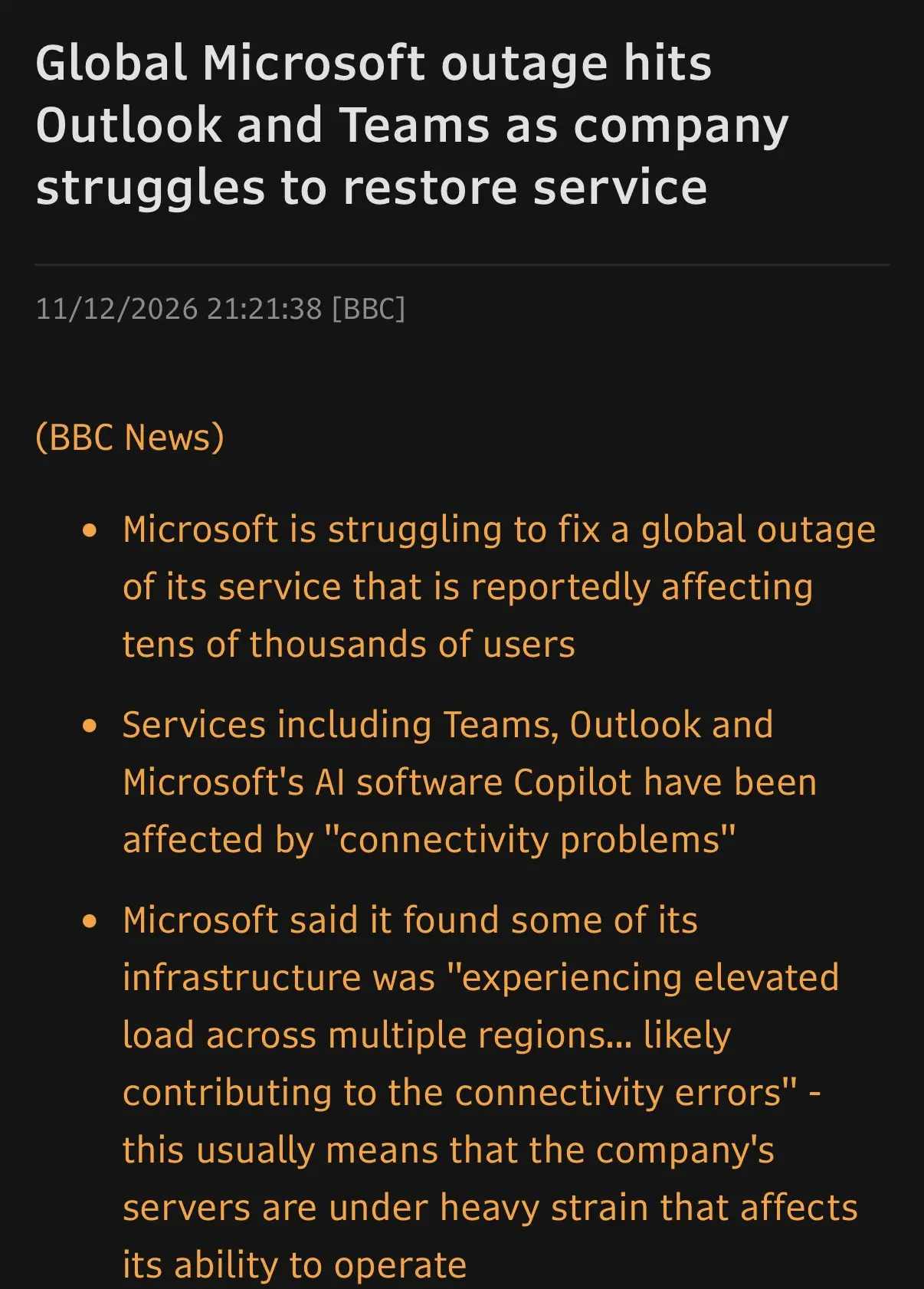
Microsoft Extends Email Timeout Window to 48 Hours – Highlights Recovery Progress Across Asia-Pacific Infrastructure $MSFT
Show more
00:00 close 528.41, high 530.37 04:00 523.43 08:00 521.46 12:00 520.19 13:00 518.71, low 518.15 14:00 518.54, 877 contracts this hour People say Microsoft is only down 0.7 points today, which sounds like barely any move. Try a different ruler: fourteen candles, hourly highs pressed from 530.37 down to 520.35. The largest bounce in between was 1.43 dollars, less than 0.3%. Measured in percentage terms it looks like a scratch; measured by hourly highs it is fourteen consecutive presses. $MSFT 518.54, just 0.68 away from the 517.86 candle on 11-12. (Not investment advice, you bear your own profit and loss)
Show more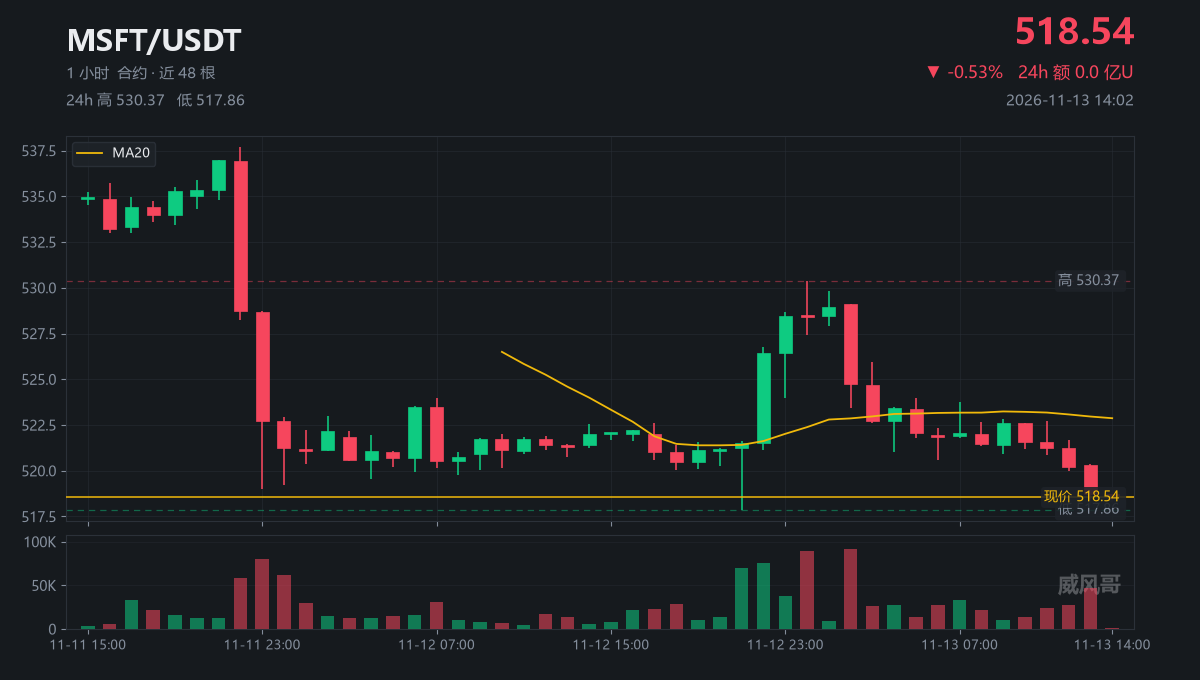

#OpenAI Q3 Revenue Rises to $10 Billion #Gate Direct IPO Round 3 Anthropic's Hundred-Billion-Dollar Paradox: OpenAI Quarterly Revenue Surges 50% to $10 Billion, but Compute Costs Still Drive Operating Loss to $10.9 Billion For years, skeptics have questioned whether generative AI could evolve from a fleeting consumer novelty into an enterprise revenue giant. That debate now has a clear answer. According to the latest financial disclosures reported by market trackers in November 2026, OpenAI generated approximately $10 billion in revenue in Q3 2026, up nearly 50% quarter over quarter, with an annualized revenue run rate approaching $40 billion. Yet beneath this historic commercial milestone lies the core financial contradiction defining the entire AI industry: even as OpenAI's quarterly revenue reached $10 billion, its adjusted operating loss was approximately $10.9 billion. Revenue monetization is accelerating at a record pace, but the massive capital required to train frontier models and run global inference clusters continues to exceed cash inflows. Inside the Revenue Engine: Enterprise Adoption Doubles OpenAI's Q3 2026 performance highlights a major structural shift in AI revenue sources. Consumer ChatGPT subscriptions once formed the company's early foundation, but commercial enterprise contracts and developer API usage are now driving the steepest growth curve: • Enterprise revenue doubles: Business-to-business revenue doubled quarter over quarter, confirming that large enterprises are moving from experimental pilots to full production deployments. • Three core monetization channels: Revenue rests on recurring ChatGPT enterprise seat licenses, large-scale API integrations in third-party software suites, and direct consumer subscription tiers. • High-value enterprise use cases: Enterprises are increasingly embedding OpenAI's models into critical business processes, including automated software engineering and coding agents, enterprise customer support, in-depth financial and scientific research, and end-to-end operational workflow automation. The Reality of Compute Costs: Margin Improvement and Cash Burn Even as commercial demand surges, OpenAI's income statement still highlights the extraordinary costs of delivering frontier intelligence globally: • Negative margin narrows: OpenAI's adjusted operating margin improved significantly from negative 150% in the prior period to negative 109% in Q3 2026, showing that economies of scale are beginning to appear as revenue growth outpaces fixed overhead. • Where the money goes: The main drivers of the $10.9 billion adjusted operating loss remain massive GPU infrastructure clusters, hyperscale data center leases, ongoing frontier model training, real-time inference compute, and aggressive R&D budgets. Six Unit Economics Metrics Defining the Next Phase of AI Evaluating frontier AI leaders now requires looking beyond headline figures such as total users and focusing strictly on underlying unit economics and ecosystem positioning: 1. Revenue growth versus operating cash flow: Quarterly sales reaching $10 billion prove product-market fit, but when compute obligations expand in tandem, rapid revenue growth does not automatically translate into positive free cash flow. 2. Token and inference economics: Sustainable profitability depends on widening the gap between the revenue generated per API token or enterprise seat and the power and GPU costs required to generate each response. 3. Gross margin trajectory: As model routing and hardware efficiency improve, analysts are closely watching whether software and API revenue grows faster than variable inference costs. 4. Enterprise seat retention: Multi-year enterprise contracts and net dollar retention are a more durable reflection of competitive moat than volatile consumer website traffic. 5. Capital intensity and utilization: Long-term valuation depends on maximizing revenue generated per dollar invested in data center capacity and long-term compute commitments. 6. Ecosystem value capture: The AI value chain remains highly interdependent: OpenAI builds and commercializes frontier models, NVIDIA captures foundational GPU hardware profits, and Microsoft monetizes cloud infrastructure through enterprise software distribution. Analysis Conclusion OpenAI's Q3 2026 revenue milestone of $10 billion is solid proof that AI has matured into a massive commercial industry rather than a passing technical experiment. However, the accompanying $10.9 billion adjusted operating loss highlights the enormous gap that remains between rapid monetization and truly achieving net profit. The core contest in the next phase of AI is no longer just about training the largest models, but about converting surging enterprise adoption into sustained, high-margin cash flow while systematically reducing the cost of accessing intelligence at scale. #ShareWeekly
Show more

Why did US tech stocks suddenly drop? Is the AI bubble really about to burst? Global tech stocks have seen a clear correction recently, especially companies tied to the AI supply chain, as investors begin to reassess the AI investment logic that drove years of gains. Swings in shares of tech giants such as Nvidia, Microsoft, and Tesla have also raised an important question: has the golden age of the AI industry already ended? I think it is too early to conclude that the AI bubble is bursting, but the market has indeed entered a stricter phase of valuation scrutiny. First, valuation pressure is rising. Over the past few years, the AI theme has pushed up share prices across many tech companies, and some have already priced in several years of future growth. When the market doubts profitability, high valuations are prone to correction. Second, the tension between capital spending and actual returns is drawing more attention. Microsoft, Google, Amazon, and others continue to invest heavily in data centers and AI infrastructure, but what investors really care about is whether that spending can eventually translate into sustained revenue and profit. Third, the high interest rate environment remains unfavorable for growth stocks. Financing costs and the discounting pressure on future cash flows make highly valued tech companies more sensitive. Fourth, market capital is beginning to favor companies with genuine competitive advantages and profitability rather than simply chasing the AI theme. I believe the long-term direction of the AI industry has not changed, but the investment logic may shift: from chasing technological concepts toward commercial deployment, profitability, and cash flow. The real opportunities may belong to companies that can turn AI technology into actual productivity. Do you think the AI industry is in a normal correction phase, or are early signals of a bubble bursting already appearing?
Show more

This page is for research only and is not investment advice. Models can be wrong. Past performance does not guarantee future results.