

Defense Stocks in 2026: How Midterms, the Iran War and a Stalled Budget Shape the Outlook
Defense stocks fell after the 2026 midterms. Learn how the Iran war, the $1.5T budget request and the December 11 funding deadline shape the sector outlook.

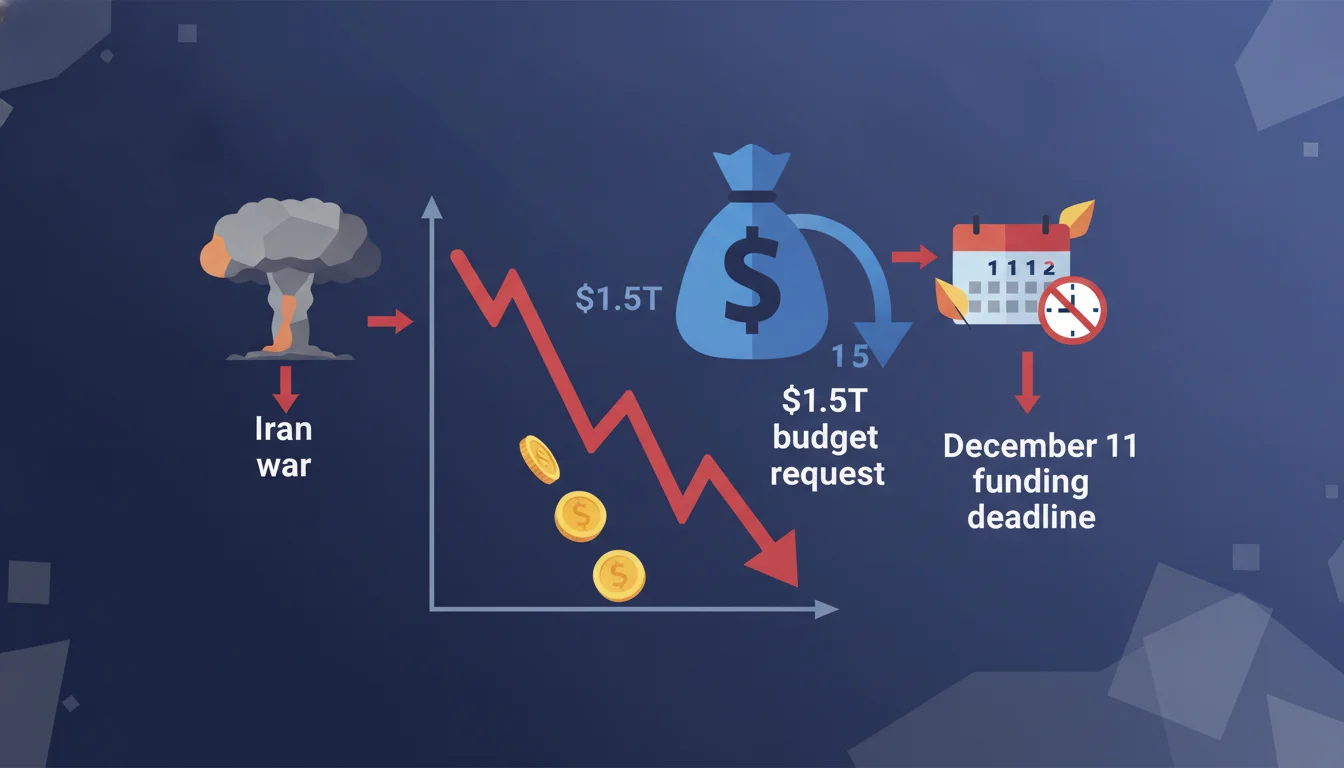
Key Takeaway
Defense stocks have spent November 2026 caught between two powerful forces pulling in opposite directions. On one side sits a nearly nine-month U.S.-Iran conflict, an elevated $1.5 trillion Pentagon budget request for fiscal 2027, and a world that keeps reminding governments why munitions stockpiles matter. On the other side sits Washington's budget machinery: Democrats won both chambers of Congress in the November 3 midterms, the Pentagon is running on a stopgap continuing resolution set to expire on December 11, and the giant reconciliation piece of the request has barely moved. The result is a sector where headlines about war and headlines about appropriations often arrive on the same day and push prices in opposite directions.
The market's first verdict on the election was blunt. According to CNBC, Lockheed Martin fell 3.6% on November 4, while RTX and Northrop Grumman each dropped more than 3% and L3Harris slid more than 2%. By the close on November 12, Investorideas data showed Lockheed at $604.09, Northrop at $549.22, RTX at $198.36 and General Dynamics at $363.09, with the group drifting lower as a technology sell-off spilled across the market. None of that tells you where these stocks go next, but it does tell you the market is now pricing politics, not just geopolitics.
This guide explains how defense stocks actually make money, why budget timing matters more than battlefield news for most contractors, what an incoming Democratic Congress can and cannot change, and how investors can build a disciplined watchlist instead of chasing the next missile headline. It is an educational framework, not a recommendation to buy or sell any security, and every price and date below carries an as-of reference so you can check whether conditions have changed.
Why Defense Stocks Sold Off After the Midterms
The headline risk the market priced in first
The immediate reaction to the Democratic sweep was about uncertainty rather than any enacted policy. Wolfe Research analyst Myles Walton wrote that a Democratic sweep "is a headline negative for defense stocks," according to CNBC's November 4 report, while also describing the sell-off as potentially short-lived. That combination captures how professional investors often approach political shocks in this sector: the first move reflects the fear that a new majority will scrutinize or trim the president's spending plans, and the second phase depends on what lawmakers actually do once they take their seats.
It is worth remembering that the new Congress is not seated until January 2027. The lame-duck session between now and then is still run by the outgoing Republican majorities, and CNBC noted that Republicans could try to race a spending package through before the handover. That creates a narrow window in which appropriations news could arrive quickly, and investors who only watch geopolitical headlines may miss it entirely.
Customer concentration makes politics unavoidable
The reason defense stocks react so sharply to Washington is that Washington is the customer. CNBC reported that Lockheed Martin generates about 70% of its sales from the U.S. government, and that L3Harris put its figure at 75% for fiscal 2025. Few other large-cap sectors are this dependent on a single buyer whose spending is set through an annual political negotiation.
That concentration cuts both ways. It gives contractors unusually visible, multi-year revenue when programs are funded, and large backlogs can provide some insulation from the economic cycle. But it also means that a delayed appropriations bill, a program cancellation, or a shift in procurement priorities can matter more than a strong quarter. When you evaluate a defense company, the first question is not how good its products are but how secure the funding lines behind those products look.
Why tech weakness still spilled over
On November 12, Investorideas attributed the sector's decline to the broader tech sell-off rather than to any defense-specific news. That was the same session in which major U.S. indexes slipped roughly 0.4% after Nvidia announced that Jensen Huang was stepping down as CEO, and the 10-year Treasury yield climbed above 5%. Defense primes are often described as defensive, but they still trade inside the same market, own the same index slots, and compete for the same capital as everything else.
Higher bond yields matter here too. Large defense contractors are frequently owned for their dividends and steady cash flows, and when government bonds offer yields above 5%, the relative appeal of a 2% to 3% dividend yield shrinks. That does not make the stocks unattractive by default, but it raises the bar that dividend-oriented investors apply.
The Budget Calendar That Moves Defense Stocks
A $1.5 trillion request stuck behind a stopgap
The White House released its fiscal 2027 budget on April 3, 2026, asking for roughly $1.5 trillion for defense. According to Air & Space Forces Magazine, that request was split into about $1.15 trillion in regular appropriations and $350 billion to be delivered through budget reconciliation. Coverage of the request at the time described it as one of the largest proposed increases in Pentagon spending in decades.
Reality has been slower. Congress passed a continuing resolution on September 1, and Air & Space Forces reported that it keeps the Pentagon funded at the extended fiscal 2026 baseline of $838.5 billion, roughly 44% below what the administration requested. House appropriators advanced a base measure with $1.07 trillion for defense in June, but Senate appropriators had not agreed on a topline, and neither chamber had made meaningful movement on the $350 billion reconciliation piece as of that report.
December 11 is the date to circle
The current continuing resolution runs through December 11, 2026. For defense investors, that is the most important near-term date on the calendar. Congress can pass a full-year appropriations bill, pass another stopgap, or fail to agree and risk a shutdown. Each outcome affects contractors differently, because continuing resolutions generally prevent the Pentagon from starting new programs or ramping production rates beyond prior-year levels.
One analyst quoted by Air & Space Forces, Callan of Capital Alpha Partners, suggested the base budget may not clear Congress "until spring 2027." If that view proves correct, companies whose growth depends on new program starts could see revenue timing pushed out, while those with mature, already-funded production lines may feel less pain. This is why reading the calendar is often more useful than reading the war news.
Reconciliation versus regular appropriations
The distinction between regular appropriations and reconciliation sounds technical, but it matters for valuation. Regular appropriations require bipartisan votes in the Senate, which gives the minority party leverage. Reconciliation can pass with a simple majority but is limited in what it can include and must be renegotiated each time. With Democrats taking control of both chambers in January, the path for a large Republican-led reconciliation package effectively narrows to the lame-duck window.
Air & Space Forces also reported that the House approved a framework for a smaller reconciliation package including $60 billion for defense, which lawmakers described as aimed at Iran war supplemental costs rather than fiscal 2027 requests. Investors should separate war-supplemental money, which tends to flow toward munitions replenishment and operations, from base budget growth, which funds long-cycle programs like ships, aircraft and missile defense.
How the Iran War Shapes the Defense Trade
Conflict spikes rarely last
History suggests that defense stocks often jump on the first evidence of conflict and then settle. MarketWise documented that on March 2, 2026, shortly after the war with Iran escalated, Northrop Grumman jumped to $768.02, RTX rose about 4.7% and Lockheed about 2.8%, while the iShares U.S. Aerospace & Defense ETF also climbed. Within three weeks, that ETF had fallen roughly 9.8% from about $250 to about $227, according to the same analysis.
That pattern is a useful warning. A war headline can lift prices in a day, but contracts take months to negotiate and years to deliver. By the time additional revenue shows up in a company's income statement, the market has often moved on to the next question, such as whether Congress will actually fund the replenishment.
Munitions replenishment is the durable channel
Where conflict does reshape the long-term picture is in munitions and air defense. Interceptors, precision-guided weapons and the components inside them are consumed in combat and must be replaced, and replenishment tends to show up as multi-year production contracts. Companies with exposure to missiles, interceptors, sensors and rocket motors are therefore more directly linked to the conflict than companies focused on large platforms such as aircraft carriers.
Investors should still be careful about drawing straight lines. Replenishment money still depends on Congress, production capacity is constrained, and fixed-price contracts can squeeze margins when input costs rise. A company can win more business and still disappoint on earnings if it cannot deliver at the price it agreed to.
Oil, Hormuz and the de-escalation question
The broader conflict also shows up in energy markets, which shape inflation and interest rates. CNBC reported that Brent crude briefly dipped below $90 on November 10 for the first time since August, then settled 3.3% higher at $95.82 on November 12 after President Trump wrote on Truth Social that the U.S. does not need a deal with Iran. Analysts quoted by CNBC were divided on whether peace was realistic, with FGE chairman Fereidun Fesharaki saying the gap between the two sides "cannot be bridged."
For defense investors, the practical takeaway is that a credible peace deal would likely remove some of the geopolitical premium from the sector, while renewed escalation could add it back. Neither scenario is predictable, which is exactly why position sizing and time horizon matter more than forecasting.
Reading a Defense Contractor's Fundamentals
Backlog and book-to-bill tell you what is coming
Because revenue is contracted far in advance, backlog is one of the most useful numbers in a defense company's earnings report. Backlog represents work that has been awarded but not yet delivered, and a book-to-bill ratio above 1.0 means the company is winning new business faster than it is completing old work. Rising backlog in a period of political uncertainty suggests demand is holding up; shrinking backlog suggests the funding pipeline may be thinning.
Investors should also separate funded backlog from unfunded backlog. Funded backlog has money appropriated behind it, while unfunded portions depend on future budgets. In a year when the Pentagon is operating under a continuing resolution, that distinction becomes especially relevant.
Margins, fixed-price risk and cash flow
Defense contractors typically operate on modest but stable margins. The bigger risk is the mix between cost-plus contracts, where the government reimburses costs plus a fee, and fixed-price contracts, where the contractor absorbs overruns. Several primes have taken charges in recent years on fixed-price development programs, and those charges can wipe out a year of earnings growth on a single line item.
Free cash flow is the final test. Defense companies are often valued on their ability to return cash through dividends and buybacks, so investors should watch whether cash conversion keeps pace with reported earnings. If a company reports strong profits but weak cash flow, it is worth asking whether working capital, program charges or delayed government payments are the reason.
Valuation in context, not in isolation
A price-to-earnings multiple on a defense stock should always be read against its own history, its peers and the broader market. Defense names have historically traded at a discount to high-growth technology companies because their growth is slower and capped by budgets. When they trade at a premium to their own history, the market is usually pricing in a sustained spending upcycle. The November sell-off may have compressed some of that premium, but whether the stocks are cheap depends on whether the budget outlook holds.
Primes, Mid-Caps and New Entrants
The prime contractors
The largest U.S. defense primes include Lockheed Martin, RTX, Northrop Grumman, General Dynamics and L3Harris. Their scale gives them deep backlogs, broad program portfolios and long histories of returning cash to shareholders. Motley Fool's November defense roundup, for example, noted that Lockheed's dividend yielded 2.16% as of November 4, 2026. The trade-off is that these companies are slow-moving, heavily exposed to budget politics, and occasionally burdened by large program charges.
Services, electronics and specialists
Below the primes sit government services firms, defense electronics specialists and niche manufacturers. Companies such as Leidos focus more on IT, analytics and support services, which can be less tied to major hardware programs. Drone and unmanned-systems specialists like AeroVironment have attracted attention as modern conflicts lean more on autonomous systems. These names can grow faster than the primes but often carry higher valuations and more volatile earnings.
Space and emerging defense tech
A growing group of space and defense-technology companies sits at the edge of the sector. On November 12, Investorideas reported that Intuitive Machines rose about 7% after reporting record third-quarter revenue of $269 million. Companies like this can offer more upside but also carry execution risk, customer concentration and in some cases unproven profitability. They belong in a different risk bucket than a century-old prime.
How to Build a Defense Stock Watchlist
Start with a thesis, not a ticker
The most common mistake in defense investing is buying after a war headline and hoping the move continues. A better approach starts with a written thesis: Are you betting on sustained budget growth, munitions replenishment, space and missile defense, or simply dividend income? Each thesis points to different companies, different time horizons and different signals that would prove you wrong.
Once the thesis is clear, the watchlist becomes a set of checkpoints rather than a list of hopes. For a budget-growth thesis, the key checkpoints are the December 11 funding deadline, the final fiscal 2027 appropriations number, and early signals from the incoming Democratic committee leadership. For a replenishment thesis, the checkpoints are contract awards and production-rate announcements.
Use ETFs for sector exposure
Investors who want exposure without single-company risk often look at aerospace and defense ETFs such as the iShares U.S. Aerospace & Defense ETF (ITA). Funds like this spread risk across primes, suppliers and commercial aerospace names, which can soften the blow from a single program charge. They also include commercial aviation exposure, so investors should check holdings to make sure the fund matches their thesis.
Automate the checkpoints
Defense investing rewards patience and punishes reacting to every headline. One practical way to stay disciplined is to automate routine monitoring, such as alerts around budget deadlines, earnings dates and price levels. Alphio's Scheduled Task feature lets you set recurring checks so your process runs on a calendar rather than on adrenaline.

Risks Every Defense Investor Should Weigh
Political and budget risk
The most direct risk is that Congress funds less than the administration requested, or funds it later than expected. A prolonged continuing resolution, a government shutdown, or a decision by the new majority to reshape priorities could all delay revenue. Even if the topline holds, individual programs can be cut or restructured.
Peace, execution and valuation risk
A durable de-escalation with Iran could reduce the geopolitical premium in the sector, especially for names that rallied hardest on conflict headlines. Execution risk is ever-present, since fixed-price programs and supply-chain bottlenecks can turn growth into losses. And valuation risk matters: buying a strong company at a stretched multiple can still produce weak returns.
Ethical and portfolio-fit considerations
Some investors exclude defense companies on ethical grounds, and many ESG-labeled funds limit or exclude weapons manufacturers. Whatever your view, it is worth deciding in advance whether the sector fits your values and how large a position makes sense in a diversified portfolio. Concentration in any single sector, including one perceived as defensive, adds risk.
Conclusion
Defense stocks in late 2026 are a lesson in how geopolitics and budget politics interact. The Iran war and the $1.5 trillion budget request support a long-term demand story, but the Democratic midterm sweep, a continuing resolution expiring on December 11, and stalled reconciliation create real near-term uncertainty. The November sell-off reflects that tension rather than a verdict on any single company's future.
For investors, the opportunity lies in process. Read backlog and cash flow rather than headlines, map each holding to a specific thesis, and watch the congressional calendar as closely as the news from the Middle East. If you want to explore how a disciplined, rules-based approach could work in practice, Alphio's Conversational Trading lets you research ideas in plain language, while Autonomous Trading can help execute a strategy within limits you define. Investors who prefer to learn from others can also review Copy Trade strategies, always with their own risk limits written down first.
FAQs
Why did defense stocks fall after the 2026 midterm elections?
Democrats won both chambers of Congress on November 3, 2026, raising concerns that the new majority could scrutinize or trim the administration's $1.5 trillion defense budget request. CNBC reported that Lockheed Martin fell 3.6% on November 4, while RTX and Northrop Grumman each dropped more than 3%.
What is the December 11, 2026 deadline for defense stocks?
December 11 is when the current continuing resolution funding the government expires. Congress must pass full-year appropriations, another stopgap, or risk a shutdown, and continuing resolutions generally prevent the Pentagon from starting new programs.
Does war always make defense stocks go up?
Not necessarily. Defense stocks often spike on the first evidence of conflict and then settle, as happened in March 2026 when the iShares U.S. Aerospace & Defense ETF fell roughly 9.8% within weeks of its war-driven high. Long-term gains depend on funded contracts, execution and valuation.
What metrics matter most when analyzing defense stocks?
Backlog, book-to-bill ratio, the mix of fixed-price and cost-plus contracts, and free cash flow are among the most useful. Funded backlog is especially important because it has appropriated money behind it.
Should I buy defense stocks or a defense ETF?
Individual stocks offer targeted exposure but carry program-specific risks like cost overruns, while ETFs such as ITA spread risk across many companies. The right choice depends on your thesis, time horizon and risk tolerance, and nothing here is a recommendation to buy or sell.
Related articles
- International Stocks vs US Stocks in 2026: How the Strong Dollar and Valuations Change the CaseInternational stocks vs US stocks in 2026: how the strong dollar, valuation gaps, Fed hikes and concentration risk shape a smarter global allocation plan now.
- Defensive Stocks in 2026: Is the Rush Into Staples and Healthcare Already Overcrowded?Investors are piling into defensive stocks as tech slides. See why staples and healthcare surged, why valuations look stretched, and how to avoid overpaying.
- When a CEO Resigns: What Nvidia's Leadership Shock Teaches Investors About Key-Person RiskWhat happens to a stock price when a CEO resigns? Lessons from Nvidia, Apple and Starbucks, the research on key-person risk, and a checklist for investors.
- Brent Crude Oil Price Forecast October 2026: Geopolitical Shock Sends Oil Above $111Brent crude surged above $111 as Saudi Aramco's Shaybah field was hit. Get the latest oil price forecast, OPEC outlook, and energy stock analysis for October 2026.
- Gold Price Forecast October 2026: Rebound Signal or Deeper Correction?Gold prices hover near $4,130 in October 2026, down 25% from January highs. Explore key drivers, Fed policy impact, and analyst price targets for Q4.
- Brent Crude Oil Hits $112: Energy Stocks to Watch as Middle East Tensions EscalateBrent crude surged to $112 as Middle East tensions escalate. Discover top energy stocks like CVX and XOM poised to benefit from the oil price rally.