

Brent Crude Oil Hits $112: Energy Stocks to Watch as Middle East Tensions Escalate
Brent crude surged to $112 as Middle East tensions escalate. Discover top energy stocks like CVX and XOM poised to benefit from the oil price rally.

Key Takeaway
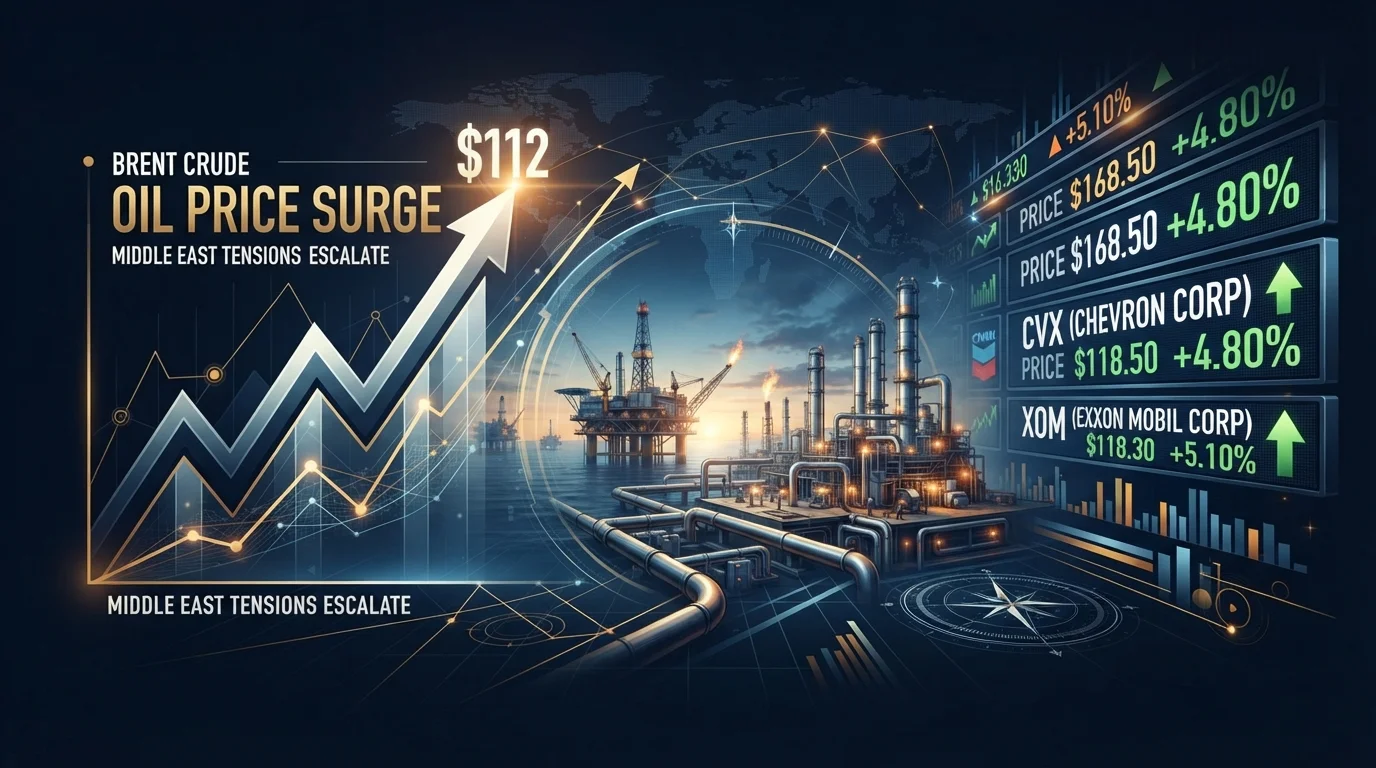
Brent crude oil prices have surged past $112 per barrel for the first time since May 2026, driven by escalating geopolitical tensions in the Middle East and renewed concerns over global oil supply security. The International Energy Agency has characterized the ongoing disruption as the largest supply shock in the history of the global oil market, creating both immediate trading opportunities and longer-term investment implications for energy sector participants.
For investors, this price level represents more than just a headline. Energy stocks have responded decisively, with the Energy Select Sector SPDR Fund (XLE) delivering approximately 38% returns year-to-date through September. Major producers like Chevron (CVX) and Exxon Mobil (XOM) are positioned to capture significant upside from elevated crude prices, while facing complex operational challenges in a region where the Strait of Hormuz remains effectively closed. Understanding the interplay between geopolitical risk, supply dynamics, and individual company positioning is essential for navigating this volatile but potentially rewarding market environment.
The Oil Price Surge: What's Driving Brent Above $112
Geopolitical Tensions in the Middle East
The current oil price rally stems from a confluence of geopolitical factors that have intensified throughout October 2026. Reports from The New York Times, citing official sources, indicate that the United States and Israel have developed plans for renewed military strikes against Iran following the upcoming U.S. midterm elections. This prospect has injected fresh uncertainty into an already fragile market, with traders pricing in elevated supply risk premiums.
Compounding these concerns, Houthi rebels have escalated attacks on Saudi Arabian energy infrastructure and commercial shipping targets. OilPrice.com reported that Brent crude maintained levels above $111 per barrel following the latest wave of Houthi strikes on Saudi targets. The attacks have expanded beyond the traditional flashpoint of the Strait of Hormuz, with LSEG analysts noting that Iran has been targeting vessels as far south as the Gulf of Oman. This geographic expansion threatens loadings outside the Arab Gulf and disrupts ship-to-ship transfers that have helped sustain Middle Eastern exports throughout the conflict.
President Trump's recent statement that there would be no negotiations with Iran and that something would happen "fairly soon" has further fueled market anxiety. When political leaders signal imminent military action in the world's most critical oil-producing region, markets respond with characteristic speed and severity.
Supply Disruption at Historic Scale
The 2026 Iran war and the associated closure of the Strait of Hormuz have created what the International Energy Agency has described as the largest supply disruption in global oil market history. The crisis has drawn direct parallels to the 1970s energy crisis, manifesting through acute supply shortages, currency volatility, inflationary pressures, and heightened risks of stagflation and recession.
Exxon Mobil and Chevron collectively lost approximately 6% of their global production in the first quarter of 2026, primarily due to the Strait of Hormuz closure. Shell's gas output was similarly impacted, falling 5% during the same period. These production losses at the world's largest integrated oil companies underscore the systemic nature of the supply constraint and explain why prices have remained elevated despite demand concerns elsewhere in the global economy.
Market Reaction and Trading Volume
The market response to these developments has been pronounced. Brent crude jumped 3.3% in recent trading sessions to reach $112 per barrel, while West Texas Intermediate (WTI) crude futures approached the $99 mark. Over the past month alone, Brent prices have risen 8.63%, and the year-over-year increase stands at an impressive 71.50%. WTI has similarly posted robust gains, up 8.22% over the past month and 67.46% compared to October 2025.
Energy has emerged as the leading sector in the S&P 500, with ten of eleven sectors posting gains and energy (XLE) and financials (XLF) leading the advance. Visa and Mastercard reached record highs even as chip stocks extended their selloff, demonstrating the rotational nature of market leadership during commodity price surges.
Top Energy Stocks to Watch in the Current Environment
Chevron (CVX): A Standout Performer
Chevron has emerged as one of the most compelling large-cap energy investments during this oil price cycle. The stock recently hit a new 52-week high, reflecting both operational excellence and favorable commodity pricing. Analyst consensus remains firmly bullish, with the stock carrying a Buy rating and an average price target of $226.77.
Morgan Stanley recently raised its price target on Chevron from $218 to $226, maintaining an Overweight rating. This upward revision reflects confidence in the company's ability to generate substantial free cash flow at current oil price levels. Chevron's integrated business model, combining upstream production with downstream refining and marketing operations, provides natural hedging against various oil price scenarios while maximizing capture during periods of elevated crude prices.
The company's upcoming earnings report, scheduled for October 30, 2026, will provide critical insights into how management is navigating the dual challenges of maximizing production profitability while managing geopolitical operational risks. With a market capitalization of $444.53 billion and a stock price that has ranged from $146.49 to $225.31 over the past twelve months, Chevron offers both scale and momentum for energy-focused portfolios.
Exxon Mobil (XOM): Refining Windfall Offsets Upstream Challenges
Exxon Mobil presents a more nuanced investment case, with its diversified operations creating offsetting forces that require careful analysis. The company has projected a substantial $4.5 billion earnings boost from higher refining margins in its Energy Products segment during the third quarter, compared to the second quarter. This refining windfall has helped push XOM stock to test the $179.17 level following a breakout above $169.60 resistance.
However, the upstream segment faces headwinds. Exxon Mobil flagged a $1.3 billion earnings headwind from lower liquids prices in its Upstream division, partially offset by a $300 million benefit from gas price changes. This divergence between refining and upstream performance illustrates the complexity of integrated oil company analysis during volatile price environments.
The market has responded favorably to the net effect, with analysts maintaining a Moderate Buy rating on the stock. Exxon Mobil's upcoming Q3 2026 earnings report, scheduled for October 30, will be closely watched for confirmation of the refining margin boost and updated guidance for the fourth quarter. With Brent crude now above $110, upstream expectations may improve materially from earlier projections.
Energy Sector ETF (XLE): Broad Exposure with Lower Risk
For investors seeking diversified exposure without the company-specific risks of individual stock selection, the Energy Select Sector SPDR Fund (XLE) offers an attractive alternative. The fund charges a minimal 0.08% expense ratio and provides exposure to the entire U.S. energy sector.
XLE's top holdings reflect the industry's concentration, with Exxon Mobil representing 23.96% of the fund, Chevron at 18.05%, ConocoPhillips at 7.11%, Marathon Petroleum at 5.12%, and Phillips 66 at 4.81%. This cap-weighted approach ensures that the largest and most financially robust companies drive performance, while maintaining meaningful diversification across the integrated oil, exploration and production, and refining subsectors.
The fund has delivered approximately 38% returns in 2026 through September, closing much of the performance gap that existed relative to broader market indices earlier in the year. With a price-to-earnings ratio of 14.01 and price-to-book ratio of 2.01, XLE offers reasonable valuations despite the recent price appreciation.
Investment Strategies for the Current Oil Environment
Timing Considerations and Entry Points
Investors contemplating energy sector exposure must grapple with the timeless challenge of timing commodity-linked investments. Oil prices above $110 per barrel have historically proven unsustainable over extended periods, as high prices incentivize both demand destruction and supply expansion. McGlone's analysis cited in recent research noted that with U.S. average production costs around $55 per barrel and crude trading near $94 to $99, the current price represents a substantial premium to extraction economics.
However, geopolitical risk premiums can persist far longer than fundamentals-based models predict. The 2026 Iran war has created structural supply constraints that cannot be resolved quickly, regardless of price signals. Investors with longer time horizons may view current prices as justified by the uncertainty premium, while shorter-term traders might consider the risk of mean reversion as diplomatic channels remain active.
For investors seeking to automate their trading strategies and capture opportunities across volatile markets, consider using Alphio AI's copy trading feature to mirror successful traders and smart money wallets navigating the energy sector.

Risk Management in Geopolitically Driven Markets
The current oil market environment demands heightened attention to risk management. Unlike demand-driven price cycles, supply shocks driven by military conflict can reverse suddenly if diplomatic breakthroughs occur. The New York Times reporting on planned military action suggests such breakthroughs may be unlikely in the near term, but markets have a history of surprising even well-informed observers.
Position sizing becomes critical in this context. Energy sector allocations should reflect both the opportunity presented by elevated oil prices and the potential for rapid downside if geopolitical tensions ease or if global economic weakness reduces demand. The simultaneous occurrence of high oil prices and recessionary fears in major economies creates a particularly complex macroeconomic backdrop for energy investing.
The Case for Long-Term Energy Exposure
Beyond the immediate trading dynamics, the current crisis has prompted what the International Energy Agency describes as a reshaping of global energy investment and an acceleration of diversification away from Middle Eastern supply sources. This structural shift has long-term implications that extend beyond the current price cycle.
For investors with multi-year time horizons, the crisis may reinforce the investment case for energy companies with diversified global production portfolios, strong balance sheets, and demonstrated operational resilience. Companies like Chevron and Exxon Mobil that can maintain production and profitability across various geopolitical scenarios are likely to command premium valuations as the industry adapts to a less stable supply environment.
Alternatively, explore Alphio's agentic trading capabilities to automate portfolio management with AI-powered strategies that adapt to shifting market conditions in real time.

Macroeconomic Implications of Sustained High Oil Prices
Inflation and Central Bank Policy
Sustained oil prices above $110 per barrel carry significant implications for global inflation dynamics. Energy costs feed directly into consumer prices through transportation, heating, and electricity costs, while indirectly affecting prices across the broader economy through supply chain impacts. The Federal Reserve's upcoming interest rate decision, scheduled for October 29, will occur against this inflationary backdrop, with markets closely watching the Personal Consumption Expenditures (PCE) inflation report for signs of broadening price pressures.
The tension between geopolitically driven supply constraints and central bank efforts to control inflation creates a challenging policy environment. Raising interest rates to combat inflation risks slowing economic growth at a time when high energy costs are already acting as a tax on consumption and investment. This dynamic increases the probability of policy errors and amplifies market volatility across asset classes.
Global Growth Concerns
High oil prices have historically preceded or accompanied economic slowdowns, and current conditions bear watching for similar signals. The European economy, already strained by energy transition costs and demographic challenges, faces additional headwinds from elevated import costs. Asian manufacturing economies, dependent on oil imports for both energy and petrochemical feedstocks, may experience margin compression that affects corporate profitability across sectors.
The confluence of supply-driven oil price spikes and demand-driven economic weakness creates the risk of stagflation, a particularly challenging environment for traditional asset allocation frameworks. Investors may need to reconsider portfolio structures that assume stable correlations between asset classes, as historical relationships have shown tendency to break down during inflationary supply shocks.
Technical Analysis and Market Structure
Key Price Levels for Oil
From a technical perspective, Brent crude's breakthrough above $110 establishes a new trading range with psychological resistance at $115 and potential support near $105. The 3.3% single-day advance that carried prices to $112 suggests strong momentum, though such moves can be vulnerable to profit-taking in the absence of fresh catalysts.
WTI's approach to the $100 threshold carries its own significance, as triple-digit oil prices tend to attract media attention and political scrutiny that can influence market dynamics beyond pure supply and demand fundamentals. The $95 to $100 range represents a critical consolidation zone that will likely determine near-term directional bias.
Energy Stock Technical Setup
Chevron's breakout to new 52-week highs suggests technical momentum that could carry the stock toward analyst price targets near $226. Volume expansion on the advance would confirm institutional participation and sustainability of the trend. For Exxon Mobil, the test of $179 resistance following the breakout above $169.60 sets up a potentially significant technical move if earnings confirmation arrives on October 30.
XLE's performance relative to the S&P 500 has improved dramatically, with the energy sector outperforming technology and other growth-oriented sectors in recent sessions. This rotation reflects both the absolute price gains in energy and the defensive characteristics that commodity producers assume during inflationary periods.
Conclusion
Brent crude oil's surge above $112 per barrel represents a significant market event with far-reaching implications for investors, policymakers, and global economic stability. The confluence of military conflict in the Middle East, historic supply disruptions, and robust year-over-year price appreciation creates an environment of both exceptional opportunity and elevated risk for energy sector participants.
For investors, the current landscape demands careful stock selection, disciplined risk management, and clear-eyed assessment of both upside potential and downside scenarios. Chevron and Exxon Mobil, as the dominant U.S. integrated oil companies, offer differentiated exposure to the current price environment, with Chevron demonstrating stronger momentum and Exxon Mobil presenting a more balanced risk-reward profile. XLE provides diversified sector exposure for those preferring to minimize company-specific risks.
The geopolitical dynamics driving current prices remain fluid, and investors should maintain flexibility to adapt as conditions evolve. Military action, diplomatic breakthroughs, or demand shifts could rapidly alter the investment calculus. In such an environment, maintaining appropriate position sizes, utilizing stop-loss discipline, and diversifying across asset classes remain essential risk management practices.
For those seeking advanced tools to navigate these volatile markets, Alphio AI's scheduled task automations enable conditional workflows that respond to price movements and news events without requiring constant manual monitoring.

Additionally, Alphio's conversational trading interface allows investors to execute trades, analyze positions, and manage risk through natural language commands, simplifying decision-making during fast-moving market conditions.

As always, thorough due diligence, attention to evolving geopolitical developments, and alignment with individual risk tolerance should guide investment decisions in this dynamic and consequential market environment.
FAQs
Why did Brent crude oil prices surge above $112 in October 2026?
Brent crude surged due to escalating Middle East tensions, including planned U.S. and Israeli military strikes against Iran, Houthi attacks on Saudi energy infrastructure, and the closure of the Strait of Hormuz. The International Energy Agency described the resulting supply disruption as the largest in global oil market history, creating acute shortages that drove prices to five-month highs.
Which energy stocks are best positioned to benefit from high oil prices?
Chevron (CVX) and Exxon Mobil (XOM) are the standout beneficiaries among U.S. large-cap energy stocks. Chevron recently hit a new 52-week high with analyst price targets around $226, while Exxon Mobil is seeing a $4.5 billion refining margin boost. For diversified exposure, the Energy Select Sector SPDR Fund (XLE) offers broad sector participation with a 0.08% expense ratio.
How does the Strait of Hormuz closure affect global oil supply?
The Strait of Hormuz closure has caused the largest supply disruption in history according to the IEA. Major producers like Exxon Mobil and Chevron lost approximately 6% of global production, while Shell's gas output dropped 5%. The closure has created acute shortages, shipping reroutes, and structural changes to global energy investment patterns.
What are the inflation implications of sustained $110+ oil prices?
Sustained high oil prices feed directly into consumer inflation through transportation, heating, and electricity costs, while indirectly affecting broader supply chains. This creates a challenging environment for central banks, including the Federal Reserve, which must balance inflation control against growth risks. The combination of supply-driven oil spikes and demand-driven weakness increases stagflation risk.
Is it too late to invest in energy stocks after the recent rally?
While energy stocks have rallied significantly, with XLE up 38% year-to-date, the structural nature of current supply constraints may support elevated oil prices longer than typical cycles. However, investors should consider position sizing carefully, as geopolitical developments can reverse quickly. Diversified exposure through XLE or gradual accumulation in individual names may be prudent approaches for those concerned about timing risk.
Related articles
- Stock Market Surges After 2026 Midterms: What the Democratic Sweep Means for Your PortfolioThe stock market rallied after Democrats won the 2026 midterms. Discover what the election means for investors, tech stocks, and the S&P 500 outlook.
- Stock Market Surges After 2026 Midterms: What the Democratic Sweep Means for Your PortfolioThe stock market rallied after Democrats won the 2026 midterms. Discover what the election means for investors, tech stocks, and the S&P 500 outlook.
- Oil Prices Surge Above $105 Amid US-Iran Conflict: Energy Investment Opportunities in November 2026Oil prices climb past $105 as US strikes Iran's Qeshm Island. Discover energy investment opportunities, top oil stocks, and market outlook for November 2026.
- Nvidia Stock Earnings August 2026: Q2 Preview & Investment OutlookNvidia reports Q2 earnings on August 26, 2026. Explore revenue forecasts, AI demand drivers, and investment strategies ahead of this critical catalyst.
- Nvidia Earnings Preview August 2026: AI Chip Leader's Next CatalystNvidia reports Q2 FY2027 earnings August 26, 2026. Wall Street expects $93-95B revenue, up 96% YoY. Analysis of data center growth, Blackwell ramp, and investment outlook.
- Fed Interest Rate Decision August 2026: Navigating Markets Amid Cooling InflationAnalysis of the Fed's August 2026 interest rate decision, cooling inflation data, and strategic investment opportunities in stocks and bonds.