

Fed Interest Rate Decision August 2026: Navigating Markets Amid Cooling Inflation
Analysis of the Fed's August 2026 interest rate decision, cooling inflation data, and strategic investment opportunities in stocks and bonds.

Key Takeaway
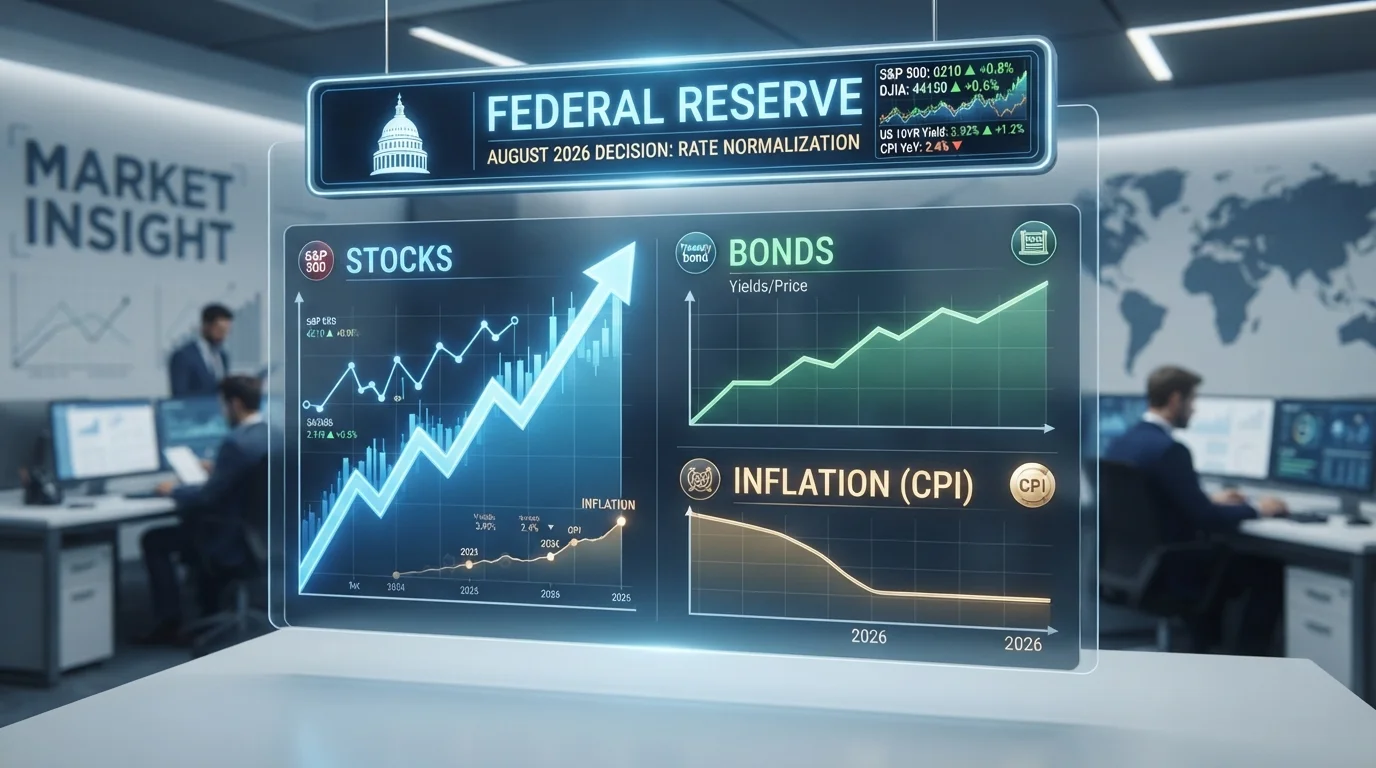
The Federal Reserve's August 2026 interest rate decision represents a pivotal moment for investors navigating an increasingly complex macroeconomic landscape. With the federal funds rate expected to remain unchanged at 3.50%–3.75% for a fifth consecutive meeting, markets are digesting the implications of cooling inflation data while maintaining cautious optimism about the broader economic trajectory. The recent Consumer Price Index (CPI) and Producer Price Index (PPI) reports have provided the Federal Open Market Committee (FOMC) with additional breathing room, suggesting that the aggressive tightening cycle of previous years is successfully bringing price pressures under control without triggering a severe economic contraction.
For investors, this environment presents both opportunities and challenges. The combination of stable interest rates and moderating inflation creates a favorable backdrop for equities, particularly growth stocks that had been pressured by higher discount rates. However, the Fed's data-dependent approach means that market volatility could persist as each new economic release shifts expectations about the timing of future rate adjustments. Understanding the nuances of the Fed's current stance and positioning portfolios accordingly will be crucial for capturing returns in the months ahead.
The broader implications extend beyond immediate market reactions. The Fed's ability to engineer a soft landing—bringing inflation back toward its 2% target without causing significant economic disruption—will have lasting effects on asset allocation strategies, sector rotations, and international capital flows. Investors who accurately anticipate the Fed's next moves while maintaining exposure to fundamentally strong companies are likely to be rewarded as the monetary policy outlook becomes clearer.
Understanding the August 2026 Fed Decision
The Case for Holding Rates Steady
The Federal Reserve's decision to maintain the federal funds rate at its current level reflects a carefully calibrated response to evolving economic conditions. After raising rates aggressively from near-zero levels in 2022 and 2023 to combat the most severe inflationary surge in decades, policymakers have shifted to a more patient approach as price pressures gradually subside. The current rate range of 3.50%–3.75% represents a level that Fed officials believe is sufficiently restrictive to continue dampening inflationary pressures while not being so high as to unnecessarily constrain economic growth.
Recent economic data has largely supported this wait-and-see approach. The July 2026 CPI report showed headline inflation rising a modest 0.2% month-over-month, with the annual rate edging down to 3.4% from the previous reading. Core inflation, which excludes volatile food and energy components and is closely watched by Fed officials, rose 0.1% on the month and 2.5% year-over-year. These figures suggest that inflation is continuing its gradual descent toward the Fed's 2% target, albeit at a slower pace than some policymakers might prefer.
The PPI data has also provided encouraging signals about pipeline inflation pressures. Cooling producer price inflation typically translates to more stable consumer prices in subsequent months, giving the Fed additional confidence that its current policy stance is appropriate. Market participants have responded positively to these developments, with major equity indices reaching fresh record highs as the prospects for a soft landing have improved.
Market Expectations and Fed Communication
Federal Reserve communication has evolved significantly in recent months, with officials emphasizing their data-dependent approach to future policy decisions. While markets had previously priced in aggressive rate cuts for 2026, expectations have moderated considerably as economic resilience has surprised to the upside. The CME FedWatch Tool currently indicates that traders see a substantial probability of rates remaining at current levels through the remainder of the year, with any potential cuts likely pushed into early 2027.
This shift in market pricing reflects a broader reassessment of the economic outlook. The U.S. economy has demonstrated remarkable resilience in the face of higher interest rates, with consumer spending remaining robust and the labor market maintaining its strength. Nonfarm payrolls have continued to show healthy job creation, while the unemployment rate has remained near historically low levels. This economic momentum has reduced the urgency for the Fed to begin easing monetary policy, allowing officials to maintain their focus on ensuring that inflation is sustainably returning to target.
Fed Chair Jerome Powell's recent remarks have reinforced this patient approach, emphasizing that policymakers will need to see sustained progress on inflation before considering rate reductions. The Fed's preferred inflation measure, the Personal Consumption Expenditures (PCE) price index, remains somewhat elevated compared to the CPI figures, suggesting that the central bank will want to see additional months of favorable data before declaring victory over inflation.
Inflation Data Analysis: CPI and PPI Reports
Consumer Price Index Trends
The July 2026 Consumer Price Index report provided markets with a generally favorable assessment of inflation dynamics. Headline CPI increased by 0.2% month-over-month, matching economists' expectations and representing a continuation of the moderating trend that has been in place for much of the past year. On an annual basis, the CPI rose 3.4%, down from higher readings in previous months and moving closer to the Fed's comfort zone.
Perhaps more significantly, core CPI—which strips out volatile food and energy prices—rose by just 0.1% month-over-month and 2.5% year-over-year. This measure is particularly important because it provides a clearer picture of underlying inflation trends that are more responsive to monetary policy. The core CPI reading suggests that the Fed's restrictive policy stance is successfully filtering through to the real economy, dampening price pressures in sectors that are most sensitive to interest rates.
Housing costs, which comprise a significant portion of the CPI basket, have shown signs of moderation as higher mortgage rates have cooled the real estate market. Shelter inflation has been a persistent source of upward pressure on overall price levels, so any deceleration in this component would be welcomed by Fed officials. Additionally, goods inflation has remained relatively tame, with supply chain disruptions from the pandemic era largely resolved and import prices stable.
Producer Price Index Insights
The Producer Price Index data has complemented the favorable CPI readings, offering insights into pipeline inflation pressures that will influence consumer prices in coming months. The PPI measures the prices that producers receive for their goods and services, making it a leading indicator of consumer inflation trends. Recent PPI reports have shown cooling price pressures at the wholesale level, suggesting that businesses are facing less intense cost pressures that would otherwise be passed on to consumers.
Several factors have contributed to the moderation in producer prices. Energy costs have stabilized after the volatility of recent years, providing relief to manufacturers and transportation companies that are significant energy consumers. Input costs for raw materials have also moderated as global supply chains have normalized and demand has adjusted to higher price levels. These developments have allowed producers to maintain profit margins without aggressively raising prices.
The services component of the PPI has been particularly noteworthy, as services inflation had been more persistent than goods inflation in the post-pandemic period. Recent data suggests that services price pressures are also beginning to ease, which would be a positive development for the Fed's inflation outlook. Wage growth, while still elevated compared to pre-pandemic levels, has shown signs of moderation as the labor market gradually cools.
Investment Implications and Market Strategy
Equity Market Opportunities
The current macroeconomic environment presents compelling opportunities for equity investors, particularly those focused on high-quality growth stocks that had been pressured by rising interest rates. As the Fed maintains its patient stance and inflation continues to moderate, the discount rates used to value future cash flows become more favorable, supporting higher valuations for growth-oriented companies.
Technology stocks have been primary beneficiaries of the improving rate outlook, with the sector leading broader market gains in recent months. Companies with strong competitive positions, robust cash flows, and clear paths to earnings growth are particularly well-positioned in this environment. The artificial intelligence theme continues to drive investor interest, with semiconductor stocks like NVIDIA and AMD attracting significant attention ahead of their upcoming earnings reports.
For investors seeking to capitalize on these trends, consider using Alphio AI's copy trading feature to mirror successful traders and smart money wallets who are positioning for the next phase of the market cycle.

Small-cap stocks have also shown signs of life as rate stability reduces concerns about refinancing risks and improves the earnings outlook for domestically focused companies. The Russell 2000 index has outperformed larger-cap indices in recent weeks, suggesting that investors are becoming more comfortable taking on cyclical exposure as recession fears recede. However, selectivity remains important, as not all small-cap companies are equally well-positioned to benefit from the current environment.
Fixed Income and Bond Markets
The bond market has experienced significant volatility as investors have recalibrated their expectations for the Fed's policy trajectory. Treasury yields have fluctuated in response to each new data release, with the 10-year yield serving as a key barometer of market sentiment about inflation and growth prospects. The yield curve has shown signs of normalization after being deeply inverted for an extended period, which historically has preceded economic expansions rather than contractions.
For fixed income investors, the current environment offers attractive yields across a range of maturities and credit qualities. Investment-grade corporate bonds are providing yields that significantly exceed inflation expectations, offering positive real returns for the first time in years. High-yield bonds have also performed well as default rates have remained lower than initially feared and corporate balance sheets have proven resilient to higher interest rates.
Municipal bonds continue to offer tax-advantaged income for investors in higher tax brackets, with yields that are competitive with taxable alternatives on an after-tax basis. The improving fiscal position of many state and local governments has supported credit quality in the municipal sector, reducing concerns about potential downgrades or defaults. Investors should consider laddering their bond portfolios to capture current yields while maintaining flexibility to reinvest as the rate environment evolves.
Sector Analysis: Winners and Losers
Technology and Growth Sectors
The technology sector has emerged as a clear beneficiary of the Fed's patient approach to monetary policy. Growth stocks, which had been disproportionately impacted by rising interest rates in 2022 and 2023, have staged a powerful recovery as the outlook for discount rates has improved. The sector's strong fundamentals, including robust revenue growth, expanding profit margins, and significant cash generation, have supported this performance.
Within technology, artificial intelligence remains the dominant theme driving investor interest and capital allocation. Companies involved in AI infrastructure, including semiconductor manufacturers, cloud computing providers, and data center operators, have seen their valuations expand as the market anticipates years of sustained growth in AI-related spending. NVIDIA's upcoming earnings report on August 26, 2026, will be closely watched for insights into the durability of this demand trend.
Software companies have also performed well, with businesses continuing to invest in digital transformation initiatives despite broader economic uncertainty. The shift to cloud-based solutions and subscription revenue models has provided these companies with predictable cash flows that are highly valued in the current environment. Cybersecurity stocks have been particularly strong as organizations prioritize protecting their digital assets in an increasingly complex threat landscape.
Alternatively, explore Alphio's agentic trading feature to automate your portfolio management with AI-powered strategies that can adapt to changing market conditions.

Financial Services and Interest Rate Sensitivity
The financial sector presents a more nuanced picture in the current environment. Banks have benefited from higher interest rates, which have expanded net interest margins and improved profitability. However, the inverted yield curve that persisted for much of the past year pressured bank earnings by compressing the spread between short-term funding costs and long-term lending rates. As the yield curve normalizes, banks should see improved profitability from their core lending operations.
Regional banks have faced additional challenges related to deposit outflows and concerns about commercial real estate exposure. While these issues have not developed into the systemic crisis that some had feared, they have created a divergence in performance between larger, more diversified banks and their smaller regional counterparts. Investors should carefully evaluate the specific risk exposures of individual institutions rather than making broad sector allocations.
Insurance companies have generally performed well in the higher rate environment, as investment income from their substantial bond portfolios has increased. Property and casualty insurers have faced headwinds from elevated catastrophe losses and inflation in repair and replacement costs, but pricing discipline has allowed them to maintain underwriting profitability. Life insurers have been clear beneficiaries of higher rates, which improve the profitability of their guaranteed products and reduce reserve requirements.
International Market Considerations
Global Central Bank Coordination
The Federal Reserve's policy stance does not exist in isolation, and developments at other major central banks have significant implications for global markets and currency dynamics. The European Central Bank (ECB) has already begun easing monetary policy, cutting interest rates as eurozone inflation has moderated more quickly than in the United States. This divergence in policy trajectories has put downward pressure on the euro relative to the dollar, creating both challenges and opportunities for multinational companies.
The Bank of England has maintained a more hawkish stance than the ECB, keeping rates elevated as UK inflation has proven more persistent. This has supported sterling against both the euro and the dollar, though concerns about the UK economic outlook may limit further gains. The Bank of Japan's gradual exit from ultra-loose monetary policy has been a significant development, with the yen experiencing heightened volatility as markets adjust to the prospect of positive interest rates in Japan for the first time in decades.
For investors with international exposure, these divergent policy paths create both currency risks and opportunities. Companies with significant overseas revenues may face headwinds from a strong dollar, while those with substantial international costs could benefit. Emerging market economies are also impacted by Fed policy, as higher U.S. rates tend to draw capital away from riskier assets and put pressure on currencies and financial conditions in developing economies.
Commodity Markets and Inflation Hedging
Commodity markets have been influenced by the evolving interest rate outlook, with precious metals and industrial commodities responding to shifting expectations about economic growth and inflation. Gold has performed well as real interest rates have stabilized, with the precious metal maintaining its appeal as a store of value and portfolio diversifier. Central bank buying, particularly from emerging market economies seeking to diversify their reserve holdings, has provided additional support for gold prices.
Industrial commodities have shown more mixed performance, with copper and other base metals sensitive to concerns about Chinese economic growth. Oil prices have been relatively range-bound as supply increases from non-OPEC producers have offset production cuts from the OPEC+ cartel. Natural gas prices have moderated significantly from the elevated levels seen during the energy crisis, providing relief to European consumers and industrial users.
For investors seeking inflation protection, a diversified approach to commodity exposure makes sense in the current environment. While inflation has moderated, the risk of a resurgence remains, particularly if the Fed begins easing policy before inflation is fully vanquished. Commodity-producing equities may offer a more efficient way to gain exposure than direct commodity investments, as they provide income through dividends and potential capital appreciation.
Risk Factors and Potential Scenarios
Upside Risks to the Outlook
While the baseline scenario calls for a soft landing with gradual rate cuts beginning in early 2027, several upside risks could accelerate the Fed's policy normalization. If inflation continues to moderate more quickly than expected, falling toward or below the Fed's 2% target, policymakers may feel comfortable beginning the easing cycle sooner than currently anticipated. This would likely provide a significant boost to risk assets, particularly growth stocks and emerging market equities.
Productivity growth represents another potential upside catalyst for markets. The widespread adoption of artificial intelligence and other productivity-enhancing technologies could drive a sustained increase in economic efficiency, allowing for stronger growth without reigniting inflationary pressures. Such a development would be extremely favorable for corporate earnings and could support higher equity valuations across a range of sectors.
Fiscal policy developments could also influence the economic outlook, with potential tax cuts or spending increases providing additional stimulus to an already resilient economy. While such measures could raise concerns about the federal deficit and long-term debt sustainability, in the near term they would likely support consumer spending and business investment. Investors should monitor political developments in Washington for signals about potential policy changes.
Consider using Alphio's automations feature to set conditional workflows that can respond quickly to changing market conditions and Fed policy announcements.

Downside Risks to Monitor
Despite the generally favorable outlook, several downside risks warrant investor attention. The most significant concern is the possibility that inflation proves more persistent than currently anticipated, forcing the Fed to maintain higher rates for longer or even resume hiking if price pressures reaccelerate. Such a scenario would likely trigger a significant repricing of risk assets and could lead to a more pronounced economic slowdown than currently expected.
Geopolitical risks remain elevated, with ongoing conflicts in Ukraine and the Middle East creating uncertainty about energy prices and global trade flows. An escalation in any of these conflicts could disrupt supply chains and reignite inflationary pressures, complicating the Fed's policy calculus. Additionally, tensions between the United States and China over trade and technology issues could impact global growth and corporate earnings.
Financial stability concerns, while not currently elevated, could resurface if higher interest rates expose vulnerabilities in the banking system or shadow banking sector. The commercial real estate market remains an area of particular concern, with elevated vacancy rates and refinancing needs creating potential stress for lenders and property owners. A broader credit event could force the Fed to pivot toward easing even if inflation has not fully moderated, creating a difficult trade-off between price stability and financial stability.
Conclusion
The Federal Reserve's August 2026 interest rate decision reflects a central bank that has successfully navigated the most challenging inflationary environment in decades while maintaining economic growth. By holding rates steady at 3.50%–3.75%, policymakers are signaling confidence that their current policy stance is appropriate for bringing inflation sustainably back to target without causing unnecessary economic disruption.
For investors, this environment presents a favorable backdrop for risk assets, with stable interest rates and moderating inflation supporting equity valuations and providing attractive opportunities in fixed income markets. The key to success will be maintaining exposure to high-quality companies with strong competitive positions while remaining vigilant about the risks that could disrupt the current equilibrium.
As we look ahead to the remainder of 2026 and into 2027, the Fed's data-dependent approach means that markets will remain sensitive to each new economic release. Investors should be prepared for potential volatility while maintaining a long-term perspective focused on fundamental value creation. The transition from restrictive to neutral monetary policy, when it eventually occurs, will likely mark the beginning of a new phase in the market cycle with its own set of opportunities and challenges.
For those looking to optimize their trading strategies in this evolving environment, Alphio AI offers powerful tools to enhance your investment approach. Explore conversational trading to execute trades via chat and access real-time market insights powered by artificial intelligence.

Whether you're interested in copy trading to mirror successful strategies, agentic trading for automated portfolio management, or setting up custom automations for conditional workflows, Alphio AI provides the technology you need to navigate complex markets with confidence. Visit Alphio AI today to discover how AI-powered trading tools can help you achieve your investment goals in any market environment.
FAQs
What is the Federal Reserve's current interest rate?
As of August 2026, the Federal Reserve has maintained the federal funds rate at 3.50%–3.75% for five consecutive meetings. This level is considered sufficiently restrictive to continue dampening inflationary pressures while not unnecessarily constraining economic growth.
When will the Fed start cutting interest rates?
Current market expectations suggest the Fed will likely hold rates steady through the remainder of 2026, with potential rate cuts beginning in early 2027. However, this timeline depends on inflation continuing to moderate toward the Fed's 2% target and the economy maintaining its resilience.
How does the Fed's interest rate decision affect the stock market?
The Fed's interest rate decisions impact stock markets through multiple channels. Stable or falling rates generally support higher equity valuations by reducing discount rates used to value future cash flows. Growth stocks, particularly in technology, tend to benefit most from rate stability, while financial stocks may see mixed impacts depending on the yield curve shape.
What is the difference between CPI and PPI inflation data?
The Consumer Price Index (CPI) measures the prices that consumers pay for goods and services, while the Producer Price Index (PPI) measures the prices that producers receive for their output. PPI is considered a leading indicator because changes in producer prices often translate to consumer prices with a lag. Core versions of both indices exclude volatile food and energy prices to show underlying inflation trends.
Which sectors perform best when the Fed holds rates steady?
When the Fed maintains stable interest rates, growth-oriented sectors like technology typically perform well as discount rates become more favorable for valuing future cash flows. Small-cap stocks may also benefit from reduced refinancing concerns. However, sector performance also depends on broader economic conditions, earnings growth, and company-specific factors beyond interest rates alone.
Related articles
- Stock Market Surges After 2026 Midterms: What the Democratic Sweep Means for Your PortfolioThe stock market rallied after Democrats won the 2026 midterms. Discover what the election means for investors, tech stocks, and the S&P 500 outlook.
- Stock Market Surges After 2026 Midterms: What the Democratic Sweep Means for Your PortfolioThe stock market rallied after Democrats won the 2026 midterms. Discover what the election means for investors, tech stocks, and the S&P 500 outlook.
- Oil Prices Surge Above $105 Amid US-Iran Conflict: Energy Investment Opportunities in November 2026Oil prices climb past $105 as US strikes Iran's Qeshm Island. Discover energy investment opportunities, top oil stocks, and market outlook for November 2026.
- Nvidia Stock August 2026: Why Analysts Predict a Major BreakoutNvidia stock could skyrocket in August 2026. Discover why analysts are bullish, with $500B in AI chip bookings and demand outpacing supply 12-to-1.
- Nuclear Energy Stocks: The Hidden Gem of Clean Energy Investment in 2026Discover why nuclear energy stocks are surging in 2026. Learn about NuScale Power (SMR), Oklo (OKLO), and emerging opportunities in the clean energy sector.
- Tesla Stock Analysis August 2026: Navigating the EV Market's Next ChapterIn-depth Tesla stock analysis for August 2026. Explore TSLA price trends, EV market growth, and investment strategies. Expert insights on Tesla's future.