

Nvidia Stock August 2026: Why Analysts Predict a Major Breakout
Nvidia stock could skyrocket in August 2026. Discover why analysts are bullish, with $500B in AI chip bookings and demand outpacing supply 12-to-1.

Key Takeaway
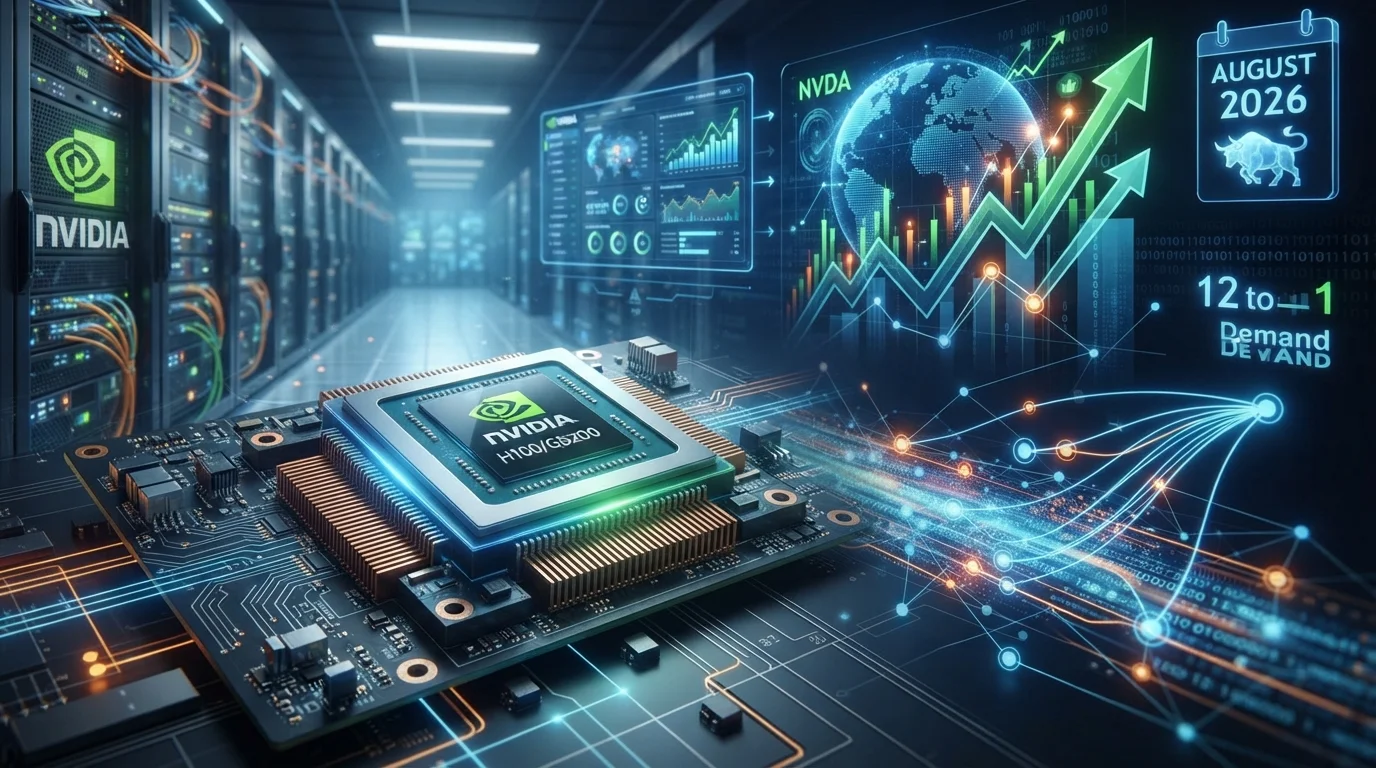
Nvidia Corporation (NVDA) stands at a critical inflection point heading into August 2026, with Wall Street analysts projecting significant upside potential driven by unprecedented demand for artificial intelligence infrastructure. The semiconductor giant has secured approximately $500 billion in AI chip bookings covering 2025 and 2026, creating a revenue backlog that provides exceptional visibility into future earnings. According to Wedbush Securities analyst Dan Ives, demand for Nvidia's AI chips is currently outpacing supply by a ratio of 12-to-1, indicating a supply-constrained environment that typically supports pricing power and margin expansion.
The convergence of several catalysts makes August 2026 particularly significant for Nvidia shareholders. The company is expected to unveil its next-generation GPU architecture, potentially the Rubin series, which would represent a substantial leap forward in AI training and inference capabilities. Additionally, ongoing deployment of AI data centers by hyperscalers including Microsoft, Amazon, Google, and Meta continues to drive exponential growth in demand for high-performance computing solutions. For investors seeking exposure to the AI revolution, understanding Nvidia's positioning heading into this pivotal month is essential for making informed portfolio decisions.
Why August 2026 Matters for Nvidia Stock
The Next-Generation GPU Catalyst
Nvidia has historically used major industry conferences and product launches to drive significant stock price movements. August 2026 aligns with the company's typical product announcement cycle, with market participants anticipating details about the Rubin architecture—Nvidia's successor to the highly successful Blackwell platform. The Rubin chips are expected to deliver substantial performance improvements in AI workloads, potentially doubling the inference capabilities that made Blackwell so compelling for large language model deployment.
The semiconductor industry operates on predictable upgrade cycles, and Nvidia's ability to maintain technological leadership directly correlates with its pricing power and market share. Each new architecture generation has historically commanded premium pricing while delivering superior total cost of ownership for customers. This dynamic has allowed Nvidia to expand gross margins consistently, even as competitors attempt to gain footholds in the AI accelerator market. The August timeframe represents when investors will gain clarity on whether Nvidia can maintain its technological moat against increasing competition from AMD, Intel, and various custom silicon initiatives.
The Supply-Demand Imbalance
Perhaps the most compelling bullish indicator for Nvidia stock is the extraordinary supply-demand imbalance currently affecting the AI chip market. Dan Ives' assessment that demand exceeds supply by a 12-to-1 ratio suggests Nvidia is operating in an environment where virtually every unit produced can be sold immediately at full price. This scarcity dynamic creates multiple positive effects for the company's financial performance.
First, the constrained supply environment eliminates any near-term pricing pressure, allowing Nvidia to maintain premium pricing across its product portfolio. Second, customers facing allocation constraints are incentivized to place larger, longer-dated orders to secure future supply, contributing to the substantial booking backlog that now extends through 2026. Third, the supply shortage creates significant barriers to entry for competitors, as customers cannot easily switch to alternative solutions when their AI infrastructure deployments are constrained by chip availability.
The $500 Billion AI Chip Backlog
Revenue Visibility Through 2026
Nvidia's reported backlog of approximately $500 billion in AI chip bookings represents one of the largest forward revenue commitments in semiconductor industry history. This backlog provides extraordinary earnings visibility, effectively pre-selling production capacity for the next 18-24 months. For investors accustomed to the cyclical nature of semiconductor demand, this level of forward commitment represents a fundamentally different business dynamic—one more akin to enterprise software with recurring revenue characteristics than traditional chip manufacturing.
The composition of this backlog reveals important insights about Nvidia's customer base and market positioning. Hyperscale cloud providers—including Amazon Web Services, Microsoft Azure, Google Cloud Platform, and Meta Platforms—constitute the majority of these commitments, reflecting the accelerating AI arms race among technology giants. These customers are not merely purchasing chips; they are investing in the computational infrastructure necessary to train and deploy increasingly sophisticated AI models. The multi-year nature of these commitments suggests AI infrastructure spending represents a secular trend rather than a temporary cycle.
Translation to Stock Performance
While order backlogs provide revenue certainty, stock prices ultimately reflect expectations about future growth rates and profitability. The $500 billion backlog must be contextualized within Nvidia's current market capitalization and valuation metrics to assess its implications for shareholders. If Nvidia can convert these bookings into revenue while maintaining current gross margins of approximately 75%, the resulting cash flows would support significant shareholder returns through both capital appreciation and potential dividend initiation.
For investors considering position sizing, the backlog provides a floor for revenue expectations that reduces downside risk. Even in scenarios where new order growth moderates, the existing commitment base ensures several quarters of strong financial performance. This predictability may justify premium valuation multiples compared to semiconductor peers with more cyclical revenue patterns.
AI Infrastructure Investment Trends
Hyperscaler Spending Acceleration
The largest technology companies globally have signaled continued aggressive investment in AI infrastructure, with capital expenditure budgets reflecting this strategic priority. Microsoft has committed over $80 billion annually to AI data center expansion, while Amazon, Google, and Meta have each announced comparable spending programs. This collective investment wave represents a multi-trillion dollar infrastructure buildout that directly benefits Nvidia as the primary supplier of AI training and inference chips.
The strategic rationale behind this spending extends beyond immediate revenue generation for cloud services. Each hyperscaler recognizes that AI capabilities will increasingly determine competitive positioning across search, advertising, e-commerce, and enterprise software markets. The companies building the most capable AI infrastructure today will likely capture disproportionate value as AI applications mature and achieve mainstream adoption. This competitive dynamic creates a prisoner's dilemma where each participant must invest heavily simply to maintain market position, regardless of whether the aggregate investment level is optimal.
Looking to automate your exposure to AI infrastructure trends? Consider using Alphio AI's copy trading feature to mirror successful traders positioning for the AI buildout.

Enterprise AI Adoption Curve
While hyperscaler demand dominates current Nvidia revenue, the next growth phase will likely come from enterprise AI adoption. Large corporations across financial services, healthcare, manufacturing, and energy sectors are beginning to deploy AI solutions for operational optimization, customer service automation, and predictive analytics. Each enterprise deployment requires significant computational resources, creating incremental demand for Nvidia's data center products.
The enterprise AI market remains in early innings, with most organizations still in pilot phases rather than production deployments. As successful use cases emerge and ROI becomes demonstrable, enterprise AI spending should accelerate meaningfully. Nvidia's software ecosystem—including CUDA, TensorRT, and various vertical-specific solutions—creates significant switching costs that should help the company maintain market share as this market develops.
Competitive Landscape Analysis
AMD's Growing Challenge
Advanced Micro Devices has emerged as the most credible competitive threat to Nvidia's AI dominance, with its MI300 series accelerators gaining traction among certain customer segments. AMD's strategy emphasizes price-performance advantages and open software ecosystems, appealing to customers concerned about Nvidia's proprietary CUDA platform and premium pricing. Recent design wins with major hyperscalers indicate AMD is making meaningful progress in capturing market share.
However, Nvidia's ecosystem advantages remain substantial. The decade-long investment in CUDA has created millions of developers and thousands of optimized applications that would require significant effort to port to alternative platforms. Additionally, Nvidia's vertical integration—including networking solutions through Mellanox and software libraries—provides comprehensive solutions that competitors struggle to match. The competitive dynamic suggests AMD may capture incremental share in price-sensitive segments while Nvidia maintains dominance in highest-performance workloads.
Custom Silicon Threat
Perhaps the more significant long-term competitive threat comes from custom silicon initiatives by Nvidia's largest customers. Google has developed TPU accelerators for internal use, Amazon offers Trainium and Inferentia chips, and Microsoft has reportedly invested in custom AI silicon development. These initiatives reflect both cost optimization desires and strategic imperatives to reduce dependence on a single supplier.
The economic rationale for custom silicon is compelling at sufficient scale. Companies deploying hundreds of thousands of AI accelerators can justify the fixed costs of chip design to capture margin that would otherwise flow to Nvidia. However, custom solutions require significant engineering investment and typically lag leading-edge commercial products in performance. Nvidia's continued pace of innovation—moving from Hopper to Blackwell to Rubin on approximately annual cadences—makes it challenging for internal silicon efforts to match commercial competitiveness.
Valuation Considerations for Investors
Current Trading Multiples
Nvidia's valuation has expanded significantly as AI enthusiasm has driven investor interest. The stock currently trades at premium multiples compared to both semiconductor peers and the broader technology sector. These elevated valuations reflect market expectations for sustained hypergrowth and margin maintenance that may be challenging to achieve as the competitive landscape evolves and revenue base expands.
Investors must consider whether current pricing fully reflects optimistic scenarios or whether additional upside remains possible. The $500 billion backlog provides near-term earnings certainty, but market valuations typically discount expectations several years into the future. Sustaining current stock price levels may require continued order growth, successful product transitions, and maintenance of industry-leading margins. Any deterioration in these factors could trigger valuation compression.
Scenario Analysis
A bullish scenario for Nvidia stock assumes the company maintains 80% market share in AI accelerators while the total addressable market expands to $300 billion annually by 2028. Under these assumptions, Nvidia could generate revenue exceeding $200 billion with gross margins above 70%, supporting a market capitalization significantly above current levels.
A bearish scenario might involve competitive pressure forcing margin compression to 60%, custom silicon capturing 30% of hyperscaler demand, and AI investment growth moderating as deployments reach saturation. Under these conditions, revenue growth could slow dramatically and valuation multiples would likely contract, creating downside risk for shareholders.
Explore agentic trading solutions to automate your portfolio management and capture opportunities in volatile tech stocks.

Technical Analysis and Price Levels
Key Support and Resistance
Technical analysis of Nvidia's stock chart reveals several important price levels that traders and investors should monitor. Historical resistance levels near previous all-time highs represent psychological barriers that may require significant catalysts to overcome. Conversely, established support levels—often corresponding to moving averages or prior consolidation zones—provide reference points for assessing risk-reward ratios.
Volume analysis suggests institutional accumulation during recent consolidation periods, with large block trades indicating continued institutional interest despite the stock's significant prior appreciation. Options market positioning shows elevated call interest for August expiration dates, consistent with expectations for potential catalysts during that timeframe.
Options Market Signals
The options market provides additional insights into investor sentiment and positioning. Implied volatility levels for Nvidia options remain elevated compared to historical averages, reflecting uncertainty about upcoming catalysts and the stock's historical tendency for significant price movements following product announcements or earnings releases.
Unusual options activity—particularly large block purchases of out-of-the-money calls—can signal informed positioning ahead of anticipated positive developments. Conversely, increased put buying may indicate hedging activity by institutional holders seeking downside protection. Monitoring these flows can provide tactical insights for timing entry and exit decisions.
Risk Factors to Monitor
Geopolitical and Regulatory Concerns
Nvidia's significant revenue exposure to China creates geopolitical risk that investors cannot ignore. Export restrictions on advanced AI chips have already impacted sales to Chinese customers, and further escalation of trade tensions could expand these restrictions or trigger retaliatory measures affecting Nvidia's supply chain or market access.
Regulatory scrutiny of AI technology represents another emerging risk factor. Potential regulations around AI model training, inference deployment, or chip export controls could impact demand patterns or increase compliance costs. While current regulatory focus remains on AI applications rather than underlying hardware, any restrictions on AI development could indirectly affect chip demand.
Set up automated alerts for market-moving news with Alphio's automation features.

Execution Risk on New Products
Nvidia's growth trajectory depends on successful execution of its product roadmap, including timely delivery of new architectures at acceptable manufacturing yields. Any delays in Rubin chip production or yield issues affecting profitability could disappoint investors and provide openings for competitors. The complexity of leading-edge semiconductor manufacturing creates inherent execution risks that increase with each process node transition.
Additionally, software ecosystem transitions required to fully leverage new hardware capabilities must proceed smoothly to maintain developer loyalty. Disruptions in CUDA compatibility or performance regressions in critical workloads could drive customers to evaluate alternative platforms more seriously.
Conclusion
Nvidia enters August 2026 positioned at the center of the AI infrastructure buildout with unprecedented revenue visibility and market leadership. The convergence of a $500 billion order backlog, 12-to-1 demand-supply imbalance, and anticipated product announcements creates a compelling setup for potential stock appreciation. Wall Street analysts have identified this timeframe as potentially transformative for shareholder value creation.
However, investors must balance this optimism against realistic assessments of competitive threats, valuation concerns, and execution risks. While Nvidia's near-term earnings trajectory appears exceptionally strong, sustaining premium valuations over multi-year horizons requires continued innovation and market leadership. The August catalysts may provide near-term trading opportunities, but long-term investment success depends on the company's ability to extend its technological moat against increasingly capable competitors.
For investors seeking to capitalize on AI infrastructure trends, Nvidia remains the purest-play option with demonstrated execution capabilities and ecosystem advantages. Position sizing should reflect individual risk tolerance and portfolio objectives, with consideration given to the stock's volatility characteristics and sensitivity to AI market sentiment.
Ready to trade Nvidia and other AI stocks with confidence? Experience conversational trading powered by AI to execute trades and analyze opportunities through natural language.

Start your AI-powered trading journey today with Alphio AI.
FAQs
Why do analysts predict Nvidia stock will rise in August 2026?
Analysts expect Nvidia stock to benefit from several August 2026 catalysts including potential announcements of next-generation Rubin GPU architecture, continued execution against the company's $500 billion AI chip backlog, and sustained demand that currently exceeds supply by 12-to-1. The convergence of these factors creates a setup for potential stock appreciation.
What is Nvidia's $500 billion AI chip backlog?
Nvidia has secured approximately $500 billion in forward bookings for AI chips covering 2025 and 2026, primarily from hyperscale cloud providers like Microsoft, Amazon, Google, and Meta. This backlog represents pre-committed orders that provide exceptional revenue visibility and indicates sustained strong demand for AI infrastructure.
Who are Nvidia's main competitors in AI chips?
Nvidia faces competition from AMD, which offers MI300 series accelerators with competitive price-performance metrics, and custom silicon initiatives from major customers including Google's TPUs, Amazon's Trainium/Inferentia chips, and Microsoft's reported AI silicon development. However, Nvidia's CUDA ecosystem and software advantages maintain significant competitive moats.
What risks should Nvidia investors consider?
Key risks include geopolitical tensions affecting China market access, regulatory scrutiny of AI technology, competitive pressure from AMD and custom silicon initiatives, execution risks on new product launches, and valuation compression if growth expectations moderate. The stock's premium valuation leaves limited margin for execution disappointment.
Is Nvidia stock overvalued at current prices?
Nvidia trades at premium valuations reflecting market optimism about AI infrastructure growth. While the $500 billion backlog provides near-term earnings certainty, sustaining current multiples requires continued hypergrowth and margin maintenance. Investors should consider individual risk tolerance and whether current pricing fully reflects optimistic scenarios.
Related articles
- Stock Market Surges After 2026 Midterms: What the Democratic Sweep Means for Your PortfolioThe stock market rallied after Democrats won the 2026 midterms. Discover what the election means for investors, tech stocks, and the S&P 500 outlook.
- Stock Market Surges After 2026 Midterms: What the Democratic Sweep Means for Your PortfolioThe stock market rallied after Democrats won the 2026 midterms. Discover what the election means for investors, tech stocks, and the S&P 500 outlook.
- Oil Prices Surge Above $105 Amid US-Iran Conflict: Energy Investment Opportunities in November 2026Oil prices climb past $105 as US strikes Iran's Qeshm Island. Discover energy investment opportunities, top oil stocks, and market outlook for November 2026.
- AI Spending Selloff: Why Meta, Tesla, and Chip Stocks Crashed in October 2026Tech stocks plunged as AI spending fears gripped markets. Discover why Meta dropped 7%, Tesla fell on doubled capex, and semiconductors sank 6.7% in October 2026.
- Fed October 2026 Meeting & Big Tech Earnings: A Pivotal Week for InvestorsThe Fed's October 2026 FOMC meeting coincides with major tech earnings from Microsoft, Alphabet, and Amazon. Here's what investors should watch.
- Oil Prices Surge Above $113: How Middle East Tensions and Energy Inflation Are Reshaping Markets in Brent crude surged above $113 in October 2026 as Middle East tensions escalated. Explore the market impact, inflation risks, and investment implications.