

AI Spending Selloff: Why Meta, Tesla, and Chip Stocks Crashed in October 2026
Tech stocks plunged as AI spending fears gripped markets. Discover why Meta dropped 7%, Tesla fell on doubled capex, and semiconductors sank 6.7% in October 2026.

Key Takeaway
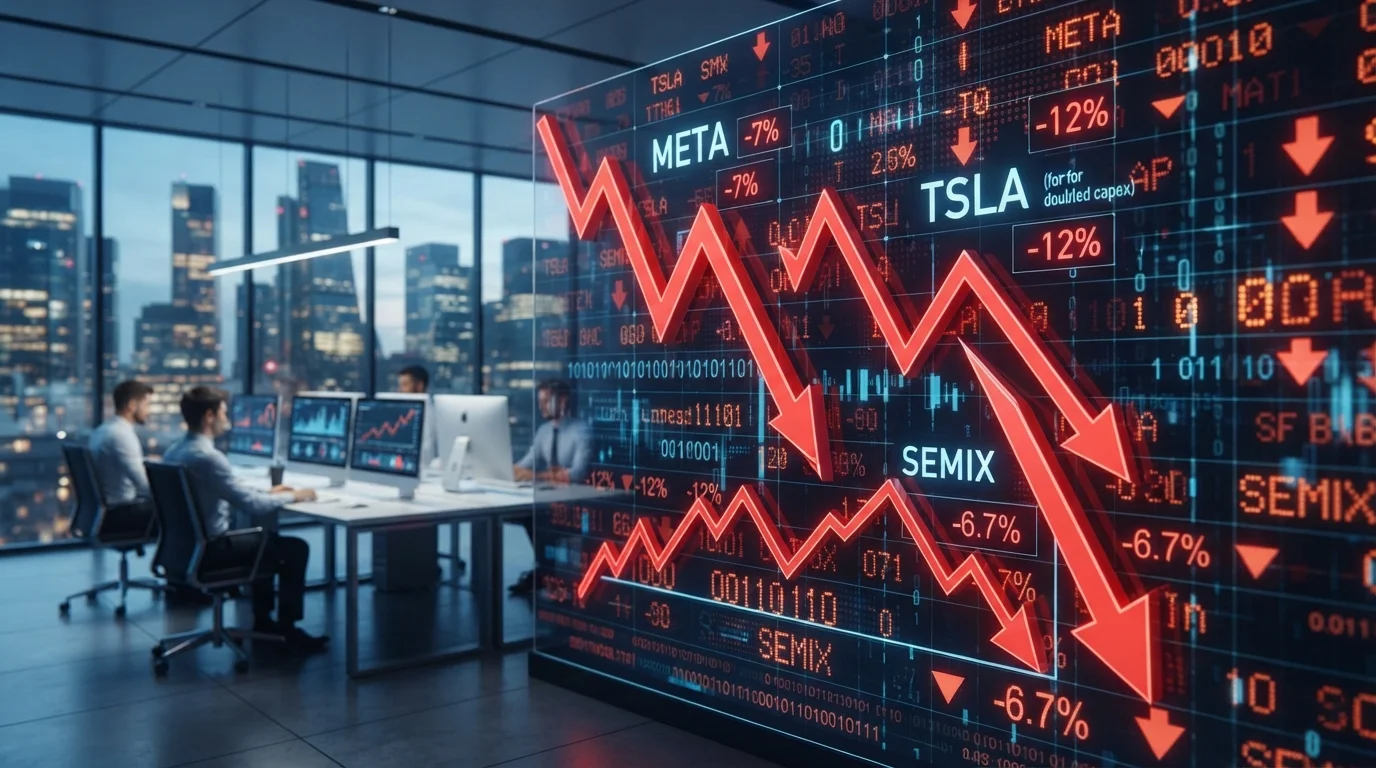
The technology sector experienced its most violent selloff since June 2026 as investors recoiled from the staggering costs of artificial intelligence infrastructure. On Thursday, October 22, the Nasdaq Composite plunged 2.6%, marking its largest single-day decline in four months, while the Philadelphia Semiconductor Index cratered 6.7%. The catalyst was not a sudden deterioration in economic fundamentals or an unexpected geopolitical shock, but rather a collective realization that the AI investment bonanza may be approaching a reckoning.
Meta Platforms led the decline with a brutal 6.98% drop to $648.85, as investors grappled with the implications of the company's aggressive AI capital expenditure plans alongside a controversial proposal to issue non-voting shares. Tesla followed closely behind, with shares sliding despite reporting third-quarter earnings that technically beat Wall Street expectations. The electric vehicle giant revealed that capital expenditures had more than doubled year-over-year to $3.73 billion, while operating income collapsed 56% as spending on AI, robotics, and the Optimus humanoid robot surged. The selling pressure radiated throughout the entire AI supply chain, with Advanced Micro Devices and Intel each shedding approximately 6-7% of their market value as the market questioned whether the returns on massive AI investments would materialize anytime soon.
For investors navigating this turbulent environment, the October selloff represents a critical inflection point. The narrative that has driven tech valuations to dizzying heights, that AI spending is always justified regardless of near-term profitability, is now facing its most serious challenge. As companies like Meta and Tesla double down on their AI ambitions while profitability metrics deteriorate, the market is demanding evidence that these massive investments will translate into sustainable revenue streams rather than becoming an endless drain on shareholder capital.
The AI Investment Bubble Faces Reality
For nearly three years, the dominant investment thesis in technology has been refreshingly simple: spend as much as possible on artificial intelligence infrastructure, and the profits will eventually follow. This logic has propelled Nvidia to a multi-trillion-dollar valuation, sent semiconductor stocks to record highs, and convinced investors to overlook ballooning capital expenditure at nearly every major technology company. However, the events of late October 2026 suggest that the market's patience with this narrative may finally be wearing thin.
The core problem confronting investors is a widening disconnect between the scale of AI spending and the tangible revenue it generates. Meta Platforms, for instance, has committed to enormous AI investments as part of its long-term vision, yet the direct monetization pathways remain uncertain. While the company has made impressive strides in integrating AI into its advertising systems, the incremental return on each additional dollar of AI capex is becoming increasingly difficult to justify. Similarly, Tesla's doubling of capital expenditures to $3.73 billion in the third quarter reflects massive bets on autonomous driving, robotics, and AI training infrastructure, areas that may not generate meaningful revenue for years.
The market's reaction reflects a growing awareness that the AI investment cycle may be following a familiar pattern seen in previous technology bubbles. During the dot-com era, enormous spending on fiber-optic networks eventually created value, but not before bankrupting many of the companies that laid the cables. The build-out of 4G wireless networks followed a similar trajectory, with massive capital deployment preceding the mobile application economy that ultimately monetized the infrastructure. In both cases, the winning strategy was not to indiscriminately invest in the infrastructure build-out, but to carefully evaluate which companies could translate that infrastructure into profitable business models. Today's AI spending spree may ultimately prove valuable, but the path from investment to profit is likely to be longer and more uncertain than the market has been willing to assume.
Meta's AI Gamble Triggers a $100 Billion Selloff
Meta Platforms has long been the most aggressive among mega-cap technology companies in its pursuit of artificial intelligence dominance, and investors have generally rewarded this ambition with a soaring stock price. That dynamic shifted dramatically on October 22, when Meta shares collapsed nearly 7% in a single session, wiping out approximately $100 billion in market value. The decline was particularly striking because it came despite analysts actually raising their price targets for the stock, suggesting that the selling was driven by broader concerns about the sustainability of AI spending rather than any specific disappointment in Meta's operational performance.
The immediate trigger for Meta's decline was the market's reaction to the company's escalating capital expenditure commitments combined with a controversial governance proposal. Meta has been investing tens of billions of dollars annually into AI infrastructure, including massive data centers, custom silicon development, and the training of increasingly large language models. While these investments have yielded tangible improvements in the company's advertising systems and user engagement metrics, the financial returns have not kept pace with the capital deployed. The company's Reality Labs division, which houses much of its metaverse and AI research spending, continues to burn through billions of dollars each quarter with limited near-term revenue prospects.
Compounding investor anxiety was Meta's proposal to issue non-voting shares, a move that would further concentrate control in the hands of CEO Mark Zuckerberg while diluting existing shareholders. This governance concern, layered on top of already stretched valuation metrics and mounting AI spending, created a perfect storm that drove the stock's worst single-day performance in months. The decline demonstrated that even companies with strong competitive positions and impressive technology can see their stock prices punished when the market begins to question the return on investment narrative that has supported their valuations.
For investors evaluating Meta at current levels, the fundamental question is whether the company's AI investments will eventually generate returns that justify the massive capital deployment. Meta's advertising business remains robust, with AI-powered targeting and content recommendation systems delivering measurable improvements in ad performance. However, the gap between the cost of these systems and their incremental revenue contribution appears to be widening, raising legitimate questions about whether the company has entered a phase of diminishing returns on its AI spending. Until Meta can demonstrate a clearer path from AI investment to profit growth, the stock may continue to face headwinds as the market recalibrates its expectations.
Tesla's Earnings Beat Fails to Mask AI Spending Alarm
Tesla's third-quarter 2026 earnings report presented a fascinating case study in how the market's priorities are shifting away from growth-at-all-costs toward a more discerning evaluation of capital efficiency. On the surface, Tesla delivered results that exceeded analyst expectations, with adjusted earnings of $0.48 per share on revenue of $28.05 billion. The stock's reaction, however, was decidedly negative, as investors focused on the staggering increase in capital expenditures and the collapse in operating profitability that accompanied the company's aggressive AI push.
The most alarming figure in Tesla's report was the 56% decline in operating income, which fell to just $718 million as research and development spending surged 69% to fund the company's AI, robotics, and autonomous driving initiatives. Capital expenditures more than doubled from the prior year to $3.73 billion, reflecting massive investments in AI training infrastructure, the Dojo supercomputer expansion, and development of the Optimus humanoid robot. Free cash flow, a critical metric for evaluating a company's financial health, plummeted 62% year-over-year to $1.53 billion, following a period in the second quarter when Tesla actually burned cash.
The market's reaction to these figures reflects a growing concern that Tesla may be overextending itself in its pursuit of AI dominance. While the company's long-term vision of fully autonomous vehicles and humanoid robots is compelling, the near-term financial burden of achieving these goals is becoming increasingly apparent. Management attempted to assuage investor concerns by cutting its full-year capex guidance from $25 billion to approximately $20 billion, but this revision did little to quell fears that Tesla's profitability is being sacrificed at the altar of AI ambition.
The Tesla situation is particularly notable because the company has historically been rewarded by investors for its willingness to invest aggressively in future technologies. For years, the market has given Tesla a pass on profitability metrics, focusing instead on the company's disruptive potential and massive addressable markets. The negative reaction to this earnings report suggests that the market's tolerance for cash-burning AI investments may be reaching its limits, particularly as interest rates remain elevated and alternative investment opportunities become more attractive. Tesla's challenge going forward will be to demonstrate that its AI investments can begin generating measurable returns before investor patience is fully exhausted.
Semiconductor Stocks Caught in the AI Spending Crossfire
The selling pressure in technology stocks was not confined to the mega-cap names that dominate headlines. The semiconductor sector, which has been the primary beneficiary of the AI infrastructure build-out, experienced some of the most severe declines as investors reassessed the sustainability of the AI investment cycle. The Philadelphia Semiconductor Index's 6.7% plunge reflected widespread selling across the entire chip ecosystem, from designers and equipment manufacturers to memory suppliers and foundries.
Advanced Micro Devices and Intel were among the hardest hit, with each stock declining approximately 6-7% during the selloff. For AMD, the decline was particularly notable given that the company had recently received a bullish upgrade from Goldman Sachs and has been gaining market share in both data center CPUs and AI accelerators. The stock's drop suggested that even companies with strong competitive momentum and improving fundamentals are not immune to sector-wide concerns about the AI spending cycle. AMD is scheduled to report its third-quarter results on November 3, and the market's reaction to that report will likely provide important clues about whether the current selloff represents a temporary correction or the beginning of a more prolonged downturn.
Intel's struggles predate the current AI spending concerns, but the recent decline added to the company's ongoing challenges. The chip giant is scheduled to report its third-quarter results on October 29, with analysts expecting earnings of $0.40 per share on revenue of $16.50 billion. Intel's turnaround efforts under CEO Pat Gelsinger have been hampered by repeated delays in bringing new manufacturing processes online, and the company has been losing market share to AMD in both the data center and PC markets. The broader concerns about AI spending sustainability add another layer of uncertainty to Intel's already complicated turnaround story.
The semiconductor sector's vulnerability to shifts in AI spending sentiment reflects the concentration of demand that has developed over the past several years. Nvidia's data center revenue, which has driven the company's extraordinary valuation, depends on continued massive spending by cloud providers and enterprises on AI training and inference infrastructure. If companies like Meta and Tesla begin to scale back their AI investments in response to profitability concerns, the ripple effects throughout the semiconductor supply chain could be significant. The current selloff may be an early warning sign that the AI infrastructure build-out is entering a more mature phase, where demand growth moderates and competition intensifies.
Bond Market Signals Deepening Concerns About Tech Valuations
While equity markets captured headlines with their dramatic declines, the fixed income market was sending its own signals about the changing risk environment for technology investments. Treasury yields fell across the curve in the wake of the tech selloff, with longer-term rates dropping more than short-term rates in a pattern known as bull steepening. This dynamic reflected a flight-to-safety as investors rotated out of volatile technology stocks and into the relative stability of government bonds.
The bond market's reaction is particularly significant given the current interest rate environment. The Federal Reserve raised its target range for the federal funds rate to 3.75%-4.00% in September 2026, marking the first rate hike since 2023, as policymakers expressed concerns about persistent inflation. In this higher-rate environment, the discounted cash flow models that underpin technology valuations become increasingly sensitive to assumptions about future growth and profitability. When investors begin to question whether massive AI investments will generate adequate returns, the present value of those future cash flows declines sharply, putting downward pressure on stock prices.
Nuveen's fixed income team forecasts the 10-year Treasury yield reaching 4.95% by year-end 2026 and 4.75% by the end of 2027, with the 2-year yield at 4.70% and 4.50% respectively. These elevated yield levels create meaningful competition for capital, as investors can now earn attractive returns in fixed income without taking on the volatility and uncertainty associated with technology stocks. The relative attractiveness of bonds versus tech equities may be contributing to the rotation out of the sector, particularly as the AI growth narrative shows signs of fraying.
For technology investors, the bond market's message is clear: the era of zero interest rates that justified extreme valuations for growth stocks is definitively over. In the current environment, companies must demonstrate tangible profitability and capital efficiency to justify premium valuations. The market's harsh reaction to AI spending at Meta and Tesla suggests that investors are no longer willing to fund open-ended technology investments without clear pathways to returns. As long as Treasury yields remain elevated, technology stocks will face a higher bar for justifying their valuations, and companies that fail to meet this standard may continue to experience downward pressure on their share prices.
What the October Tech Selloff Means for Investors
The October 2026 tech selloff represents more than just a routine market correction. It signals a potential shift in the dominant investment narrative that has driven technology stocks for the past several years. The idea that AI spending is inherently virtuous, regardless of near-term profitability, is being challenged by a market that is increasingly focused on capital discipline and measurable returns. This shift has important implications for how investors should approach the technology sector in the months ahead.
For investors with existing positions in AI-sensitive stocks, the current environment demands a careful reassessment of portfolio allocations. Companies that have been the biggest beneficiaries of the AI spending boom, including the mega-cap technology names and semiconductor leaders, may face continued volatility as the market digests the implications of slower AI investment growth. Diversification beyond the most AI-exposed names may be prudent, particularly for investors with concentrated positions in the technology sector.
The selloff also creates potential opportunities for disciplined investors willing to look through the near-term noise. Not all AI spending is wasteful, and companies that can demonstrate clear pathways from investment to revenue generation may ultimately emerge stronger from the current correction. The key is distinguishing between companies that are investing in AI with specific, measurable business objectives and those that are pursuing AI as a vague strategic imperative without clear financial goals.
For traders seeking to navigate this volatile environment, having access to real-time market data and sophisticated analysis tools is essential. Consider using Alphio AI's copy trading feature to mirror successful traders and smart money wallets, gaining exposure to strategies that have proven effective during market corrections.

Alternatively, explore agentic trading to automate your portfolio management with AI-powered strategies that can adapt to rapidly changing market conditions.

Navigating the New Reality of Tech Investing
As the dust settles from October's dramatic tech selloff, investors are confronting a new reality in which AI spending must be justified by tangible returns rather than vague promises of future disruption. This more discerning environment is likely to persist as long as interest rates remain elevated and capital has attractive alternative destinations. Companies that can adapt to this new paradigm by demonstrating capital efficiency and clear paths to profitability will likely be rewarded, while those that continue to burn cash in pursuit of speculative AI visions may face ongoing pressure.
The market's reaction to Meta and Tesla's earnings provides a template for how investors should evaluate technology companies going forward. Rather than focusing solely on revenue growth or technological ambition, the market is increasingly looking at metrics like return on invested capital, free cash flow generation, and the incremental profitability of new initiatives. Companies that can show positive trends in these areas, even while investing in AI, are likely to outperform those where AI spending is diluting overall profitability without clear strategic benefits.
The semiconductor sector's sharp decline also serves as a reminder of the risks associated with concentrated demand drivers. When a single investment theme, such as AI infrastructure build-out, drives a disproportionate share of demand growth for an entire industry, any questioning of that theme can trigger widespread selling. Investors in chip stocks should be particularly attentive to signals about AI capital expenditure trends from major customers like cloud providers and hyperscalers, as these will likely be the leading indicators of sector health.
Conclusion
The October 2026 tech selloff marks a potential inflection point in the artificial intelligence investment cycle. After years of unchecked enthusiasm for AI spending, the market is demanding evidence that massive capital deployments will generate adequate returns. Meta's 7% plunge, Tesla's sharp decline despite an earnings beat, and the semiconductor sector's 6.7% collapse all reflect a market that is recalibrating its expectations for the AI trade.
For investors, the key takeaway is that the easy gains from indiscriminate AI exposure are likely behind us. The next phase of AI investing will require greater selectivity, focusing on companies that can translate their AI investments into measurable business outcomes and sustainable profitability. In a higher interest rate environment where capital has alternative uses, companies that burn cash in pursuit of speculative AI visions will face increasing skepticism from investors.
The technology sector remains home to some of the most innovative and fastest-growing companies in the world, and artificial intelligence will undoubtedly play a transformative role in the economy for decades to come. However, the path from AI investment to AI profit is proving longer and more uncertain than many investors assumed. Navigating this transition successfully will require discipline, careful analysis, and a willingness to look beyond the hype to evaluate the fundamental economics of AI spending.
For investors looking to stay ahead of these market shifts, Alphio AI's scheduled automations can help you set conditional workflows to react to market movements in real-time.

Additionally, Alphio's conversational trading interface allows you to execute trades via natural language chat, making it easier to act on your investment decisions quickly and intuitively.

Stay informed, stay disciplined, and remember that in volatile markets, the investors who thrive are those who combine conviction with careful risk management.
FAQs
Why did tech stocks crash in October 2026?
Tech stocks crashed due to growing investor concerns about the sustainability of massive AI spending. Meta dropped nearly 7% on AI capex worries, Tesla fell despite beating earnings as its operating income collapsed 56%, and the Philadelphia Semiconductor Index plunged 6.7% as the market questioned whether AI investments would generate adequate returns.
How much did Tesla spend on AI in Q3 2026?
Tesla's capital expenditures more than doubled year-over-year to $3.73 billion in Q3 2026, while research and development spending surged 69%. The company cut its full-year capex guidance from $25 billion to approximately $20 billion, but operating income still fell 56% to $718 million as AI and robotics spending climbed.
Is the AI investment bubble bursting?
While it's too early to declare the AI bubble burst, October 2026 marked a significant shift in market sentiment. Investors are increasingly demanding evidence that massive AI investments will generate returns, rather than accepting the narrative that AI spending is inherently virtuous. Companies that can demonstrate clear paths from AI investment to profitability will likely fare better than those burning cash without measurable outcomes.
Which semiconductor stocks were hit hardest?
Advanced Micro Devices and Intel were among the hardest hit, each declining approximately 6-7% during the selloff. The Philadelphia Semiconductor Index fell 6.7% overall, reflecting widespread concerns that a slowdown in AI infrastructure spending by major tech companies could reduce demand throughout the chip supply chain.
What should investors do during the tech selloff?
Investors should reassess their AI exposure and focus on companies demonstrating capital efficiency and clear paths to profitability. Diversification beyond the most AI-concentrated names may be prudent. The selloff also creates opportunities for disciplined investors to acquire quality companies at discounted valuations, provided they can distinguish between wasteful AI spending and productive AI investments.
Related articles
- Stock Market Surges After 2026 Midterms: What the Democratic Sweep Means for Your PortfolioThe stock market rallied after Democrats won the 2026 midterms. Discover what the election means for investors, tech stocks, and the S&P 500 outlook.
- Stock Market Surges After 2026 Midterms: What the Democratic Sweep Means for Your PortfolioThe stock market rallied after Democrats won the 2026 midterms. Discover what the election means for investors, tech stocks, and the S&P 500 outlook.
- Oil Prices Surge Above $105 Amid US-Iran Conflict: Energy Investment Opportunities in November 2026Oil prices climb past $105 as US strikes Iran's Qeshm Island. Discover energy investment opportunities, top oil stocks, and market outlook for November 2026.
- Super Micro Computer (SMCI) Stock Analysis: AI Server Boom AcceleratesSuper Micro Computer stock analysis for August 2026. SMCI's blowout FY2027 guidance of $65-72B revenue crushes estimates. Is this AI server leader a buy?
- Tesla Robotaxi Hits 380K Unsupervised Miles: TSLA Stock Analysis for August 2026Tesla's Robotaxi hits 380K unsupervised miles across 7 US markets. Analyze TSLA stock outlook as Cybercab production ramps and FSD revenue potential unfolds.
- Nvidia Earnings August 2026 Preview: What to Expect from the AI Chip Leader's Q2 ReportNvidia reports Q2 FY27 earnings on August 26, 2026. Get expert analysis on revenue forecasts, Blackwell ramp, AI demand trends, and investment outlook for NVDA stock.