

Defensive Stocks in 2026: Is the Rush Into Staples and Healthcare Already Overcrowded?
Investors are piling into defensive stocks as tech slides. See why staples and healthcare surged, why valuations look stretched, and how to avoid overpaying.

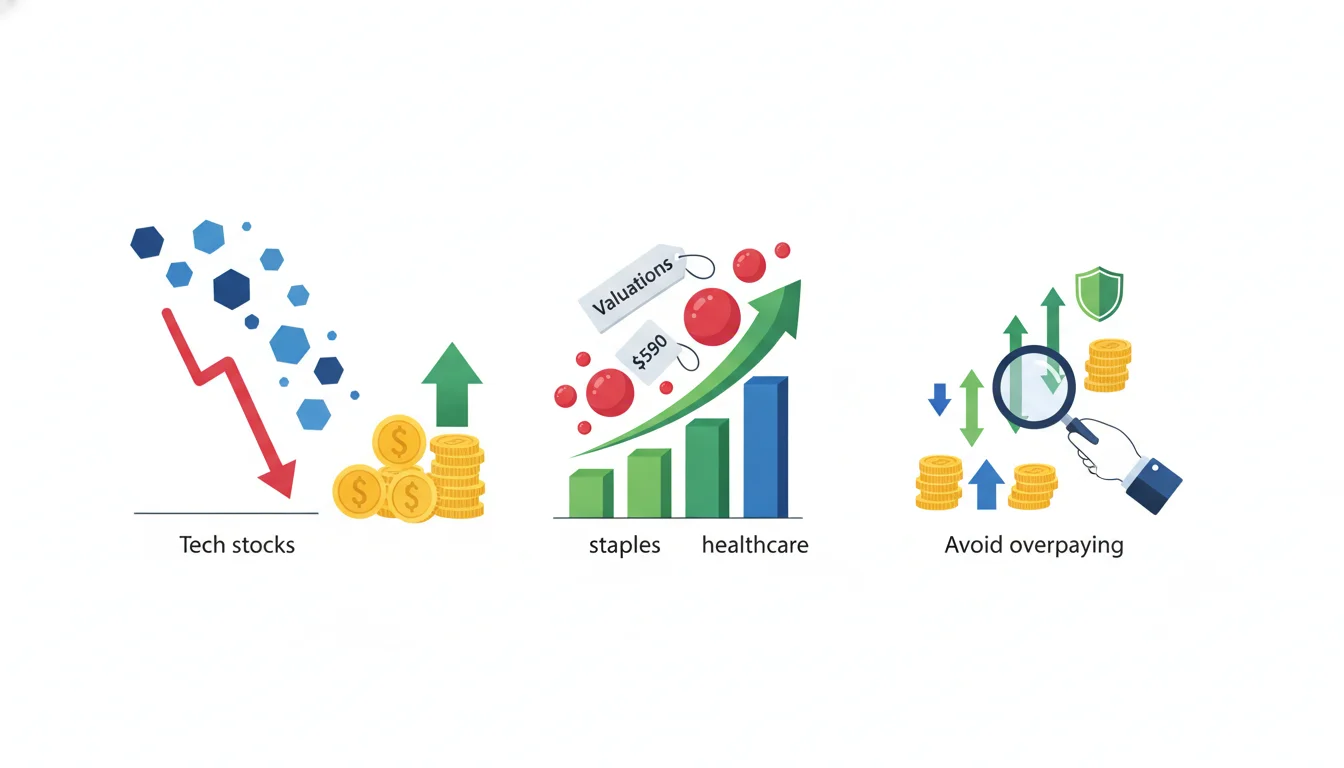
Key Takeaway
Defensive stocks have become the most crowded refuge on Wall Street this autumn. As doubts about AI spending, a hawkish Federal Reserve and a messy post-midterm political backdrop knocked technology shares off their highs, investors poured money into consumer staples, healthcare and utilities. According to a November 11 CNBC report, the MSCI US information technology index was down 11.5% since October, while MSCI's consumer staples, healthcare and utilities indexes had all risen significantly over the prior month. Commentary from deVere Group CEO Nigel Green, published the same day, put global consumer staples up 10.6% in October, their best month since 1998, with global healthcare up 9.8%.
The problem is that safety now has a price tag. Green's commentary noted that consumer staples trade on roughly 23.8 times forward earnings, the richest level since 1998, versus below 21 times a year earlier. HSBC, cited by CNBC, highlighted the inversion in stark terms: Walmart at about 40 times forward earnings near a record high, and Nvidia at about 13 times near a record low. When the "boring" corner of the market costs more than the growth leaders, the old rule that defensive stocks protect you on the way down deserves a closer look.
This guide explains what makes a stock defensive, why the rotation happened so quickly, how to tell genuine resilience from expensive comfort, and how to build a defensive sleeve that does its job without becoming the next crowded trade. It is educational, not a recommendation to buy or sell any security, and every figure carries a source and an as-of date so you can check whether conditions have changed.
What Makes a Stock Defensive
Demand that does not wait for a good economy
A defensive stock is one whose revenue and earnings hold up relatively well when the economy slows. The classic examples sit in three sectors. Consumer staples companies sell toothpaste, detergent, packaged food and groceries, things households keep buying in a recession. Healthcare companies sell medicines, devices and services that people need regardless of the business cycle. Utilities deliver electricity, gas and water under regulated pricing frameworks. What unites them is demand that is less discretionary, so sales tend to wobble rather than collapse when consumers tighten their belts.
That stability usually shows up in a lower beta, meaning the stock historically moves less than the overall market. A low-beta stock is not a stock that cannot fall; it is a stock that has tended to fall less in broad selloffs and to rise less in strong rallies. Investors who buy defensives are effectively trading some upside for a smoother ride, and understanding that trade-off is the starting point for using the category well.
Dividends, balance sheets and pricing power
Most defensive companies are mature businesses that return a large share of their cash to shareholders, which is why the category overlaps heavily with dividend investing. Steady dividends help cushion total returns when prices stall, and a long record of raising payouts can signal management confidence in the cash flow behind them. Strong balance sheets matter too, because a company that does not need to refinance in a hostile credit market has one less way to get hurt.
Pricing power is the quieter ingredient. A staples brand that can pass along higher input costs without losing customers protects its margins during inflation, while a weaker brand gets squeezed between rising costs and shoppers trading down to private labels. That distinction is especially relevant now, with October consumer prices running hotter than expected, and it is one of the main reasons that two companies in the same "defensive" sector can deliver very different results.
The evidence from 2022
The clearest recent test came in 2022, when the Fed raised rates aggressively and the S&P 500 lost about 18% on a total-return basis. According to S&P Dow Jones Indices sector data, consumer staples finished that year down less than 1%, healthcare fell about 2% and utilities eked out a small gain, while technology, communication services and consumer discretionary each lost more than a quarter of their value. That is the textbook case for defensives: they did not make investors rich, but they dramatically reduced the damage in a brutal year.
The caveat is that 2022 started with defensives at reasonable valuations. The protection they offered came partly from their businesses and partly from the fact that investors had not already bid them up. Whether they can repeat that performance from today's starting multiples is the central question for 2026.
Why the Rotation Accelerated in November 2026
AI spending fears hit the market's leaders
The trigger for this year's rotation was a loss of confidence in the AI trade that had powered markets for most of 2026. According to the CNBC report, technology was the strongest of AJ Bell's eleven "super-sectors" in the first half of the year, rising 28.4%, before becoming the worst performer in the second half with a decline of more than 11%. AJ Bell investment director Russ Mould summed up the reversal by saying IT had "gone from penthouse to outhouse." Concerns about the scale of AI capital expenditure, how it is financed and whether the returns will arrive on time sat at the center of the selloff.
Then came a fresh shock. On November 12, Nvidia announced that Jensen Huang was stepping down as CEO, with CFO Colette Kress named interim chief executive. Nvidia shares fell as much as 14% early in the session before paring the loss to about 4.3%, and the major indexes each closed around 0.4% lower, according to market wrap-ups from the Washington Post and Yahoo Finance. For investors already nervous about tech leadership, it was another reason to look for shelter.
Rates, inflation and the Fed backdrop
Macro data gave little comfort. The Bureau of Labor Statistics reported on November 10 that the consumer price index rose 0.4% in October, above the 0.3% consensus, while core prices rose 0.3% against expectations of 0.2%. The Federal Reserve raised its target range to 3.75%–4% in September and held there on October 28, with two governors dissenting in favor of another hike. Bond market reports in early November described futures markets as leaning toward a December hike, and Treasury yields climbed back toward 5% on the 10-year note this week.
A hawkish Fed is a double-edged sword for defensives. Slower growth and tighter financial conditions make dependable earnings more valuable, which supports the rotation. But higher bond yields also compete directly with dividend stocks for income-seeking money, which historically weighs on utilities and high-yield staples. That tension is part of why the defensive trade can be more fragile than it looks.
Politics added another layer of uncertainty
CNBC also reported that the Democrats' sweep of Congress in the November 3 midterms "amplified pressure" on technology shares the following week. Policy uncertainty tends to push investors toward businesses whose demand does not depend on regulation, subsidies or capital-spending cycles. The combination of a political transition, sticky inflation and a wobbling growth trade created close to ideal conditions for a rush into staples and healthcare.
The Valuation Problem: When Safety Gets Expensive
Staples at the richest multiple since 1998
Paying more for stability is reasonable up to a point. The issue in late 2026 is how far that point has been pushed. Nigel Green's figure of roughly 23.8 times forward earnings for consumer staples compares with a multiple below 21 times a year earlier, and his commentary noted that staples earnings have grown less than 5% a year over the past decade while their dividend yields are among the lowest since 2005. In plain terms, investors are paying a growth-stock multiple for low-growth businesses with shrinking income appeal.
HSBC's comparison makes the point vividly. A big-box retailer at around 40 times forward earnings is priced like a high-growth company, while the leading AI chipmaker at around 13 times is priced as if its growth will fade sharply. Both prices could prove correct, but they are a reminder that "defensive" describes the business, not the stock price.
What crowding means for downside protection
Defensive stocks protect portfolios partly because they are usually under-owned when trouble starts. When everyone has already moved into them, that cushion shrinks. Green warned that the trade "could unwind sharply" once sentiment on technology steadies, and argued that the next shock could come from the place investors consider bulletproof. HSBC strategist Alastair Pinder, quoted by CNBC, called the recent moves "vicious, and in our view, overdone."
There is already evidence of how fast leadership can flip. On November 9, a sharp one-day rebound saw technology outperform staples by a wide margin, according to the deVere commentary. Investors who rotated late into defensives can find themselves holding expensive stocks just as the market reaches back for growth.
Healthcare tells a different valuation story
Not every defensive sector carries the same valuation risk. Healthcare's October surge was driven by many of the same fears, but the sector spans everything from large pharmaceutical companies to insurers, device makers and tools suppliers, each with very different sensitivities. That diversity makes healthcare a better hunting ground for selective investors than an all-or-nothing sector bet.
How to Evaluate a Defensive Stock Today
Start with earnings durability, not the sector label
The most useful question is not whether a company sits in a defensive sector but whether its earnings would survive a recession. Look at how revenue, operating margins and earnings per share behaved in 2020 and 2022. Check whether the company has kept growing volumes or has relied mostly on price increases, which can stall once inflation cools or shoppers push back. Durable defensives usually show modest but steady volume growth, consistent margins and free cash flow that comfortably covers the dividend.
Compare the multiple with the company's own history
Because the whole category has re-rated, comparing a staples stock with the broader market can be misleading. A more useful test is to compare its current forward price-to-earnings ratio with its own five- and ten-year averages, then ask whether anything about the business has improved enough to justify the gap. A household-products leader such as Procter & Gamble is a good illustration of how investors can track that relationship over time.
If the multiple is well above its long-run range while growth expectations are unchanged, future returns depend on the market staying willing to pay that premium. That is a much weaker foundation than earnings growth.
Check dividend safety and balance-sheet strength
A defensive stock's dividend should be covered by free cash flow with room to spare. Payout ratios persistently above 80% of earnings, rising debt used to fund buybacks, or a dividend that has stopped growing are all warning signs. In a higher-rate world, also check the maturity schedule of the company's debt. A business that must refinance cheap bonds at today's yields could see interest costs eat into the cash available for shareholders, and that risk often goes unnoticed until it shows up in earnings guidance.
Building a Defensive Sleeve Without Overpaying
Decide what the defensive sleeve is for
Before buying anything, define the job. For some investors, defensive stocks exist to reduce portfolio volatility; for others, they provide income or a place to wait out uncertainty. Each goal suggests a different approach. Volatility reduction argues for a diversified basket of low-beta names or sector funds. Income argues for proven dividend growers with covered payouts. A short-term hedge might be better served by cash, Treasury bills or explicit hedges than by expensive equities that can still fall.
Use rules instead of headlines
Rotations driven by fear tend to overshoot in both directions, so the most practical defense is a set of rules written in advance. Many investors use a target allocation, for example a fixed percentage of the equity portfolio in defensive sectors, and rebalance back to it when the weight drifts. Others add positions in tranches over several weeks rather than all at once. A simple checklist helps keep emotions out of the decision:
- Confirm forward P/E versus the stock's own ten-year average before adding.
- Require free-cash-flow dividend coverage of at least 1.2 times.
- Cap any single defensive sector at a preset share of equities.
- Review positions after each Fed meeting and CPI release.
- Rebalance when a sector drifts more than five percentage points from target.
Routine reviews like these are exactly the kind of work that can be automated. With Alphio's Scheduled Task feature, you can set recurring checks that summarize sector moves, valuation changes or upcoming macro events on a timetable you choose, so rebalancing decisions follow your plan rather than the day's headlines.

Sector-by-Sector Playbook
Consumer staples: favor pricing power and volume growth
Within staples, the strongest candidates usually combine leading brands with evidence that customers are still buying more, not just paying more. Retailers with scale advantages and growing membership or loyalty programs can also qualify, although some now trade at multiples that leave little room for error. Investors tracking how analysts view large staples retailers can monitor consensus changes on a name like Walmart, whose valuation has become a reference point for the entire rotation.
Smaller packaged-food companies facing private-label competition, high debt or shrinking volumes tend to be weaker defensives. Their low multiples can look tempting, but cheap is not the same as safe.
Healthcare: diversify across sub-industries
Healthcare is better approached as several businesses than as one. Large diversified pharmaceutical companies often offer dividends and pipelines that are less tied to the economic cycle, while managed-care insurers carry policy and medical-cost risks, and device and tools companies can be more cyclical than many investors expect. A diversified healthcare company such as Johnson & Johnson illustrates how investors weigh pipeline, litigation and dividend durability against valuation.
Patent expirations, drug-pricing policy and regulatory decisions can move individual stocks sharply, so position sizing matters even in a "safe" sector.
Utilities: the rate-sensitive defensive
Utilities remain defensive in their demand profile, and AI-driven electricity demand has given parts of the sector a growth story. But they are also among the most interest-rate-sensitive equities, because they borrow heavily to fund capital spending and compete with bonds for income investors. With the Fed in hiking mode and the 10-year yield near 5%, utilities may offer less downside protection than staples or healthcare if rates keep climbing.
Risks That Could Break the Defensive Trade
A tech rebound and a sharp reversal
The most immediate risk is that the rotation simply reverses. If AI earnings hold up, valuations in semiconductors and software look attractive after a large de-rating, and the leadership questions at major companies are resolved, money could flow back into growth as quickly as it left. In that scenario, expensive defensives could lag badly or fall even as the overall market rises, which is the opposite of what many recent buyers expect.
Higher yields and slower growth at the same time
A second risk is a mix of persistent inflation and slowing growth. Staples companies facing higher input costs may struggle to raise prices further without losing volume, while higher yields would pressure the multiples investors are willing to pay for dividend stocks. In that environment, defensive equities might still beat the market but deliver disappointing absolute returns, especially from today's valuations.
Conversational research to stress-test your thesis
Because the risks are scenario-driven, it helps to test a holding against several possible outcomes before committing capital. Alphio's Conversational Trading lets you ask plain-English questions about a stock or sector, such as how a company performed in past rate cycles or how its valuation compares with history, and turn the answers into a disciplined plan rather than a reaction to the latest headline.

What to Watch Next
The December Fed meeting and November CPI
The Fed's December meeting is the next major catalyst for both growth and defensive stocks, and the November CPI report is scheduled for release on December 10. A hike accompanied by hawkish guidance could support the argument for stable earnings while pressuring rate-sensitive income stocks. A pause or softer inflation data could revive appetite for growth and test the defensive trade.
Earnings guidance from staples and healthcare leaders
Upcoming earnings reports and investor days from large staples and healthcare companies will show whether their fundamentals justify the new valuations. Watch volume trends, margin guidance and any commentary about consumers trading down. If guidance holds steady while multiples sit near multi-decade highs, the stocks may stall; if guidance improves, the premium becomes easier to defend.
Conclusion
Defensive stocks earned their reputation in years like 2022, when consumer staples, healthcare and utilities shielded investors from the worst of a bear market. In November 2026 that reputation has drawn a stampede: staples hit their best month since 1998 in October and now trade near their richest valuations in more than two decades, while parts of the technology sector trade at multiples that looked unthinkable a year ago. The businesses are still defensive. The stocks, at these prices, carry more risk than their label suggests.
The practical answer is selectivity and discipline rather than an all-in rotation. Focus on companies with durable earnings, covered dividends and valuations that are reasonable relative to their own history; diversify within healthcare; treat utilities as a rate-sensitive position; and rebalance by rule. If you want to see how experienced investors are positioning through this rotation, Alphio's Copy Trade lets you follow strategies transparently, and Autonomous Trading can help execute a rules-based plan consistently, so your defensive sleeve stays a stabilizer instead of becoming the next crowded bet.
FAQs
What are defensive stocks?
Defensive stocks are shares of companies whose earnings tend to hold up during economic slowdowns, typically in consumer staples, healthcare and utilities. They usually have lower volatility than the overall market and often pay steady dividends.
Why are investors rotating into defensive stocks in November 2026?
Doubts about AI spending, a hotter-than-expected October CPI report, the prospect of another Fed rate hike and post-midterm political uncertainty pushed investors out of technology. CNBC reported that the MSCI US IT index fell 11.5% since October while staples, healthcare and utilities indexes rose.
Are consumer staples stocks overvalued right now?
By historical standards they are expensive: deVere Group CEO Nigel Green put the sector at about 23.8 times forward earnings in November 2026, the richest level since 1998. That does not guarantee a decline, but it reduces the margin of safety that usually makes staples defensive.
Do defensive stocks always fall less in a bear market?
Not always. They held up well in 2022, when staples and healthcare lost only about 1% to 2% while the S&P 500 fell about 18%, but crowded positioning and high valuations can weaken that protection. Rising bond yields can also hurt rate-sensitive defensives such as utilities.
How can I add defensive exposure without overpaying?
Compare each stock's forward P/E with its own long-term average, confirm that free cash flow covers the dividend, and build positions gradually under a target allocation. Diversifying across staples, healthcare sub-industries and quality cyclicals reduces the risk of a sharp reversal.
Related articles
- International Stocks vs US Stocks in 2026: How the Strong Dollar and Valuations Change the CaseInternational stocks vs US stocks in 2026: how the strong dollar, valuation gaps, Fed hikes and concentration risk shape a smarter global allocation plan now.
- Defense Stocks in 2026: How Midterms, the Iran War and a Stalled Budget Shape the OutlookDefense stocks fell after the 2026 midterms. Learn how the Iran war, the $1.5T budget request and the December 11 funding deadline shape the sector outlook.
- When a CEO Resigns: What Nvidia's Leadership Shock Teaches Investors About Key-Person RiskWhat happens to a stock price when a CEO resigns? Lessons from Nvidia, Apple and Starbucks, the research on key-person risk, and a checklist for investors.
- AMD Stock Analysis August 2026: Can MI350 GPU Power the Path to $600?Comprehensive AMD stock analysis for August 2026. Explore MI350 GPU potential, AI chip competition with Nvidia, earnings outlook, and investment thesis for the $600 price target.
- Nvidia Stock Earnings August 2026: AI Chip Leader's Q2 Performance and Future OutlookNvidia stock analysis ahead of August 26 earnings. Explore AI chip demand, Blackwell systems adoption, and price targets. Expert forecast for NVDA investors.
- AMD Stock Analysis August 2026: Data Center Revenue Doubles as AI Chip Wars IntensifyComprehensive AMD stock analysis for August 2026. Explore data center revenue doubling, AI chip market position, and investment outlook. Expert insights on AMD vs NVIDIA competition.