

AMD Stock Analysis August 2026: Data Center Revenue Doubles as AI Chip Wars Intensify
Comprehensive AMD stock analysis for August 2026. Explore data center revenue doubling, AI chip market position, and investment outlook. Expert insights on AMD vs NVIDIA competition.

Key Takeaway
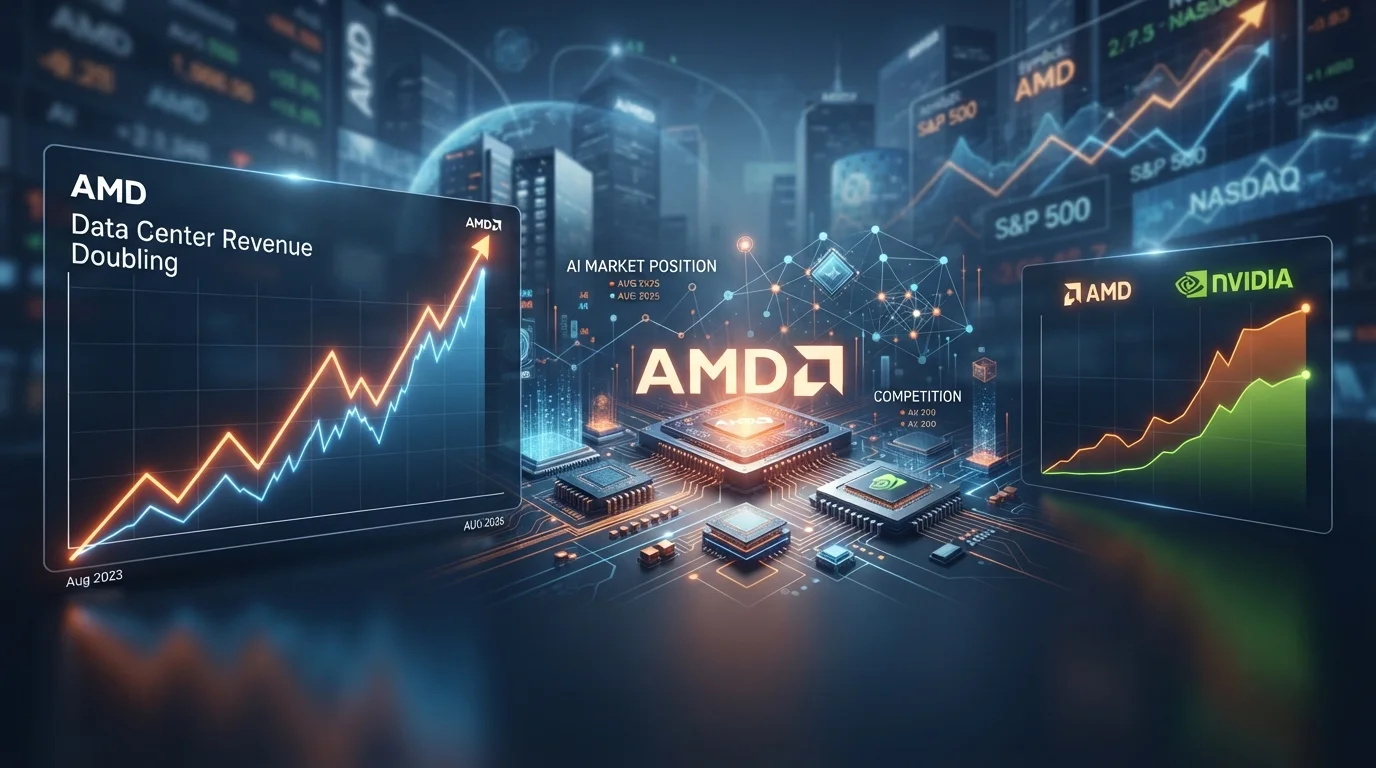
Advanced Micro Devices (AMD) has emerged as one of the most compelling investment stories in the semiconductor sector during 2026, with its stock delivering approximately 66% year-to-date returns as of August. The company's strategic pivot toward AI data center solutions has translated into record financial performance, with Q2 2026 revenue reaching $11.5 billion, representing a remarkable 50% year-over-year increase. The standout figure was data center revenue more than doubling to $6.7 billion, now accounting for over half of total company revenue.
Despite these impressive results, AMD's stock has experienced significant volatility following earnings announcements, initially surging on strong numbers before pulling back as investors digested forward guidance. This reaction highlights the market's sky-high expectations for AI chip companies and the challenge of sustaining growth momentum in an increasingly competitive landscape. CEO Lisa Su's projection that data center sales will double again in 2027 demonstrates management's confidence in the company's AI strategy, though investors remain focused on execution risks and margin pressures from rising capital expenditures.
For investors evaluating AMD's investment thesis, the company represents a unique opportunity to gain exposure to the AI infrastructure buildout while benefiting from its established position in the server CPU market. The combination of EPYC processors and Instinct AI accelerators creates a compelling product portfolio that addresses both traditional cloud computing workloads and emerging AI training and inference demands.
AMD's Record-Breaking Q2 2026 Performance
AMD's second-quarter earnings report delivered results that would have been considered exceptional in any other era, yet the market's reaction illustrated how dramatically expectations have shifted for AI chip companies. Total revenue of $11.536 billion represented a 50% increase from the prior year period, with every major business segment contributing to growth. The data center segment's performance was particularly noteworthy, with revenue surging 107% year-over-year to reach $6.7 billion.
This milestone marks the first time that data center revenue has exceeded 50% of AMD's total business, signaling a fundamental transformation in the company's revenue mix. The client segment, which includes Ryzen processors for PCs and laptops, contributed $3.1 billion in revenue, also beating analyst expectations and suggesting a recovery in the PC market. Gaming revenue, while smaller at $1.5 billion, remained stable despite the cyclical nature of console demand.
The company's gross margin expanded to 52%, reflecting the favorable product mix shift toward higher-margin data center products. Operating income increased substantially, demonstrating AMD's ability to scale profitably while investing heavily in research and development. These financial metrics validate the strategic decisions made by CEO Lisa Su and her management team to prioritize data center and AI opportunities over the past several years.
The AI Chip Market Opportunity
The artificial intelligence infrastructure market has become the primary battleground for semiconductor companies, with total addressable market estimates ranging from $300 billion to $500 billion by 2030. AMD has positioned itself to capture a meaningful share of this opportunity through its Instinct line of AI accelerators, which compete directly with NVIDIA's dominant H100 and upcoming Blackwell platforms.
The competitive dynamics in the AI chip market have evolved significantly during 2026. While NVIDIA maintains a dominant market share estimated at 70-80%, AMD has made meaningful inroads with major cloud providers and enterprise customers seeking to diversify their AI infrastructure suppliers. The company's MI300X accelerator has gained traction for inference workloads, where its memory bandwidth advantages provide competitive performance characteristics.
Hyperscalers including Microsoft, Amazon, and Google have all announced deployments of AMD Instinct accelerators in their cloud platforms, validating the technology's capabilities. These design wins represent multi-year revenue opportunities as cloud providers expand their AI infrastructure capacity to meet growing demand from enterprise customers developing custom AI models and applications.
For investors seeking exposure to the AI infrastructure buildout, consider using Alphio AI's copy trading feature to mirror successful traders and smart money wallets who are positioning for the semiconductor cycle.

AMD vs NVIDIA: The Competitive Landscape
The rivalry between AMD and NVIDIA has intensified dramatically as both companies compete for dominance in the AI accelerator market. While NVIDIA's CUDA software ecosystem and comprehensive platform approach have created significant switching costs for customers, AMD has focused on delivering competitive hardware performance at attractive price points while building out its ROCm software platform.
NVIDIA's upcoming earnings report on August 26, 2026, will provide important context for evaluating AMD's competitive position. Wall Street expects NVIDIA to report approximately $91.8 billion in quarterly revenue, with the company's data center business continuing to drive the majority of growth. The comparison between the two companies' guidance and commentary on AI demand trends will be closely watched by investors.
AMD's stock performance in 2026 has actually outpaced NVIDIA's, with AMD shares up approximately 66% year-to-date compared to NVIDIA's more modest single-digit gains. This divergence reflects investor recognition that AMD is earlier in its AI growth cycle and may have more room for multiple expansion as the company proves its ability to capture market share.
The competitive threat from custom silicon developed by cloud hyperscalers represents a longer-term consideration for both companies. Amazon's Trainium and Inferentia chips, Google's TPUs, and Microsoft's Maia processors could eventually capture meaningful share of the AI accelerator market, particularly for internal workloads. However, the complexity of AI chip design and the need for broad software ecosystem support suggest that general-purpose AI accelerators from AMD and NVIDIA will remain dominant for the foreseeable future.
Data Center Revenue Growth Drivers
AMD's data center business has benefited from multiple growth drivers that extend beyond the AI accelerator opportunity. The company's EPYC server processors have continued to gain market share from Intel, with AMD now commanding an estimated 25-30% of the server CPU market compared to single-digit share just five years ago.
The generational transition to EPYC Turin processors, built on TSMC's advanced 3nm process technology, has strengthened AMD's competitive position in the enterprise server market. These processors offer industry-leading core counts and performance-per-watt metrics that appeal to cloud providers focused on optimizing their infrastructure efficiency.
CEO Lisa Su's guidance for server revenue to increase more than 80% annually in the second half of fiscal 2026 reflects strong demand visibility from major customers. This growth trajectory suggests that AMD's data center momentum extends beyond one-time AI accelerator purchases to sustained share gains in the broader server market.
The integration of CPU and GPU capabilities in AMD's product roadmap creates opportunities for unified AI training and inference solutions. The company's Infinity Fabric interconnect technology enables efficient communication between processors and accelerators, potentially delivering performance advantages for certain AI workloads compared to heterogeneous systems combining CPUs and GPUs from different vendors.
Investment Outlook and Valuation Analysis
AMD's current valuation reflects investor optimism about the company's AI growth prospects, with shares trading at approximately 35x forward earnings. This multiple represents a premium to traditional semiconductor companies but a discount to NVIDIA's valuation, suggesting the market is pricing in execution risk while acknowledging the growth opportunity.
The company's balance sheet strength provides flexibility for continued investment in research and development, manufacturing partnerships, and potential strategic acquisitions. AMD's cash position of approximately $5 billion and minimal debt burden support management's ability to pursue growth initiatives without financial constraints.
Analyst sentiment toward AMD remains predominantly positive, with the majority of covering analysts maintaining buy or strong buy ratings. The consensus price target of approximately $200 implies meaningful upside from current levels, though individual estimates vary widely based on assumptions about AI market growth and competitive dynamics.
For investors considering automated trading strategies to capture AMD's volatility, explore Alphio AI's agentic trading to automate your portfolio management with AI-powered strategies.

Risks and Challenges
Despite the compelling growth narrative, AMD faces several risks that investors should consider. The company's reliance on TSMC for manufacturing creates supply chain concentration risk, particularly as demand for advanced process nodes exceeds available capacity. Any disruption to TSMC's operations could significantly impact AMD's ability to meet customer demand.
Competition from NVIDIA in the AI accelerator market remains intense, with NVIDIA's CUDA software ecosystem creating significant switching costs for customers. AMD's ROCm platform has made progress but still lags in terms of developer adoption and optimization breadth. Closing this software gap represents a critical challenge for AMD's long-term AI ambitions.
The cyclical nature of the semiconductor industry means that current growth rates may not be sustainable indefinitely. Memory market downturns, PC demand weakness, or macroeconomic headwinds could pressure revenue and margins in future periods. Investors should maintain realistic expectations about growth trajectories beyond the current AI infrastructure buildout cycle.
Margin pressure from rising capital expenditures represents another consideration. AMD has guided for increased investment in research and development as well as sales and marketing to support its AI growth initiatives. While these investments are necessary for long-term competitiveness, they may temporarily depress profitability metrics.
Conclusion
AMD's transformation into a data center-focused semiconductor leader represents one of the most successful strategic pivots in the technology industry. The company's Q2 2026 results demonstrated that this transition is translating into meaningful financial performance, with data center revenue now exceeding 50% of total sales and growth rates that justify premium valuation multiples.
For investors, AMD offers exposure to multiple secular growth trends including AI infrastructure expansion, cloud computing adoption, and server market share gains. The company's competitive position has never been stronger, with technology leadership in both CPUs and GPUs that positions it well for the evolving demands of modern data centers.
However, the stock's significant year-to-date gains and high valuation multiples suggest that much of the near-term growth is already reflected in the share price. Investors should approach AMD with a long-term perspective, recognizing that the AI chip market will experience cycles of investment and digestion while maintaining confidence in the company's fundamental competitive advantages.
To stay ahead of market movements and automate your trading decisions, consider Alphio AI's scheduled automations to set conditional workflows that respond to earnings announcements and price movements.

For real-time trade execution and market analysis, try Alphio AI's conversational trading to execute trades via chat and access AI-powered market insights.

FAQs
What is AMD's current stock price and performance in 2026?
As of August 2026, AMD stock has delivered approximately 66% year-to-date returns, significantly outperforming the broader semiconductor sector. The stock has experienced volatility around earnings announcements but maintains a strong upward trajectory driven by data center revenue growth and AI chip market opportunities.
How does AMD compete with NVIDIA in the AI chip market?
AMD competes with NVIDIA through its Instinct line of AI accelerators, particularly the MI300X, which offers competitive performance for inference workloads. While NVIDIA maintains dominant market share with 70-80%, AMD has gained traction with major cloud providers seeking supplier diversification. AMD focuses on delivering competitive hardware performance at attractive price points while building its ROCm software ecosystem.
What drove AMD's data center revenue to double in Q2 2026?
AMD's data center revenue surged 107% year-over-year to $6.7 billion in Q2 2026, driven by strong demand for both EPYC server processors and Instinct AI accelerators. Major cloud providers including Microsoft, Amazon, and Google have deployed AMD solutions, while enterprise customers increasingly adopt AMD technology for AI workloads. The company's server CPU market share gains also contributed significantly to growth.
What is AMD's guidance for future data center growth?
CEO Lisa Su has projected that AMD's data center sales will double again in 2027, building on the strong 2026 performance. Additionally, server revenue is expected to increase more than 80% annually in the second half of fiscal 2026. These projections reflect strong demand visibility from major customers and continued market share gains in both CPUs and AI accelerators.
What are the main risks facing AMD investors?
Key risks include supply chain concentration from reliance on TSMC manufacturing, intense competition from NVIDIA's established CUDA ecosystem, cyclical semiconductor industry downturns, and margin pressure from rising capital expenditures. Additionally, custom AI chips developed by cloud hyperscalers could eventually capture meaningful market share from general-purpose AI accelerators.
Related articles
- How to Rebalance a Concentrated Stock Portfolio in 2026: Mag7 Drift, Tax-Aware Trims, and Practical Rebalance a concentrated stock portfolio in 2026: Mag7 drift risk, 5pp bands, tax-aware trims, RSP/IWM diversifiers, and single-name caps.
- Small Cap Stocks Investing Guide 2026: Russell 2000, Fed Hikes, and the Financing TradeSmall-cap stocks investing guide 2026: Russell 2000 vs S&P, IWM rate sensitivity, floating-rate debt, Fed hikes, valuation discounts, and a practical checklist.
- Santa Claus Rally and the Year-End Stock Market: Investor Guide for Late 2026Santa Claus rally explained: 7-day window stats since 1950, Nov–Dec seasonality, post-midterm 2026 setup, and a risk-managed year-end investing playbook.
- NVIDIA Q2 2026 Earnings Analysis: AI Chip Market Dominance ContinuesNVIDIA's Q2 2026 earnings exceeded expectations with $39.1B revenue. Explore the AI chip market leader's data center growth and investment outlook.
- Is S&P 500 Still a Safe Investment in 2026? Historical Evidence and Smart StrategiesDiscover why the S&P 500 remains a cornerstone investment in 2026 despite market volatility. Learn proven strategies, historical insights, and smart allocation tactics.
- NVIDIA Stock Analysis 2026: Navigating the AI Semiconductor Investment LandscapeComprehensive NVIDIA stock analysis for 2026. Explore AI semiconductor investment opportunities, financial metrics, and expert price targets for NVDA shares.