

Brent Crude Oil Price Forecast October 2026: Geopolitical Shock Sends Oil Above $111
Brent crude surged above $111 as Saudi Aramco's Shaybah field was hit. Get the latest oil price forecast, OPEC outlook, and energy stock analysis for October 2026.

Key Takeaway
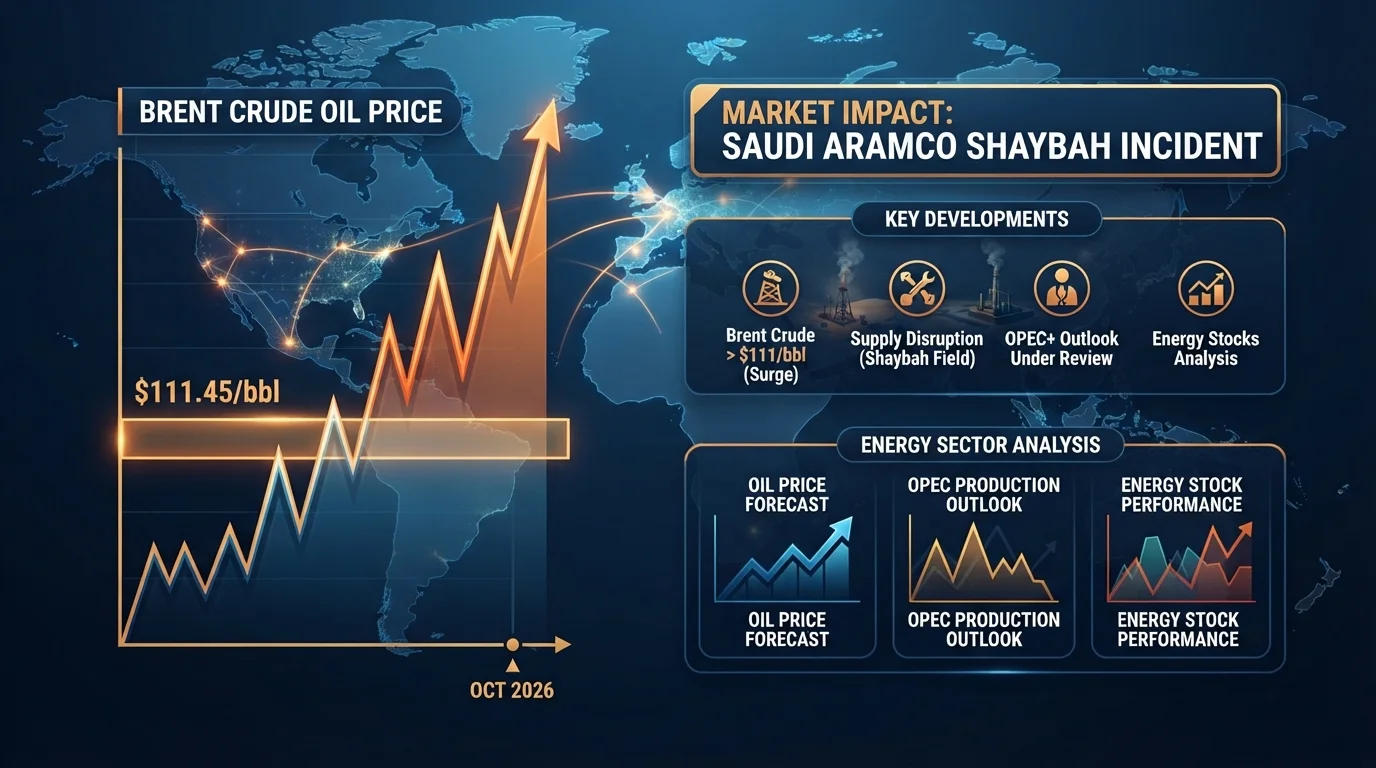
Brent crude oil has shattered the $110 barrier in late October 2026, climbing above $111 per barrel for the first time in five months after a Houthi drone strike targeted Saudi Aramco's Shaybah oil field. The attack, which killed two foreign workers and injured two others, has reignited fears over Middle East supply disruptions at a time when global inventories were already tightening. With WTI crude trading near $99 per barrel and energy markets pricing in elevated geopolitical risk premiums, investors are now asking whether this is a temporary spike or the beginning of a sustained rally into year-end.
The confluence of factors driving oil higher extends beyond the immediate geopolitical shock. OPEC+ production discipline has kept supply relatively constrained throughout 2026, while recovering demand from China and resilient consumption in the United States have prevented any significant inventory builds. Meanwhile, hotter-than-expected inflation data and mounting doubts over the returns on AI infrastructure spending have shifted some institutional capital back toward hard commodities, providing additional support to crude prices. For traders and long-term investors alike, understanding the interplay between supply risks, macroeconomic conditions, and sector-specific dynamics is essential for navigating the energy landscape in the final quarter of 2026.
The Shaybah Attack: A Supply Shock in an Already Tight Market
On October 21, 2026, Saudi air defenses intercepted a drone targeting a facility at the Shaybah oil field in Saudi Arabia's Eastern Province. While the interception was successful, falling debris struck a processing plant, killing two expatriate workers and injuring two others. The Shaybah field, located in the remote Rub al-Khali desert near the UAE border, produces approximately one million barrels per day and represents a critical component of Saudi Arabia's spare production capacity.
The market reaction was immediate and decisive. Brent crude futures surged past $110 per barrel within hours of the news breaking, eventually touching $111.23 by October 22. WTI crude followed suit, rising to $99.05. What makes this price movement particularly significant is that it reversed a summer decline that had seen Brent slide toward pre-war levels following the collapse of the April ceasefire and the June US-Iran deal. The attack served as a stark reminder that geopolitical risks in the Middle East remain acute, despite diplomatic progress on other fronts.
Energy analysts have noted that the psychological impact of the Shaybah strike may be as important as the physical damage, which Saudi officials confirmed did not disrupt overall operations. The message to markets is that Yemen's Houthi rebels retain both the capability and the willingness to strike high-value energy infrastructure, even after months of relative calm. For a global oil market that had grown somewhat complacent about supply security, this was a wake-up call with real price consequences.
OPEC+ Production Strategy and the Path to $100+ Oil
OPEC and its allies have maintained a disciplined approach to production management throughout 2026, and that strategy is now paying dividends in the form of higher prices. The alliance has successfully prevented any significant oversupply despite weakening economic signals in Europe and slower-than-expected growth in several emerging markets. Saudi Arabia's voluntary production cuts, combined with Russian export reductions, have kept global inventories below the five-year average for most of the year.
The return of Brent to triple-digit territory raises important questions about OPEC's next move. Historically, the cartel has been uncomfortable with prices sustained above $100 per barrel for extended periods, fearing that such levels would accelerate demand destruction and incentivize non-OPEC production growth, particularly from US shale basins. However, the current geopolitical premium complicates the calculation. If prices are being driven primarily by fear of supply disruption rather than fundamental tightness, OPEC may be reluctant to increase output and risk legitimizing the risk premium.
Looking ahead to the November 2026 OPEC+ ministerial meeting, delegates are likely to face pressure from consuming nations to ease production constraints. Yet with the Shaybah attack fresh in memory and the US election cycle creating uncertainty about future Middle East policy, the alliance may opt to maintain current quotas through the end of the year. Any decision to increase production would need to be carefully calibrated to avoid appearing to capitalize on geopolitical instability while still addressing legitimate concerns about affordability.
WTI vs. Brent: Understanding the Spread Dynamics
The differential between West Texas Intermediate and Brent crude has widened somewhat in October, reflecting both logistical factors and regional risk assessments. As of October 22, 2026, WTI was trading at approximately $98.93 per barrel compared to Brent's $111.23, creating a spread of roughly $12.30. This gap is wider than the historical average and speaks to several underlying dynamics that traders should monitor closely.
First, the geopolitical risk premium is being applied more heavily to Brent, which serves as the global pricing benchmark and is more directly exposed to Middle East supply disruptions. WTI, as a landlocked US crude, benefits from America's relative energy independence and robust domestic production. Second, US crude inventories have shown modest builds in recent weeks as refinery maintenance season reduced domestic demand, putting slight downward pressure on WTI relative to Brent.
The Energy Information Administration's latest Short-Term Energy Outlook projects WTI crude to average $88.21 per barrel and Brent $96.32 for the full year 2026. These official government forecasts, which are revised monthly, now appear conservative given the recent price action. Independent analysts at LongForecast have updated their October outlook to show Brent trading in a range of $93.94 to $114.22, with a monthly close expected around $101.05. The divergence between government projections and market prices underscores how quickly geopolitical events can render even the most rigorous forecasts obsolete.
Inflation, Interest Rates, and the Macro Backdrop for Oil
Crude oil prices do not exist in a vacuum, and the broader macroeconomic environment is providing both tailwinds and headwinds for energy markets. Hotter inflation prints across major economies have kept central banks in a hawkish posture, with markets now pricing in approximately a 17% chance of a Federal Reserve rate hike in October and an 86% probability of an increase by December. Higher interest rates typically weigh on commodity prices by strengthening the US dollar and increasing the cost of carry for speculative positions.
However, the inflation story itself is supportive of oil in a counterintuitive way. As consumer prices remain elevated, real assets including commodities become more attractive relative to fixed-income securities. Gold, traditionally the premier inflation hedge, has experienced some weakness recently, dropping below $4,100 per ounce as the oil-driven inflation surge raised concerns about more aggressive monetary tightening. This has created a rotation opportunity where institutional investors are increasingly looking at energy equities and crude oil futures as alternative inflation hedges with superior cash flow generation potential.
The interplay between oil prices and inflation creates a feedback loop that policymakers find difficult to break. Higher oil prices feed into transportation costs, manufacturing inputs, and ultimately consumer prices. This forces central banks to maintain or tighten policy, which can slow economic growth and eventually reduce oil demand. Yet if supply constraints are structural rather than cyclical, as the Shaybah attack suggests, demand destruction may be the only mechanism capable of bringing prices back down. For investors, this means energy markets will remain sensitive to every inflation report and central bank communication for the remainder of 2026.
Energy Stocks in Focus: ExxonMobil and the Supermajors
With crude prices surging, the spotlight naturally falls on the integrated oil majors that stand to benefit most from elevated realizations. ExxonMobil, the largest US energy company by market capitalization, has already seen its stock outperform the broader market in October as investors recalibrate earnings expectations upward. The company's diversified portfolio, spanning upstream production, downstream refining, and chemicals manufacturing, provides multiple levers for capturing value from higher oil prices.
ExxonMobil's upstream operations in the Permian Basin, Guyana, and Brazil are particularly well-positioned to capitalize on the current price environment. Production costs in these regions remain well below $50 per barrel, meaning the company generates substantial free cash flow at current prices. Management has consistently emphasized capital discipline and shareholder returns over production growth, a strategy that becomes even more compelling when oil trades above $100. Analysts are likely to revise their fourth-quarter earnings estimates upward, with consensus potentially shifting toward $2.50 to $3.00 per share depending on the duration of the price spike.
Beyond ExxonMobil, the entire supermajor complex is benefiting from improved sentiment. Chevron, Shell, BP, and TotalEnergies have all seen their valuations expand as the market prices in higher terminal cash flows. However, investors should remain selective. Companies with heavier exposure to European refining margins may face headwinds from weakening industrial demand, while those with significant natural gas portfolios could see mixed results depending on regional LNG price dynamics. For investors seeking to automate their exposure to energy sector movements, consider using Alphio AI's copy trading feature to mirror strategies from experienced commodities traders.

Defense Stocks Tumble: The Election Factor
An interesting cross-current in the October market narrative is the sharp decline in US defense stocks amid growing expectations of a Democratic sweep in the upcoming midterm elections. The iShares US Aerospace and Defense ETF has dropped approximately 16% between July and mid-October as investors price in the possibility that a Democratic-controlled Congress could complicate the Trump administration's plans for $500 billion in additional military spending.
This development matters for energy markets because defense and energy sectors are often correlated through the geopolitical risk channel. A reduction in US military spending could, in theory, reduce American leverage in Middle East diplomacy and potentially create more instability in oil-producing regions. Conversely, if a Democratic sweep leads to a more diplomatic approach to Iran and Yemen, the long-term supply outlook could improve, putting downward pressure on the geopolitical risk premium currently embedded in oil prices.
The market is effectively running a real-time experiment on how political risk in Washington translates to commodity risk in the Persian Gulf. For traders, this creates opportunities in relative value trades between defense and energy equities, as well as in options strategies that capture volatility across both sectors. The outcome of the November elections may prove to be as important for oil prices as any OPEC decision.
Technical Outlook and Trading Strategies
From a technical perspective, Brent crude has broken decisively above the $105 resistance level that had constrained price action since August. The move to $111 represents a clean breakout on elevated volume, with the next psychological resistance level at $115 and structural resistance near the 2026 high of approximately $118. Momentum indicators including the Relative Strength Index and MACD histogram have turned bullish, though the RSI is approaching overbought territory on daily timeframes.
For active traders, the current environment favors momentum strategies on the long side with tight stop-losses beneath $105. The risk-reward profile is attractive for swing trades targeting $115 to $118, provided that no de-escalation in the Middle East undermines the geopolitical narrative. Options traders might consider call spreads in December Brent futures to capitalize on potential upside while limiting premium outlay in a high-volatility environment.
Longer-term investors should consider the possibility that current prices reflect a temporary risk premium rather than a sustainable new equilibrium. If diplomatic efforts succeed in reducing Houthi attack capabilities or if OPEC+ increases production quotas in response to consumer nation pressure, prices could retrace toward the $95 to $100 range. Dollar-cost averaging into energy equities rather than chasing crude futures at these levels may offer a more prudent risk-adjusted approach. For those looking to automate portfolio management in volatile markets, Alphio's agentic trading offers AI-powered strategy execution.

Gold and the Safe Haven Rotation
The relationship between gold and oil has shown some unusual divergences in October 2026. While both are traditionally considered inflation hedges and safe-haven assets, gold has struggled to maintain momentum even as oil prices have surged. Spot gold dropped below $4,100 per ounce on October 22, erasing gains from the previous session as renewed Middle East tensions paradoxically fueled inflation concerns that strengthened the case for higher interest rates.
This dynamic illustrates an important point about safe-haven assets: they do not always move in tandem, and their relative performance depends on the specific nature of the risk event. When geopolitical shocks are perceived to increase inflationary pressure, gold may actually underperform because the expected monetary policy response becomes more hawkish. Oil, by contrast, benefits directly from the supply disruption that caused the shock in the first place.
Institutional end-of-year forecasts for gold span a remarkably wide range of $4,000 to $6,000 per ounce, reflecting deep uncertainty about the trajectory of monetary policy and fiscal stability in major economies. For investors constructing diversified commodity portfolios, the current divergence between gold and oil may present a rebalancing opportunity. Allocating toward energy and away from precious metals could capture the momentum in crude while positioning for a potential mean reversion if central banks ultimately pivot toward easing in 2027.
What to Watch in the Coming Weeks
Several key events and data releases will shape the oil market narrative through the end of October and into November. The Federal Reserve's October 27-28 meeting is the most significant macro event on the calendar, with markets divided on whether policymakers will deliver another rate hike or hold steady to assess the impact of previous tightening. Any hawkish surprise could put immediate downward pressure on crude by strengthening the dollar and raising recession fears.
On the geopolitical front, the international response to the Shaybah attack will be closely monitored. Saudi Arabia has historically responded to such incidents by reinforcing air defenses and seeking diplomatic solutions through backchannels. However, if the Houthis escalate further with additional strikes, the risk premium in oil could expand significantly. Traders should watch for statements from the Saudi Energy Ministry and any signs of US naval presence increases in the Red Sea and Gulf of Aden.
OPEC+ communications will also be critical in the lead-up to the November ministerial meeting. Saudi Energy Minister Prince Abdulaziz bin Salman has mastered the art of verbal intervention, often using public statements to guide market expectations. Any hint that the kingdom is considering unilateral production increases would likely trigger a sharp price correction, while continued silence would be interpreted as tacit support for current price levels.
Conclusion
Brent crude's surge above $111 per barrel in late October 2026 represents more than a temporary geopolitical spike. It reflects a fundamentally tighter oil market where OPEC+ discipline, recovering demand, and persistent supply risks have created conditions conducive to sustained higher prices. The Shaybah attack served as the catalyst, but the underlying dynamics supporting crude were already in place.
For investors, the current environment demands a nuanced approach. Energy equities offer exposure to higher oil prices with the benefit of dividend yields and valuation support, while direct crude futures trading requires careful risk management given the volatility of geopolitical risk premiums. The interplay between oil prices, inflation, and central bank policy will remain the dominant macro theme through year-end, creating both opportunities and pitfalls across asset classes.
Looking ahead to 2027, the path for oil prices will depend on whether the current supply disruptions prove temporary or structural, and whether global economic growth can remain resilient in the face of higher energy costs. The EIA's forecast of $96 average Brent for 2026 may still prove accurate if prices stabilize in the low $100s, but the upside risk has clearly increased. For those seeking to navigate these complex markets with precision, Alphio AI's scheduled task automations allow you to set conditional workflows that respond to price triggers and news events automatically.

Additionally, Alphio's conversational trading interface enables you to execute trades and monitor positions through natural language commands, making it easier to react quickly when oil markets move.

FAQs
Why did Brent crude oil prices surge above $111 in October 2026?
Brent crude surged after a Houthi drone strike targeted Saudi Aramco's Shaybah oil field on October 21, 2026, killing two workers. The attack reignited fears over Middle East supply disruptions in an already tight market where OPEC+ had maintained production discipline throughout the year.
What is the difference between WTI and Brent crude oil prices?
WTI (West Texas Intermediate) is a US-based crude benchmark priced at Cushing, Oklahoma, while Brent is the global pricing benchmark sourced from the North Sea. Brent typically trades at a premium to WTI due to its broader international exposure. As of October 22, 2026, the spread was approximately $12.30 per barrel.
How do geopolitical events affect oil price forecasts?
Geopolitical events add a risk premium to oil prices by creating uncertainty about future supply availability. Attacks on production facilities, shipping disruptions, or diplomatic conflicts in major producing regions can cause immediate price spikes. However, these premiums often fade if the physical supply impact is minimal and diplomatic solutions emerge.
Are energy stocks a good investment when oil prices are above $100?
Energy stocks can be attractive when oil prices are elevated because upstream producers generate substantial free cash flow with production costs typically below $50 per barrel. Companies like ExxonMobil and Chevron benefit from higher realizations while also returning capital to shareholders through dividends and buybacks. However, investors should consider whether current prices reflect sustainable fundamentals or temporary risk premiums.
What is the EIA's oil price forecast for 2026?
The US Energy Information Administration's Short-Term Energy Outlook projects WTI crude to average $88.21 per barrel and Brent crude to average $96.32 for the full year 2026. These forecasts are revised monthly and may be updated to reflect the recent geopolitical developments and price action above $110.
Related articles
- Stock Market Surges After 2026 Midterms: What the Democratic Sweep Means for Your PortfolioThe stock market rallied after Democrats won the 2026 midterms. Discover what the election means for investors, tech stocks, and the S&P 500 outlook.
- Stock Market Surges After 2026 Midterms: What the Democratic Sweep Means for Your PortfolioThe stock market rallied after Democrats won the 2026 midterms. Discover what the election means for investors, tech stocks, and the S&P 500 outlook.
- Oil Prices Surge Above $105 Amid US-Iran Conflict: Energy Investment Opportunities in November 2026Oil prices climb past $105 as US strikes Iran's Qeshm Island. Discover energy investment opportunities, top oil stocks, and market outlook for November 2026.
- NVIDIA Stock Analysis 2026: Navigating the AI Semiconductor Investment LandscapeComprehensive NVIDIA stock analysis for 2026. Explore AI semiconductor investment opportunities, financial metrics, and expert price targets for NVDA shares.
- Berkshire Hathaway Succession: What Abel's $4.5 Billion Bet Means for InvestorsGreg Abel's massive $4.5 billion Berkshire Hathaway stock purchase signals confidence in the post-Buffett era. Discover what this means for long-term investors.
- S&P 500 Tech Stock Market Analysis August 2026: NVDA, AAPL Lead the ChargeComprehensive analysis of S&P 500 tech stocks in August 2026. Discover NVDA, AAPL price targets and market outlook for smart investment decisions.