

S&P 500 Tech Stock Market Analysis August 2026: NVDA, AAPL Lead the Charge
Comprehensive analysis of S&P 500 tech stocks in August 2026. Discover NVDA, AAPL price targets and market outlook for smart investment decisions.

Key Takeaway
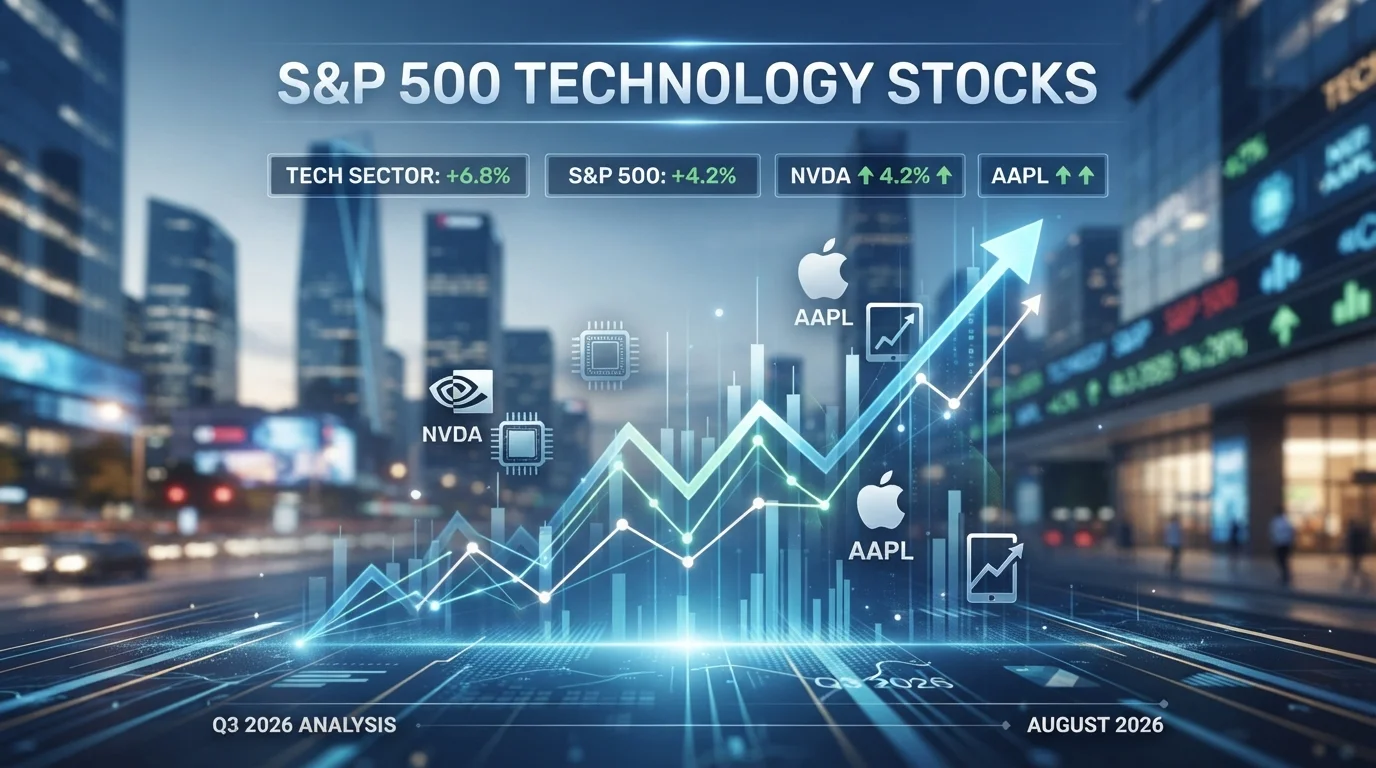
The S&P 500 has reached new heights in August 2026, climbing to 7,757.64 with a solid 0.62% gain as technology stocks continue to drive market momentum. This rally reflects investor confidence in the ongoing AI revolution and the resilience of major tech companies despite macroeconomic uncertainties. The technology sector remains the primary engine of growth, with NVIDIA and Apple standing out as key performers shaping market sentiment.
For investors navigating this landscape, understanding the underlying drivers of tech stock performance has become essential. The convergence of artificial intelligence adoption, strong corporate earnings, and strategic positioning by market leaders has created a compelling investment environment. However, with valuations at elevated levels, discerning between sustainable growth narratives and speculative excess requires careful analysis of fundamentals and market dynamics.
The S&P 500 Rally: What's Driving the Market
Market Overview and Performance
The S&P 500's ascent to 7,757.64 represents more than just a number—it signals the market's confidence in the ongoing economic recovery and the transformative potential of technology. This level marks the index near its 52-week high of 7,793.68, suggesting that despite concerns about interest rates and geopolitical tensions, institutional investors remain optimistic about corporate America's ability to deliver earnings growth.
Trading volume on recent sessions has been robust at over 2.7 billion shares, indicating strong participation from both institutional and retail investors. The breadth of the rally has been notable, with multiple sectors contributing to gains, though technology continues to lead the charge. This broad-based participation suggests the rally has firmer foundations than previous narrow-led advances.
The VIX, often called the market's fear gauge, has remained relatively subdued, currently trading around 14.90, down 1.65%. This low volatility environment reflects investor complacency but also confidence that corporate earnings can support current valuations. Historical patterns suggest that periods of low volatility can persist for extended durations, particularly when economic fundamentals remain supportive.
Sector Rotation and Leadership
Technology stocks have maintained their dominance in 2026, with the sector outperforming the broader S&P 500 by a significant margin. This leadership extends beyond the mega-cap names to include semiconductor companies, software providers, and emerging players in the AI infrastructure space. The market has rewarded companies that can demonstrate tangible AI monetization strategies while punishing those with vague or distant growth prospects.
Healthcare and consumer discretionary sectors have also shown strength, benefiting from demographic trends and resilient consumer spending. However, the divergence between tech and traditional value sectors has widened, creating both opportunities and risks for portfolio managers. Investors seeking diversification must balance the growth potential of technology with the stability offered by more defensive positions.
The energy sector has experienced volatility amid fluctuating oil prices and geopolitical developments in the Middle East. While this has created trading opportunities, the long-term trend continues to favor companies transitioning toward renewable energy solutions. Traditional energy majors have responded by increasing capital returns to shareholders while gradually diversifying their asset bases.
NVIDIA (NVDA) Deep Dive: The AI Chip King
Current Valuation and Price Action
NVIDIA currently trades at $218.14, experiencing a modest pullback of 0.49% in recent sessions. Despite this short-term decline, the stock maintains an impressive year-to-date gain of 17.11%, significantly outpacing the S&P 500's 12.84% return. This performance reflects continued investor confidence in NVIDIA's dominant position in the AI accelerator market and its ability to monetize the ongoing artificial intelligence boom.
The stock's valuation metrics reveal both opportunities and considerations for investors. With a trailing P/E ratio of 33.41 and a forward P/E of 22.88, NVIDIA trades at a premium to the broader market but at a discount to its historical valuation multiples during peak growth phases. The PEG ratio of 0.55 suggests that despite the high absolute valuation, the company's growth rate justifies the premium when viewed through a growth-adjusted lens.
Analysts maintain a bullish outlook on NVIDIA, with an average price target of $302.83, implying approximately 38% upside from current levels. Recent upgrades from firms like KeyBanc, which raised its target from $310 to $330, reflect optimism about sustained demand for AI infrastructure. The consensus rating skews heavily toward Buy and Strong Buy recommendations, though the wide dispersion between low ($180) and high ($500) price targets indicates significant uncertainty about the stock's trajectory.
Fundamental Strength and Growth Drivers
NVIDIA's most recent quarterly results showcased the company's exceptional financial performance, with revenue reaching $81.61 billion and earnings hitting $58.32 billion for Q1 FY27. These figures represent year-over-year growth that few companies of NVIDIA's scale can match, demonstrating the company's ability to capture value from the AI infrastructure buildout across cloud providers, enterprises, and sovereign nations.
The company's profit margins remain industry-leading, with a profit margin of 62.97% and return on equity of 114.29%. These metrics underscore NVIDIA's pricing power and operational efficiency, characteristics that typically support premium valuations. The balance sheet remains fortress-like, with $53.17 billion in cash against minimal debt, providing ample flexibility for strategic investments, acquisitions, and shareholder returns.
Looking ahead, NVIDIA's growth prospects center on several key areas. The data center segment continues to expand as cloud providers and enterprises scale their AI capabilities. The automotive business, while smaller, represents a long-term opportunity as autonomous driving technology advances. Additionally, the company's software and services offerings, including AI Enterprise and Omniverse, provide recurring revenue streams that could improve earnings quality over time.
For traders looking to capitalize on NVIDIA's volatility and growth potential, consider using Alphio AI's agentic trading feature to automate your portfolio management with AI-powered strategies.
Apple (AAPL): The Steady Giant
Performance and Market Position
Apple trades at $313.33, up 0.29% in recent trading, with a year-to-date gain of 15.47% that closely mirrors the broader tech rally. The stock has delivered a remarkable 42.97% return over the past year, demonstrating the company's ability to maintain growth despite its massive scale. With a market capitalization exceeding $4.5 trillion, Apple remains one of the most valuable companies in the world and a cornerstone of many investment portfolios.
The company's valuation reflects both its quality characteristics and growth prospects. Trading at a P/E ratio of 35.97, Apple commands a premium multiple that acknowledges its brand strength, ecosystem loyalty, and capital return program. The forward dividend yield of 0.34% may seem modest, but Apple's commitment to returning capital through both dividends and share buybacks has created significant shareholder value over time.
Analyst sentiment on Apple remains predominantly positive, with an average price target of $322.82 suggesting modest upside from current levels. Recent ratings from firms like Wedbush maintain Outperform recommendations, citing Apple's services growth and the potential for an AI-driven iPhone upgrade cycle. The upcoming earnings report, estimated for October 29, 2026, will provide crucial insights into how Apple's AI initiatives are resonating with consumers.
Growth Catalysts and Challenges
Apple's recent quarterly results showed revenue of $111.18 billion with earnings of $29.58 billion, figures that demonstrate the company's ability to generate massive profits even amid concerns about iPhone sales saturation. The services segment has emerged as a critical growth driver, providing high-margin recurring revenue that helps offset cyclicality in hardware sales. This segment includes App Store commissions, subscription services like Apple Music and TV+, and emerging offerings in fintech and healthcare.
The company's AI strategy, branded as Apple Intelligence, represents the next major product cycle catalyst. By integrating generative AI capabilities across its ecosystem, Apple aims to drive device upgrades while creating new monetization opportunities. The recent announcements regarding on-device AI processing and enhanced Siri capabilities suggest Apple is taking a privacy-focused approach that could differentiate its offerings from competitors.
However, challenges remain. Regulatory scrutiny in key markets, particularly the European Union and China, threatens to impact App Store revenue and operational flexibility. Additionally, the mature smartphone market limits the pace of iPhone unit growth, placing greater emphasis on average selling price improvements and services monetization. Apple's ability to navigate these challenges while maintaining its premium brand positioning will determine its long-term trajectory.
Palantir (PLTR): The AI Software Play
Valuation and Recent Performance
Palantir Technologies trades at $155.99, down 1.54% in recent sessions, though the stock maintains a respectable 12.24% year-to-date gain. The company's market capitalization stands at approximately $375 billion, reflecting investor enthusiasm for its AI-powered data analytics platform. However, the stock's P/E ratio of 133.32 signals that investors are paying a significant premium for future growth expectations.
The recent price action reflects some profit-taking after Palantir's remarkable 757% three-year return, which far exceeds the S&P 500's 72% gain over the same period. This extraordinary performance has created a challenging setup for new investors, as the stock's valuation already embeds substantial growth assumptions. Analyst price targets range from $70 to $255, with an average of $185.68, suggesting the stock is trading above consensus fair value.
Palantir's Q1 FY26 results showed revenue of $1.63 billion with earnings of $870.53 million, demonstrating the company's ability to convert its technology into profitable outcomes. The government's business remains a stable revenue base, while commercial adoption of the AIP (Artificial Intelligence Platform) drives growth acceleration. Recent analyst actions, including UBS raising its target from $200 to $220, reflect optimism about commercial traction.
Macroeconomic Context: Interest Rates and Fed Policy
The Fed's Impact on Tech Valuations
The Federal Reserve's monetary policy stance continues to influence technology stock valuations significantly. Current market expectations suggest the Fed may maintain higher interest rates for longer than previously anticipated, given persistent inflation concerns and resilient economic growth. This environment creates headwinds for growth stocks, as higher discount rates reduce the present value of future cash flows.
However, technology companies with strong cash flows and balance sheets, like Apple and NVIDIA, are relatively well-positioned to weather higher rates. Their ability to generate free cash flow reduces dependence on external financing, while substantial cash reserves provide operational flexibility. In contrast, unprofitable growth companies face greater pressure in a higher-rate environment, potentially benefiting established tech leaders.
The relationship between interest rates and tech stock performance has become more nuanced as the market digests the AI investment cycle. While higher rates typically pressure growth multiples, the transformational potential of AI has created a narrative that partially insulates leading companies from traditional valuation metrics. Investors appear willing to pay premium multiples for companies they believe will capture significant value from AI adoption.
Inflation and Consumer Spending Trends
Inflation data has shown signs of moderation, though core inflation remains above the Fed's 2% target. This persistence complicates the monetary policy outlook and creates uncertainty about the timing and magnitude of future rate cuts. For technology companies, inflation impacts both input costs and consumer purchasing power, though the effect varies significantly across business models.
Apple faces potential pressure on consumer discretionary spending if inflation erodes household budgets, though its affluent customer base provides some insulation. Services pricing power and the subscription nature of many offerings create recurring revenue that is less sensitive to short-term economic fluctuations. NVIDIA's data center business, driven by enterprise and cloud spending, is more tied to corporate investment cycles than consumer health.
The resilience of consumer spending has surprised many economists, supporting technology companies with consumer-facing products. This strength reflects tight labor markets, accumulated savings from pandemic-era stimulus, and the wealth effect from strong equity and housing markets. However, any meaningful deterioration in consumer sentiment could pressure valuations across the technology sector.
Investment Strategies for the Current Market
Portfolio Allocation Approaches
Given the current market environment, investors should consider several strategies for technology exposure. A core-satellite approach, with broad tech ETF exposure complemented by individual stock selections, offers diversification while allowing for targeted bets on specific themes. The Invesco QQQ Trust (QQQ) provides exposure to the Nasdaq-100, while more focused ETFs target specific subsectors like semiconductors or cybersecurity.
For individual stock selection, investors should focus on companies with sustainable competitive advantages, strong balance sheets, and clear paths to monetizing AI technologies. NVIDIA and Apple both fit these criteria, though position sizing should reflect their elevated valuations and the concentration risk of owning multiple mega-cap tech names. Diversification across market capitalizations and geographies can help mitigate idiosyncratic risks.
Risk management remains crucial in the current environment. Setting stop-loss orders, maintaining cash reserves for opportunities, and regularly rebalancing positions can help protect portfolios from significant drawdowns. The technology sector's volatility creates both opportunities and risks, requiring disciplined execution and a long-term perspective to navigate successfully.
Timing and Entry Strategies
The current market presents challenges for timing new entries, with the S&P 500 near all-time highs and many tech stocks trading at premium valuations. Dollar-cost averaging can help reduce timing risk by spreading purchases over time, capturing both dips and rallies in the market. This approach is particularly appropriate for long-term investors building positions in high-quality companies.
For more active traders, technical analysis can provide entry signals based on price patterns and momentum indicators. Support and resistance levels, moving averages, and relative strength indicators offer tools for identifying favorable entry points. However, technical analysis should complement rather than replace fundamental analysis, ensuring that trading decisions align with long-term investment theses.
Seasonal patterns may also influence entry timing. August and September historically show elevated volatility, potentially creating buying opportunities for patient investors. Earnings seasons provide regular catalysts for stock movements, with pre-earnings run-ups and post-earnings reactions creating trading opportunities for those with strong conviction about company performance.
If you're interested in automating your trading strategies based on market signals, explore Alphio AI's automations feature to set conditional workflows for your portfolio.
Risks and Considerations
Valuation Concerns
The primary risk facing technology investors is valuation. With the S&P 500 trading at elevated multiples and many tech stocks at historically high valuations, there is limited margin of safety if growth disappoints or interest rates rise further. A re-rating of growth multiples could lead to significant drawdowns even for companies with strong fundamentals.
Concentration risk is another concern, as the largest technology companies represent an increasingly large share of major indices. This concentration amplifies both upside potential and downside risk, making portfolio diversification challenging for investors seeking broad market exposure. Understanding the drivers of mega-cap performance has become essential for managing portfolio risk.
Regulatory risks continue to loom over the technology sector, with antitrust investigations and data privacy regulations threatening business models and profitability. The European Union's Digital Markets Act and similar legislation in other jurisdictions could force changes to platform business models, potentially impacting revenue and margins for affected companies.
Geopolitical and Supply Chain Factors
The technology sector remains exposed to geopolitical tensions, particularly between the United States and China. Trade restrictions on semiconductor exports to China have impacted companies like NVIDIA, though the company has adapted by developing compliant product variants. Further escalation of trade tensions could disrupt supply chains and limit market access for U.S. technology companies.
Supply chain resilience has improved since the pandemic-era disruptions, but vulnerabilities remain. Semiconductor manufacturing concentration in Taiwan creates geopolitical risk, while the complexity of global supply chains leaves companies exposed to disruptions from natural disasters, labor disputes, or shipping bottlenecks. Companies with diversified supply chains and inventory management capabilities are better positioned to navigate these challenges.
Conclusion
The S&P 500's rally to 7,757.64 in August 2026 reflects investor confidence in the technology sector's ability to drive earnings growth and innovation. NVIDIA and Apple stand out as leaders in this environment, each offering exposure to transformative technologies while maintaining strong competitive positions and financial health. However, elevated valuations require careful consideration of entry points and position sizing.
For investors, the current market offers both opportunities and challenges. The AI revolution is creating genuine value for companies that can capture it, but not all beneficiaries are equally positioned for success. Focusing on companies with durable competitive advantages, strong cash generation, and clear paths to monetization offers the best risk-adjusted returns in this environment.
Whether you're a long-term investor building positions in quality companies or an active trader seeking to capitalize on market volatility, having the right tools is essential. Consider using Alphio AI's copy trading feature to mirror successful traders and smart money wallets, or explore conversational trading to execute trades via chat with natural language commands.

Stay informed, stay disciplined, and remember that successful investing requires balancing opportunity with risk management in all market environments.
FAQs
Is now a good time to invest in S&P 500 tech stocks?
The current market presents both opportunities and risks for tech investors. While companies like NVIDIA and Apple have strong fundamentals and growth prospects, valuations are elevated after significant rallies. Dollar-cost averaging and focusing on high-quality companies with durable competitive advantages can help manage timing risk. Consider your investment timeline and risk tolerance before making decisions.
What is the price target for NVIDIA stock in 2026?
Analysts have an average price target of $302.83 for NVIDIA, suggesting approximately 38% upside from current levels around $218. Recent upgrades from firms like KeyBanc have raised targets to $330, reflecting optimism about AI infrastructure demand. However, price targets vary widely from $180 to $500, indicating significant uncertainty about the stock's trajectory.
How does the Fed's interest rate policy affect tech stocks?
Higher interest rates typically pressure growth stock valuations by reducing the present value of future cash flows. However, companies with strong current cash flows and balance sheets, like Apple and NVIDIA, are relatively well-positioned. The AI investment cycle has created a narrative that partially insulates leading tech companies from traditional valuation pressures.
What are the main risks facing tech stocks right now?
Key risks include elevated valuations limiting margin of safety, concentration risk in mega-cap names, regulatory scrutiny from antitrust and data privacy laws, geopolitical tensions affecting supply chains and market access, and potential deterioration in consumer spending if inflation persists. Diversification and risk management are essential in this environment.
Should I focus on individual tech stocks or ETFs for exposure?
A core-satellite approach often works well, with broad tech ETF exposure providing diversification while individual stock selections allow targeted bets on specific themes. ETFs like QQQ offer Nasdaq-100 exposure, while individual stocks enable conviction-driven positions. Your approach should reflect your investment knowledge, time commitment, and risk tolerance.
Related articles
- Stock Market Surges After 2026 Midterms: What the Democratic Sweep Means for Your PortfolioThe stock market rallied after Democrats won the 2026 midterms. Discover what the election means for investors, tech stocks, and the S&P 500 outlook.
- Stock Market Surges After 2026 Midterms: What the Democratic Sweep Means for Your PortfolioThe stock market rallied after Democrats won the 2026 midterms. Discover what the election means for investors, tech stocks, and the S&P 500 outlook.
- Oil Prices Surge Above $105 Amid US-Iran Conflict: Energy Investment Opportunities in November 2026Oil prices climb past $105 as US strikes Iran's Qeshm Island. Discover energy investment opportunities, top oil stocks, and market outlook for November 2026.
- How to Read AI Hyperscaler Earnings During Fed Week: A Practical Investor GuideInvestor guide to Microsoft, Alphabet, and Amazon earnings amid a Fed hold and AI CapEx skepticism: cloud growth, CapEx, FCF, and what to watch.
- Meta's ~$95B Equity Tap: From Buybacks to Issuance — Why the Market Dumped, Then Argued, Over AI CapMeta launches a ~$95B equity financing plan (~$35B underwritten + planned $60B Class C ATM) to fund AI CapEx. Dump-then-argue tape, dilution math, analyst debate, and falsifiable watchpoints.
- When to Stop Following a Crypto Vault or WhaleA practical unfollow checklist for crypto vaults and whales: drawdown limits, style drift, manipulation red flags, and review cadences.