

Meta's ~$95B Equity Tap: From Buybacks to Issuance — Why the Market Dumped, Then Argued, Over AI Cap
Meta launches a ~$95B equity financing plan (~$35B underwritten + planned $60B Class C ATM) to fund AI CapEx. Dump-then-argue tape, dilution math, analyst debate, and falsifiable watchpoints.


Meta's ~$95B Equity Tap: From Buybacks to Issuance — Why the Market Dumped, Then Argued, Over AI CapEx Dilution
On Monday, October 26, 2026, Meta Platforms did something that, five years ago, would have sounded like satire in a Menlo Park conference room: a company that still prints advertising cash at continental scale launched a financing plan that can total roughly $95 billion of equity — about $35 billion in concurrent underwritten offerings now, plus a planned ~$60 billion at-the-market program of non-voting Class C shares that is not yet contracted and is expected, if launched, to begin in the first quarter of 2027 after Class C starts trading.
The tape's first instinct was classic dilution muscle memory. Secondary coverage described shares falling as much as roughly 4% early in the session, then reversing toward a modest intraday gain near +1% as the book was digested; by the close, Investing.com's session summary showed META near $630.56, about −1.88% on the day, while CNBC flagged roughly −1.6% in morning trade. The honest path is not a clean "rally on AI conviction" or a clean "dilution wipeout." It is a dump-then-argue day: the market priced the size of the tap immediately, then spent hours debating whether Meta was admitting CapEx cannot be funded from operating cash alone — or announcing, with Morgan Stanley and Goldman Sachs as lead books and NVIDIA, AMD, and Broadcom as non-binding cornerstone interest, that the AI arms race now has a public equity underwriting calendar.
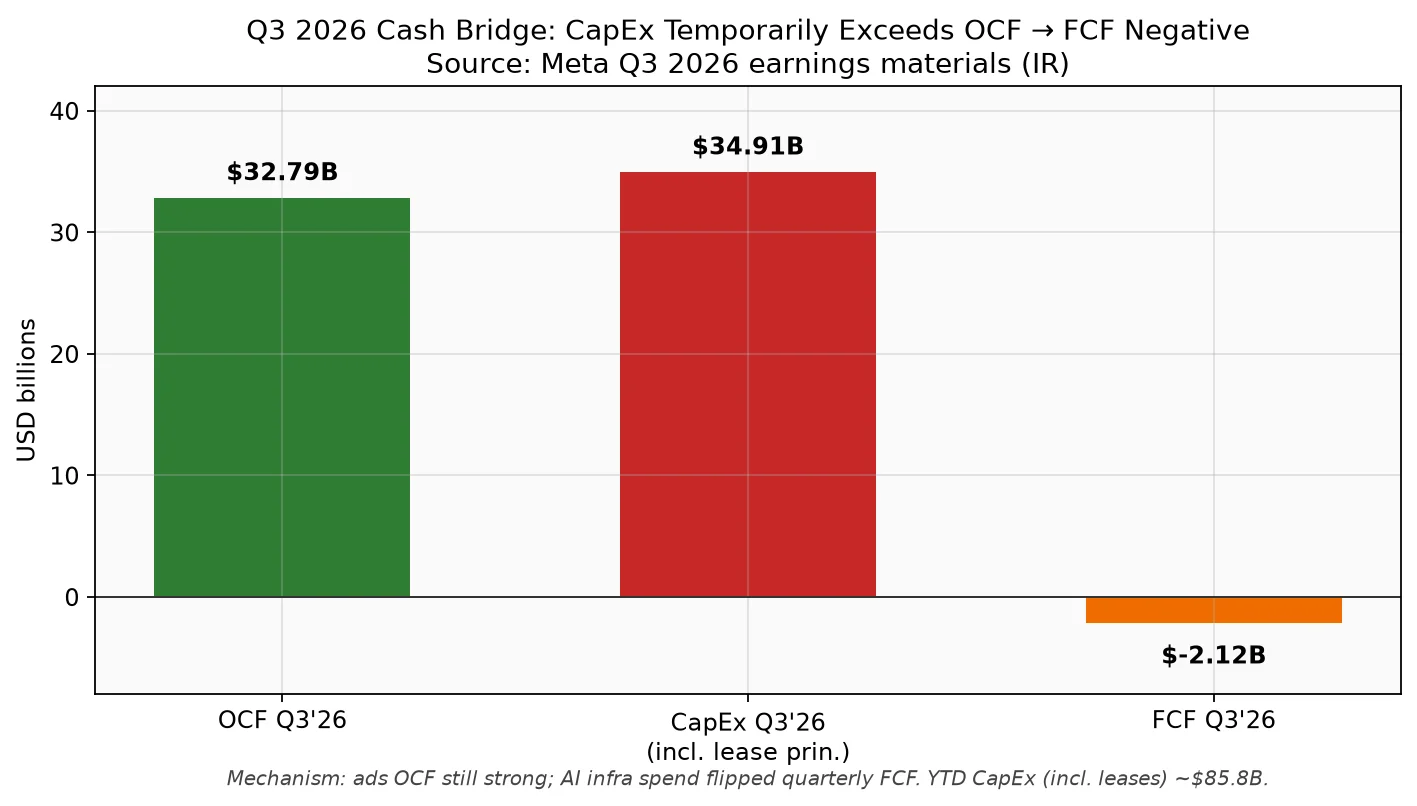
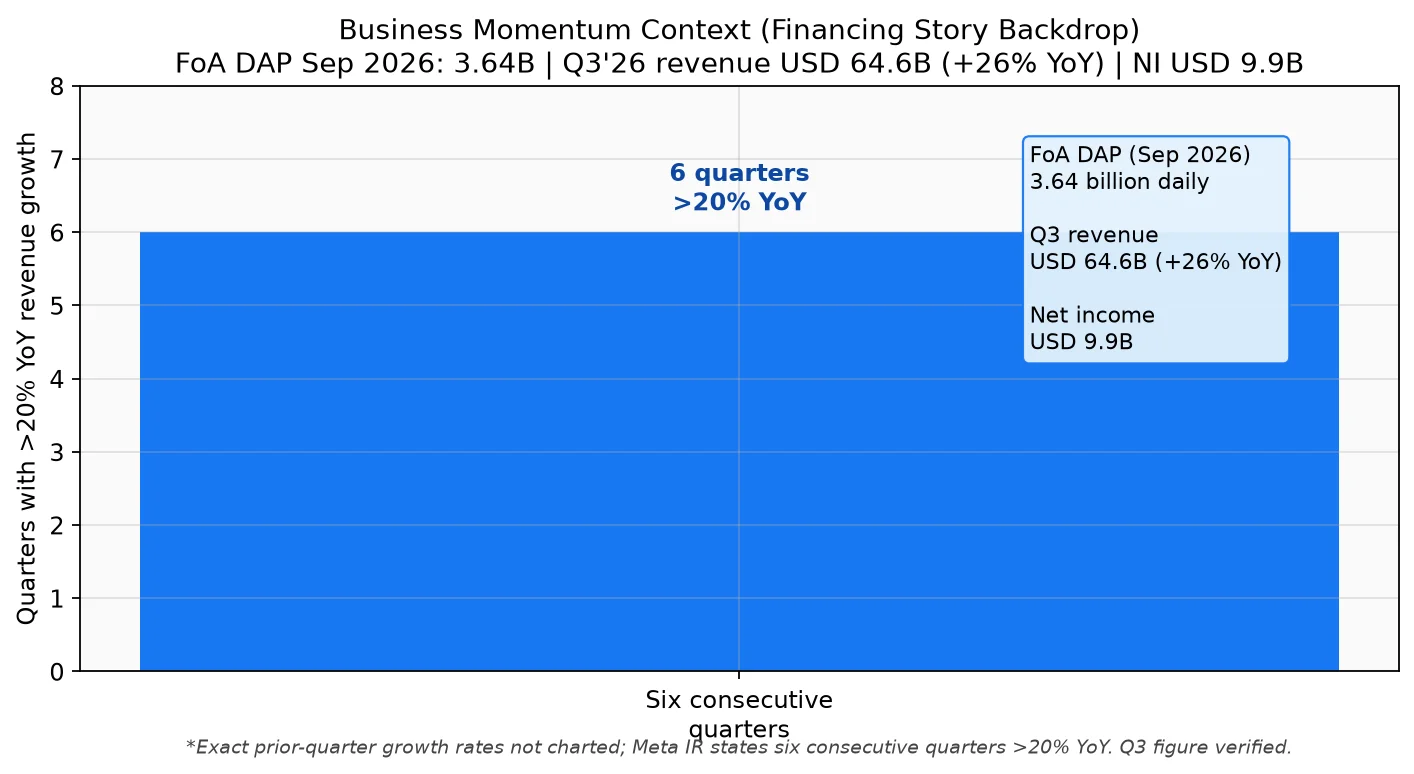
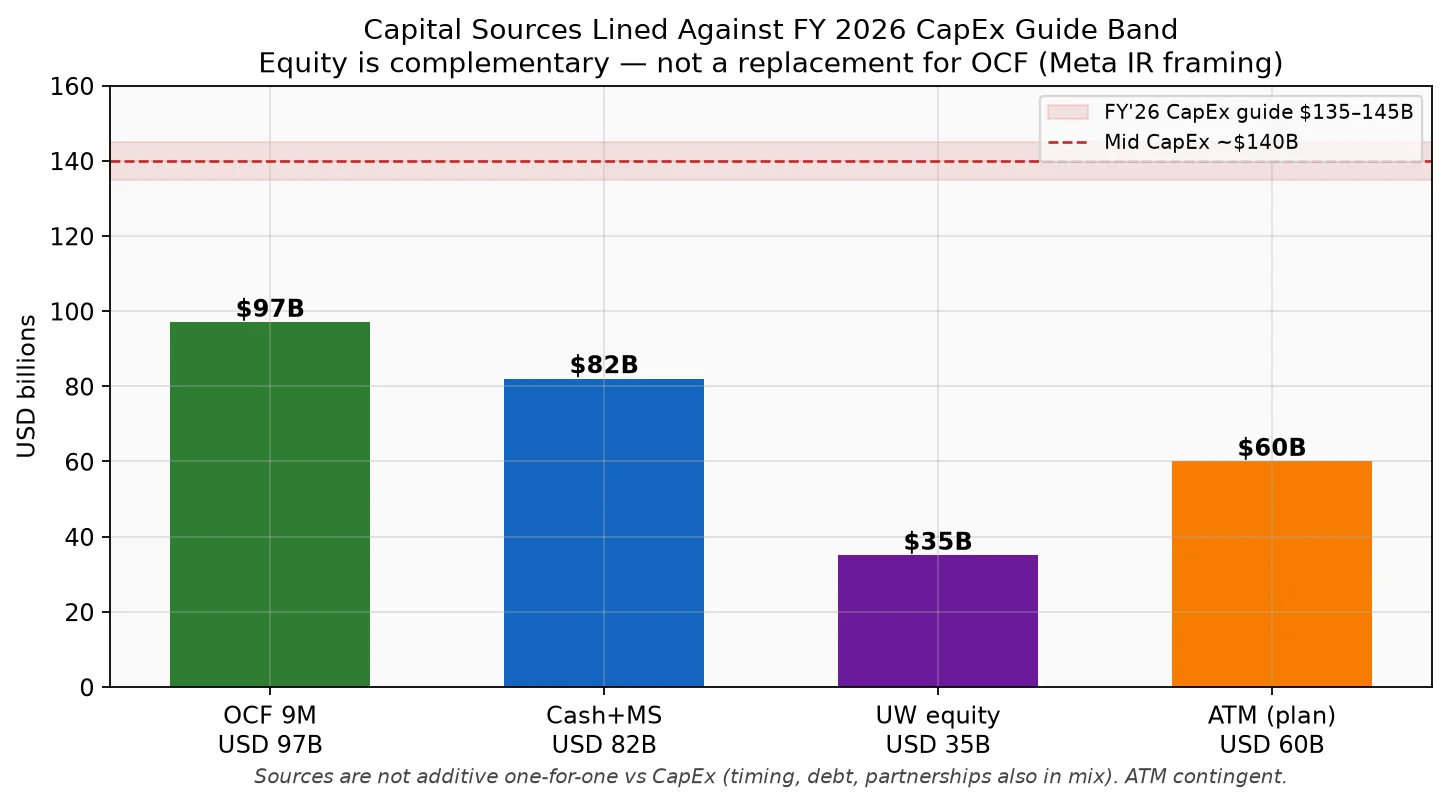
That tension is the story. The ads machine is still working. Family of Apps daily active people hit 3.64 billion in September 2026. Meta has delivered six consecutive quarters of more than 20% year-over-year revenue growth; third-quarter 2026 revenue was $64.6 billion, up 26%, with net income $9.9 billion. Operating cash flow for the first three quarters of 2026 was $97 billion, and cash, cash equivalents, and marketable securities at quarter-end were about $82 billion. Credit sits at Aa3/AA-. And yet CapEx for 2026 is guided to $135–$145 billion, Q3 CapEx including finance-lease principal was $34.91 billion against Q3 OCF of $32.79 billion, and free cash flow flipped to −$2.12 billion for the quarter. Buybacks, which totaled $26.2 billion in the first nine months of 2025 per Meta's cash-flow disclosure, were zero in the same stretch of 2026. The pivot from capital return to capital raise is no longer a whisper in the Class C charter footnotes from October 21. It is a prospectus.
What the market fears — and what it is quietly celebrating
Fear has a clean narrative. Equity issuance at mega-cap scale after a decade of buyback culture feels like a regime change. Investors who modeled Meta as a cash compounder that shrinks its share count while AI improves ad ranking now have to model a company that can grow its share count — and, via Class C, do so without diluting founder voting control in the same way a pure Class A raise would. The planned ATM is $60 billion of non-voting paper; that number alone is larger than the market capitalization of many "AI winners" that never earned a dollar of Facebook advertising. Layer on the mandatory convertible preferred structure — depositary shares targeting a METAM listing, preferred liquidation preference expected at $1,000 per preferred share, automatic conversion settlement on or about August 15, 2029 into a variable number of Class A (or Class C once issued and conditions are met) — and the market has to price not only near-term technical supply from the Class A forward sale, but a multi-year conversion overhang.
Celebration has a different narrative, and it is why the stock could reverse off the lows. Meta is not raising because the ads engine stalled. It is raising while still growing revenue more than 20% for six straight quarters, while Muse — Meta's consumer AI agent — onboarded more than 10 million users in the U.S. and Canada in its early weeks, with shopping above 25% of Muse weekly active users, Business Agent used by more than 2 million businesses weekly and more than 30 million conversations per week, and an estimated 500 million self-identified SMBs on the Family of Apps. Infrastructure sits in 23 U.S. states, with four superclusters above 1 GW each and a plan to nearly double total infrastructure capacity year over year in 2026. In that frame, equity is not distress capital. It is war-chest capital — and the presence of chip suppliers as cornerstone indications of interest (non-binding, up to an aggregate $5.0 billion of Class A) is read by bulls as a strategic alignment tax on the semiconductor complex that Meta must keep fed.
The market's mood on October 26 was the collision of those two stories in the same session.
The financing print: structure, traps, and what "$95 billion" actually means
Read the Meta IR release and the Rule 433 free writing prospectus carefully; the headline "$95 billion" is a plan envelope, not a single underwritten close.
Concurrent underwritten offerings (~$35 billion):
-
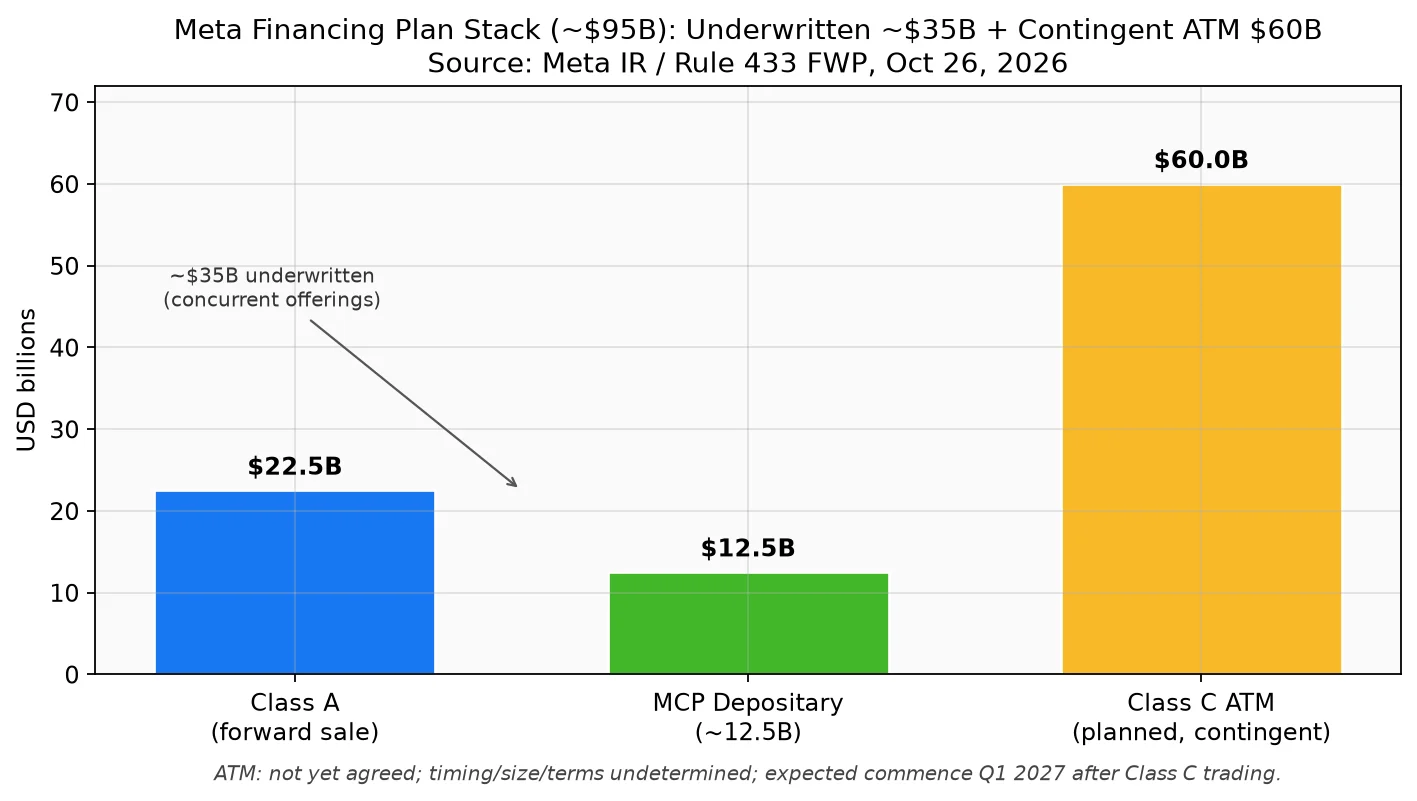
Depositary / mandatory convertible preferred: 250,000,000 Series A depositary shares, each a 1/20th interest in a share of newly issued Series A Mandatory Convertible Preferred Stock. Underwriters get a 30-day option for an additional 37,500,000 depositary shares. Preferred liquidation preference is expected at $1,000 per preferred share. Dividend rate and conversion terms are set at pricing. Automatic conversion settlement is on or about August 15, 2029. Listing target: METAM. Net proceeds from the depositary offering are for general corporate purposes. Rough economics: ~$12.5 billion of this sleeve in the financing-plan summary.
-
Class A common via forward sale: $22.5 billion of Class A offered in connection with forward sale agreements with Morgan Stanley Capital Services LLC and Goldman Sachs & Co. LLC. Underwriters' option: up to an additional $3.375 billion of Class A (with additional forwards if exercised). Critical trap for headline readers: Meta does not initially receive proceeds from the forward sellers' (or affiliates') sale of those Class A shares. Meta intends to issue and deliver shares on settlement dates it chooses on or prior to November 19, 2027, in exchange for cash at the forward sale price (public offering price less underwriting discounts, subject to adjustments). Upon Class C issuance and certain conditions, the forwards can reference Class A and Class C, and in certain circumstances Meta may settle entirely in Class C.
Future ATM (~$60 billion, contingent): Meta plans an approximately $60 billion at-the-market program of Class C upon Class C trading. It has not entered into an agreement; timing, size, and terms are undetermined; there is no assurance the ATM is established as described or at all. Expected commencement, if it happens: Q1 2027. Sales under any ATM are not conditioned on the underwritten offerings.
Lead joint bookrunners: Morgan Stanley & Co. LLC and Goldman Sachs & Co. LLC. The two offerings are not cross-conditioned.
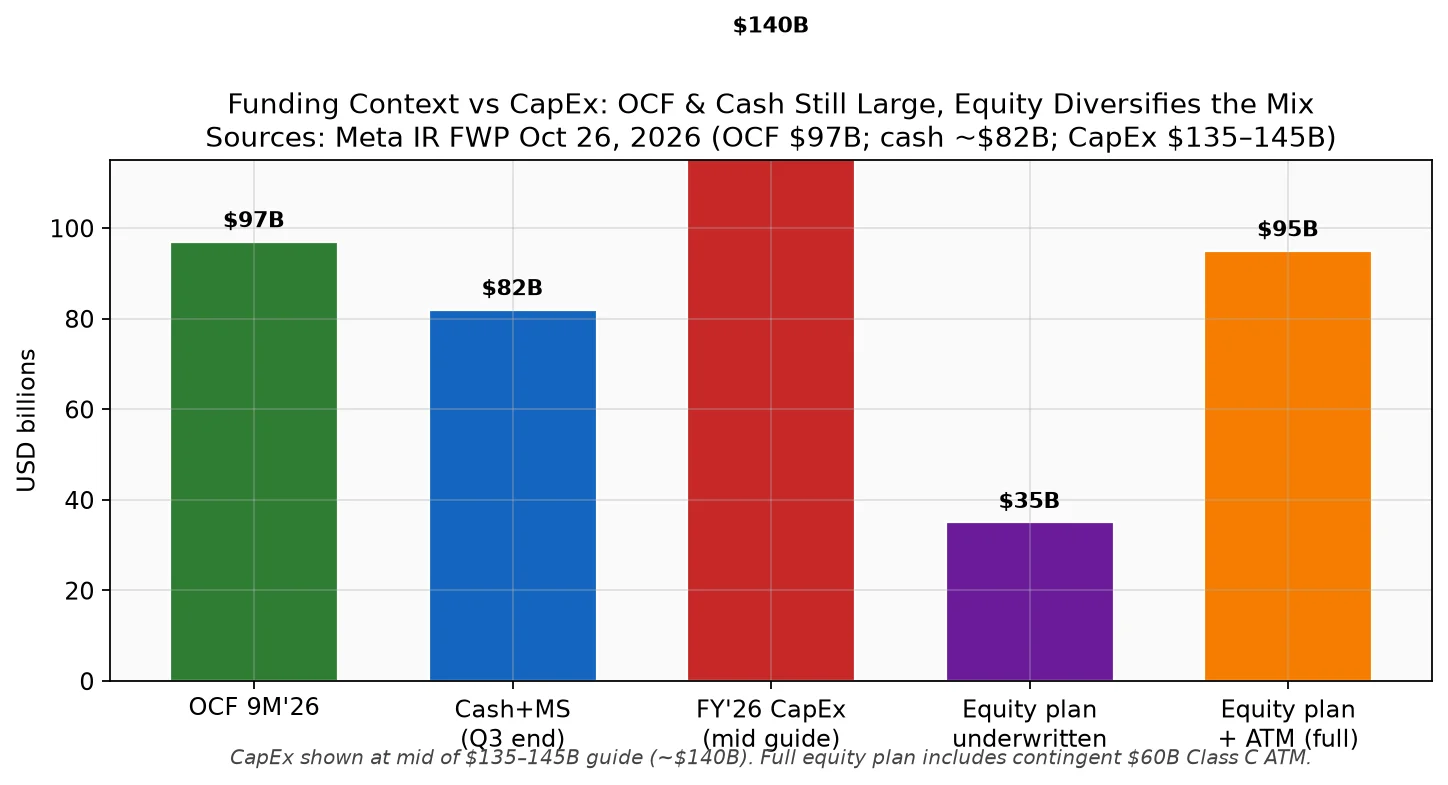
Two traps matter for sell-side models. First, timing of cash. The preferred sleeve can bring cash nearer-term; the Class A forward sleeve brings cash when Meta elects to settle, through November 19, 2027 — a design that lets Meta match equity funding to CapEx draws rather than park a giant cash pile on day one. Second, contingency of the $60 billion. Any model that treats $95 billion as "raised" is wrong; any model that treats $60 billion as zero because it is "only planned" is also incomplete. The Class C charter amendment was filed in Delaware on October 21, 2026, with effectiveness framed around January 19, 2027, and a declared Class C dividend (one Class C for each outstanding Class A and Class B, contingent on charter effectiveness) that markets often read as an effective 2-for-1 pricing mechanic without changing the A/B voting stack. The ATM is the financing use of that governance tool.
Management's story: "financial discipline" with an equity pen
Meta's own framing in the IR release and FWP is deliberate. The company says AI is already producing tangible returns — engagement, advertising performance, monetization — while it pursues personal superintelligence, consumer and business agents, enterprise products, and AI glasses. CapEx of $135–$145 billion in 2026 is presented as the price of bringing that stack to billions of people and businesses. Funding, Meta says, will be a balanced mix of operating cash flow, investment-grade debt, strategic partnerships, and equity capital. The equity offerings and future ATM are positioned as complementary and diversifying — not as a confession that OCF failed.
That voice has to be stress-tested against the Q3 cash bridge. In the third quarter, CapEx including lease principal ($34.91 billion) exceeded OCF ($32.79 billion) and FCF printed −$2.12 billion. Year-to-date CapEx including leases ran about $85.8 billion. The FY CapEx mid-point near $140 billion implies a heavy fourth-quarter spend band if the company tracks the guide. OCF of $97 billion through nine months is extraordinary by any historical Meta standard — and still may not, alone, comfortably cover a CapEx year in the mid-$140 billions while also preserving balance-sheet optionality, partnership flexibility, and the political economy of not levering the Aa3/AA- rating into the ground.
So the management story is coherent if you accept the premise: the ads flywheel funds a large share of AI, but not all of a wartime CapEx curve, and Meta would rather diversify funding early than discover a funding gap late. The Class C non-voting design is the governance half of that story — raise equity without the same voting dilution path. Whether public holders celebrate "discipline" or resent "control-preserving dilution" is a preference, not a spreadsheet cell.
Risk ledger: CapEx ROI, dilution math, Class C supply, circular silicon capital
CapEx ROI risk. Meta does not have a hyperscale cloud P&L that can show AI infrastructure as rentable capacity to third parties at disclosed utilization. Returns must show up as ad ranking lift, Reels/video engagement, Muse monetization, Business Agent attachment, and eventual enterprise inference margins. Muse's early shopping mix and agent conversation counts are encouraging product signals; they are not yet a CapEx payback schedule. Four >1 GW superclusters and a near-doubling of infrastructure capacity are impressive engineering facts — and they raise the bar for evidence that each incremental watt earns its keep inside Meta's own products.
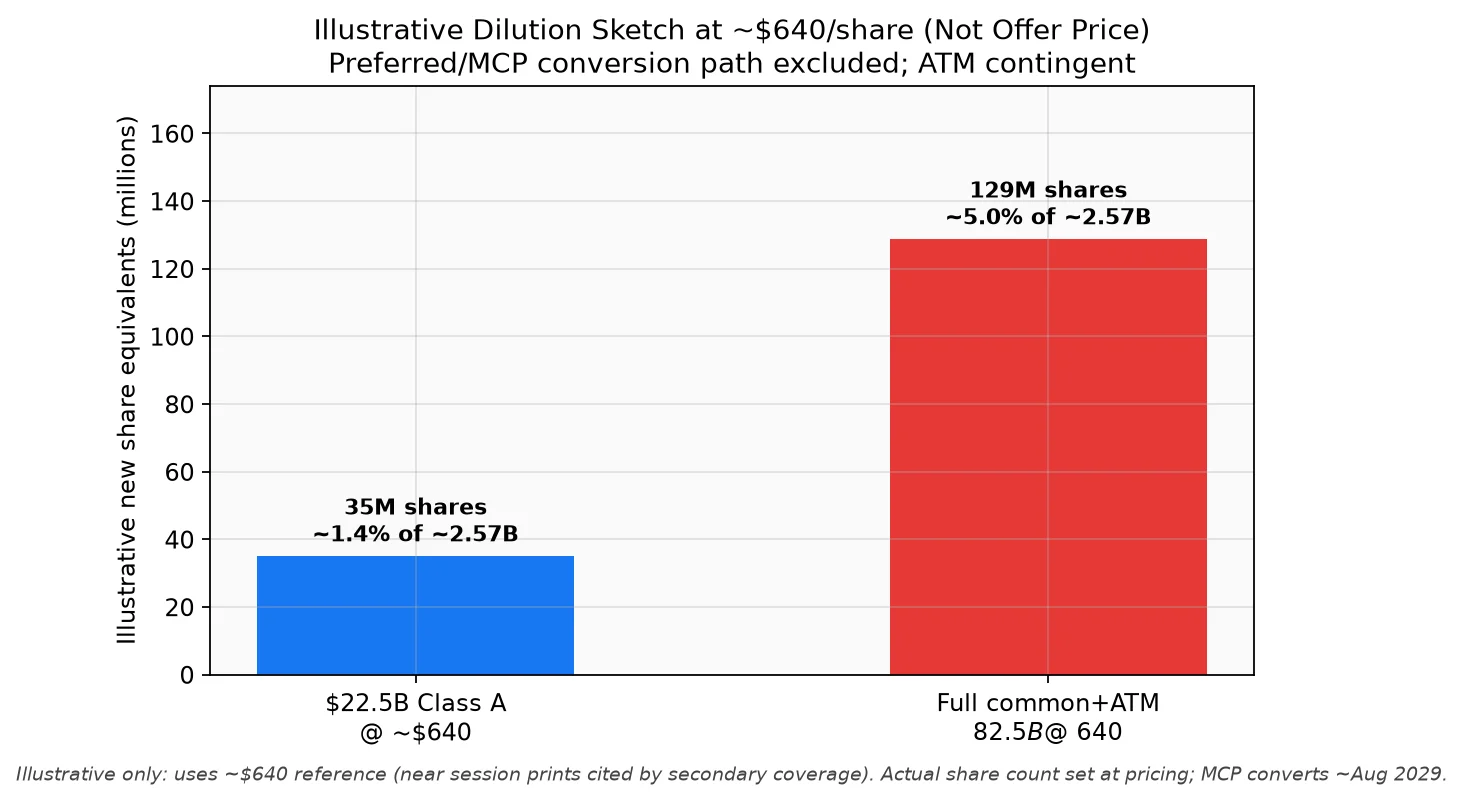
Dilution risk. Treat numbers as illustrative, not as the priced deal. Using a reference price near $640 (in the neighborhood of secondary session prints discussed around the announcement), $22.5 billion of Class A implies on the order of ~35 million share equivalents — roughly ~1.4% of an approximate ~2.57 billion diluted share base inferred from Q3 net income and diluted EPS in Meta's earnings materials. Stretching to $82.5 billion of common-plus-ATM ($22.5B + $60B), still at ~$640 and still excluding preferred conversion complexity, lands near ~129 million share equivalents, or about ~5% of that same base — the mid-single-digit zone Canaccord highlighted for the full plan. Preferred conversion in 2029 adds another layer that depends on dividend and conversion terms set at pricing. The ATM may never print full size. Share counts will be set by actual offer prices, not by this sketch.
Class C supply risk. Non-voting stock can trade at a discount to voting Class A in some multi-class histories; it can also become the preferred issuance currency precisely because it protects control. Either way, a $60 billion ATM authorization — even if used gradually — is a multi-quarter overhang narrative. Index and active managers will argue about float, voting premium, and whether Class C becomes the "AI funding share class."
Circular chip-supplier capital. NVIDIA, AMD, and Broadcom's non-binding IOI for up to $5.0 billion aggregate of the Class A offering is strategically elegant and analytically awkward. Suppliers investing in a customer's equity raise while that customer buys their silicon is not illegal and may be economically rational; it is also the sort of circularity that skeptics will put on every AI-capex slide until utilization and incremental ROIC data arrive. The FWP is explicit: indications are not binding; any cornerstone may buy more, fewer, or none; underwriters may sell them more, fewer, or none.
Balance-sheet mix risk. Meta already leaned more on debt into 2026 (long-term debt was elevated versus year-end 2025 in the Q3 materials). Equity diversifies that path. Too much equity, and dilution dominates the narrative. Too little, and the next CapEx guide raise reopens the funding debate. The Aa3/AA- rating is an asset Meta is trying not to spend carelessly.
Long vs short: named voices on the day
Canaccord reiterated Buy with a $950 price target after the underwritten offerings. The firm characterized full-plan dilution as manageable — mid-single-digit percentage of shares if the broader plan prints — and framed offering-related pressure as largely technical rather than a change in the long-term thesis, pointing to the six-quarter >20% revenue-growth streak and still-attractive growth/multiple optics in their note as summarized in secondary coverage.
William Blair reiterated Outperform. The constructive read, as summarized in Street coverage, is double-edged in a useful way: the financing reinforces confidence in AI returns and underscores how capital-intensive the race has become. Blair's posture implies investors will keep questioning financing and future raises even while staying constructive on the equity — a "yes, and" rather than a binary.
Wedbush's Dan Ives reiterated Outperform with a price target around $920, treating the Class C / AI funding architecture as consistent with the AI infrastructure thesis rather than a thesis-breaker.
Rosenblatt maintained Buy with a $900 target in the post-Q3 context, while secondary summaries also flagged the firm's concern about the scale and language around future capital raises — bullish rating, open eyes on the funding path.
Reuters / broad tape framed the plan as Meta eyeing a record-scale equity raise for AI expansion — language that itself shapes retail and systematic flows even when the ATM is still a plan.
The long case, synthesized: ads growth plus early Muse/agent traction justifies wartime CapEx; equity is cheaper than underfunding the infra curve; dilution is mid-single digits if the whole envelope prints; chip cornerstones are a soft demand signal; Class C preserves strategic control while funding the build.
The short case, synthesized: FCF already flipped negative in Q3; CapEx guide mid ~$140B may not be the peak year; buybacks are gone; Class C ATM is a standing dilution option; preferred converts later into common-equivalent supply; supplier IOIs look circular; Anthropic's same-day S-1 reminds everyone that AI funding pressure is industry-wide and competing for the same risk capital.
Side plots that matter: Anthropic's S-1, silicon IOIs, and the Oct 21 Class C charter
Anthropic. The same calendar day, Anthropic filed an S-1 for a proposed IPO (ticker ANT in registration materials). First-half 2026 revenue was about $16.29 billion, with an operating loss near $693 million and a net loss near $80.7 billion driven largely by non-cash fair-value charges on notes — a reminder that AI funding pressure is not Meta-specific. Meta's equity tap and Anthropic's registration are different instruments on the same macro theme: the private and public markets are being asked to underwrite an infrastructure supercycle. For META holders, Anthropic is a side plot, not the thesis — but it colors risk appetite for "more AI equity supply" on a Monday.
Silicon cornerstones. The NVDA/AMD/AVGO IOI up to $5.0 billion aggregate is small versus a $22.5 billion Class A sleeve, let alone a $95 billion plan — yet it is large as a signaling device. Watch whether any of it becomes a binding allocation in final pricing disclosures.
Class C charter (Oct 21). The financing announcement is the second act of a play that opened with Q3 earnings: Delaware amended and restated certificate filed October 21, 2026, Class C non-voting common established, effectiveness framed for January 19, 2027, and a contingent Class C dividend declared. Five days later, Meta told the market what Class C is for in capital-markets language: an ATM-sized equity toolkit. Governance first, prospectus second — that sequencing was not accidental.
Braiding one thesis
Meta on October 26 was not "broken ads" and not "infinite free cash." It was a cash-generative advertising platform electing to socialize part of an AI infrastructure wartime budget across public equity, while preserving founder-era voting architecture through Class C and delaying some common-equity cash via forwards into 2027. The initial selloff priced dilution and regime change. The partial reverse priced quality of the underlying business and the optionality of funding the build without pretending OCF alone is enough for a $135–$145 billion CapEx year. The closing print near a ~2% decline (Investing.com's −1.88% session mark) left the argument open — which is usually where multi-quarter AI funding debates live.
The investable question is therefore not "is $95 billion big?" It is. The question is whether incremental returns on Meta's own distribution — 3.64 billion DAP, AI-ranked ads, Muse commerce, Business Agent conversations — compound faster than the dilution and CapEx depreciation curves. If they do, today's equity tap looks like pre-funding a scarcity asset (compute + distribution). If they do not, today's equity tap looks like the moment the market learned that even Meta's OCF cannot paper over an open-ended watts race.
Falsifiable watchpoints
- Pricing and greenshoe: Final Class A offer price, preferred dividend/conversion terms, and whether the $3.375B / 37.5M options are exercised.
- Forward settlement pace: How quickly Meta settles the Class A forwards into cash before the November 19, 2027 outside date — and whether settlement migrates to Class C.
- ATM reality check: Whether a Class C ATM agreement is actually signed, at what size versus the $60B sketch, and the run-rate of issuance in Q1–Q2 2027.
- Q4 CapEx and FCF: Whether Q4 CapEx lands near the implied ~$49–59B residual band from the FY $135–145B guide and whether FCF stays negative.
- Cornerstone conversion: Whether NVDA/AMD/AVGO IOIs become real allocations in final deal docs — and at what size versus the $5.0B aggregate ceiling.
- Ads + Muse KPIs: Whether FoA revenue growth stays in the >20% club and whether Muse shopping/agent metrics graduate from early-week anecdotes to durable monetization in subsequent quarters.
- Capital-return policy: Whether buybacks remain halted through 2027 CapEx years or reappear as a signal that equity funding pressure has eased.
- Credit and debt mix: Whether Aa3/AA- and the debt/equity mix stay "balanced" as Meta described — or whether another funding instrument surprises the tape.
For investors tracking mega-cap AI funding and dilution in real time, Alphio's research and copy-trade tools can help follow how discretionary and systematic flows reprice names like META when CapEx and equity issuance collide — useful context alongside primary IR and SEC filings, not a substitute for them.
Primary sources: Meta Platforms IR press release, Oct 26, 2026; Meta Rule 433 Free Writing Prospectus (SEC EDGAR); Meta preliminary prospectus supplement / 424B5 materials; Meta Q3 2026 earnings materials (CapEx, OCF, FCF, buybacks, Class C charter context). Secondary (market path / analyst): CNBC, Investing.com, WSJ, StreetInsider/Reuters summaries of Canaccord, William Blair, Wedbush/Ives, Rosenblatt. Side plot: Anthropic S-1 registration materials (SEC). Figures not from Meta IR are labeled as secondary or illustrative.
FAQs
How large is Meta's October 26, 2026 equity financing plan?
Meta described a financing plan of roughly $95 billion: about $35 billion in concurrent underwritten offerings ($22.5 billion Class A via forward sales plus about $12.5 billion of Series A mandatory convertible preferred depositary shares) and a planned approximately $60 billion Class C at-the-market program. The ATM is not yet agreed; timing, size, and terms are undetermined; it is expected to commence in Q1 2027 after Class C trading, if established.
Does Meta receive the $22.5 billion Class A proceeds immediately?
No. Meta does not initially receive proceeds from the forward sellers' sale of Class A shares. Under the forward sale agreements with Morgan Stanley Capital Services LLC and Goldman Sachs & Co. LLC, Meta intends to deliver shares for cash at the forward sale price on dates it chooses on or prior to November 19, 2027.
Why is Meta raising equity if operating cash flow is still strong?
Meta generated $97 billion of operating cash flow in the first three quarters of 2026 and held about $82 billion of cash and marketable securities at Q3-end, but expects $135–$145 billion of 2026 CapEx. Q3 CapEx of $34.91 billion exceeded Q3 OCF of $32.79 billion and FCF was −$2.12 billion. Meta frames equity as complementary to OCF, investment-grade debt, and partnerships.
How much dilution could the plan represent?
It depends on pricing and how much of the contingent ATM prints. Canaccord characterized full-plan dilution as mid-single-digit percent of shares if the broader plan is completed, and called near-term pressure largely technical. An illustrative sketch at ~$640 (not the offer price) puts $22.5 billion of Class A near ~35 million share equivalents (~1.4% of an approximate ~2.57 billion diluted base) and $82.5 billion common-plus-ATM near ~5% — preferred conversion terms are set at pricing.
What are NVIDIA, AMD, and Broadcom doing in the deal?
As cornerstone investors, they have severally indicated non-binding interest in purchasing up to an aggregate $5.0 billion of Class A shares in the common offering at the same price and terms as other purchasers. They may buy more, fewer, or none; underwriters may sell them more, fewer, or none.
Related articles
- Stock Market Surges After 2026 Midterms: What the Democratic Sweep Means for Your PortfolioThe stock market rallied after Democrats won the 2026 midterms. Discover what the election means for investors, tech stocks, and the S&P 500 outlook.
- Stock Market Surges After 2026 Midterms: What the Democratic Sweep Means for Your PortfolioThe stock market rallied after Democrats won the 2026 midterms. Discover what the election means for investors, tech stocks, and the S&P 500 outlook.
- Oil Prices Surge Above $105 Amid US-Iran Conflict: Energy Investment Opportunities in November 2026Oil prices climb past $105 as US strikes Iran's Qeshm Island. Discover energy investment opportunities, top oil stocks, and market outlook for November 2026.
- Micron Stock Analysis 2026: Can AI Demand Drive MU to $3,000 by 2027?Comprehensive Micron stock analysis for 2026. Explore MU's AI-driven growth potential, memory chip demand, and whether it can reach $3,000 by 2027.
- Top 6 Crypto Trading Bots in 2026: Tested and RankedWe tested and ranked the top 6 crypto trading bots for 2026. From Cryptohopper to Alphio to 3Commas, find out which automated trading platform suits your needs.
- Microsoft Q4 2026 Earnings: Breaking Down the $331 Billion Revenue MilestoneMicrosoft's Q4 2026 earnings reveal record-breaking revenue of $331B+. Explore Azure growth, AI integration, cloud dominance, and investment outlook for MSFT stock.