

Micron Stock Analysis 2026: Can AI Demand Drive MU to $3,000 by 2027?
Comprehensive Micron stock analysis for 2026. Explore MU's AI-driven growth potential, memory chip demand, and whether it can reach $3,000 by 2027.

Key Takeaway
Micron Technology stands at the epicenter of the artificial intelligence revolution, with its high-bandwidth memory (HBM) chips becoming essential components for AI data centers worldwide. As the demand for AI computing power accelerates exponentially, Micron's strategic positioning in the memory semiconductor market has transformed the company from a cyclical commodity producer into a critical infrastructure provider for the digital economy. Recent analyst predictions suggesting Micron stock could surpass $3,000 per share by 2027 reflect not merely optimistic speculation, but rather a fundamental reassessment of the company's growth trajectory driven by structural shifts in the technology landscape.
The memory chip market has entered a new paradigm where supply constraints and technological complexity have created significant barriers to entry, benefiting established leaders like Micron. Unlike previous semiconductor cycles characterized by boom-and-bust price fluctuations, the current environment features sustained demand from hyperscale cloud providers racing to build AI infrastructure. This structural demand shift, combined with Micron's technological leadership in advanced memory solutions, positions the company for unprecedented revenue growth and margin expansion over the coming years.
For investors evaluating Micron's investment thesis, the critical question extends beyond near-term price targets to understanding whether the company can maintain its competitive advantages as AI workloads continue to evolve. The transition from traditional DRAM to high-bandwidth memory represents both an opportunity and a challenge, requiring sustained capital investment and manufacturing excellence while delivering the performance characteristics that AI applications demand.
The AI Memory Revolution
The artificial intelligence boom has fundamentally altered the memory semiconductor landscape, creating demand dynamics that differ substantially from previous technology cycles. Training large language models and running inference workloads requires massive amounts of high-speed memory, with each AI accelerator card containing multiple HBM stacks that command premium pricing compared to conventional DRAM modules. This shift has transformed memory from a commoditized component into a differentiated, high-value product essential for AI performance.
Micron's investment in HBM3E technology positions the company to capture significant market share as hyperscale customers expand their AI infrastructure. The company's manufacturing capabilities and research investments have enabled it to produce memory solutions that meet the stringent performance requirements of next-generation AI chips from Nvidia, AMD, and custom silicon developed by cloud providers. This technological alignment with the AI ecosystem creates customer relationships and volume commitments that extend beyond typical semiconductor procurement cycles.
The memory intensity of AI workloads continues to increase as models grow larger and more complex. Each successive generation of AI accelerators requires greater memory bandwidth and capacity, driving upgrade cycles that benefit memory suppliers with advanced technology roadmaps. Micron's focus on developing next-generation memory architectures positions the company to participate in this ongoing technology evolution, potentially capturing value from the secular growth trends in artificial intelligence applications.
Market Position and Competitive Dynamics
Micron operates in an oligopolistic market structure alongside Samsung and SK Hynix, with these three companies controlling the vast majority of global DRAM and NAND flash production. This concentrated competitive landscape has historically led to supply discipline during downturns and pricing power during periods of strong demand. The AI-driven memory upgrade cycle has further consolidated competitive advantages among technology leaders, as developing advanced HBM capabilities requires substantial R&D investment and manufacturing expertise that smaller competitors cannot easily replicate.
The company's manufacturing footprint across the United States, Singapore, and Japan provides geographic diversification and supply chain resilience increasingly valued by customers concerned about geopolitical risks. Micron's investments in domestic manufacturing, supported by CHIPS Act incentives, position the company to benefit from the reshoring trend while potentially qualifying for preferential treatment in government procurement and strategic technology initiatives.
Competitive positioning in the HBM market requires not only technological capability but also the manufacturing scale to meet the enormous demand from AI infrastructure buildouts. Micron's capital investments in advanced packaging and memory manufacturing capacity demonstrate management's confidence in sustained demand growth and the company's ability to capture market share from competitors. The transition to HBM3E and eventual HBM4 architectures will likely favor companies with the deepest technical expertise and strongest customer relationships.
Financial Performance and Valuation Metrics
Micron's recent financial results reflect the improving demand environment and the company's ability to leverage its technology leadership into stronger pricing and margins. Revenue growth has accelerated as AI customers ramp their infrastructure investments, while the mix shift toward higher-value HBM products has expanded gross margins beyond levels achievable with commodity memory sales. This margin expansion represents a structural improvement in Micron's profitability profile, potentially enabling sustained higher returns on invested capital.
The company's balance sheet has strengthened considerably following periods of disciplined capital allocation and debt reduction. Micron's financial flexibility enables continued investment in advanced manufacturing while maintaining capacity to return capital to shareholders through dividends and share repurchases. The recent dividend increases signal management's confidence in sustainable cash flow generation and the reduced cyclicality of the underlying business model.
Valuation metrics must be interpreted within the context of Micron's transformation from a cyclical commodity business to a technology growth company. Traditional price-to-earnings multiples may understate the company's value during investment-intensive periods when earnings are depressed by depreciation and R&D spending. Analysts increasingly focus on revenue multiples and long-term earnings power as more appropriate valuation frameworks for assessing Micron's intrinsic value in the AI era.
For investors seeking to automate their trading strategies and capitalize on opportunities like Micron's growth trajectory, consider using Alphio AI's copy trading feature to mirror successful traders and smart money wallets who are positioning for the AI semiconductor boom.

The Path to $3,000: Analyst Perspectives
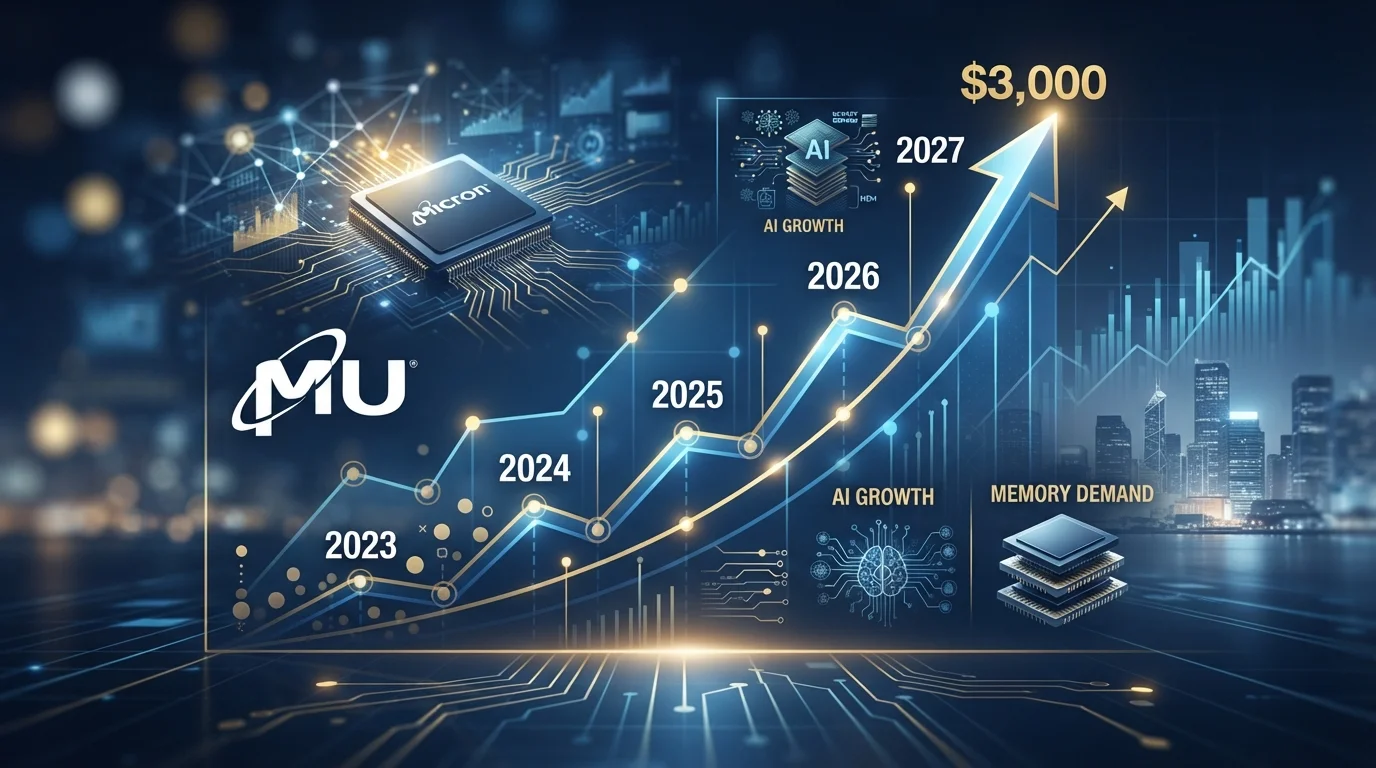
The ambitious price target of $3,000 per share by 2027 implies a multi-trillion dollar market capitalization that would place Micron among the most valuable companies globally. Achieving this valuation would require not only continued execution on the company's technology roadmap but also sustained demand growth from AI applications and potential market share gains from competitors. While such targets capture attention and reflect optimistic scenarios, investors should evaluate the underlying assumptions and probability-weighted outcomes.
Key variables determining Micron's long-term value creation include the growth trajectory of AI infrastructure spending, the company's success in advancing its technology position, and the competitive dynamics within the memory oligopoly. Each percentage point of market share gained from Samsung or SK Hynix in the HBM market translates to billions in incremental revenue given the high value content per AI accelerator. The company's progress in qualifying its products with major AI chip designers represents critical milestones for realizing these growth projections.
The timing of new product introductions and manufacturing capacity ramps will significantly influence Micron's financial trajectory. The company's ability to accelerate its HBM3E production and successfully develop HBM4 technology ahead of competitors could create temporary periods of supply-constrained pricing that dramatically expand profitability. Conversely, delays in technology development or manufacturing execution could cede market opportunities to better-positioned competitors.
Risk Factors and Considerations
Despite the compelling growth narrative, Micron faces significant risks that could derail optimistic projections. The semiconductor industry remains inherently cyclical, and while AI demand appears structural, memory markets have historically experienced periods of oversupply that crush pricing and profitability. Competitors may increase capital expenditures more aggressively than expected, potentially creating supply gluts that undermine pricing discipline within the oligopoly.
Geopolitical tensions between the United States and China pose ongoing risks for semiconductor companies with significant exposure to Chinese markets. Export controls and trade restrictions could limit Micron's ability to serve certain customers or regions, potentially ceding market share to competitors with different geographic footprints. The company's investments in domestic manufacturing provide some insulation from these risks but do not eliminate them entirely.
Technology transitions present both opportunities and execution challenges. The shift from planar DRAM to 3D architectures and the evolution of HBM packaging require substantial capital investment and manufacturing innovation. Any missteps in technology development or yield improvement could result in market share losses that persist for years given the long product qualification cycles in the semiconductor industry.
For sophisticated investors looking to navigate these complexities, Alphio's agentic trading capabilities offer automated portfolio management that can adapt to changing market conditions and volatility in the semiconductor sector.

Strategic Implications for Investors
Investors considering Micron should evaluate the stock within the context of their overall portfolio and risk tolerance. The company's transformation story offers compelling upside potential for those willing to accept the inherent volatility of semiconductor investments. Position sizing should reflect the binary outcomes possible in technology investments, where execution success or failure can dramatically alter company trajectories over multi-year periods.
Diversification within the AI theme may be prudent for investors seeking exposure to the semiconductor opportunity while managing single-company risk. Micron's memory-focused business model differs from the logic chip dominance of Nvidia or the diversified portfolio of Broadcom, offering a distinct risk-reward profile within the AI ecosystem. Combining positions across the semiconductor value chain can provide more balanced exposure to the AI infrastructure buildout.
The investment horizon matters significantly for Micron's thesis realization. Short-term traders may find opportunities in the stock's characteristic volatility around earnings announcements and industry data releases. Long-term investors focused on the AI transformation story should be prepared for multi-year holding periods as the memory market evolves and Micron's technology investments mature into revenue and earnings contributions.
Explore Alphio's automation features to set conditional workflows that execute trades based on technical indicators or earnings events for stocks like Micron.

Industry Trends and Demand Drivers
Beyond artificial intelligence, multiple technology trends drive demand for Micron's memory products. Edge computing applications require increasing memory content as processing moves closer to data sources, while automotive electrification and autonomous driving features consume substantial memory resources for sensor fusion and decision-making systems. These diverse demand sources provide some insulation from over-reliance on any single technology cycle.
The data center expansion driven by cloud computing continues to create baseline demand for commodity DRAM and NAND flash products. While these markets lack the explosive growth characteristics of AI memory, they provide stable revenue foundations that support ongoing capital investment and technology development. The combination of high-growth HBM segments and steady mainstream memory demand creates a more balanced business model than Micron has historically enjoyed.
Emerging applications in virtual reality, augmented reality, and the Internet of Things represent potential future demand sources that could surprise to the upside as these technologies mature and achieve mainstream adoption. Micron's broad product portfolio positions the company to participate across these diverse end markets, with manufacturing flexibility enabling production allocation toward the most profitable opportunities as market conditions evolve.
Conclusion
Micron Technology represents one of the most compelling investment opportunities in the semiconductor sector, benefiting from the structural shift toward AI-driven memory demand while maintaining exposure to broader technology trends. The company's technological leadership in high-bandwidth memory, combined with the oligopolistic market structure and growing barriers to entry, creates favorable conditions for sustained value creation over the coming years.
While price targets exceeding $3,000 per share by 2027 reflect optimistic scenarios requiring near-perfect execution, the fundamental thesis for Micron's outperformance remains robust. Investors should focus on the company's progress in HBM market share gains, margin expansion trends, and capital allocation discipline as key indicators for evaluating the investment thesis over time.
For those seeking exposure to the AI infrastructure buildout through a differentiated position in the memory semiconductor market, Micron offers an attractive risk-adjusted return profile. The combination of technology leadership, manufacturing scale, and favorable industry dynamics positions the company to generate substantial shareholder returns as artificial intelligence transforms the global economy.
Ready to take advantage of opportunities like Micron's AI-driven growth? Experience the future of trading with Alphio's conversational trading interface - execute trades via chat and let AI power your investment decisions.

FAQs
What makes Micron stock attractive for AI investors?
Micron produces high-bandwidth memory (HBM) chips essential for AI data centers and training large language models. As AI infrastructure spending accelerates, Micron's specialized memory products command premium pricing and strong demand from hyperscale cloud providers, transforming the company from a cyclical commodity producer into a critical AI technology supplier.
Can Micron stock really reach $3,000 by 2027?
The $3,000 price target represents an optimistic scenario requiring sustained AI demand growth, successful HBM market share gains from competitors, and continued technology leadership. While ambitious, such targets reflect the structural shift in memory demand driven by AI workloads and the oligopolistic market structure that benefits established players like Micron.
What are the main risks of investing in Micron?
Key risks include semiconductor industry cyclicality, potential oversupply from competitor capacity expansion, geopolitical tensions affecting China market access, technology execution challenges in HBM development, and the possibility that AI demand growth slows or fails to meet optimistic projections.
How does Micron compare to Nvidia as an AI investment?
While Nvidia dominates AI accelerators and graphics processors, Micron specializes in the high-bandwidth memory required by these chips. Micron offers exposure to AI infrastructure growth through a different value chain position, with potentially less extreme valuation multiples but similar exposure to AI demand trends.
Should I invest in Micron for the long term?
Micron may suit investors seeking exposure to AI infrastructure trends through a differentiated semiconductor position. Consider your risk tolerance for cyclical stocks, portfolio diversification needs, and belief in sustained AI memory demand growth. Long-term investors should monitor HBM market share, margin trends, and capital allocation discipline as key success indicators.
Related articles
- Stock Market Surges After 2026 Midterms: What the Democratic Sweep Means for Your PortfolioThe stock market rallied after Democrats won the 2026 midterms. Discover what the election means for investors, tech stocks, and the S&P 500 outlook.
- Stock Market Surges After 2026 Midterms: What the Democratic Sweep Means for Your PortfolioThe stock market rallied after Democrats won the 2026 midterms. Discover what the election means for investors, tech stocks, and the S&P 500 outlook.
- Oil Prices Surge Above $105 Amid US-Iran Conflict: Energy Investment Opportunities in November 2026Oil prices climb past $105 as US strikes Iran's Qeshm Island. Discover energy investment opportunities, top oil stocks, and market outlook for November 2026.
- Stripe's 3 Billion PayPal Takeover Bid: The Largest Fintech Acquisition in HistoryStripe and Advent's 3 billion bid for PayPal signals a historic fintech consolidation. Explore the strategic implications, antitrust concerns, and what this means for investors.
- Gold Investment Strategy 2026: How to Protect Your Portfolio as US Debt Nears 40 TrillionDiscover the best gold investment strategies for 2026. Learn how to hedge against inflation and economic uncertainty with physical gold, ETFs, and mining stocks.
- How to Build Passive Dividend Income: A Complete Strategy Guide for 2026Learn how to build sustainable passive dividend income with proven strategies, stock picks, and portfolio allocation. Expert guide to dividend investing in 2026.