

Equal-Weight S&P 500 vs Magnificent 7: How to Diversify a Top-Heavy Index in 2026
Equal-weight S&P 500 vs Mag 7 concentration (Oct 2026): Mag 7 near 35% of SPX, RSP vs SPY/VOO tradeoffs, fees, and how to diversify a top-heavy index.

Key Takeaway
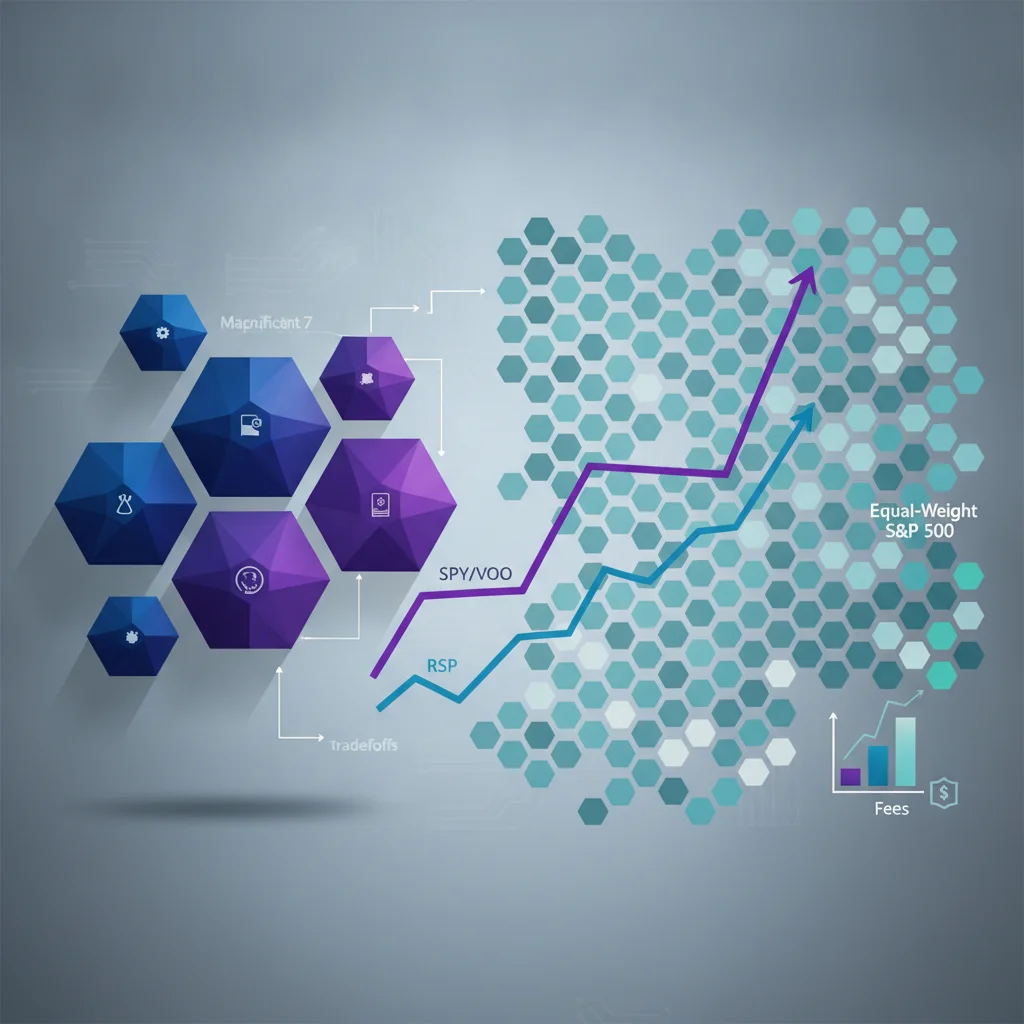
By late October 2026 the S&P 500 no longer looks like a broad basket of five hundred businesses so much as a concentrated bet on a handful of AI-era platforms. The Magnificent 7—NVIDIA, Apple, Microsoft, Alphabet, Amazon, Meta, and Tesla—account for roughly 34.5% to 34.9% of the index by market weight, depending on the mid-to-late October snapshot you read. Motley Fool’s late-October framing put the group near 34.9%; SimianX’s mid-October SPY holdings landed around 34.8%; WealthyBud’s October 1 read sat near 34.5%. The top ten names as a whole absorb about 38% to 40% of the index. That is not a rounding error in “passive” ownership. It is the portfolio.
Equal-weight is the clearest mechanical answer to that tilt. Invesco’s S&P 500 Equal Weight ETF (RSP) holds each constituent near 0.2%, so the Mag 7 combined shrink to roughly 1.4% of the fund versus more than 32% in SPY, and the top ten fall to about 3% versus roughly 40% in VOO or SPY. Technology’s slice compresses from the mid-30s in cap-weight toward the mid-teens in equal-weight. RSP crossed about $100 billion in assets in August 2026 after more than $12 billion of year-to-date inflows, and late-October commentary still highlighted equal-weight gaining more than 13% on the year even as 2026 leadership stayed mixed versus the Mag 7 dominance of 2023–24. This article explains what that concentration actually means for “set it and forget it” investors, how equal-weight rebalancing and sector tilt work, when RSP historically wins or loses versus SPY and VOO, how the October Fed-and-earnings backdrop reframes the debate, and how to blend rather than flip a switch—without pretending either sleeve is permanently superior.
Educational note only: nothing here is investment advice. Index weights, returns, and expense ratios move; verify live figures before you act.
Why Concentration Matters Now
The index that stopped looking diversified
For two decades the marketing of large-cap U.S. equity indexing rested on a simple promise: buy the S&P 500 and you own corporate America in proportion to its public equity value. That promise still holds mathematically. Economically it has drifted. When seven names approach a third of the index and ten names approach two-fifths, a dollar of new SPY or VOO capital is no longer spreading risk across factories, banks, retailers, and utilities in anything like equal measure. It is amplifying the same AI, cloud, advertising, and consumer-platform narratives that already dominate headlines. Concentration risk is the arithmetic of free-float market capitalization meeting a multi-year megacap bull run.
Passive ownership as an active Mag 7 bet
The uncomfortable implication is that many “passive” investors already run an active Magnificent 7 overweight without ever writing a thesis. WisdomTree’s historical framing that Mag 7 drove more than half of S&P gains in 2023–24 made that bet look brilliant in hindsight. 2026 has been messier. Exent data for January 1 through September 30 showed SPY up about 12.1%, a Mag 7 size-weighted sleeve near +11.5%, Mag 7 equal-weight near +10.5%, RSP near +9.1%, and QQQ near +20.6%. Cap-weight still led equal-weight over that window, yet the Mag 7 themselves did not cleanly outrun the broad index the way they did in the prior two years. Leadership that is mixed rather than monopolistic is exactly when investors start asking whether the next decade should look like the last one.
What “top-heavy” feels like in a selloff or a rotation
Concentration matters most when the market stops rewarding the same seven tickers. A 3% drawdown in NVIDIA when it is roughly 8% of the index is not a sector footnote; it is an index event. Alphabet’s late-October revenue miss and higher 2027 capital-expenditure outlook spooked AI-adjacent risk appetite precisely because Alphabet is a mid-single-digit weight, not a 0.2% equal-weight name. Microsoft’s mixed-positive print and Oracle’s muted capex outlook tugged the same narrative rope in opposite directions. In a top-heavy index, earnings weeks for a few platforms rewrite breadth statistics for everyone who thought they owned “the market.”
What Mag 7 Weight Means for “Passive” Investors
Approximate weights, late October 2026
Approximate individual weights in the late-October 2026 conversation—drawing Motley Fool’s October 29 context together with SimianX’s mid-October holdings—put NVIDIA near 8%, Apple near 6.9% to 7.5%, Microsoft near 5.5% to 6%, Alphabet near 5.5% to 6%, Amazon near 3.8%, Meta near 2.5%, and Tesla near 1.6% to 2.1%. Those ranges move daily with prices; treat them as order-of-magnitude facts, not permanent allocations. The structural point survives the rounding: a handful of platforms dwarf hundreds of industrials, financials, and health-care names that each sit near or below 0.5% in a cap-weighted S&P 500.
Diversification theater versus economic exposure
Owning five hundred stocks is not the same as owning five hundred economically independent cash-flow streams. When Mag 7 shares correlated AI-capex, cloud, advertising, and consumer-tech risk factors, the effective number of independent bets inside the S&P 500 shrinks. Retail investors who rebalance into SPY after every paycheck are not neutralizing that factor; they are dollar-cost averaging into it. Institutions that benchmark tightly to the S&P 500 face the same gravity when NVIDIA or Apple are mid-to-high single-digit weights.
The psychological trap of “everyone owns it”
Megacap concentration also breeds narrative consensus. When every 401(k) and every target-date fund already embeds the same seven names at large weights, the next buyer is competing for liquidity against an enormous installed base rather than against a neglected mid-cap. That does not mean Mag 7 must underperform. It means the asymmetry of surprise tilts toward disappointment if AI returns on capital disappoint, regulatory costs rise, or simply if the rest of the S&P 500’s earnings catch up. Yardeni’s framing of record S&P forward profit margins near 16.8%, alongside rising margins among the other 493 names, is the breadth story equal-weight investors want to hear—and the risk Mag 7 bulls must keep falsifying with continued earnings dominance.
How Equal-Weight Works Under the Hood
Rebalancing as the product
Equal-weight is not a different universe; it is a different weighting rule on largely the same S&P 500 constituents. Each name starts near 0.2%. Names that rally are trimmed; names that lag are topped up on the rebalance calendar. That mechanical sell-high, buy-low discipline is the entire engine. It creates a systematic mid-cap and smaller-large-cap tilt relative to free-float market cap, because the largest companies are forcibly held down to the same starting weight as the 400th name. Turnover and taxes follow from that rebalancing; equal-weight is not a VOO clone even when the ticker list looks familiar.
Sector shift without stock picking
Because technology and communication-services megacaps dominate cap-weight, equal-weight automatically raises the relative importance of industrials, financials, health care, utilities, and other sleeves that look small in SPY. Approximate tech weight in the mid-30s for cap-weight versus roughly 14% to 17% for equal-weight—sources vary, so treat the band as directional—is the cleanest single statistic for that shift. You are not declaring that banks or industrials will outperform NVIDIA next quarter. You are declaring that your index exposure should not let seven platforms dictate two-thirds of a third of the portfolio.
Mid-cap tilt and what it buys you
Equal-weight’s mid-cap tilt is why RSP’s path can diverge sharply from SPY even in years when the S&P 500’s headline return looks calm. When breadth expands—more names participating in earnings growth and price gains—equal-weight tends to capture that participation. When a few megacaps sprint and the median stock stagnates, equal-weight lags. The product is a bet on breadth and mean reversion inside the large-cap universe, not a bet against technology as an industry.
RSP vs SPY and VOO: Tradeoffs That Actually Matter
Fees, liquidity, and the cost of diversification
RSP’s expense ratio near 0.20% versus VOO near 0.03% (ETF.com) is the first hard tradeoff. Twenty basis points annually is real money over a decade, and it is the price of the rebalancing engine and the equal-weight license. Liquidity in SPY and VOO remains enormous; RSP’s climb past roughly $100 billion AUM in August 2026 after more than $12 billion of year-to-date inflows closed the old “too small” objection, but it will never match flagship cap-weight trading ecosystems. Investors who obsess over three basis points while ignoring a 30-plus-point Mag 7 overweight are optimizing the wrong decimal.
Historical windows: when each sleeve wins
Longer windows that include the Mag 7 run often favor SPY over RSP—Yahoo’s multi-year comparisons have repeatedly shown cap-weight ahead during megacap dominance. Shorter windows can flip. Through late August 2026, some comparisons had RSP leading IVV or other cap-weight proxies by roughly three percentage points; CNBC’s October 28 note that equal-weight ETFs were up more than 13% on the year kept that narrative alive even as Exent’s January–September panel still showed SPY ahead of RSP (+12.1% versus +9.1%). Jeffrey Gundlach’s preference for equal-weight over cap-weighted indexes, citing AI concentration risk, is a high-profile expression of the same concern—not a guarantee of forward returns. The honest reading is regime-dependent: Mag 7 sprint years favor SPY; breadth years favor RSP.
Mag 7 inside RSP versus Mag 7 inside SPY
Yahoo’s framing that Mag 7 combined sit near 1.4% in RSP versus more than 32% in SPY, and that the top ten occupy about 3% in RSP versus roughly 40% in VOO or SPY, is the cleanest before-and-after picture. You still own NVIDIA and Apple in RSP; you simply refuse to let them become an 8% or 7% line item. For investors who like the Mag 7 as businesses but dislike them as index destiny, that is the product’s entire value proposition.
Earnings Week, AI Capex, and the Fed Backdrop
October 2026 as a live stress test
The late-October 2026 tape was a textbook concentration laboratory. The Federal Reserve held the funds rate in a 3.75% to 4.00% range on October 28, removing an immediate easing catalyst and leaving equity duration and growth multiples to argue among themselves. Alphabet’s revenue miss and higher 2027 capex outlook hit the AI-spend narrative from the cost side. Microsoft’s mixed-positive results kept the hyperscaler story alive without giving bulls a clean victory lap. Oracle’s muted capital-expenditure outlook helped calm parts of the AI trade by suggesting not every large tech name would chase the same spend curve. In a diversified equal-weight sleeve, those single-name shocks still matter—but they cannot rewrite a third of the portfolio in one session.
Margins, breadth, and the “other 493”
Record S&P forward profit margins near 16.8% in Yardeni’s framing, paired with rising margins among the other 493 constituents, is the fundamental case for caring about equal-weight now rather than only after a crash. If earnings power is broadening beyond the Mag 7, a weighting scheme that refuses to starve the median name starts to look less like a contrarian stunt and more like a way to own the actual improvement. If margins and revisions reconcentrate in the same seven platforms, SPY will likely resume its familiar lead. Watch the breadth of earnings revisions, not only the headline index level.
AI capex as both fuel and concentration amplifier
AI capital expenditure is the common thread. It lifts NVIDIA’s weight through demand for accelerators; it compresses free cash flow at Microsoft, Alphabet, Amazon, and Meta even when earnings look robust; and it ties index-level outcomes to a narrow set of capex calendars. Equal-weight does not immunize you from an AI downturn—those companies still sit in RSP—but it caps how large any one capex miss can become as a percentage of your S&P exposure. That is risk budgeting, not stock picking.
If you want that earnings-and-breadth check on a cadence rather than as a one-week obsession, Alphio’s Scheduled Task can rerun Mag 7 weight and equal-weight versus cap-weight performance screens, while Conversational Trading lets you interrogate RSP versus SPY tradeoffs in plain language before you move cash.

Automate equal-weight vs Mag 7 checks with Scheduled Task

Ask RSP vs SPY questions with Conversational Trading
Practical Allocation Frameworks: Blend, Don’t Flip
Barbell and satellite sleeves
Few taxable investors should liquidate a long-held VOO or SPY position solely to chase equal-weight fashion. A cleaner framework is a core-satellite blend: keep a low-cost cap-weight core for beta and tax efficiency, then add an RSP (or similar equal-weight) satellite sized to the concentration risk you actually want to reduce. A 70/30 or 80/20 core-satellite split still leaves Mag 7 economically large through the core, but it measurably dilutes the extreme top-heaviness of a pure SPY book. Write the split down before the next Mag 7 melt-up tempts you to abandon the satellite.
Budget caps on single-name and factor risk
Investors who already hold individual NVIDIA, Apple, or Microsoft positions on top of a cap-weight index are stacking concentration. An equal-weight sleeve can offset that stack without forcing a sale of names you still like. If you follow strategies through Alphio Copy Trade or deploy Autonomous Trading agents, hard budget caps matter more than ticker enthusiasm: an agent that keeps buying Mag 7 momentum into an already 35% index weight is compounding the same risk the equal-weight debate exists to dilute.

Apply copy-trade budget caps on Alphio

Set agent risk limits with Autonomous Trading
Rebalance rules beat vibes
Whatever blend you choose, pair it with calendar or threshold rebalancing. Equal-weight’s internal rebalance already enforces discipline inside RSP; your personal SPY-versus-RSP mix needs the same honesty. A 5-percentage-point drift band, or a semi-annual calendar rebalance, prevents a strong Mag 7 year from silently converting your “diversified” blend back into a stealth SPY clone. Discipline is the product; the ticker is only the wrapper.
Risks of Equal-Weight (and When Cap-Weight Wins)
Megacap resume and opportunity cost
The primary risk of equal-weight is simple underperformance if the Magnificent 7 resume their 2023–24 dominance. WisdomTree’s observation that Mag 7 drove more than half of S&P gains in those years is the opportunity-cost case against RSP. Multi-year Yahoo comparisons favoring SPY during megacap runs are not a bug; they are what concentration does when concentration works. Investors who rotate 100% into equal-weight after a weak Mag 7 month are often buying breadth just as the market prepares to reward narrowness again.
Turnover, taxes, and tracking regret
Equal-weight rebalancing creates turnover that pure buy-and-hold cap-weight avoids. In taxable accounts that turnover can crystallize gains; in tax-advantaged accounts it is mostly a tracking and cost conversation. Tracking regret is psychological as well as financial: watching SPY surge on an NVIDIA or Apple breakout while RSP lags can push investors to abandon the diversification thesis at the worst time. If you cannot tolerate lagging a Mag 7 melt-up for a few quarters, size the equal-weight sleeve smaller—or do not own it.
Equal-weight is not a crash hedge
RSP still owns the same large-cap U.S. equity beta. In a broad risk-off tape, equal-weight and cap-weight both fall; the difference is composition, not magic downside protection. Mid-cap tilt can even hurt if smaller large-caps are more leveraged or less liquid in a panic. Treat equal-weight as a concentration and breadth tool, not as portfolio insurance.
Watchpoints Into Year-End 2026 and Beyond
Weights, revisions, and the AI spend calendar
Keep three dashboards, not thirty. First, Mag 7 combined weight in the S&P 500—whether it stays in the mid-30s or compresses toward the high-20s. Second, equal-weight versus cap-weight relative performance and the breadth of earnings revisions across the “other 493.” Third, hyperscaler and semiconductor capital-expenditure guidance—because AI spend is both the fundamental engine and the concentration amplifier. Alphabet’s higher 2027 capex signal and Oracle’s more muted outlook in the same October window show how quickly that dashboard can flash mixed colors.
Policy and margin durability
A Fed on hold at 3.75%–4.00% keeps real rates and equity duration in play without delivering an easing sugar high. Record forward margins near 16.8% are wonderful until they mean-revert. If margin leadership stays with Mag 7 while the other 493 stall, the equal-weight thesis weakens; if margin gains diffuse, RSP’s structural mid-cap and sector tilt has more fundamental fuel. Neither path is guaranteed by October’s snapshots.
Process over prediction
The useful investor response is not a binary call that “equal-weight will win 2027.” It is a written policy: target Mag 7-plus-individual-stock exposure caps, a defined RSP satellite weight, and a rebalance rule you will follow when SPY is making new highs. Tools that enforce that process—scheduled screens, conversational checklists, copy-trade and agent budget caps—matter more than another hot take on NVIDIA’s exact weight this Friday.
Conclusion
Equal-weight S&P 500 exposure exists because Magnificent 7 concentration has turned a “passive” index into something closer to an active AI-platform sleeve. With Mag 7 near 34.5%–34.9% of the S&P 500 by late October 2026, top-ten weights near 38%–40%, and individual giants such as NVIDIA near 8% and Apple in a roughly 7% neighborhood, the diversification question is no longer academic. RSP’s answer—each name near 0.2%, Mag 7 near 1.4%, top ten near 3%, tech weight compressed toward the mid-teens, AUM past roughly $100 billion after heavy 2026 inflows—trades a higher ~0.20% expense ratio and potential megacap lag for a mechanical breadth bet. 2026’s mixed leadership (SPY still ahead of RSP in some January–September windows even as equal-weight printed strong year-to-date gains into late October) is exactly the environment where blends beat slogans.
Keep a low-cost cap-weight core if you need it, add an equal-weight satellite sized to the concentration you refuse to ignore, and rebalance on rules rather than headlines. When you are ready to operationalize that discipline on Alphio, use Scheduled Task for recurring Mag 7 weight and RSP-versus-SPY reviews, Conversational Trading to stress-test allocation questions in natural language, and keep any Copy Trade or Autonomous Trading sleeves inside hard budget caps so a handful of platforms cannot quietly rewrite your risk.
This article is for educational purposes only and is not investment advice. Verify live index weights, ETF holdings, returns, and expense ratios before making decisions.
FAQs
What is an equal-weight S&P 500 ETF?
An equal-weight S&P 500 ETF such as RSP holds the same constituents as the familiar cap-weighted index but starts each name near the same weight (about 0.2%) and rebalances periodically. That reduces Magnificent 7 concentration—from roughly a third of SPY to about 1.4% combined in RSP—and tilts toward mid-sized large-caps and broader sector exposure.
How concentrated are the Magnificent 7 in the S&P 500 in 2026?
As of October 2026, Mag 7 combined weight was roughly 34.5%–34.9% of the S&P 500 depending on the source and date (WealthyBud near 34.5% on Oct 1; SimianX/SPY mid-Oct near 34.8%; Motley Fool near 34.9%). Approximate individual weights put NVIDIA near 8%, Apple near 6.9%–7.5%, and Microsoft and Alphabet each near 5.5%–6%.
Is RSP better than SPY or VOO?
Neither is permanently better. Cap-weight (SPY/VOO) usually leads when Mag 7 dominate, as in much of 2023–24 and in some 2026 windows where SPY outpaced RSP. Equal-weight tends to do better when market breadth expands. RSP also costs more (~0.20% vs VOO ~0.03%), so many investors blend rather than replace.
Why did equal-weight ETFs attract inflows in 2026?
RSP crossed about $100 billion AUM in August 2026 after more than $12 billion of year-to-date inflows, reflecting investor concern about AI-driven megacap concentration. Commentators including Jeffrey Gundlach have favored equal-weight over cap-weighted indexes for that reason, while late-October notes still highlighted strong year-to-date equal-weight gains.
How should investors use equal-weight without abandoning Mag 7 entirely?
A practical approach is a core-satellite blend: keep low-cost cap-weight for beta, add an RSP satellite to dilute top-heaviness, and rebalance on a calendar or drift rule. Also avoid stacking large individual Mag 7 positions on top of an already concentrated index without budget caps.
Related articles
- Santa Claus Rally and the Year-End Stock Market: Investor Guide for Late 2026Santa Claus rally explained: 7-day window stats since 1950, Nov–Dec seasonality, post-midterm 2026 setup, and a risk-managed year-end investing playbook.
- AppLovin Q3 2026 Deep Dive: Beaten-Down S&P Dog Meets Axon Next-Gen Beat-and-Raise—and a $3.2B BuybaAppLovin Q3 2026: $2.185B rev (+55%), EPS $4.30 vs ~$4.03–4.04 Street, Adj EBITDA $1.842B (84%). Beat own guide $100M; Q4 $2.365–2.395B; auth +$3.2B; AH +22–24%.
- Democratic Sweep Sends Stocks Soaring: Dow Posts Best Post-Midterm Rally in 44 Years Amid AI Sector US stocks surged after Democrats swept the 2026 midterms. The Dow jumped 1,569 points for its best post-election day since 1982 as markets cheered political clarity.
- Nvidia Earnings August 2026: Q2 Preview & AI Chip Demand AnalysisNvidia reports Q2 FY2027 earnings on August 26, 2026. Wall Street expects $92-95B revenue driven by AI accelerator demand and Blackwell platform ramp. Stock analysis and investment outlook.
- Gold Price Forecast XAU/USD: Can Gold Hit New Highs in August 2026?Gold price forecast for August 2026: XAU/USD surges past $4,600 as Fed rate cut odds rise. Analysis of key drivers, technical levels, and investment outlook.
- Nvidia Stock Earnings August 2026: AI Chip Demand Analysis & Price ForecastNvidia reports Q2 earnings August 26, 2026. Analysis of NVDA stock forecast, AI chip demand trends, and price targets of $225-$230. Key factors for investors.