

AppLovin Q3 2026 Deep Dive: Beaten-Down S&P Dog Meets Axon Next-Gen Beat-and-Raise—and a $3.2B Buyba
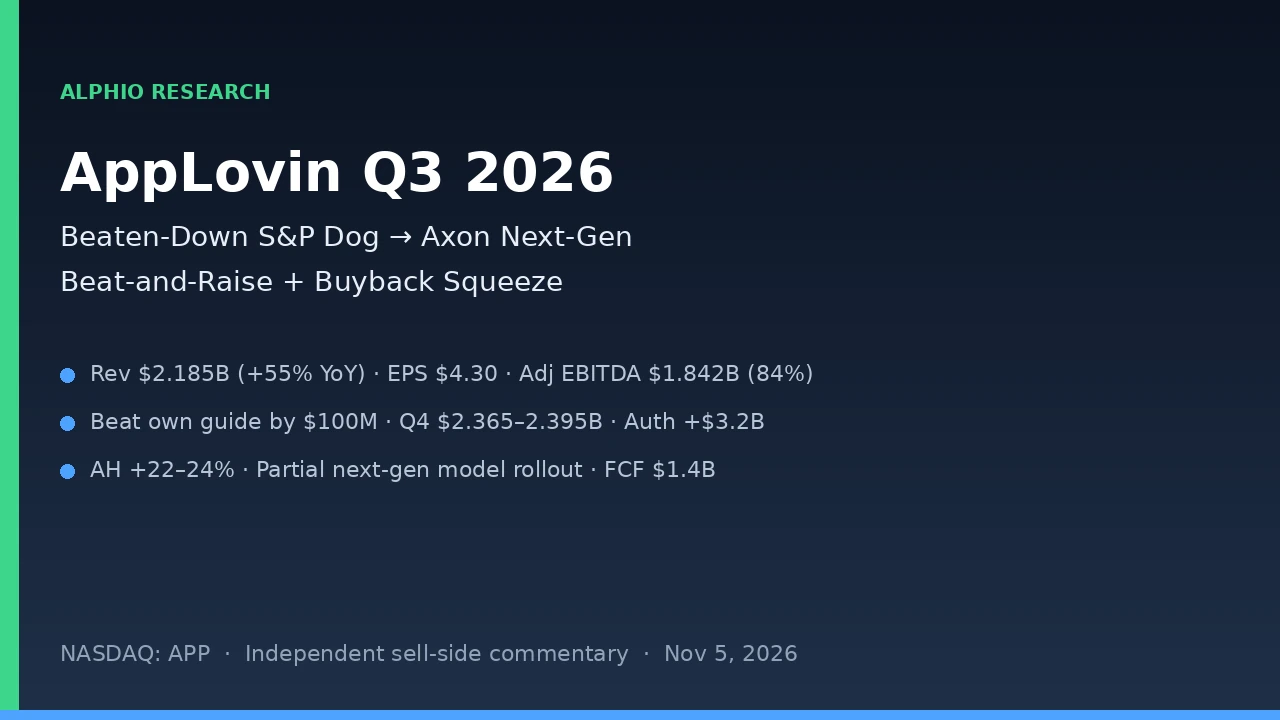
AppLovin Q3 2026: $2.185B rev (+55%), EPS $4.30 vs ~$4.03–4.04 Street, Adj EBITDA $1.842B (84%). Beat own guide $100M; Q4 $2.365–2.395B; auth +$3.2B; AH +22–24%.

AppLovin Q3 2026 Deep Dive: Beaten-Down S&P Dog Meets Axon Next-Gen Beat-and-Raise—and a $3.2B Buyback Reload
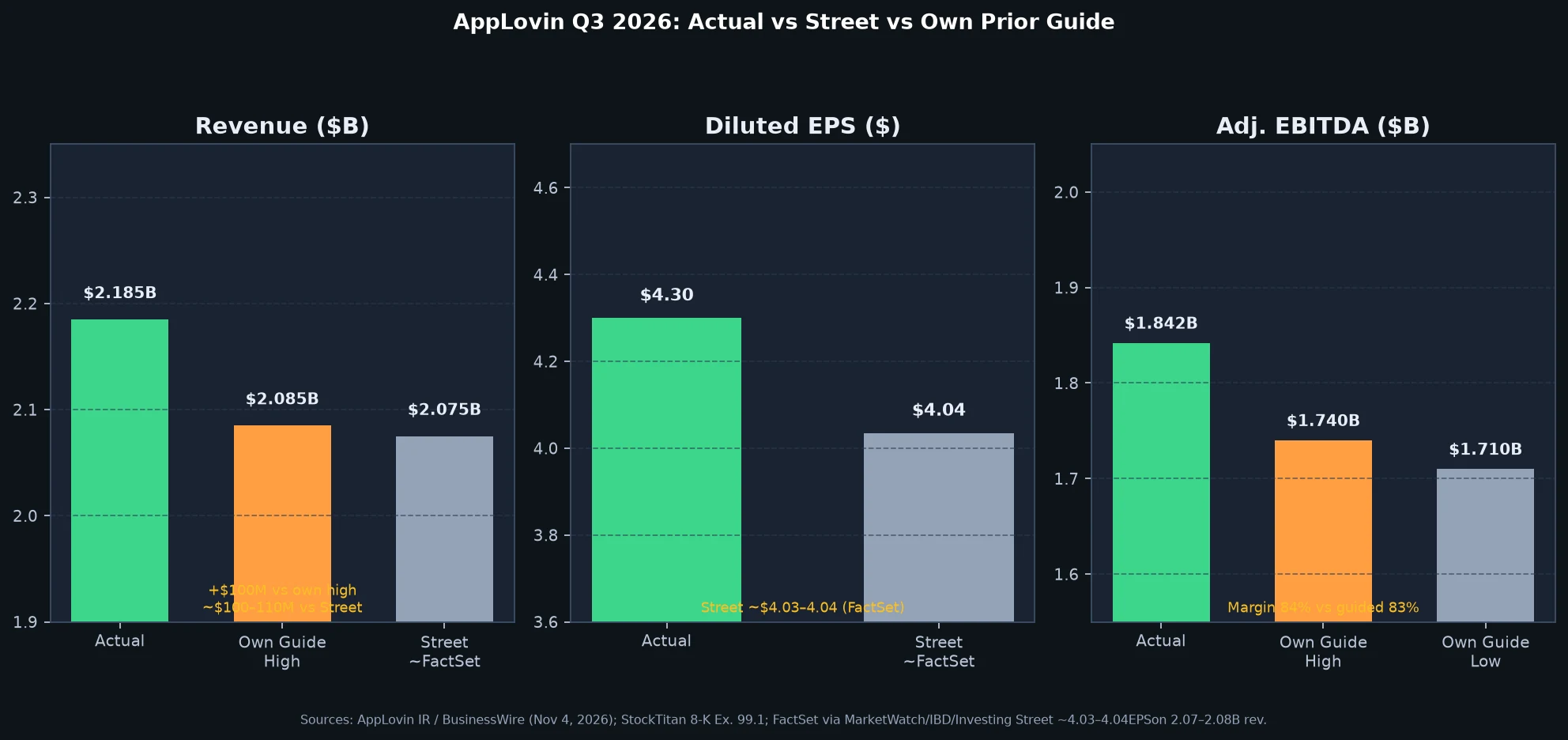
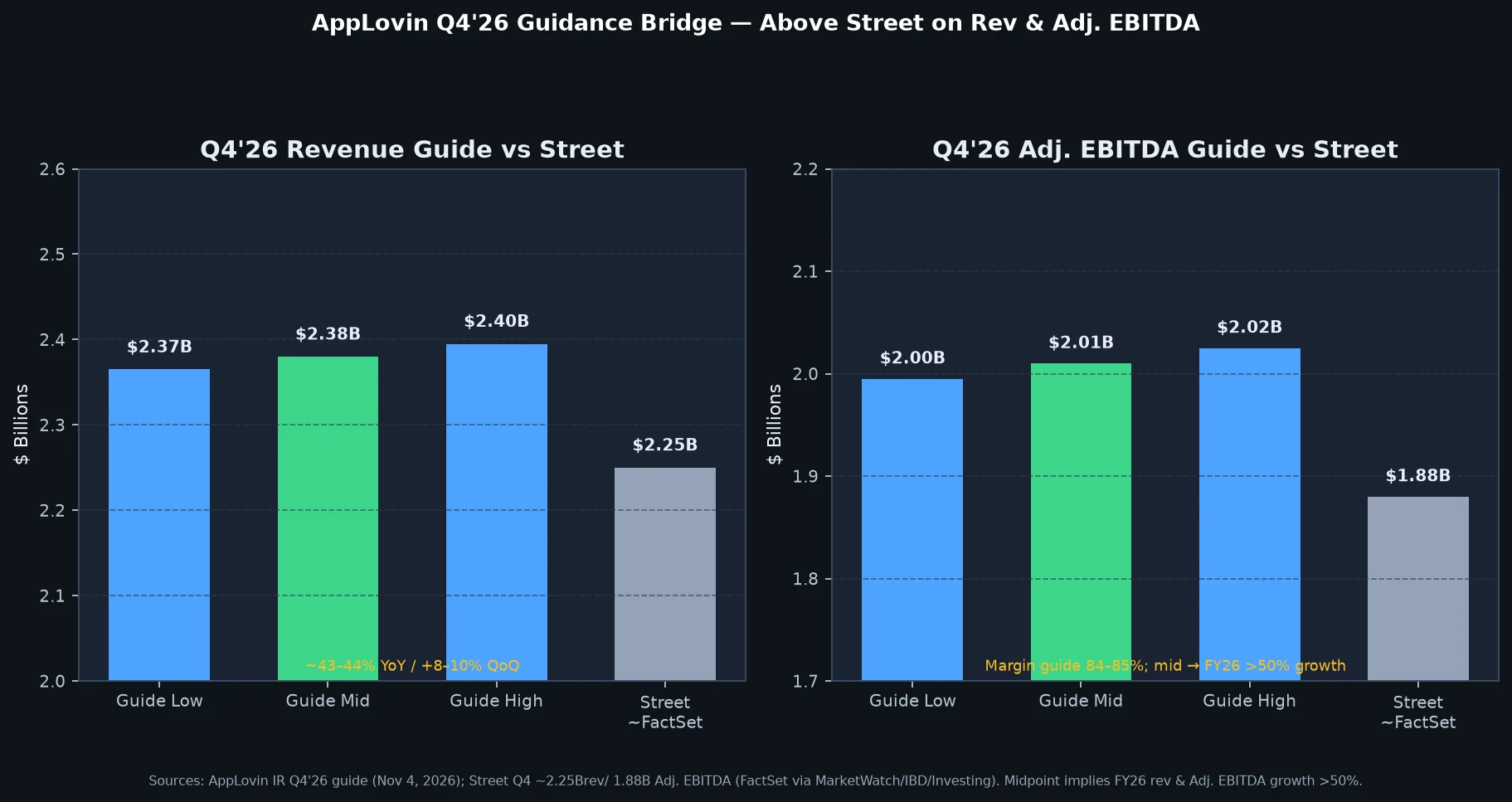
After the close on Wednesday, November 4, 2026, AppLovin (NASDAQ: APP) handed Wall Street the highest-signal digital-advertising print of the week—and the tape treated a beaten-down S&P name like a short-covering confession. Revenue printed $2,185M (+55% YoY, +14% QoQ) versus the company's own prior guide of $2.055–2.085B—about $100M above the high end—and versus FactSet Street around ~$2.07–2.08B (MarketWatch / IBD / Investing). Diluted EPS landed at $4.30 versus FactSet $4.03–4.04. Adjusted EBITDA printed $1,842M (+59% YoY) at an 84% margin, beating own prior guide of $1.710–1.740B. Net income was $1,439M (+72%) at a 66% net margin. Then management raised the bridge: Q4 revenue $2.365–2.395B (43–44% YoY, +8–10% QoQ) and Adj. EBITDA $1.995–2.025B at 84–85% margin—above Street Q4 ~$2.25B rev / ~$1.88B Adj. EBITDA—and said the midpoint implies full-year 2026 revenue and Adj. EBITDA growth of more than 50%.
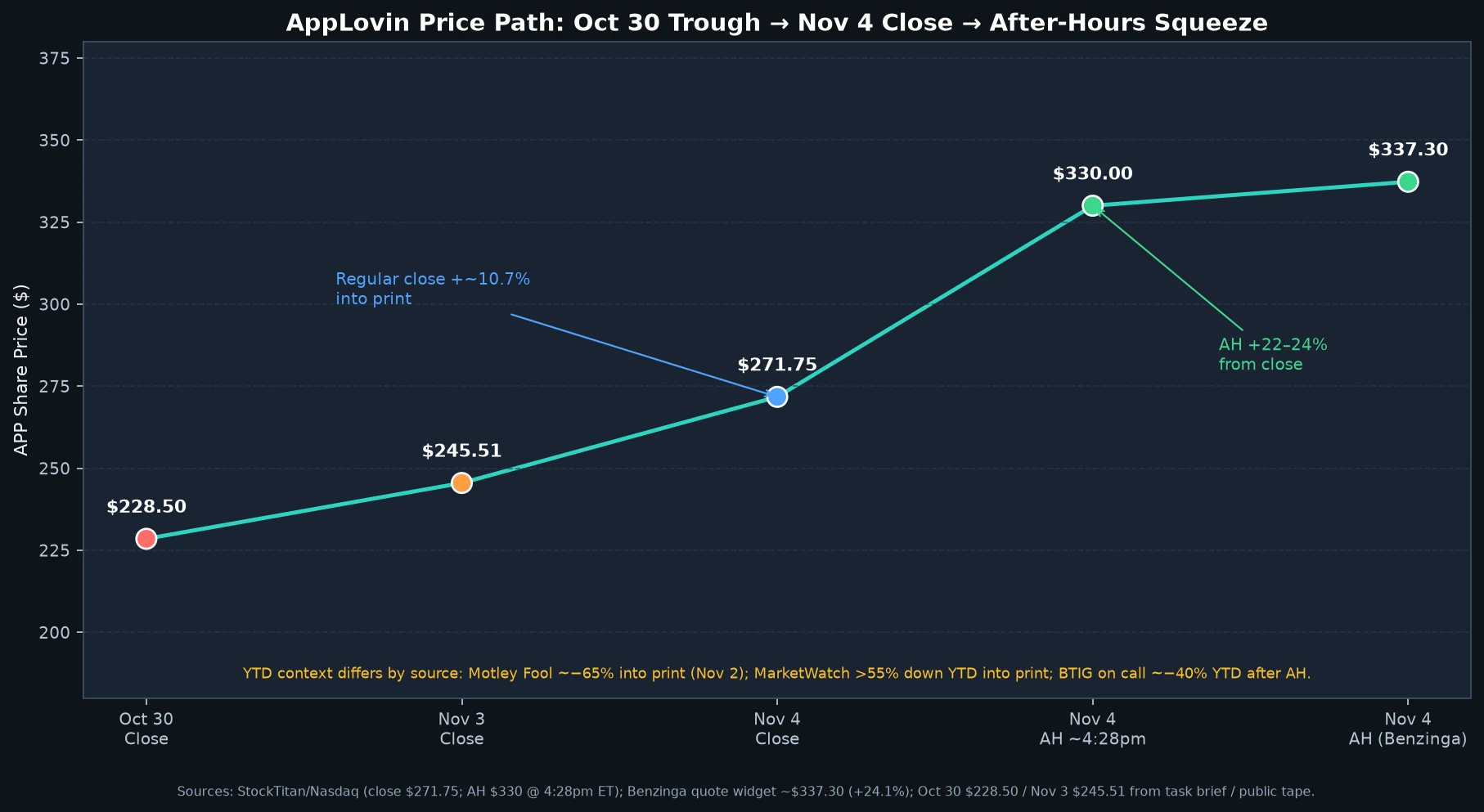
The price path matched the emotion of a dog that finally barked. APP closed the regular session at $271.75 (+~10.7%) after an Oct 30 trough near $228.50 and a Nov 3 close of $245.51, then ripped after hours into roughly $330–$337—about +22–24% from the close (StockTitan Nasdaq AH $330 at 4:28pm ET; Benzinga quote widget ~$337.30 / +24.1%). YTD context is messy and source-dependent: Motley Fool (Nov 2) framed APP among the worst-in-S&P YTD ~−65% into the print; MarketWatch said the stock was down more than 55% YTD into the print; BTIG's Clark Lampen on the call still called it ~−40% YTD after the AH reaction. This note does not invent a single YTD number—it attributes the conflict and reads the print as a redemption-and-model story colliding with valuation scar tissue, e-commerce seasonality, and a capital-return machine that just got reloaded.
Primary figures below come from AppLovin's BusinessWire / IR release dated November 4, 2026, StockTitan's compilation of 8-K Exhibit 99.1, and the Benzinga full earnings-call transcript (Adam Foroughi, Matt Stumpf). Consensus anchors are FactSet via MarketWatch / IBD / Investing where noted. Nothing below invents a Street number that is not attributed.
1. What the Market Was Celebrating—and What It Still Feared
Heading into Adam Foroughi's print, the constructive braid was thinner than AMD's Helios party but emotionally louder—because the stock had been treated like a broken growth name into the report:
- Q2 miss redemption — management had told the Street a quarter ago that the miss was fixed and the business was re-accelerating; Q3 was the promised proof.
- Axon next-gen / Axon-2.0-scale model transition — Foroughi had foreshadowed architectural changes; a partial rollout with gaming re-acceleration would validate the AI-ad compounder narrative.
- Consumer / e-commerce runway into Q4 — triple-digit YoY consumer spend plus holiday seasonality was the sequential setup bulls wanted.
- Capital-return asymmetry — with the stock deeply dislocated into the print, an opportunistic buyback step-up would tell holders management believed intrinsic value, not just narrative.
The fear set—which the after-hours tape chose not to dominate, but which any honest note still forces onto the page—was the opposite braid:
- Credibility after Q2 — one clean beat does not erase a guidance foot-fault; bears wanted to see whether Q4's +8–10% QoQ guide was sandbagged conservatism or early deceleration.
- Law of large numbers on gaming — Morgan Stanley's Matthew Cost pressed the 20–30% gaming growth framing; if gaming is the cash engine and consumer is still early, model gains must keep outrunning scale.
- Auction crowding / ROAS compression — UBS's Stephen Ju relayed advertiser checks about e-commerce bidders inflating CPMs and incumbents pre-emptively shifting budgets to competitors.
- Valuation scar tissue — even after AH, BTIG still framed ~−40% YTD; Motley Fool / MarketWatch had framed worse into the print. A +22% AH move on a beaten name can be positioning as much as fundamental regime change.
Pre-print, APP was already marking optimism into the regular session (+~10.7% into the close). The AH extension said investors were willing to look through YTD damage into the Axon partial rollout, the $100M own-guide beat, and the buyback reload—at least overnight. The research question is whether that look-through survives a seasonal Q1 e-commerce reset and a still-incomplete model transition.
2. Scorecard: Beat Own Guide, Beat Street, Raise the Bridge—Watch the Deceleration Optics
| Metric | Q3 2026 actual | Benchmark / prior | Read-through |
|---|---|---|---|
| Revenue | $2,185M | PY $1,405M; QoQ +14%; own guide $2.055–2.085B; Street ~$2.07–2.08B | +55% YoY; ~$100M above own high |
| Net income / margin | $1,439M / 66% | PY $836M / 59%; +72% YoY | Industry-leading NI margin (call) |
| Diluted EPS | $4.30 | PY $2.45; Street ~$4.03–4.04 | Clean beat |
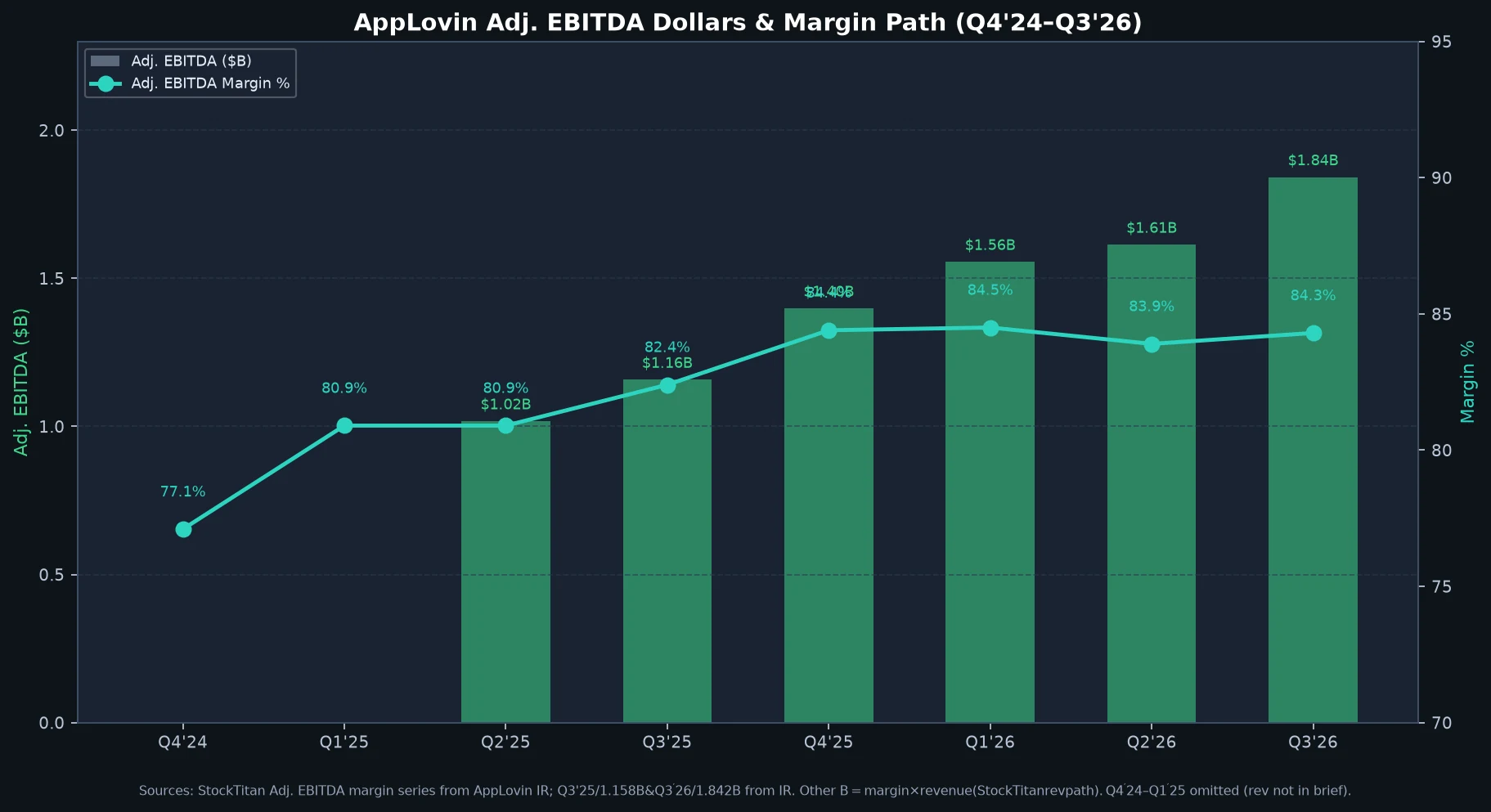
| Adj. EBITDA / margin | $1,842M / 84% | PY $1,158M / 82%; own guide $1.710–1.740B (83%) | Above high; +~190 bps YoY margin |
| QoQ Adj. EBITDA flow-through | 87% | — | Operating leverage intact |
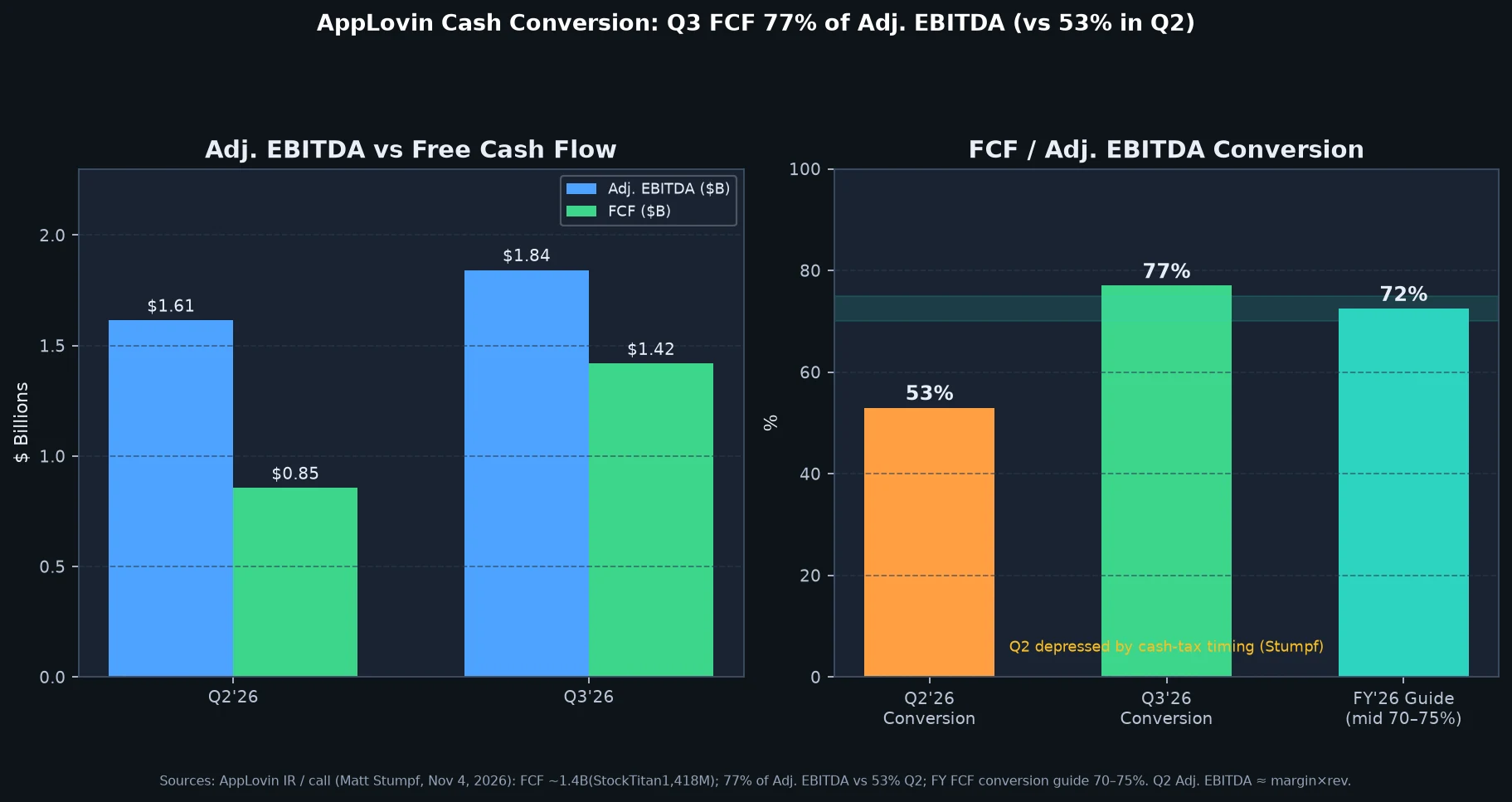
| FCF | ~$1.4B (StockTitan $1,418M) | 77% of Adj. EBITDA vs 53% in Q2 | Cash-tax timing had depressed Q2 |
| FY FCF conversion guide | 70–75% of Adj. EBITDA | Stumpf on call | Still the framework |
| 9M revenue / NI / Adj. EBITDA | $5,951M / $3,911M / $5,013M | +56% / +75% / +61% YoY | Compounding year |
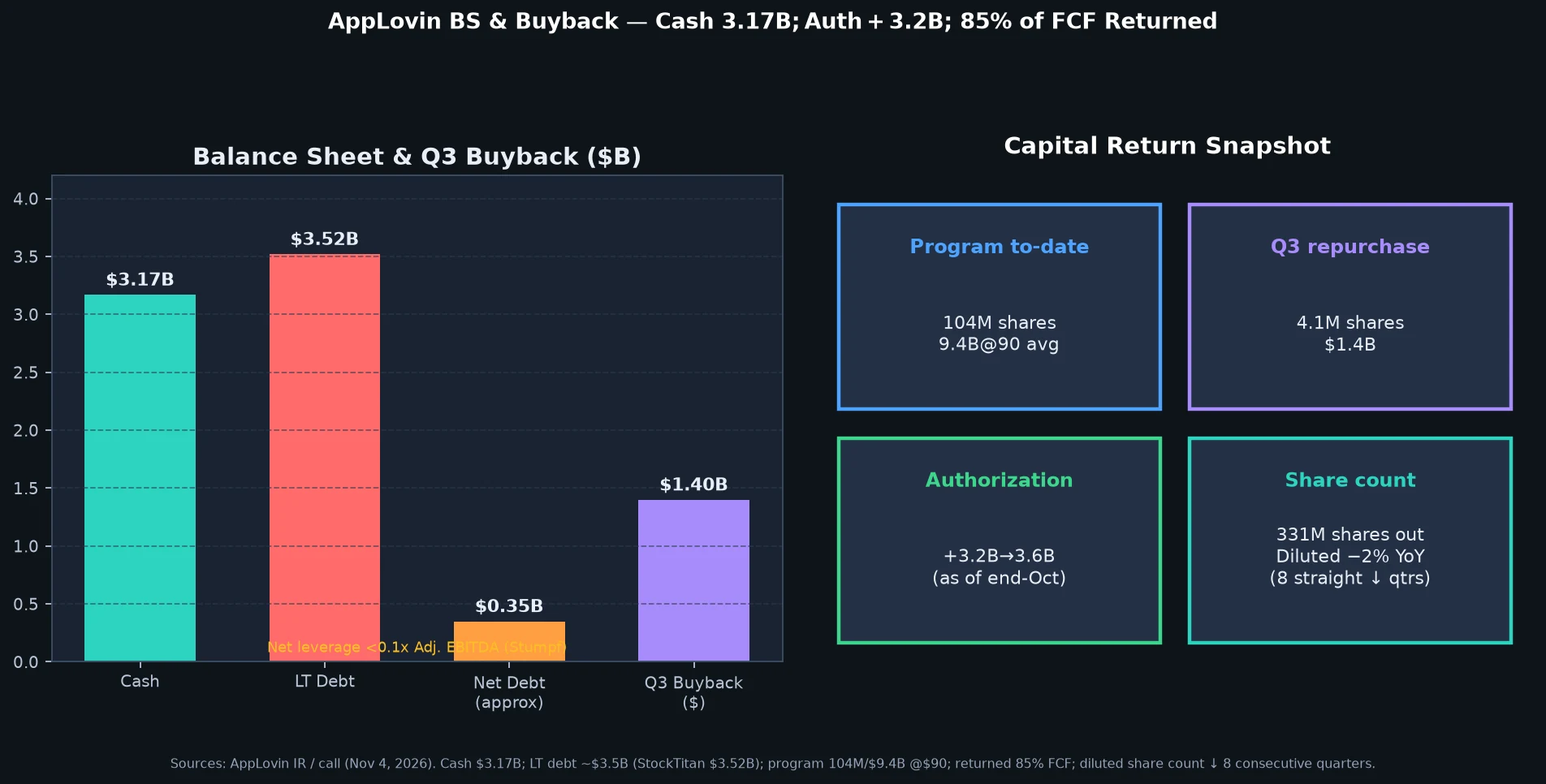
| Cash / LT debt | $3.17B / ~$3.5B | Net leverage <0.1x Adj. EBITDA | Below ~1x long-term operating target |
| Q3 buyback | 4.1M shares / $1.4B | Step-up vs Q2 | Opportunistic on dislocation |
| Auth | +$3.2B → $3.6B (end-Oct) | Program 104M / $9.4B @ $90 avg | 85% of FCF returned historically |
| Shares out | 331M | Diluted share count ↓ 8 straight quarters; ~−2% YoY | Growth + shrink |
| Q4 rev guide | $2.365–2.395B | ~43–44% YoY; +8–10% QoQ; Street ~$2.25B | Above Street; slower YoY than Q3 |
| Q4 Adj. EBITDA guide | $1.995–2.025B | Margin 84–85%; Street ~$1.88B | Above Street |
| FY26 implied (mid) | >50% rev & Adj. EBITDA growth | Stumpf | Beat-and-raise year math |
| Gaming (call color) | ~+50% YoY | Re-acceleration with model rollout | Core engine |
| Consumer (call color) | DD QoQ / triple-digit YoY | Holiday setup | Runway narrative |
| Long-term CAGR color | ~30% | Foroughi; run ahead when possible | Anchor, not ceiling |
Trap 1: Celebrating +55% without noticing Q4 guides ~43–44% YoY—still elite versus peers, but the deceleration optics are real and will be the first slide in every bear deck. Trap 2: Treating the $100M own-guide beat as "always beats" without remembering Q2 landed inside the range (StockTitan beat-history table)—credibility is a streak, not a law. Trap 3: Reading AH +22–24% as permanent multiple repair while Motley Fool / MarketWatch / BTIG still disagree on how damaged the YTD tape remains. Trap 4: Extrapolating consumer triple-digit YoY into 2027 without Foroughi's own seasonal warning: like-for-like e-commerce advertisers will have a huge Q4 and a weak Q1.
3. Management Voice: Partial Next-Gen Rollout, Q2 Redemption, 30% CAGR, Opportunistic Buyback
CEO Adam Foroughi framed a record quarter around a model transition "as significant as Axon 2.0" while the business ran at full speed. The driver, in his words: a partial rollout of next-generation models built on architectural changes he foreshadowed last quarter; advertisers saw more spend deploying profitably at target ROAS; budgets stepped up; gaming grew nearly 50% YoY, re-accelerating alongside the rollout. The line he asked investors to sit with: "This was a partial rollout. The transition is still in front of us. And the new generation gives us meaningfully more room to optimize than the architecture it replaces." He added that the new generation improves performance most where data is sparser—newer advertisers, smaller advertisers, newer categories—"exactly where our consumer vertical lives." Discipline mattered as much as upside: even as training investment increased, data center costs declined as a percentage of revenue. Consumer had another strong quarter and, with Q4 underway, "set up very well heading into the biggest spending season of the year." Long-term color was unchanged: one auction across categories; compound at roughly 30% annually; "and as this year shows, we intend to run well ahead of that whenever we can." Focus into next year: complete the model transition, expand spend from current customers while ramping new-customer acquisition, improve creative tools and ad formats, and start expanding CTV efforts. Closing redemption beat: "A quarter ago, we stood here answering questions about a miss. We told you what had happened, that it was fixed, and that the business was re-accelerating. And everything we told you showed up in this quarter's numbers."
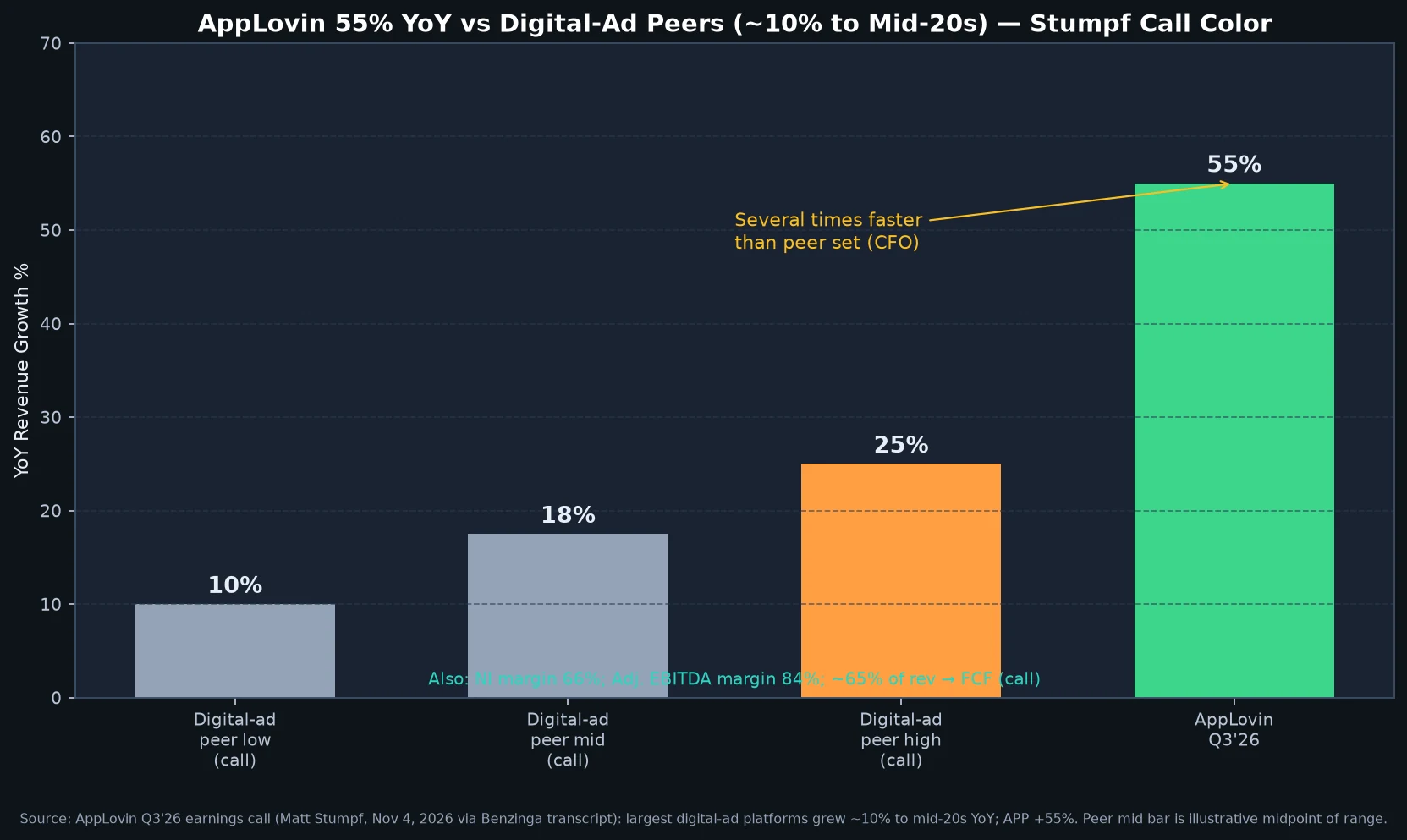
CFO Matt Stumpf carried the scoreboard and the peer contrast. Revenue $2.18B (+55%), NI $1.44B (+72%), NI margin 66%, Adj. EBITDA $1.84B at 84% (+~190 bps YoY), QoQ flow-through 87%. Consumer spend: double digits QoQ, triple digits YoY. FCF $1.4B, or 77% of Adj. EBITDA, up from 53% in Q2 (cash-tax timing); FY conversion still 70–75%. Peer framing was deliberate: largest digital-ad platforms grew roughly 10% to the mid-twenties this earnings season; APP grew 55% "several times faster," at margins "well above all of our peers," converting roughly 65% of revenue into free cash flow. Balance sheet: cash $3.17B vs LT debt ~$3.5B, net leverage <0.1x Adj. EBITDA—below the ~1x long-term operating posture. Buyback: 4.1M / $1.4B in Q3; auth +$3.2B → $3.6B; program-to-date 104M / $9.4B @ $90; 85% of FCF returned; diluted share count down eight consecutive quarters, ~−2% YoY. Q4 guide as above; midpoint implies FY26 rev and Adj. EBITDA growth >50%.
Call Q&A themes (named desks): James Heaney on full-rollout timing (Foroughi: can't commit cadence; more optimize room than old gen). Citi's Jason Bazinet on referral partners (work in progress; pixel counts accelerating; multi-quarter trajectory). Morgan Stanley's Matthew Cost on gaming runway and CTV (Foroughi: unified auction; consumer triple-digit; CTV pilots "very promising" but "I wouldn't bank on it at all for being accretive to numbers anytime soon"). Deutsche Bank's Benjamin Black on consumer data flywheel and holiday stickiness. UBS's Stephen Ju on auction crowding / ROAS (Foroughi: ROAS stronger than three years ago; industry checks often sample the wrong advertisers). Evercore's Robert Colbreth on model generalizability and performance-brand shift into apps. BTIG's Clark Lampen on effective supply expansion and buyback flexibility (Stumpf: Q3 step-up was opportunistic on dislocation vs intrinsic value; ability remains). Oppenheimer's Martin Yang on dynamic product ads vs GenAI video. Loop's Rob Sanderson on self-serve vs hand-holding and data appetite. Wolfe's Shweta Kajeria on visibility/moat (Foroughi: 14 of 16 quarters beat high end; early consumer still hard to KPI). William Blair's Ralph Shackert on framing the step-change vs Axon 2.0 and competitive concern after Q2. JPM's Brian Smilek on ~$20B annualized gross spend (All-In Summit color) and guide composition. Wells Fargo's Alec Brandolo on data/M&A appetite and APAC pixel inflection. BofA's Omar Dasuki, Piper's Jim Callahan, Cannonball's Vasily Karasyev, SSR's Tim Nolan, RBC's Matthew Swanson pressed take rate, MAX supply, data provenance, and onboarding sophistication.
4. The Risk Ledger: Deceleration Optics, Seasonality, Auction Crowding, Incomplete Rollout, Governance
| Risk | What we know | Why it matters |
|---|---|---|
| YoY deceleration into Q4 | Q3 +55%; Q4 guide ~43–44% | Bear slide #1 even if still peer-crushing |
| Guide philosophy / sandbag debate | Stumpf: guide to what is known; Heaney flagged 8–10% QoQ vs 14% | Beat streak depends on conservatism remaining rational |
| Incomplete model transition | Partial rollout only; no full-rollout cadence | Upside optionality cuts both ways if transition stalls |
| E-commerce Q1 seasonal reset | Foroughi: like-for-like huge Q4 → weak Q1 | Consumer mix rising = more seasonal P&L |
| Auction crowding / ROAS checks | Ju advertiser anecdote; Foroughi rebuttal | Narrative risk even if technology rebuts it |
| Gaming law of large numbers | Cost asked 20–30% framing; gaming ~+50% this quarter | If model gains slow, cash engine slows |
| Competitive concern hangover | Q2 miss sparked "others winning" narrative; Foroughi: own foot-fault, not zero-sum | One quarter does not bury the check circuit |
| Data / M&A execution | Appetite for data relationships; MoPub analogy | Wrong deal or distraction risk on a premium multiple |
| CTV is early | Pilots promising; not near-term accretive | Do not underwrite CTV into 2027 numbers yet |
| Governance / Nevada move | Written consent ~67% voting power (Foroughi/Chen Class B); Schedule 14C forthcoming | Control optics; shareholder-rights detail TBD |
| Valuation scar tissue | Conflicting YTD drawdown figures; AH squeeze | Multiple repair can fade if Q4 merely "in-line" |
| Self-serve / SMB readiness | Sophisticated + hand-held win; tiny SMB still future | Consumer TAM story is longer than Twitter pacing |
The ledger's center of gravity is credibility duration + seasonal mix, not whether Q3 beat. That is why an honest note can cheer the AH rally and still refuse to pretend a partial model rollout plus a slower Q4 YoY print ends the debate.
5. Long vs Short Debate (Named Sources)
The long / redemption case (tape + management + buyback signal): Regular close $271.75 (+~10.7%) then AH ~$330–$337 (+22–24%) is the market voting that a $100M own-guide beat, EPS $4.30 vs ~$4.03–4.04, Adj. EBITDA $1.84B at 84%, gaming ~+50%, consumer triple-digit YoY, Q4 guide above Street, and an Axon-2.0-scale partial rollout dominate the Q2 scar. Stumpf's peer contrast—peers ~10% to mid-20s, APP 55%, ~65% of revenue to FCF—is the bull screenshot. The buyback is not cosmetic: $1.4B repurchased in the quarter of dislocation, auth +$3.2B, and Stumpf's answer to BTIG that the step-up was opportunistic versus intrinsic value. Foroughi's redemption close—"everything we told you showed up"—is the cultural tell bulls want from a founder-operator. Mechanism: if the partial next-gen rollout completes with more optimize headroom, consumer keeps compounding into and through holiday, and FCF conversion holds the 70–75% band while shares shrink, APP re-rates from "broken ad-tech" back toward "AI auction compounder with fortress margins."
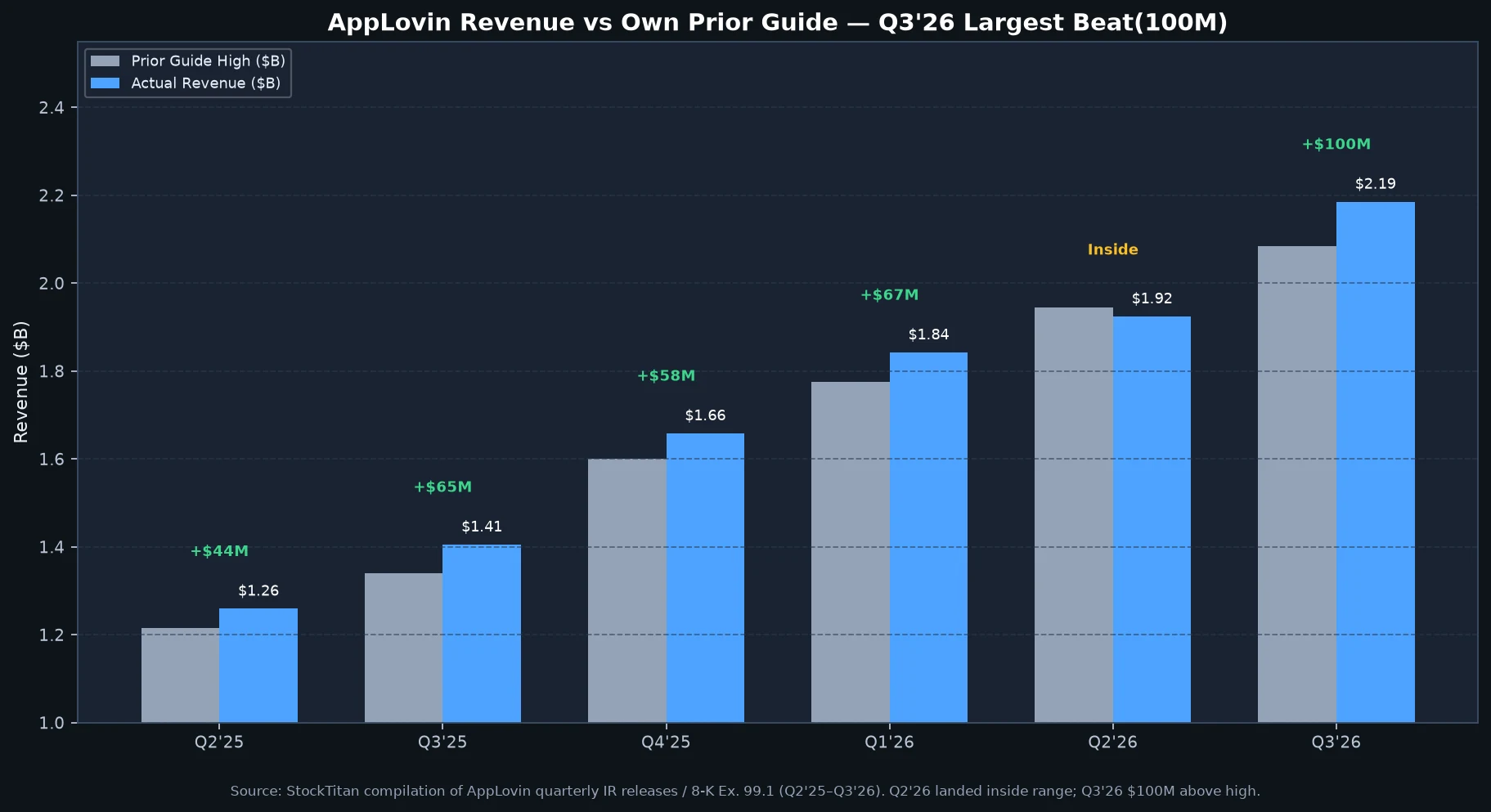
The short / skeptic case (deceleration + seasonality + checks + control): Skeptics do not need to deny the print. They need only argue that (1) guiding ~43–44% after printing 55% is the first growth-duration cut; (2) Q2 already proved the beat streak can break—StockTitan's table shows Q2 inside range after four prior above-high beats; (3) UBS-style advertiser checks about crowding, even if Foroughi calls them flawed sampling, will keep a narrative tax on the multiple; (4) rising e-commerce mix imports a Q4 up / Q1 down seasonal signature Foroughi himself flagged; (5) CTV, data M&A, and SMB self-serve are real options that are not in the Q4 number and should not be underwritten as 2027 ballast yet; (6) Nevada reincorporation via ~67% written consent concentrates control optics just as the stock tries to rebuild institutional trust; (7) even after AH, BTIG's ~−40% YTD framing (and Motley Fool / MarketWatch's worse into-print frames) says the equity still has to earn back duration capital, not just squeeze shorts overnight.
Synthesis: Bulls are not inventing the print, the margins, or the cash conversion. Bears are not inventing the deceleration optics, the seasonal warning, or the incomplete rollout. The equity story after November 4 is a credibility-duration debate: can AppLovin convert a partial Axon next-gen rollout and consumer holiday strength into another above-high Q4 before the market re-prices "55% hero quarter" as "43% guide with Q1 seasonality ahead"?
6. Side Plots: Nevada Reincorporation, CTV Pilots, Data M&A Appetite, Q2 Miss Redemption
Nevada reincorporation. Per StockTitan / 8-K color, holders with about 67% of the voting power—Adam Foroughi, Herald Chen, a trust and five companies—signed written consent on October 29, 2026, to move incorporation from Delaware to Nevada. Class B (20 votes) vs Class A (1 vote) makes the consent mathematically unsurprising and politically loud. Schedule 14C is forthcoming; completion no earlier than 20 days after mailing. For Alphio readers: treat this as a governance sleeve, not as P&L. Watch whether the Nevada articles/bylaws change appraisal, forum, or fiduciary optics in ways institutions care about.
CTV pilots. Foroughi told Cost the product is "looking very promising," pilots are live, and if you watch connected TV you may already see some AppLovin ads—but "I wouldn't bank on it at all for being accretive to numbers anytime soon." Lampen pulled the supply thread; Foroughi said CTV looks like mobile did 10–15 years ago if AppLovin can build true top-of-funnel-to-purchase performance. Side plot, not base case.
Data / customer M&A appetite. Black, Sanderson, and Brandolo all pulled the data thread. Foroughi: organic data was enough for a record quarter, but bigger models "just need more data"; MoPub is the template—buy relationships, migrate customers fast, accelerate a decade of work. Bull case: compressed consumer penetration timeline. Bear case: classic ad-tech M&A distraction priced into a momentum multiple that just squeezed.
Q2 miss redemption. This is the emotional spine of the call. Foroughi opened and closed on it. William Blair's Shackert asked about competitive concern after last quarter; Foroughi: not zero-sum, own foot-fault, and "we put up a massive quarter" while multiple peers also did well. The research tell: redemption only sticks if Q4 does not re-open the foot-fault file.
Gross spend / All-In color. Smilek referenced Foroughi's All-In Summit remark that gross spend through the ecosystem was approaching ~$20B annualized. That is management-conference color, not an IR GAAP line—useful for scale intuition, not for a model input without further disclosure.
7. Braided Thesis
AppLovin Q3 2026 is a redemption-and-model print colliding with deceleration optics and seasonal mix risk. Track one—revenue $2.185B (+55%), EPS $4.30, Adj. EBITDA $1.842B at 84%, FCF ~$1.4B (77% conversion), gaming ~+50%, consumer DD QoQ / triple-digit YoY, Q4 guide above Street with FY26 mid >50% growth, auth +$3.2B, AH discovery toward $330–$337—is the APP the squeeze tape owned into the print. Track two—Q4 YoY guided down to ~43–44%, model transition still partial, e-commerce Q1 reset explicitly flagged, advertiser-check crowding narrative, Nevada control optics, and conflicting YTD drawdown frames from Motley Fool / MarketWatch / BTIG—is what an honest risk ledger refuses to edit out of the victory lap.
The braided read: this was not a demand miss, and it was not a peer-share wipeout story. Management is explicit that the largest digital-ad platforms grew ~10% to mid-20s while APP grew 55%, that DC costs fell as a percent of revenue even as training compute rose, and that Q2's issue was an own foot-fault now visible in the rear-view. It was a credibility-duration and mix-seasonality event. Foroughi's Axon next-gen partial rollout asks investors to underwrite unfinished R&D optionality. Stumpf's Q4 bridge asks them to accept slower YoY math that is still above Street. The buyback asks them to believe management's intrinsic-value call at the point of maximum narrative pain. The AH party says the Street bought Track one overnight. The research discipline says Track two decides whether that party was regime confirmation or a positioning squeeze into a beat.
For Alphio readers thinking in copy-trade / budget terms: APP after this print is a high-beta AI-ad auction compounder with fortress margins and an active buyback overlay, where position sizing has to respect (a) guide deceleration optics, (b) rising e-commerce seasonality, (c) incomplete model-transition path dependence, and (d) the fact that a +22% AH squeeze on a YTD-damaged name can give back as fast as it was given if Q4 merely meets rather than clears the high end. The Axon/peer-growth/FCF charts remain the bull screenshots. The Q4 deceleration/seasonality/governance charts remain the bear screenshots. Both are true on the same IR release.
8. Falsifiable Watchpoints
- Q4 revenue vs $2.365–2.395B — print above the high end would extend the StockTitan beat streak and confirm holiday + model; a miss below the low end re-opens the Q2 credibility file.
- Q4 Adj. EBITDA vs $1.995–2.025B / 84–85% margin — margin hold with dollar beat falsifies "growth at any cost"; margin slip on mix falsifies the peer-superiority screenshot.
- Full vs partial next-gen rollout — evidence in Q1/Q2 commentary that the Axon-2.0-scale transition completed with continued optimize headroom; silence or "still partial" into mid-2027 weakens the optionality premium.
- Consumer into Q1'27 — if like-for-like e-commerce resets hard and new-logo growth fails to offset, Foroughi's seasonal warning becomes the bear thesis; if customer acquisition keeps Q1 sequential resilient, consumer mix is still a gift.
- FCF conversion vs 70–75% FY band — another 77%-like quarter supports asset-light compounding; a relapse toward Q2's 53% without clear tax timing would worry cash bulls.
- Buyback pace vs dislocation — whether the new $3.6B auth is used opportunistically (Stumpf's words) if AH gains fade; a purely programmatic thin buyback would weaken the intrinsic-value signal.
- CTV — first disclosure of material CTV revenue or ROAS proof; until then, treat as option value only.
- Nevada Schedule 14C — whether articles/bylaws change shareholder rights in ways institutions flag; quiet conversion vs contested optics.
FAQ
Why did AppLovin jump after hours on the Q3 2026 print?
Because the company beat its own prior revenue guide by about $100M ($2.185B vs $2.055–2.085B), beat FactSet EPS (~$4.30 vs $4.03–4.04), printed Adj. EBITDA $1.842B at 84%, guided Q4 revenue $2.365–2.395B and Adj. EBITDA $1.995–2.025B above Street ($2.25B / ~$1.88B), and framed a partial Axon next-gen model rollout with gaming ~+50% and consumer triple-digit YoY. Regular close $271.75 and AH ~$330–$337 priced the redemption more than the YTD scar tissue.
How clean was the beat versus AppLovin's own guidance?
Very clean on both lines that management guides. Revenue $2.185B was $100M above the August high of $2.085B—StockTitan notes that as the largest dollar beat of the last six quarters after Q2 landed inside its range. Adj. EBITDA $1.842B topped the $1.710–1.740B range, with margin 84% versus guided 83%.
What did management say about the new models?
Foroughi said the team partially rolled out next-generation models built on last quarter's architectural changes—a transition he compared in technical significance to Axon 2.0. Gains showed up in advertiser ROAS and gaming re-acceleration, with more room to optimize than the prior architecture, especially in sparse-data / consumer settings. He would not commit to a full-rollout cadence.
How should investors read Q4 guidance of ~43–44% YoY after a 55% quarter?
As still elite versus Stumpf's peer set (10% to mid-20s), still above FactSet Street ($2.25B rev), and still consistent with FY26 midpoint growth >50%—but also as real deceleration optics. Stumpf said the guide includes known seasonality, live model updates, and training-compute investment; Heaney explicitly asked whether 8–10% QoQ was conservative versus Q3's 14%.
How aggressive is the buyback after the dislocation?
Q3 repurchases/withholdings were 4.1M shares for $1.4B; the board added $3.2B, taking authorization to $3.6B as of end-October. Program-to-date: 104M shares / $9.4B at a $90 average, returning 85% of FCF. Stumpf told BTIG the Q3 step-up was opportunistic because price dislocated from intrinsic value—and that flexibility remains.
What is the Nevada reincorporation subplot?
Holders with ~67% voting power (Foroughi / Chen Class B and affiliates) approved a Delaware-to-Nevada move by written consent on October 29, 2026. Schedule 14C will be mailed; completion no earlier than 20 days after mailing starts. It is a governance / control optics item, not a Q3 P&L driver.
Sources: AppLovin BusinessWire / IR press release, "AppLovin Announces Third Quarter 2026 Financial Results" (Nov 4, 2026); StockTitan article and 8-K Exhibit 99.1 compilation (revenue beat history, Adj. EBITDA margin path, FCF $1,418M, Nevada consent); Benzinga full Q3 2026 earnings-call transcript (Adam Foroughi, Matt Stumpf; analysts including James Heaney, Jason Bazinet, Matthew Cost, Benjamin Black, Stephen Ju, Robert Colbreth, Clark Lampen, Martin Yang, Rob Sanderson, Shweta Kajeria, Ralph Shackert, Brian Smilek, Alec Brandolo, Omar Dasuki, Jim Callahan, Vasily Karasyev, Tim Nolan, Matthew Swanson); FactSet consensus via MarketWatch / IBD / Investing (~$4.03–4.04 EPS on ~$2.07–2.08B rev; Q4 Street ~$2.25B / $1.88B Adj. EBITDA); price path from StockTitan/Nasdaq (close $271.75; AH $330 @ 4:28pm ET), Benzinga −40% YTD after AH). This article is independent research commentary for Alphio readers, not investment advice.$337.30, and brief tape (Oct 30 $228.50; Nov 3 $245.51); YTD frames attributed to Motley Fool (−65% into print), MarketWatch (>55% down YTD into print), and BTIG on call (
Disclaimer: For information and research-methodology demonstration only—not investment advice, a recommendation, or a performance guarantee. Figures follow AppLovin IR primary disclosures and public earnings-call/media attributions; consensus figures are as reported by financial media citing FactSet and may differ by vendor. Investors should review AppLovin's SEC filings and form independent judgments.
FAQs
Why did AppLovin jump after hours on the Q3 2026 print?
APP beat its own prior revenue guide by ~$100M ($2.185B vs $2.055–2.085B), beat FactSet EPS (~$4.30 vs ~$4.03–4.04), printed Adj. EBITDA $1.842B at 84%, guided Q4 above Street, and framed a partial Axon next-gen model rollout with gaming ~+50% and consumer triple-digit YoY. Close $271.75; AH ~$330–$337 (+22–24%).
How clean was AppLovin's beat versus its own guidance?
Revenue $2.185B was $100M above the August high of $2.085B—StockTitan's largest dollar beat of the last six quarters after Q2 landed inside its range. Adj. EBITDA $1.842B topped the $1.710–1.740B range at an 84% margin versus guided 83%.
What did Adam Foroughi say about the new Axon-scale models?
Management partially rolled out next-generation models built on last quarter's architectural changes—a transition Foroughi compared in technical significance to Axon 2.0. Gains showed in advertiser ROAS and gaming re-acceleration, with more optimize room than the prior architecture, especially in sparse-data/consumer settings. No full-rollout cadence was committed.
How should investors read Q4 guidance of ~43–44% YoY after a 55% quarter?
Still elite versus Stumpf's peer set (~10% to mid-20s), still above FactSet Street (~$2.25B rev / ~$1.88B Adj. EBITDA), and consistent with FY26 midpoint growth >50%—but also real deceleration optics. Guide includes known seasonality, live model updates, and training-compute investment.
How aggressive is AppLovin's buyback after the dislocation?
Q3 repurchases/withholdings were 4.1M shares for $1.4B; authorization rose +$3.2B to $3.6B as of end-October. Program-to-date: 104M shares / $9.4B at a $90 average, returning 85% of FCF. CFO Matt Stumpf told BTIG the Q3 step-up was opportunistic versus intrinsic value.
What is the Nevada reincorporation subplot?
Holders with ~67% voting power (Foroughi/Chen Class B and affiliates) approved a Delaware-to-Nevada move by written consent on October 29, 2026. Schedule 14C will be mailed; completion no earlier than 20 days after mailing. Governance/control optics, not a Q3 P&L driver.
Related articles
- Santa Claus Rally and the Year-End Stock Market: Investor Guide for Late 2026Santa Claus rally explained: 7-day window stats since 1950, Nov–Dec seasonality, post-midterm 2026 setup, and a risk-managed year-end investing playbook.
- Democratic Sweep Sends Stocks Soaring: Dow Posts Best Post-Midterm Rally in 44 Years Amid AI Sector US stocks surged after Democrats swept the 2026 midterms. The Dow jumped 1,569 points for its best post-election day since 1982 as markets cheered political clarity.
- Stock Market Surges After 2026 Midterms: What the Democratic Sweep Means for Your PortfolioThe stock market rallied after Democrats won the 2026 midterms. Discover what the election means for investors, tech stocks, and the S&P 500 outlook.
- US Dollar Hits 13-Month High: What Fed Policy Means for Forex Traders in June 2026The US Dollar surged to 13-month highs as markets price in Federal Reserve rate hikes. Discover forex trading strategies, currency pair analysis, and what this means for traders.
- Bitcoin ETF Outflows Hit Record $8 Billion in June 2026: What Traders Need to KnowBitcoin ETFs saw record $8B outflows in June 2026 as BTC consolidates around $64K. Learn market analysis, key support levels, and automated trading strategies.
- Bitcoin Price Analysis 2026: How AI Trading Strategies Are Reshaping Crypto InvestmentExplore Bitcoin's 2026 market outlook, institutional adoption trends, and AI-powered trading strategies. Learn how machine learning is transforming crypto investment decisions.