

2026 Midterm Results Are In: What Democratic Control of Congress Means for the Stock Market
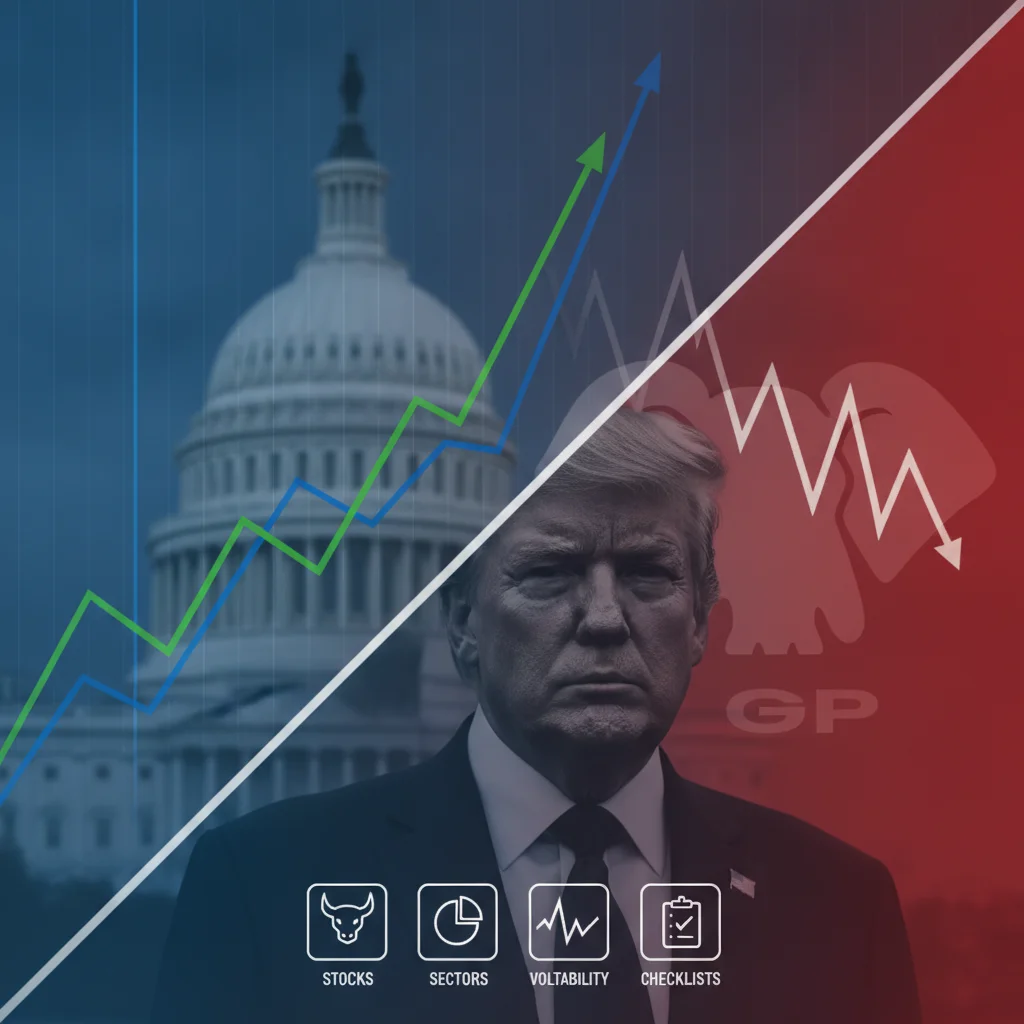
Democrats win House and Senate in 2026 midterms: what divided government under Trump means for stocks, sectors, volatility, and investor checklists.

Key Takeaway
AP, NBC News, and other major networks projected on election night and into early November 4, 2026 that Democrats will take control of both the U.S. House and the Senate when the new Congress convenes in January. That outcome ends unified Republican control of Washington for the remainder of President Donald Trump’s term and replaces it with classic divided government: a Democratic Congress facing a Republican White House that still holds the veto pen, trade tools, and much of foreign-policy authority. NBC’s projection put the Senate near 54 Democratic seats (including independents who caucus with Democrats) against about 44 Republican seats after Democrats flipped seven contests—widely reported in Iowa, Kansas, Ohio, Maine, North Carolina, South Carolina, and Texas. House seat tallies were still firming as ballots finished, but networks called a Democratic majority well above the 218 threshold; NBC’s early analysis pointed to a large projected margin while some live trackers showed Democrats already past the majority line with dozens of races still outstanding.
For equity investors, the overnight story is less “blue wave equals bear market” than a rapid re-pricing of fiscal, regulatory, and sector odds. Futures sold hard in Asia as AI and data-center names fretted about tighter oversight, then U.S. and European risk assets steadied as desks emphasized gridlock, a softer dollar, and lower Treasury yields. History still argues that midterm clarity often precedes constructive twelve-month S&P 500 returns, and that divided government has frequently coincided with fewer abrupt legislative shocks—even when investigations, debt-ceiling fights, and shutdown theater keep the news wire hot. This article translates the called map into a market playbook: what Democratic House-plus-Senate control under Trump changes for healthcare, energy and climate, defense, banks, and mega-cap tech; how overnight volatility should be separated from multi-month fundamentals; and a practical checklist so you do not confuse a cable chyron with an earnings revision.
Educational note only: nothing here is investment advice. Final seat counts, committee gavel assignments, and prices will keep updating—verify live data before you act.
What the Networks Called: Congress Flips Blue
Senate: seven flips and a working majority
NBC News projected Democrats would control the Senate with roughly 54 seats against 44 Republicans after a seven-seat net gain. The reported flip list—Iowa, Kansas, Ohio (including a special election), Maine, North Carolina, South Carolina, and Texas—cut through states that President Trump carried in 2024 and, in several cases, had not elected a Democrat statewide in decades. AP framed the night as a decisive rebuke of Republican governance in Washington, with voters citing high prices, foreign-policy strain, and corruption concerns. For markets, the Senate map matters because it determines confirmation power, investigation subpoena reach, and whether Democratic priorities can clear the upper chamber even when a presidential veto still blocks transformative statutes.
House: majority called, margin still settling
AP called Democratic control of the House, and NBC projected Democrats would win a large majority—its early analysis floated at least about 258 seats, a figure that can still tick a few seats either way as outstanding districts resolve. Live trackers earlier in the count showed Democrats already past 218 with many races uncalled, so investors should treat “Democratic House” as settled policy and treat the exact seat total as a work in progress. The practical market distinction is veto math, not the last three uncalled suburban districts: a Democratic speaker can set the floor calendar, open oversight lanes, and shape appropriations riders, while a veto-proof two-thirds majority remains a much higher bar.
Governors and the political signal behind the tape
Democratic gubernatorial flips in states such as Texas, Georgia, Ohio, and Iowa reinforced the national message that cost-of-living frustration traveled into deep-red territory. Equity desks do not trade governors the way they trade House control, but the breadth of the swing matters for risk appetite: a narrow House flip is a one-chamber story; a simultaneous Senate wave plus red-state Senate and gubernatorial losses is a broader regime signal that raises odds of sustained congressional friction with the White House for the next two years.
Divided Government Under Trump: Gridlock, Vetoes, and Oversight
What Democrats can and cannot pass
With Democrats running both chambers and Trump retaining the White House, sweeping tax, spending, or regulatory bills that require the president’s signature face a veto wall unless enough Republicans peel off—an outcome few strategists treat as the base case. That is the core of the “gridlock is not chaos” thesis Wall Street leaned on as futures stabilized: deficits may expand less aggressively than under unified Republican control, transformative AI or energy statutes become harder to jam through, and markets re-price the probability of sudden sector-level legislative shocks lower even as headline risk stays elevated. Janus Henderson and others have long noted that split control can raise volatility without clearly hurting annualized equity returns; the 2026 map is that experiment in real time.
Where friction still bites portfolios
Divided government does not retire debt-ceiling brinkmanship, continuing resolutions, or shutdown theater. Reuters-cited strategists flagged a debt-ceiling challenge into 2027 and the possibility of high-profile investigations—or even impeachment talk—as political noise that can still move the front end of the Treasury curve, the dollar, and short-dated equity vol. Separately, Trump retains tariffs, executive orders, and foreign-policy levers that do not need Congress. Investors who treat “Democratic Congress” as automatically dovish on trade or automatically bullish on every clean-energy name are flattening a three-dimensional risk map into a party logo.
How Asian and U.S. sessions digested the call
As results cascaded through Asian hours, AI-linked shares sold and U.S. futures dropped before paring losses. The Guardian’s market live blog noted a softer dollar, firmer gold and Treasuries, and European leadership from banks and clean-energy names while some defense stocks lagged. The New York Times described an early risk-off impulse that faded as investors concluded that a Democratic sweep still leaves Washington divided and that AI earnings and capex debates may matter more than the election alone. That path—gap down on oversight fear, stabilize on gridlock math—is the template many desks now use for the next few sessions rather than a permanent risk-off regime.
Healthcare: ACA, Medicaid, and Defensive Growth After the Sweep
Funding risk pivots from cuts to oversight
Healthcare was already one of late-2026’s stronger sector stories into the midterms, and Democratic control of both chambers raises the odds that Medicaid and Affordable Care Act funding fights tilt toward preservation rather than further cuts. Hospital operators and Medicaid-exposed managed-care names sit closest to that narrative, while Medicare Advantage and pharmacy-benefit names still face oversight heat regardless of which party holds the gavels. The clean investor question is not “did Democrats win?” but “did the consensus path for 2027–28 reimbursement and membership change enough to justify the overnight move?”
Separate demographics from election beta
Aging populations, utilization trends, and drug-pricing politics do not reset because a network chyron flipped blue. Use election week as a prompt to re-check valuation and estimate revisions for liquid healthcare proxies, then size any policy sleeve so a wrong read on committee priorities cannot dominate drawdown. UnitedHealth remains a high-visibility lens for managed-care multiples even when the whole sector ETF is the cleaner expression of Washington beta.
What “Democratic Congress” does not guarantee
A presidential veto still limits how far a Democratic Congress can rewrite national healthcare statutes in a single session. Markets can price higher odds of hearings, subpoenas, and rider fights without pricing a full legislative rewrite. That distinction keeps healthcare as a relative-value and estimate-revision story rather than a binary political lottery ticket.
Energy, Climate, and the AI Power Overlay
Fossil majors versus clean power in a split capital
A Democratic House and Senate are widely read as friendlier to renewables, grid investment, and climate oversight—and less friendly to unconstrained fossil permitting narratives—than a Republican sweep would have been. European clean-energy names’ early bounce after the call illustrated how quickly that probability shift can travel through listed equities. At the same time, oil still trades the global supply balance, and integrated majors remain dual-beta names: partly Washington, mostly barrels and refining margins. Treat XLE and liquid major proxies as tools for separating commodity beta from U.S. policy beta rather than as pure election ETFs.
AI electricity demand still sits above the party map
Data-center power demand did not vanish because Democrats won Congress. Utilities, nuclear, gas peakers, and grid equipment remain tied to multi-year AI capex that strategists already flagged as a 2026–27 fundamental driver. What changes at the margin is permitting tone, renewable subsidy durability, and oversight of hyperscaler energy deals. Investors who collapse “Democratic Congress” into “short all fossil / long all wind” ignore how much of the AI power trade is physical interconnection and generation adequacy rather than a single statute.
Watch the bond market’s fiscal read
Softer yields after the Democratic sweep partly reflected a view that fiscal expansion may be more constrained under divided government. Energy and utility equities are duration-sensitive; a lasting decline in term premia can support rate-sensitive clean-power and regulated-utility multiples even when commodity tapes are choppy. Re-check the 10-year and real yields alongside any sector rotation so you are not mistaking a rates move for a pure politics move.
Defense and Financials: Appropriations, Regulation, and Rates
Defense: backlog first, gavels second
Geopolitics, stockpile replenishment, and long-cycle platforms keep defense demand bipartisan even when Democrats hold both chambers. What can intensify is scrutiny of supplementals, contractor margins, and program oversight. Lockheed Martin and peers should still be underwritten on backlog conversion and margin discipline; election beta is a secondary overlay that can widen implied volatility without rewriting multi-year cash-flow models overnight.
Banks: regulation tone meets the yield curve
Large U.S. banks such as JPMorgan sit at the intersection of credit, net interest margins, and regulatory posture. Democratic gavels raise oversight and investigation risk relative to a Republican hold, while a presidential veto still limits how far Congress can rewrite financial statutes in one leap. Early European bank strength after the results also tracked the softer-yield, risk-on stabilization impulse more than a sudden deregulatory fantasy. Anchor bank trades to the curve, credit spreads, and fee income—not to a single midterm headline.
Why financials and defense can diverge on the same night
Defense can sell on “less Republican fiscal priority” narratives while banks catch a bid from lower yields and a belief that gridlock caps the most aggressive fiscal surprises. Those cross-currents are normal on election mornings. A sleeve that blindly longs “Republican themes” or “Democratic themes” as undifferentiated baskets will fight itself inside the same portfolio.
Mega-Cap Tech, Mag7, and the AI Oversight Premium
Why AI sold first and stabilized later
JPMorgan and Reuters-cited strategists had pre-positioned a Democratic sweep as the least friendly near-term scenario for unconstrained AI and data-center expansion narratives, even while arguing that veto-proof legislation remained unlikely. That script largely played out in Asia: AI baskets gap lower on oversight fear, then U.S. futures recover as desks emphasize that earnings, capex guidance, and discount rates still dominate. The Mag7 and semiconductor complex remain fundamentally tied to cloud demand and memory costs; Congress changes the regulatory temperature more than the next quarter’s GPU shipment math.
Tax, antitrust, and the two-year friction window
Democratic control opens more runway for hearings on Big Tech, AI safety, and market power, and it complicates any Republican-led tax or deregulation agenda that still needs statutes. It does not automatically deliver a confiscatory tax rewrite past a veto. Investors should map three separate channels—antitrust and FTC/DOJ intensity (partly executive), congressional hearings (now more Democratic), and statutory tax changes (still veto-constrained)—instead of treating “tech under Democrats” as a single factor.
Keep election vol inside a risk budget
If you express an AI-oversight view through liquid mega-caps or semiconductor ETFs, size it as a satellite. Overnight implied-vol spikes into incomplete counts are a poor reason to concentrate a core retirement sleeve. Prefer a written thesis you would still hold if Democrats had won the House by five seats instead of a landslide.
Volatility, History, and a Post-Results Investor Checklist
History still favors post-midterm clarity—with caveats
Schwab, Capital Group, CNBC, and others have documented stronger average S&P 500 performance in the months and year after midterms, and Yahoo Finance’s review of Democratic Congress outcomes under Republican presidents found positive three-month returns in every such case in its sample—while stressing the tiny sample size. Late 2026’s twist is that equities already rallied hard into the vote, so the classic “weak into November, strong after” catch-up narrative is thinner. Treat history as a base rate for uncertainty collapse, not as a promise of another 15% gift from the calendar.
A one-page operating checklist
- Treat Democratic House and Senate control as the called regime; treat exact House seat counts as still updating
- Separate veto-constrained legislation from hearings, tariffs, and executive actions
- Re-check sector earnings estimates and the 10-year yield before resizing healthcare, energy, defense, bank, or Mag7 sleeves
- Cap any single election-theme sleeve so a wrong political read cannot dominate drawdown
- Schedule a 30-day review to unwind trades that were only election-week noise
Turn the map into a recurring process, not a 2 a.m. ticket
Once control is known, the edge shifts from predicting the last uncalled district to monitoring committee gavels, debt-ceiling dates, and estimate revisions. Alphio’s Scheduled Task can refresh a post-midterm watchlist—SPY for index beta, healthcare and energy sector proxies, LMT, and JPM—on a fixed cadence so you are not rebuilding spreadsheets every time a hearing is scheduled. Pair that with Conversational Trading when you need to pressure-test “did Medicaid funding odds actually change, or did only the ETF gap?” in plain language.

Automate post-midterm watchlist reviews with Scheduled Task

Stress-test election scenarios with Conversational Trading
If you follow other traders through Copy Trade or run Autonomous Trading agents through election week, hard budget and drawdown caps matter more than clever narratives. Strategies that look brilliant for forty-eight hours after a blue-wave call often mean-revert when the Fed calendar, earnings prints, or a debt-ceiling headline reassert themselves.

Apply copy-trade budget caps on Alphio

Set agent risk limits with Autonomous Trading
Conclusion
The 2026 midterms, as projected by AP, NBC, and other major outlets, deliver Democratic control of both the House and the Senate—and with it a divided government for the last two years of the Trump presidency. Senate projections near 54–44 after seven flips, plus a called Democratic House majority (with NBC pointing to a large projected margin while final district tallies continue), re-price oversight intensity upward and unconstrained fiscal or deregulatory ambition downward. Markets’ first impulse—pressure on AI and risk assets, a softer dollar, firmer Treasuries and gold, then a stabilization as desks emphasize gridlock—fits that map. Healthcare funding odds, clean-power and grid narratives, defense scrutiny, bank regulation tone, and Mag7 antitrust temperature are the cleanest sector lenses; SPY remains the reminder that index beta and election beta are not the same trade.
Build your process around veto math, estimate revisions, and the bond market—not around partisan cheerleading. When you are ready to run that process with fewer overnight spreadsheets, use Alphio’s Scheduled Task for recurring post-election reviews, Conversational Trading to interrogate what actually changed for each sector, and keep Copy Trade or Autonomous Trading sleeves inside hard caps so a midterm headline cannot quietly become your portfolio policy.
This article is for educational purposes only and is not investment advice. Verify live election results, prices, and estimates before making decisions.
FAQs
Who won the 2026 U.S. midterm elections?
Major networks including AP and NBC News projected that Democrats won control of both the House and the Senate. NBC put the Senate near 54 Democratic seats (including independents who caucus with Democrats) versus about 44 Republican seats after seven flips, and projected a large Democratic House majority while final district tallies were still settling.
Which Senate seats did Democrats flip in 2026?
NBC and other outlets reported Democratic flips in Iowa, Kansas, Ohio, Maine, North Carolina, South Carolina, and Texas—seven seats that underpinned the projected Senate majority. Some of those states had not elected a Democrat statewide in decades.
How did stock markets react to the Democratic sweep?
AI-linked shares and U.S. futures initially sold as investors fretted about tighter oversight, while the dollar softened and Treasuries and gold firmed. Risk assets later stabilized as desks emphasized divided government, a presidential veto, and the idea that earnings and rates still dominate multi-month returns.
What does Democratic control of Congress mean for stocks under Trump?
It creates divided government: Democrats can set the congressional agenda and intensify oversight, but transformative bills still face a veto. Markets often read that as lower odds of abrupt legislative shocks plus higher headline risk around investigations, debt-ceiling fights, and sector hearings—especially in healthcare, energy, defense, banks, and mega-cap tech.
Which sectors are most sensitive after the 2026 midterm results?
Healthcare (ACA/Medicaid funding and oversight), energy and clean power (permitting and climate policy plus AI electricity demand), defense (appropriations scrutiny), financials (regulation and the yield curve), and mega-cap tech/AI infrastructure (oversight and tax/antitrust narratives) are the sleeves strategists are mapping most closely to the new Congress.
Related articles
- Oil Prices Surge Above $105 Amid US-Iran Conflict: Energy Investment Opportunities in November 2026Oil prices climb past $105 as US strikes Iran's Qeshm Island. Discover energy investment opportunities, top oil stocks, and market outlook for November 2026.
- Oil Prices Surge Above $105 Amid US-Iran Conflict: Energy Investment Opportunities in November 2026Oil prices climb past $105 as US strikes Iran's Qeshm Island. Discover energy investment opportunities, top oil stocks, and market outlook for November 2026.
- US Midterm Elections and the Stock Market: Investor Playbook for Late 2026How US midterm elections affect stocks historically: S&P returns, gridlock premium, healthcare/defense/energy sectors, and a late-2026 investor checklist.
- Nvidia Earnings August 2026: AI Chip Demand Analysis & Price ForecastNvidia reports Q2 earnings on August 26, 2026. Wall Street expects 3-95B revenue. Discover AI chip demand trends, Blackwell ramp-up, and NVDA stock price targets.
- NVIDIA Q2 Earnings Preview August 2026: AI Chip Leader Faces High ExpectationsNVIDIA reports Q2 FY27 earnings on August 26, 2026. Wall Street expects $93-95B revenue driven by AI accelerator demand and Blackwell ramp. Stock analysis.
- NVIDIA Stock Earnings August 2026: AI Chip Leader's Next CatalystNVIDIA's Q2 FY2027 earnings preview: AI chip demand surge, Blackwell ramp, and $93-95B revenue forecast. Wall Street price targets and investment outlook for August 2026.