

US Job Market Report August 2026: Sudden Employment Stall Sends Shockwaves Through Markets
US employers unexpectedly cut 23,000 jobs in July 2026, with unemployment at 4.1%. Analyze the market impact, Fed policy implications, and investment strategies.

Key Takeaway
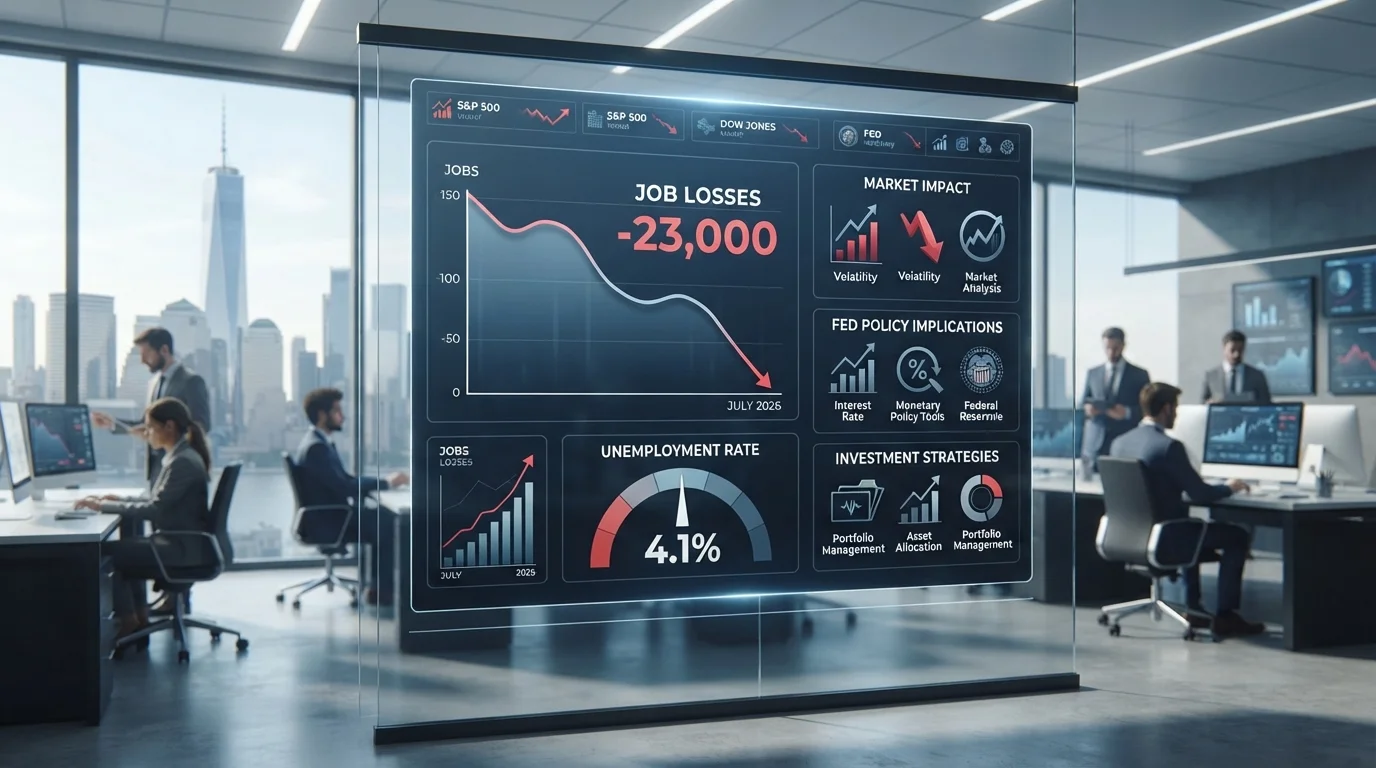
The U.S. labor market delivered a stunning surprise in July 2026 as employers unexpectedly cut 23,000 jobs, marking a sharp reversal from months of steady growth and triggering renewed concerns about the health of the American economy. This dramatic downturn, coupled with downward revisions that slashed 103,000 jobs from May and June payrolls, has created significant uncertainty for investors and policymakers alike.
The unemployment rate technically improved to 4.1%, the lowest since June 2025, but this decline masks deeper problems within the labor market. The drop occurred for the wrong reason entirely: 264,000 Americans left the labor force, pushing the participation rate down to 61.4%, the lowest level since February 2021. This exodus of workers suggests growing frustration among job seekers who have given up looking for employment, a classic warning sign of labor market weakness.
For investors, this data presents a complex puzzle. On one hand, weakening employment could prompt the Federal Reserve to accelerate interest rate cuts, potentially boosting asset prices. On the other hand, the sudden deterioration raises legitimate concerns about whether the economy is heading toward recession, which would pressure corporate earnings and stock valuations across multiple sectors.
Understanding the July 2026 Employment Report
The Numbers Behind the Headlines
The July employment report revealed stark disparities across different sectors of the economy. While manufacturing and construction showed modest gains, with construction companies adding 22,000 jobs and factories increasing payrolls by 5,000, these gains were overwhelmed by losses elsewhere in the economy.
Local public schools emerged as the biggest source of job cuts, eliminating 50,000 positions in July alone. This dramatic reduction in education employment likely reflects ongoing fiscal pressures at the state and local level, as well as the completion of temporary positions that were created during the previous academic year. The restaurant and bar sector shed 26,000 jobs, suggesting that consumer discretionary spending may be weakening as households become more cautious about their finances.
Retailers also felt the pain, cutting 19,000 positions as brick-and-mortar stores continue to struggle with changing consumer habits and the persistent shift toward e-commerce. These sectoral patterns paint a picture of an economy in transition, where traditional employers are retrenching while newer industries have yet to generate sufficient employment growth to offset these losses.
The Participation Rate Problem
Perhaps the most troubling aspect of the July report was the decline in the labor force participation rate. When 264,000 Americans stop looking for work, it signals a fundamental breakdown in the relationship between workers and the labor market. This phenomenon, often called discouraged worker syndrome, typically occurs when job seekers conclude that their efforts to find employment are futile.
Economists closely watch the participation rate because it provides a more comprehensive picture of labor market health than the unemployment rate alone. A falling participation rate can make the unemployment rate look better than it actually is, as the official unemployment statistics only count people who are actively seeking work. The drop to 61.4% participation suggests that the true extent of labor market weakness is being masked by statistical measurement issues.
Sector Analysis: Winners and Losers
Manufacturing and Construction: The Bright Spots
Despite the overall weakness in the employment report, manufacturing and construction demonstrated surprising resilience. Construction companies added 22,000 jobs, continuing a trend of steady growth that has characterized this sector over the past several years. This expansion reflects ongoing investment in infrastructure, residential housing, and commercial real estate projects across the country.
Manufacturing payrolls increased by 5,000 positions, providing some evidence that the Trump administration's industrial policy initiatives may be bearing fruit. The administration has consistently emphasized the importance of rebuilding American manufacturing capacity through tariffs, tax incentives, and targeted government spending programs.
For investors considering exposure to these sectors, the employment data suggests that construction and manufacturing companies may offer relative strength compared to consumer-facing businesses. However, it is important to recognize that these sectors are also vulnerable to higher interest rates, which can increase borrowing costs and dampen demand for new construction and capital equipment.
Service Sector Weakness: A Warning Sign
The service sector, which accounts for approximately 80% of U.S. employment, showed significant weakness in July. Restaurants, bars, and retailers all posted job losses, suggesting that consumer spending may be slowing as households respond to elevated inflation and higher borrowing costs.
This service sector weakness carries important implications for the broader economy. Consumer spending drives approximately two-thirds of U.S. economic activity, so any sustained slowdown in consumption could translate into weaker GDP growth and corporate earnings. The job losses in retail and hospitality may also signal that businesses are becoming more cautious about their hiring plans, potentially creating a negative feedback loop where weaker employment leads to weaker consumption.
Investors seeking to navigate this environment should consider reducing exposure to consumer discretionary stocks while potentially increasing allocations to defensive sectors such as utilities, healthcare, and consumer staples. These sectors tend to be less sensitive to economic cycles and may provide better downside protection if the labor market continues to deteriorate.
Federal Reserve Policy Implications
The Rate Cut Dilemma
The July employment report has significantly complicated the Federal Reserve's policy calculus. Prior to this data release, most market participants expected the Fed to maintain a cautious approach to interest rate cuts, gradually reducing borrowing costs over the coming months while monitoring inflation trends. The sudden weakness in the labor market may force the central bank to accelerate its rate-cutting timeline.
Federal Reserve officials have consistently emphasized their commitment to maintaining full employment while keeping inflation near their 2% target. The July employment report suggests that the Fed may have waited too long to begin cutting rates, allowing monetary policy to remain too restrictive for too long. This policy error, if confirmed, could have significant implications for both the economy and financial markets.
Market pricing for Fed policy has shifted dramatically in response to the employment data. Traders are now pricing in more aggressive rate cuts, with some analysts suggesting that the Fed could cut rates by 50 basis points at its next meeting rather than the 25 basis points that had been widely anticipated.
Inflation vs. Employment: The Fed's Balancing Act
The Federal Reserve now faces a difficult balancing act between addressing labor market weakness and ensuring that inflation remains under control. While the employment data suggests that the economy is slowing, inflationary pressures have not completely dissipated. The Consumer Price Index continues to run above the Fed's 2% target, creating a stagflationary environment where the economy is slowing while prices continue to rise.
This stagflationary scenario presents particular challenges for monetary policymakers. Traditional rate cuts designed to stimulate employment could reignite inflationary pressures, while maintaining restrictive policy could deepen the economic slowdown. The Fed will need to carefully calibrate its policy response to avoid exacerbating either problem.
For investors, this policy uncertainty creates both risks and opportunities. Fixed income investors may benefit from declining interest rates, while equity investors will need to carefully assess which companies are best positioned to navigate a stagflationary environment.
Investment Strategies for the Current Environment
Navigating Market Volatility
The sudden deterioration in labor market conditions has introduced significant volatility into financial markets. Investors should prepare for continued choppy trading as market participants digest the implications of the July employment report and adjust their expectations for Federal Reserve policy.
One approach to navigating this volatility is to focus on high-quality companies with strong balance sheets and durable competitive advantages. These businesses are better positioned to weather economic downturns and may actually benefit from weaker competitors being forced out of the market. Look for companies with low debt levels, consistent cash flows, and pricing power that allows them to maintain margins even during periods of economic stress.
Another strategy is to consider increasing allocations to fixed income securities, particularly high-quality government and corporate bonds. If the Federal Reserve does indeed accelerate its rate-cutting timeline, bond prices could rally significantly, providing capital appreciation in addition to ongoing interest payments.
Sector Rotation Opportunities
The labor market weakness creates opportunities for sector rotation within equity portfolios. As mentioned earlier, defensive sectors such as utilities, healthcare, and consumer staples may outperform during periods of economic uncertainty. These sectors provide essential goods and services that consumers continue to purchase regardless of economic conditions.
Technology stocks present a more complex picture. On one hand, many technology companies have demonstrated impressive resilience during previous economic downturns, benefiting from the ongoing digital transformation of the economy. On the other hand, higher interest rates have pressured the valuations of growth-oriented technology stocks, and a slowing economy could reduce corporate IT spending.
For investors considering technology exposure, it may be prudent to focus on established companies with strong cash flows and reasonable valuations rather than speculative growth names. Companies like Alphabet, which recently attracted a $10 billion investment from Berkshire Hathaway, may offer an attractive combination of growth potential and financial stability.
For investors seeking to automate their trading strategies during these volatile times, consider using Alphio AI's copy trading feature to mirror successful traders and smart money wallets.

Alternatively, explore agentic trading to automate your portfolio management with AI-powered strategies that can respond quickly to changing market conditions.

International Diversification
The U.S. labor market weakness may also create opportunities for international diversification. While the American economy is showing signs of strain, other regions may be at different points in their economic cycles. European markets, for example, have already experienced significant economic weakness and may be closer to recovery than the United States.
Emerging markets also warrant consideration, particularly if the Federal Reserve does begin cutting interest rates more aggressively. Lower U.S. interest rates tend to support emerging market currencies and reduce borrowing costs for developing economies, potentially boosting both their economic growth and equity market performance.
However, investors should be mindful of the risks associated with international investing, including currency fluctuations, political instability, and less-developed regulatory frameworks. International diversification should be implemented gradually and with appropriate risk management measures in place.
Political Implications and Economic Policy
The Midterm Election Factor
The July employment report has significant political implications, coming less than three months before the 2026 midterm elections. President Trump and his Republican Party had been counting on a strong economy to help them maintain control of Congress, and the sudden deterioration in labor market conditions complicates their electoral strategy.
The White House has attempted to put a positive spin on the data, emphasizing the gains in manufacturing and construction while downplaying the broader weakness in the labor market. However, voters tend to focus on their personal economic circumstances rather than macroeconomic statistics, and the job losses in sectors such as education, retail, and hospitality are likely to be felt acutely by many American families.
The political pressure on the Trump administration may lead to increased fiscal stimulus measures in the coming months. Additional tax cuts, infrastructure spending, or targeted support for affected industries could all be on the table as the administration seeks to boost employment ahead of the November elections.
Trade Policy and Economic Resilience
The employment data also raises questions about the effectiveness of the Trump administration's trade policies. The administration has imposed significant tariffs on imports from China and other trading partners in an effort to protect American manufacturing jobs and reduce the trade deficit.
While manufacturing employment did show modest gains in July, the overall weakness in the labor market suggests that trade protectionism may not be delivering the broad-based economic benefits that the administration had promised. The job losses in sectors such as retail and restaurants may partly reflect the impact of tariffs on consumer prices, which have squeezed household budgets and reduced discretionary spending.
For investors, the political uncertainty surrounding trade policy adds another layer of complexity to the current environment. Companies with significant exposure to international trade, either through imports or exports, may face ongoing headwinds as trade tensions continue to simmer.
Historical Context: How This Compares to Past Downturns
Lessons from Previous Recessions
The sudden deterioration in the July employment report has naturally led to comparisons with previous economic downturns. While it is too early to declare that a recession is imminent, the magnitude of the job losses and the decline in labor force participation do bear some similarities to the early stages of past recessions.
The 2008 financial crisis provides a sobering example of how quickly labor market conditions can deteriorate once a negative cycle takes hold. In that episode, initial signs of weakness were followed by accelerating job losses as businesses cut back on hiring and investment in response to falling demand. The key lesson from that experience is that labor market weakness can be self-reinforcing, with job losses leading to reduced consumer spending, which in turn leads to further job losses.
However, there are also important differences between the current situation and previous downturns. The banking sector is significantly better capitalized than it was in 2008, reducing the risk of a systemic financial crisis. Additionally, the Federal Reserve has demonstrated a willingness to provide aggressive monetary stimulus when necessary, which could help cushion the impact of any economic slowdown.
The Soft Landing Debate
The July employment report has reignited the debate about whether the Federal Reserve can achieve a soft landing for the economy. A soft landing occurs when the central bank successfully slows economic growth enough to reduce inflation without triggering a full-blown recession.
Prior to the July employment report, many economists were optimistic that the Fed could pull off this difficult balancing act. The labor market had remained strong despite higher interest rates, and inflation was gradually moving back toward the Fed's 2% target. The sudden weakness in July has cast doubt on this optimistic scenario, with some analysts now predicting that a recession may be unavoidable.
For investors, the soft landing debate has important implications for portfolio positioning. If a soft landing is achieved, risk assets such as equities could continue to perform well as interest rates decline and economic growth stabilizes. If a recession does materialize, however, more defensive positioning may be warranted.
What to Watch in the Coming Weeks
Key Economic Indicators
Investors should closely monitor several key economic indicators in the coming weeks to assess whether the July employment weakness was a temporary blip or the start of a more sustained downturn. The most important data points to watch include:
Weekly jobless claims will provide early indication of whether layoffs are continuing to accelerate. The four-week moving average of initial claims is often the best indicator of underlying labor market trends, smoothing out weekly volatility to reveal the broader direction of employment conditions.
The August employment report, due in early September, will be critical in determining whether July's weakness was an anomaly or the start of a more troubling trend. If August also shows job losses, the probability of a recession will increase significantly.
Consumer confidence surveys will provide insight into how households are responding to the weakening labor market. Declining confidence could translate into reduced consumer spending, creating a negative feedback loop that further pressures employment.
Corporate Earnings Season
The upcoming corporate earnings season will also provide important clues about the health of the economy. Company management teams will offer their perspectives on demand trends, hiring plans, and pricing power during their earnings calls. Any widespread downgrades to guidance or announcements of hiring freezes would confirm that businesses are becoming more cautious about the economic outlook.
Particular attention should be paid to forward-looking guidance rather than backward-looking results. While second-quarter earnings may still look reasonably strong, any deterioration in management commentary about future quarters could signal that the economic slowdown is beginning to impact corporate profitability.
For investors who want to stay ahead of market movements, Alphio AI's automations feature allows you to set conditional workflows that trigger trades based on economic data releases or earnings announcements.

Additionally, conversational trading enables you to execute trades quickly via chat interface when market-moving news breaks.

Conclusion
The July 2026 employment report has fundamentally altered the investment landscape, transforming what had been a relatively stable economic environment into one characterized by significant uncertainty and elevated recession risk. The unexpected loss of 23,000 jobs, combined with the decline in labor force participation, suggests that the U.S. economy may be more fragile than previously believed.
For investors, this environment requires a more cautious approach to portfolio management. High-quality companies with strong balance sheets should be favored over speculative growth names, and defensive sector allocations may provide better downside protection than cyclical exposures. Fixed income securities also deserve consideration, particularly if the Federal Reserve responds to the labor market weakness with more aggressive rate cuts.
The coming weeks will be critical in determining whether July's employment weakness was a temporary setback or the beginning of a more sustained economic downturn. Investors should remain vigilant, closely monitoring incoming economic data and being prepared to adjust their portfolios as the outlook becomes clearer.
While the current environment presents challenges, it is important to remember that market dislocations also create opportunities. Companies that can navigate this period successfully may emerge stronger on the other side, and valuations have become more attractive after the recent market volatility. The key is to remain disciplined, focus on quality, and avoid making emotional decisions during periods of market stress.
For those looking to enhance their trading capabilities during these uncertain times, consider exploring Alphio AI's suite of trading tools. The copy trading feature allows you to mirror the strategies of successful traders, while agentic trading provides AI-powered portfolio management. Automations enable you to set up conditional trading workflows, and conversational trading offers an intuitive chat-based interface for executing trades quickly.
FAQs
What caused the US job market to stall in July 2026?
The July 2026 employment report showed that US employers unexpectedly cut 23,000 jobs, primarily due to significant layoffs in local public schools (50,000 jobs), restaurants and bars (26,000 jobs), and retailers (19,000 jobs). While manufacturing and construction showed modest gains, these were insufficient to offset losses in the service sector. The decline also reflected 264,000 Americans leaving the labor force entirely.
How does the unemployment rate dropping to 4.1% mask underlying weakness?
The unemployment rate fell to 4.1% not because more people found jobs, but because 264,000 Americans dropped out of the labor force. The labor force participation rate fell to 61.4%, the lowest since February 2021. This discouraged worker phenomenon means the true extent of labor market weakness is being masked by statistical measurement, as unemployment statistics only count people actively seeking work.
What does this mean for Federal Reserve interest rate policy?
The weak employment data may force the Federal Reserve to accelerate its rate-cutting timeline. Market participants are now pricing in more aggressive cuts, with some analysts expecting 50 basis point reductions rather than the previously anticipated 25 basis points. The Fed faces a difficult balancing act between addressing labor market weakness and ensuring inflation remains controlled.
Which sectors were hardest hit in the July employment report?
Local public schools eliminated 50,000 positions, making education the hardest-hit sector. Restaurants and bars cut 26,000 jobs, reflecting potential weakness in consumer discretionary spending. Retailers shed 19,000 positions as brick-and-mortar stores continue struggling with the shift to e-commerce. In contrast, construction added 22,000 jobs and manufacturing gained 5,000 positions.
What investment strategies should investors consider given the weak employment data?
Investors should focus on high-quality companies with strong balance sheets and durable competitive advantages. Consider increasing allocations to defensive sectors like utilities, healthcare, and consumer staples. Fixed income securities may benefit from declining interest rates. International diversification could provide opportunities, as other regions may be at different points in their economic cycles.
Related articles
- Stock Market Surges After 2026 Midterms: What the Democratic Sweep Means for Your PortfolioThe stock market rallied after Democrats won the 2026 midterms. Discover what the election means for investors, tech stocks, and the S&P 500 outlook.
- Stock Market Surges After 2026 Midterms: What the Democratic Sweep Means for Your PortfolioThe stock market rallied after Democrats won the 2026 midterms. Discover what the election means for investors, tech stocks, and the S&P 500 outlook.
- Oil Prices Surge Above $105 Amid US-Iran Conflict: Energy Investment Opportunities in November 2026Oil prices climb past $105 as US strikes Iran's Qeshm Island. Discover energy investment opportunities, top oil stocks, and market outlook for November 2026.
- Moderna Stock Skyrockets 177% on Landmark Cancer Vaccine Breakthrough: Investment AnalysisModerna (MRNA) stock jumped 177% after Phase 3 melanoma vaccine success with Merck. Analysis of the breakthrough, market impact, and investment outlook for 2026.
- NVIDIA Earnings August 2026: AI Chip Leader's Q2 Preview & Investment OutlookNVIDIA reports Q2 FY27 earnings on August 26, 2026. Wall Street expects $93-95B revenue driven by AI accelerator demand and Blackwell chip ramp. Stock analysis.
- Nvidia Earnings August 2026: AI Chip Leader's Q2 Preview & Investment OutlookNvidia's Q2 FY27 earnings preview: Expect $93-95B revenue driven by AI accelerator demand. Analysis of Blackwell ramp, data center growth, and price targets reaching $238.