

NVIDIA Earnings August 2026: AI Chip Leader's Q2 Preview & Investment Outlook
NVIDIA reports Q2 FY27 earnings on August 26, 2026. Wall Street expects $93-95B revenue driven by AI accelerator demand and Blackwell chip ramp. Stock analysis.

Key Takeaway
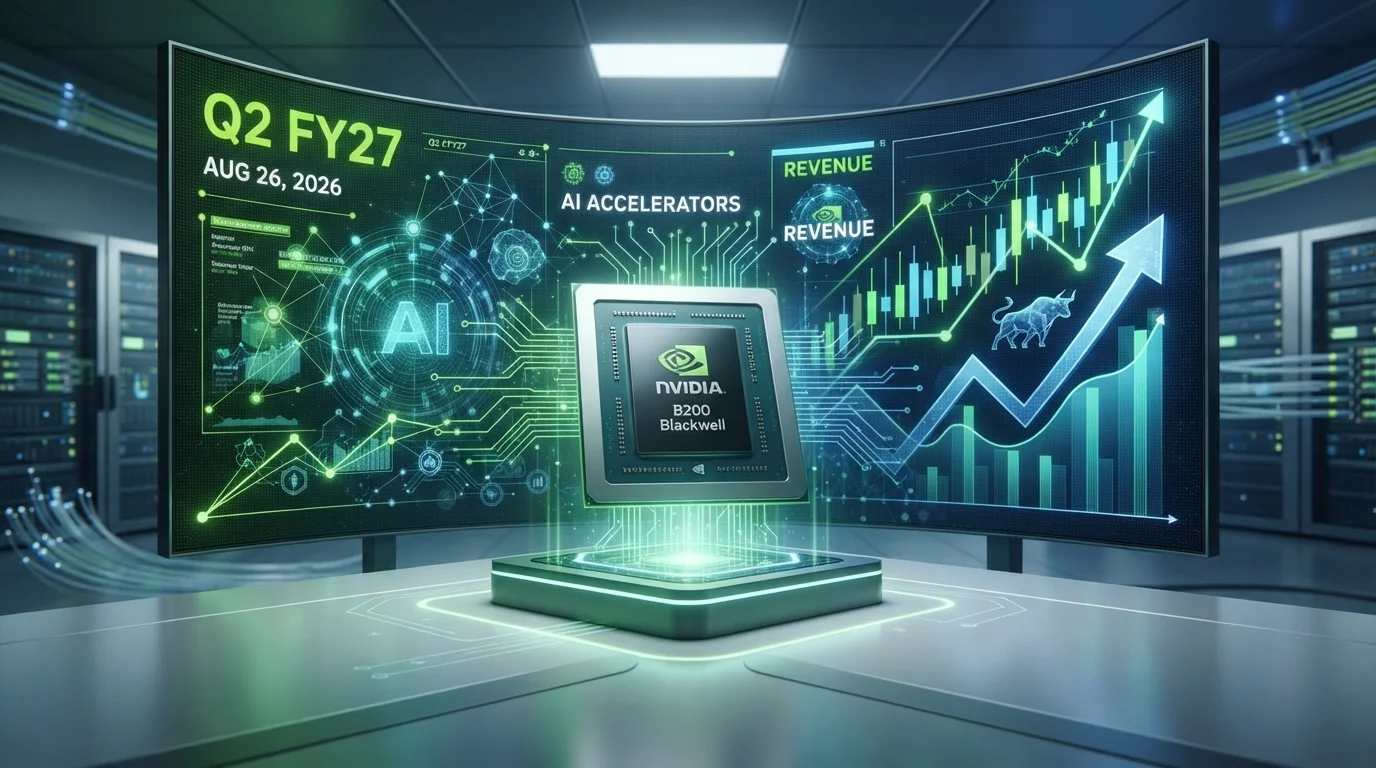
NVIDIA Corporation (NASDAQ: NVDA) stands at a pivotal moment as it prepares to report its second-quarter fiscal year 2027 earnings on August 26, 2026. Wall Street analysts are projecting quarterly revenue between $93 billion and $95 billion, which would represent a staggering year-over-year increase of approximately 67% to 100%. This anticipated growth is primarily driven by insatiable demand for AI accelerators and the successful ramp-up of NVIDIA's next-generation Blackwell architecture.
The semiconductor giant has maintained its dominant position in the AI chip market, commanding an estimated 75% to 81% of AI accelerator revenue in 2026. With the stock trading around $220 in mid-August and market capitalization exceeding $4.86 trillion, NVIDIA remains the world's most valuable semiconductor company. Analysts have set price targets clustering between $275 and $325, with an average target around $305, implying potential upside of 25% to 45% from current trading levels.
For investors seeking to capitalize on the AI revolution through automated trading strategies, consider using Alphio AI's copy trading feature to mirror successful traders and smart money wallets who are positioning ahead of major earnings events.

Understanding NVIDIA's Q2 FY27 Earnings Expectations
Revenue Projections and Growth Drivers
Wall Street's consensus estimates for NVIDIA's Q2 FY27 paint a picture of continued explosive growth. Analysts expect quarterly revenue between $93 billion and $95 billion, driven by several key factors that have positioned NVIDIA at the center of the AI infrastructure buildout.
Data center revenue is expected to contribute approximately $85-87 billion, or roughly 90% of total company revenue. This represents a fundamental shift in NVIDIA's business model from a gaming-focused GPU manufacturer to an AI infrastructure powerhouse. The company's data center segment has become the primary growth engine, with hyperscalers like Microsoft, Google, Amazon, and Meta continuing to invest billions in AI training and inference capabilities.
The Blackwell architecture ramp represents a critical catalyst for the upcoming quarter. Management has indicated that Blackwell will comprise the majority of data center revenue by the fiscal fourth quarter, representing one of the fastest product transitions in the company's history. This next-generation chip delivers significant performance improvements over the previous Hopper generation, with customers eager to upgrade their AI infrastructure.
Margins and Profitability Metrics
NVIDIA's gross margins have reached unprecedented levels, with the company reporting 85-88% gross margins that dwarf competitors AMD's 65-68% and Intel's 58%. These extraordinary margins reflect NVIDIA's pricing power in a supply-constrained market where demand for AI accelerators far exceeds available production capacity.
Operating margins have similarly expanded as revenue growth outpaces operating expense increases. The company's ability to maintain these elevated margins while scaling production will be a key focus area during the earnings call. Any signs of margin compression due to competitive pricing or increased manufacturing costs could impact investor sentiment.
Blackwell Architecture: The Next Growth Engine
Technical Capabilities and Market Reception
The Blackwell architecture represents NVIDIA's most ambitious data center chip design to date, delivering substantial performance improvements for both AI training and inference workloads. Early customer feedback has been overwhelmingly positive, with major cloud providers and AI model builders eager to deploy Blackwell-based systems.
The transition from Hopper to Blackwell is proceeding faster than many analysts initially expected. Management's guidance that Blackwell will become the majority of data center revenue by Q4 FY27 suggests strong production ramp and customer demand. This rapid transition is critical for maintaining NVIDIA's technological lead over emerging competitors.
For traders looking to automate their portfolio management during this volatile earnings period, Alphio's agentic trading feature offers AI-powered strategies to optimize your positions.

Supply Chain and Production Scaling
NVIDIA's reliance on TSMC for chip manufacturing has been both a strength and a constraint. While TSMC's advanced process technology enables NVIDIA's industry-leading performance, production capacity limitations have created supply constraints that limit revenue growth potential.
The company has been working to diversify its supply chain and increase production capacity, but the specialized nature of AI chip manufacturing means that significant capacity expansion takes time. Investors will be watching for any updates on production scaling and supply chain improvements during the earnings call.
Competitive Landscape and Market Position
NVIDIA's Dominant Market Share
NVIDIA continues to dominate the AI accelerator market with an estimated 75% to 81% market share in 2026. This dominance is built on a comprehensive ecosystem that includes not just hardware but also software platforms like CUDA, which has become the industry standard for AI development.
The company's competitive moat extends beyond raw performance metrics. NVIDIA's software ecosystem, developer tools, and established relationships with major cloud providers create significant switching costs for customers considering alternative solutions. This ecosystem advantage has proven difficult for competitors to replicate.
Emerging Competition from AMD and Intel
While NVIDIA maintains a commanding lead, competition is intensifying. AMD holds approximately 6-7% of the data center AI chip market and has been gaining traction with its MI300 series accelerators. Intel, despite capturing only about 1% of the market, continues to invest in its Gaudi accelerator line and has the resources to remain competitive over the long term.
Perhaps more concerning for NVIDIA is the trend toward custom AI chips developed by hyperscalers themselves. Companies like Google (TPU), Amazon (Trainium/Inferentia), and Microsoft have been investing in their own accelerator designs to reduce dependence on NVIDIA and optimize for their specific workloads. While these custom chips primarily serve internal workloads currently, they represent a long-term competitive threat.
Investment Outlook and Price Targets
Analyst Consensus and Valuation
Wall Street analysts remain overwhelmingly bullish on NVIDIA, with the majority maintaining buy or strong buy ratings. Price targets cluster between $275 and $325, with an average target around $305. These targets imply potential upside of 25% to 45% from current trading levels around $220.
AI-powered forecasts suggest NVIDIA stock could reach $225-$230 by August 31, 2026, representing approximately 4.6% upside from current levels in the near term. However, these targets depend heavily on the company's ability to meet or exceed earnings expectations and provide strong forward guidance.
Set up conditional trading workflows with Alphio's automation features to execute trades based on earnings results and price movements.

Key Risks and Considerations
Despite the bullish outlook, investors should be aware of several risks that could impact NVIDIA's stock performance. Geopolitical tensions, particularly regarding China export restrictions, continue to create uncertainty. The company has already faced limitations on selling certain high-end chips to Chinese customers, and any expansion of these restrictions could impact revenue.
Valuation remains a concern for some investors, with NVIDIA trading at premium multiples that assume continued exceptional growth. Any signs of demand deceleration, margin compression, or competitive pressure could lead to significant multiple compression.
What to Watch in the Earnings Report
Critical Metrics and Guidance
Investors should focus on several key metrics when NVIDIA reports earnings. Data center revenue growth and Blackwell ramp progress will be the primary drivers of stock performance. Management's commentary on supply constraints and production scaling will provide important context for future growth potential.
Forward guidance for Q3 FY27 will be particularly important, as it will indicate whether the company expects the current growth trajectory to continue. Any changes to gross margin guidance could signal shifts in pricing power or manufacturing costs.
Management Commentary and Strategic Direction
Beyond the numbers, investors should pay attention to management's commentary on several strategic topics. The company's approach to emerging competition, particularly from hyperscaler custom chips, will be important for assessing long-term competitive positioning.
Updates on software and services initiatives, including the AI Enterprise platform and DGX Cloud offerings, will provide insight into NVIDIA's strategy to expand beyond hardware and capture more value from the AI ecosystem.
Conclusion
NVIDIA's upcoming Q2 FY27 earnings report represents a critical moment for the AI chip leader and the broader semiconductor sector. With Wall Street expecting quarterly revenue between $93 billion and $95 billion, the company faces high expectations that will be challenging to meet.
The successful ramp of Blackwell architecture, continued data center demand from hyperscalers, and the company's dominant market position provide a strong foundation for continued growth. However, investors should remain mindful of competitive pressures, geopolitical risks, and valuation concerns that could impact stock performance.
For investors looking to navigate the volatility around major earnings events, Alphio's conversational trading interface allows you to execute trades via chat and manage your positions with AI assistance.

Whether NVIDIA can maintain its extraordinary growth trajectory while fending off emerging competition will largely determine whether the stock can reach analyst price targets of $275-$325. The August 26 earnings report will provide crucial insights into these questions and likely set the tone for NVIDIA's stock performance through the remainder of 2026.
Consider exploring Alphio's copy trading feature to mirror the strategies of successful investors who are positioning ahead of major market events like NVIDIA's earnings release.
FAQs
When is NVIDIA's Q2 FY27 earnings report date?
NVIDIA is scheduled to report its second-quarter fiscal year 2027 earnings on Wednesday, August 26, 2026, after the market close.
What revenue does Wall Street expect from NVIDIA in Q2 FY27?
Wall Street analysts expect NVIDIA to report quarterly revenue between $93 billion and $95 billion, representing year-over-year growth of approximately 67% to 100%.
What is the price target for NVIDIA stock after earnings?
Analysts have set price targets clustering between $275 and $325, with an average target around $305, implying potential upside of 25% to 45% from current trading levels around $220.
What is NVIDIA's Blackwell architecture?
Blackwell is NVIDIA's next-generation AI chip architecture that delivers significant performance improvements over the previous Hopper generation. Management expects Blackwell to comprise the majority of data center revenue by fiscal Q4 2027.
What is NVIDIA's market share in AI chips?
NVIDIA dominates the AI accelerator market with an estimated 75% to 81% market share in 2026, compared to AMD's 6-7% and Intel's approximately 1%.
Related articles
- Stock Market Surges After 2026 Midterms: What the Democratic Sweep Means for Your PortfolioThe stock market rallied after Democrats won the 2026 midterms. Discover what the election means for investors, tech stocks, and the S&P 500 outlook.
- Stock Market Surges After 2026 Midterms: What the Democratic Sweep Means for Your PortfolioThe stock market rallied after Democrats won the 2026 midterms. Discover what the election means for investors, tech stocks, and the S&P 500 outlook.
- Oil Prices Surge Above $105 Amid US-Iran Conflict: Energy Investment Opportunities in November 2026Oil prices climb past $105 as US strikes Iran's Qeshm Island. Discover energy investment opportunities, top oil stocks, and market outlook for November 2026.
- AMD Stock Analysis August 2026: Can MI350 GPU Power the Path to $600?Comprehensive AMD stock analysis for August 2026. Explore MI350 GPU potential, AI chip competition with Nvidia, earnings outlook, and investment thesis for the $600 price target.
- Nvidia Stock Earnings August 2026: AI Chip Leader's Q2 Outlook and Investment AnalysisNvidia reports Q2 FY2027 earnings on August 26, 2026. Discover NVDA stock analysis, AI chip demand trends, and price forecasts for investors.
- Nvidia Stock Earnings August 2026: AI Chip Leader's Q2 Performance and Future OutlookNvidia stock analysis ahead of August 26 earnings. Explore AI chip demand, Blackwell systems adoption, and price targets. Expert forecast for NVDA investors.