

Nvidia Earnings August 2026: AI Chip Leader's Q2 Preview & Investment Outlook
Nvidia's Q2 FY27 earnings preview: Expect $93-95B revenue driven by AI accelerator demand. Analysis of Blackwell ramp, data center growth, and price targets reaching $238.

Key Takeaway
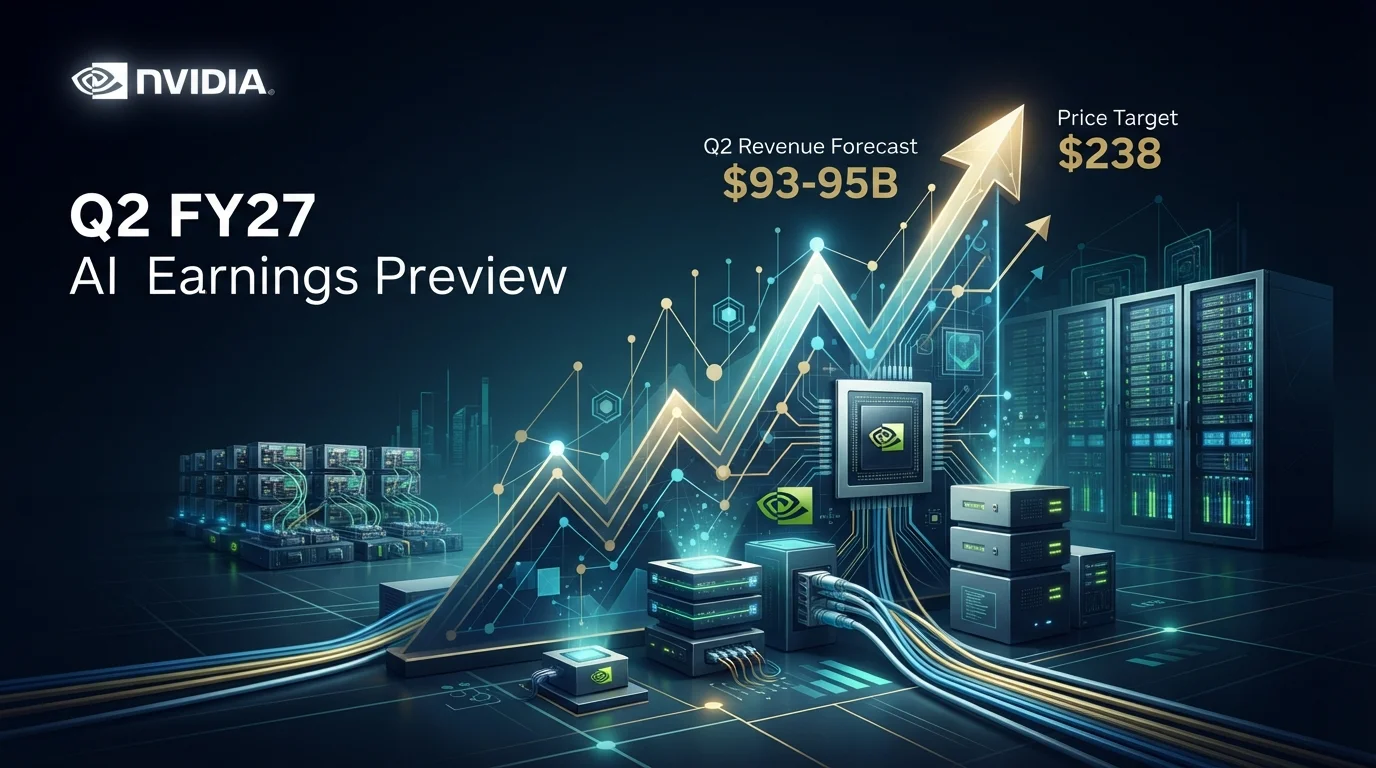
Nvidia's upcoming Q2 fiscal 2027 earnings report, scheduled for August 26, 2026, represents one of the most significant catalysts for the technology sector this quarter. Wall Street analysts have set aggressive expectations, targeting quarterly revenue between $93 billion and $95 billion, which would represent a staggering year-over-year increase of approximately 67% to 100%. This anticipated growth is primarily driven by insatiable demand for AI accelerators and the successful ramp-up of Nvidia's next-generation Blackwell architecture.
The semiconductor giant, which has seen its stock rise approximately 17.7% year-to-date to around $219, faces a critical moment as investors weigh the sustainability of its extraordinary growth trajectory against intensifying competition and potential supply constraints. Analysts expect Nvidia to report GAAP earnings of approximately $2.06 per share for Q2 2026, nearly double the year-ago result. With AI-powered forecasts suggesting the stock could reach $225-$230 by month-end, representing approximately 4.6% upside from current levels, all eyes are on whether Nvidia can meet or exceed these lofty expectations.
For investors seeking to capitalize on the AI revolution through automated trading strategies, consider using Alphio AI's copy trading feature to mirror successful traders who specialize in technology and semiconductor stocks.

Understanding Nvidia's Q2 FY27 Earnings Expectations
Revenue Projections and Growth Drivers
The magnitude of Nvidia's expected Q2 performance reflects the company's dominant position in the AI accelerator market. With data center revenue now representing approximately 87% of total revenue, the company's fortunes are increasingly tied to the continued expansion of artificial intelligence infrastructure across cloud providers, enterprises, and sovereign AI initiatives. Full-year fiscal 2026 data center revenue is estimated at $170-190 billion, underscoring the structural shift in Nvidia's business model.
The primary growth driver remains the relentless demand for AI training and inference chips. Major cloud providers including Microsoft, Amazon, Google, and Meta continue to aggressively expand their AI infrastructure, with Nvidia's GPUs remaining the gold standard for large language model training and deployment. The company's ability to command premium pricing while maintaining supply discipline has created a favorable margin environment that supports both top-line growth and profitability expansion.
Blackwell Architecture: The Next Growth Engine
Nvidia's Blackwell platform represents a critical inflection point for the company's product roadmap. The B200 GPU delivers approximately 20 PFLOPS of FP4 compute, a significant leap forward from the previous H100 generation. This performance improvement, combined with enhanced memory bandwidth and power efficiency, positions Blackwell as the foundation for the next wave of AI model development.
Reports indicate that Nvidia has pre-allocated nearly all B200 production through Q2 2026, with smaller AI companies facing 6-12 month waits for Blackwell hardware. This supply constraint, while potentially limiting near-term revenue upside, demonstrates the extraordinary demand environment and provides visibility into future quarters. The GB200 NVL72 rack-scale system, which connects 72 B200 GPUs and 36 Grace CPUs via NVLink 5 at 1.8 TB/s per GPU, represents a new category of AI infrastructure that could drive significant average selling price expansion.
Market Position and Competitive Landscape
Dominance in AI Accelerators
Nvidia currently holds approximately 86% of the AI accelerator market, maintaining a commanding lead over competitors AMD and Intel. This market position reflects years of investment in CUDA software ecosystem development, which has created significant switching costs for AI developers and enterprises. The company's comprehensive platform approach, combining hardware, software, and networking solutions, provides an integrated value proposition that competitors struggle to match.
However, competitive pressures are intensifying. AMD's MI300 series has gained traction in certain workloads, while custom silicon initiatives from major cloud providers pose longer-term threats. Intel's Gaudi accelerators and various startup offerings continue to vie for market share, though none have yet achieved the scale or ecosystem maturity to challenge Nvidia's dominance in the near term.
Customer Concentration Risks
A notable consideration for investors is Nvidia's customer concentration. According to recent filings, two mystery customers accounted for a significant portion of Q2 fiscal 2026 revenue, with "Customer A" representing 23% of total revenue and "Customer B" comprising 16%. While this concentration reflects the scale of major cloud providers' AI investments, it also creates potential vulnerability if any major customer were to reduce orders or accelerate internal silicon development.
For traders looking to automate their portfolio management in response to earnings volatility, Alphio's agentic trading feature offers AI-powered strategies that can adapt to market conditions in real-time.

Financial Analysis and Valuation Considerations
Earnings Expectations and Margins
Beyond revenue growth, investors will closely monitor Nvidia's margin trajectory. The company's ability to maintain premium pricing while scaling production has historically supported industry-leading gross margins. However, the transition to Blackwell and potential manufacturing complexity could introduce near-term margin pressure. Analysts will be particularly focused on gross margin guidance for the remainder of fiscal 2027, as this metric significantly impacts earnings power and valuation multiples.
The expected GAAP earnings of $2.06 per share would represent nearly a 100% increase from the prior year, demonstrating the operating leverage inherent in Nvidia's business model. This earnings growth, combined with continued share buybacks, supports the bullish case for the stock despite elevated valuation multiples.
Valuation Metrics and Price Targets
Nvidia's valuation reflects extraordinary growth expectations embedded in the current stock price. Traditional valuation metrics such as price-to-earnings and price-to-sales ratios exceed semiconductor industry averages by significant margins, implying the market anticipates sustained high growth rates for years to come. According to 62 analysts covering the stock, the average rating remains 'Strong Buy,' with price targets reaching as high as $238.
The investment thesis hinges on Nvidia's ability to maintain its technological leadership while expanding its addressable market beyond traditional data center applications into areas such as autonomous vehicles, robotics, and edge AI. Success in these emerging markets could justify current valuations and provide a pathway to continued outperformance.
Key Risks and Catalysts to Watch
Supply Chain and Production Constraints
The most significant near-term risk to Nvidia's earnings performance relates to supply constraints. The complexity of manufacturing advanced AI chips, combined with limited capacity at leading-edge foundries, has created a supply-demand imbalance that shows no signs of abating. While this environment supports pricing power, it also limits revenue upside and could result in unmet demand that competitors might eventually capture.
Geopolitical considerations also loom large, with export restrictions on advanced AI chips to China creating both revenue headwinds and strategic challenges. Nvidia has adapted by developing China-compliant product variants, but the long-term implications of technology decoupling remain uncertain.
Product Transition Dynamics
The ramp of Blackwell introduces execution risk as Nvidia manages the transition from H100 to the new architecture. Historical patterns suggest that major product transitions can create temporary demand pauses as customers await new products, potentially impacting quarterly results. However, the magnitude of demand for AI infrastructure may mitigate this effect in the current cycle.
Investors should also monitor commentary regarding the Grace CPU platform and the GB200 superchip, which combines CPU and GPU on a single die. This integrated approach targets the growing market for large AI models and high-performance computing workloads, potentially expanding Nvidia's addressable market beyond standalone GPU sales.
For investors who want to set up conditional trading workflows based on earnings announcements, Alphio's automations feature allows you to create sophisticated trading rules that execute automatically.

Sector Implications and Market Impact
Broader Technology Sector Impact
Nvidia's earnings report carries implications far beyond the company itself. As a bellwether for AI infrastructure investment, Nvidia's results provide insight into the spending patterns of major cloud providers and enterprises. Strong results would validate the AI investment thesis and likely benefit related stocks in the semiconductor and technology sectors. Conversely, any disappointment could trigger broader risk-off sentiment in growth stocks.
The stock's performance following earnings has historically been volatile, with shares declining between 1% and 9% following results days over the past four quarters, even when underlying numbers were strong. This pattern suggests that expectations have been elevated, and the bar for positive stock reaction is exceptionally high.
AI Investment Cycle Sustainability
Perhaps the most critical question for investors is whether the current AI investment cycle represents a sustainable long-term trend or a cyclical peak. Nvidia's guidance for the remainder of fiscal 2027 will provide important clues regarding demand visibility and the potential for continued growth acceleration. Commentary regarding sovereign AI initiatives, enterprise adoption, and new application areas will help investors assess the durability of demand.
The data center segment's revenue trajectory, now approaching $200 billion annually, represents a remarkable transformation from the company's gaming-focused origins. This growth has created a company of unprecedented scale in the semiconductor industry, with implications for competitive dynamics, capital allocation, and strategic positioning.
Conclusion
Nvidia's Q2 FY27 earnings report represents a pivotal moment for the AI chip leader and the broader technology sector. With expectations set for revenue between $93-95 billion and earnings of approximately $2.06 per share, the company faces the challenge of meeting extraordinarily high expectations while navigating supply constraints and competitive pressures. The successful ramp of Blackwell, continued data center strength, and expanding AI adoption provide a favorable fundamental backdrop.
For investors, the key considerations extend beyond the headline numbers to include margin trajectory, customer concentration risks, and guidance for future quarters. While valuation remains elevated by traditional metrics, the company's dominant market position and the structural growth of AI infrastructure provide a compelling long-term thesis. Price targets reaching $238 suggest continued analyst optimism, though near-term stock performance may depend on the magnitude of any earnings beat and management's commentary regarding future demand visibility.
As the AI revolution continues to reshape the technology landscape, Nvidia remains at the epicenter of this transformation. Whether the stock can sustain its remarkable run will depend on execution, competitive positioning, and the continued expansion of AI applications across industries. For investors seeking exposure to this megatrend, Nvidia offers a pure-play opportunity, albeit one that requires careful attention to valuation and risk management.
To execute trades and manage your portfolio with the power of conversational AI, explore Alphio's conversational trading platform and experience the future of intelligent investing.

Additionally, consider leveraging Alphio's copy trading feature to mirror Hyperliquid Vaults and Smart Money Wallets, or explore agentic trading to automate your portfolio management with AI-powered strategies that adapt to market conditions.
FAQs
When is Nvidia's Q2 FY27 earnings report scheduled?
Nvidia's Q2 fiscal 2027 earnings report is scheduled for August 26, 2026. This represents one of the most significant catalysts for the technology sector this quarter, with analysts expecting quarterly revenue between $93-95 billion.
What are Wall Street's revenue expectations for Nvidia's Q2 2026?
Wall Street analysts project quarterly revenue between $93 billion and $95 billion for Q2 FY27, representing a year-over-year increase of approximately 67% to 100%. This growth is driven primarily by insatiable demand for AI accelerators and the ramp-up of Nvidia's Blackwell architecture.
What is Nvidia's Blackwell platform and why is it important?
Nvidia's Blackwell platform is the company's next-generation AI chip architecture, featuring the B200 GPU which delivers approximately 20 PFLOPS of FP4 compute. It represents a significant performance leap from the previous H100 generation and is fully allocated through Q2 2026, demonstrating extraordinary demand.
What is Nvidia's market share in AI accelerators?
Nvidia currently holds approximately 86% of the AI accelerator market, maintaining a commanding lead over competitors AMD and Intel. This dominance reflects years of investment in the CUDA software ecosystem and comprehensive platform solutions.
What are the key risks facing Nvidia investors?
Key risks include supply chain constraints limiting production, customer concentration with two major customers representing nearly 40% of revenue, intensifying competition from AMD and custom silicon initiatives, and geopolitical export restrictions affecting China sales. Additionally, high valuation multiples require sustained growth to justify current prices.
Related articles
- Stock Market Surges After 2026 Midterms: What the Democratic Sweep Means for Your PortfolioThe stock market rallied after Democrats won the 2026 midterms. Discover what the election means for investors, tech stocks, and the S&P 500 outlook.
- Stock Market Surges After 2026 Midterms: What the Democratic Sweep Means for Your PortfolioThe stock market rallied after Democrats won the 2026 midterms. Discover what the election means for investors, tech stocks, and the S&P 500 outlook.
- Oil Prices Surge Above $105 Amid US-Iran Conflict: Energy Investment Opportunities in November 2026Oil prices climb past $105 as US strikes Iran's Qeshm Island. Discover energy investment opportunities, top oil stocks, and market outlook for November 2026.
- How Federal Reserve Interest Rate Policy Shapes Stock Market Performance in 2026Comprehensive analysis of Federal Reserve interest rate decisions and their impact on stock market performance, sectors, and investment strategies in 2026.
- Pfizer Stock Analysis: Is PFE's 6.9% Dividend Yield Worth the Risk?Is Pfizer undervalued? Explore PFE's 6.9% dividend yield, weight loss drug pipeline, and why analysts see 15% upside. Complete investment analysis for 2026.
- Pfizer Stock Analysis 2026: Is PFE's 6.9% Dividend Yield Too Good to Ignore?Pfizer stock offers 6.9% dividend yield and trades at 8.5X earnings. Discover PFE's investment potential with late-stage weight loss drug pipeline analysis.