

Nvidia Earnings August 2026: Record Revenue and the Future of AI Chip Demand
Nvidia reported record Q2 2026 earnings with $96.22B revenue. Analyze AI chip demand trends, stock price forecast, and investment implications for NVDA investors.

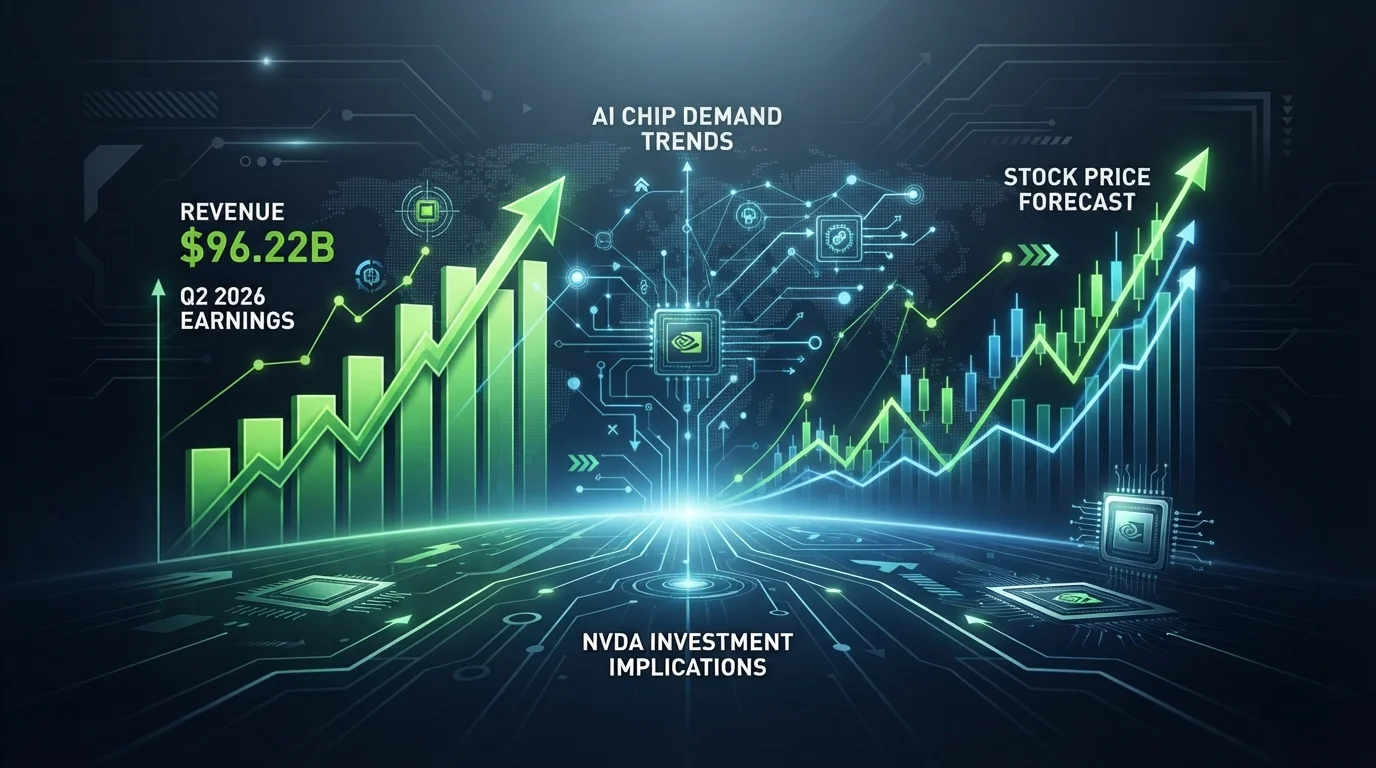
Key Takeaway
Nvidia's fiscal second-quarter earnings report for 2026 has delivered yet another blowout performance, cementing the company's position as the undisputed leader in artificial intelligence infrastructure. The semiconductor giant reported adjusted earnings of $2.22 per share, comfortably beating analyst expectations of $2.10, while revenue surged 106% year-over-year to a record $96.22 billion. These staggering numbers reflect the insatiable global demand for AI computing power as enterprises, cloud providers, and governments race to build out their artificial intelligence capabilities.
The market's reaction was immediate and decisive, with Nvidia shares jumping 8.7% in the trading session following the earnings release—the largest single-day percentage gain since April 2025. This rally added billions to the company's market capitalization and provided a significant boost to broader technology indices. For investors, the results validate Nvidia's premium valuation and suggest that the AI boom shows no signs of slowing down, despite concerns about competition and potential market saturation.
However, the earnings report also revealed important nuances about the evolving competitive landscape. While Nvidia continues to dominate the AI accelerator market with its H100 and H200 chips, the company faces increasing pressure from custom silicon solutions developed by major cloud providers and emerging competitors like AMD. Management's guidance for the upcoming quarter will be critical in determining whether Nvidia can maintain its extraordinary growth trajectory or if we're approaching an inflection point in the AI investment cycle.
Breaking Down the Numbers: Nvidia's Q2 2026 Financial Performance
Nvidia's second-quarter results represent a continuation of the extraordinary financial performance that has characterized the AI era. Revenue of $96.22 billion represents not just a doubling from the prior year, but also sequential growth that defies the typical seasonality patterns seen in the semiconductor industry. This consistent quarter-over-quarter expansion demonstrates that demand for AI infrastructure continues to outpace even the most optimistic projections.
The company's data center segment, which includes AI accelerators and related infrastructure, was once again the primary growth driver. Data center revenue exceeded $80 billion for the quarter, accounting for the vast majority of total sales. This concentration highlights both Nvidia's strength in the AI market and its vulnerability to any potential slowdown in enterprise AI spending. The gross margin profile remained exceptionally strong, with non-GAAP gross margins hovering near 75%, reflecting the pricing power that comes with market dominance in a supply-constrained environment.
Cash generation continues to be robust, with free cash flow exceeding $20 billion for the quarter. This financial strength provides Nvidia with significant strategic flexibility, enabling continued investment in research and development while also returning capital to shareholders through buybacks and dividends. The company's balance sheet remains fortress-like, with cash and equivalents well in excess of debt obligations.
The AI Chip Market: Understanding Demand Drivers
The explosive growth in AI chip demand stems from several interconnected trends that show no signs of abating. Large language models and generative AI applications require massive computational resources for both training and inference, creating a structural tailwind for specialized accelerators like Nvidia's GPUs. Major cloud providers including Amazon, Microsoft, and Google are investing tens of billions of dollars annually to expand their AI infrastructure capabilities, with Nvidia chips forming the backbone of these deployments.
Enterprise adoption of AI is accelerating across virtually every industry sector. Financial services firms are deploying AI for risk modeling and fraud detection. Healthcare organizations are using AI for drug discovery and diagnostic imaging. Manufacturing companies are implementing AI for quality control and predictive maintenance. Each of these applications requires specialized hardware, and Nvidia's comprehensive software ecosystem, including CUDA and its various AI frameworks, creates significant switching costs that protect its market position.
The sovereign AI trend represents another significant demand driver. Countries around the world are recognizing the strategic importance of AI capabilities and are investing heavily in domestic AI infrastructure. From the Middle East to Southeast Asia to Europe, governments are building out national AI computing centers, and Nvidia chips are the default choice for these deployments. This sovereign demand provides an additional layer of revenue stability beyond commercial customers.
For investors looking to capitalize on the AI revolution, Alphio AI's copy trading feature offers an innovative way to mirror the strategies of successful tech investors and smart money wallets that have been early to recognize Nvidia's potential.

Competitive Landscape: Challenges on the Horizon
Despite its dominant position, Nvidia faces an increasingly complex competitive environment. AMD has made significant strides with its MI300 series accelerators, winning deployments at major cloud providers and offering a credible alternative for certain workloads. While AMD's market share remains small relative to Nvidia, the competitive pressure is real and growing, particularly on price-performance metrics for inference workloads.
Perhaps more concerning for Nvidia's long-term prospects is the trend toward custom silicon among its largest customers. Amazon's Trainium and Inferentia chips, Google's TPU series, and Microsoft's Maia accelerators all represent attempts by cloud providers to reduce their dependence on Nvidia and capture more of the value chain. These custom solutions are unlikely to completely displace Nvidia in the near term, but they could capture meaningful share of the inference market and put pressure on pricing over time.
The regulatory environment also presents potential challenges. Nvidia's dominance has attracted scrutiny from antitrust authorities in multiple jurisdictions. Export controls on advanced semiconductors to China have already impacted revenue, and further restrictions could limit growth in one of the world's largest AI markets. The company must navigate these geopolitical complexities while maintaining its technological leadership.
Stock Price Analysis and Valuation Considerations
Nvidia's stock has been one of the best performers in the market over the past two years, with gains exceeding several hundred percent since the beginning of the AI boom. The post-earnings rally pushed shares above $240, bringing the company's market capitalization to unprecedented levels. At these valuations, Nvidia trades at a significant premium to traditional semiconductor companies, reflecting investor expectations for continued exceptional growth.
Analysts remain broadly positive on the stock, with the majority maintaining buy or strong buy ratings. Price targets cluster in the $250-$300 range, suggesting continued upside potential from current levels. The bull case centers on the sustained nature of AI infrastructure investment, Nvidia's software ecosystem moat, and the company's ability to maintain pricing power even as competition intensifies.
However, valuation concerns are legitimate and growing. Trading at over 30 times forward revenue and 50 times forward earnings, Nvidia is priced for perfection. Any disappointment in guidance, market share loss, or macroeconomic headwinds could trigger significant multiple compression. Investors should be prepared for volatility and consider position sizing accordingly.
Those interested in automating their investment approach may want to explore Alphio's agentic trading capabilities, which can help manage positions in volatile growth stocks like Nvidia through AI-powered portfolio management strategies.

Forward Guidance: What Management Is Telling Us
Management's commentary during the earnings call provided important insights into the company's outlook and strategic priorities. Demand visibility remains strong, with the company indicating that supply constraints rather than demand weakness continue to be the primary limiting factor on growth. This suggests that the AI investment cycle has further to run, even if the rate of growth may moderate from the extraordinary levels seen in recent quarters.
The Blackwell platform, Nvidia's next-generation architecture, remains on track for volume production in the coming quarters. This new product cycle will be critical for maintaining technological leadership and justifying premium pricing. Management expressed confidence that Blackwell will deliver significant performance improvements that will drive upgrade cycles among existing customers and attract new deployments.
Capital allocation priorities remain focused on research and development, with spending expected to increase significantly to support the transition to Blackwell and continued software ecosystem development. Share buybacks will continue but at a measured pace that preserves financial flexibility for strategic opportunities.
Investment Implications: How to Position for the AI Era
For investors considering Nvidia, the fundamental question is whether the company's extraordinary growth can continue long enough to justify current valuations. The bull case is compelling: AI represents a generational technology shift, and Nvidia is the picks-and-shovels play that benefits regardless of which AI applications ultimately succeed. The company's software ecosystem creates powerful network effects that will be difficult for competitors to replicate.
However, prudent investors should also consider the risks. The semiconductor industry is notoriously cyclical, and the current AI investment boom will eventually normalize. Competition is intensifying, and Nvidia's largest customers are actively working to reduce their dependence on the company. Valuation leaves little room for error, and the stock could be vulnerable to broader market corrections or rotation out of growth stocks.
Diversification within the AI theme makes sense for most investors. While Nvidia remains the dominant player, other semiconductor companies, cloud providers, and AI software companies offer exposure to the trend with different risk-reward profiles. A basket approach can capture the upside of AI adoption while reducing single-stock risk.
Investors can also leverage Alphio's automation features to set up conditional workflows that respond to earnings announcements, price movements, and other market events without requiring constant monitoring.

Broader Market Impact: Nvidia as a Bellwether
Nvidia's earnings have become a market-moving event that extends far beyond the company's own stock price. As a major component of the S&P 500 and Nasdaq indices, Nvidia's performance has an outsized impact on broader market sentiment. The post-earnings rally provided a significant boost to technology indices and helped support the market during a period of uncertainty about Federal Reserve policy and economic growth.
The results also have implications for the broader AI ecosystem. Companies that supply Nvidia with components, including memory manufacturers like SK Hynix and Micron, tend to move in sympathy with Nvidia's results. Cloud providers that are major Nvidia customers see their own AI strategies validated or called into question based on Nvidia's commentary about demand trends.
For active traders, Nvidia's earnings provide valuable information about the health of the AI trade and the broader technology sector. The company's guidance can inform positioning in related stocks and help identify potential winners and losers as the AI infrastructure buildout continues.
Conclusion
Nvidia's Q2 2026 earnings report confirms that the company remains at the epicenter of the artificial intelligence revolution. Record revenue of $96.22 billion and earnings of $2.22 per share demonstrate that demand for AI infrastructure continues to exceed even the most optimistic projections. The 8.7% post-earnings rally reflects investor confidence that Nvidia can maintain its extraordinary growth trajectory, at least in the near term.
For investors, the key question is whether to chase the stock at current valuations or wait for a better entry point. The bull case is supported by strong demand visibility, technological leadership, and the structural nature of AI adoption. However, valuation concerns and competitive pressures suggest that future returns may be more modest than the spectacular gains of the past two years.
Regardless of one's view on Nvidia as an investment, the company's results provide valuable insights into the state of AI adoption and the health of the technology sector. As the dominant supplier of AI infrastructure, Nvidia's performance is a bellwether for the broader digital transformation that is reshaping the global economy.
Ready to take your trading to the next level? Explore Alphio's conversational trading interface to execute trades, monitor positions, and access market insights through an intuitive chat-based experience. Whether you're trading Nvidia or exploring other AI opportunities, Alphio provides the tools you need to stay ahead of the market.

FAQs
What were Nvidia's actual earnings results for Q2 2026?
Nvidia reported adjusted earnings of $2.22 per share, beating analyst expectations of $2.10. Revenue reached a record $96.22 billion, representing 106% year-over-year growth. The data center segment was the primary driver, with revenue exceeding $80 billion.
How did the stock market react to Nvidia's earnings?
Nvidia shares jumped 8.7% following the earnings release, marking the largest single-day percentage gain since April 2025. This rally added significant value to the company's market capitalization and provided a boost to broader technology indices.
What is driving the demand for Nvidia's AI chips?
Demand is driven by large language model development, enterprise AI adoption across industries, cloud provider infrastructure expansion, and sovereign AI initiatives by governments worldwide. The company's CUDA software ecosystem creates significant switching costs that protect its market position.
Who are Nvidia's main competitors in the AI chip market?
AMD is the most direct competitor with its MI300 series accelerators. However, Nvidia also faces competition from custom silicon developed by cloud providers (Amazon's Trainium, Google's TPU, Microsoft's Maia) and emerging players in the AI accelerator space.
Is Nvidia stock still a good investment at current prices?
Analysts remain broadly positive with price targets in the $250-$300 range, but valuation concerns exist. Trading at over 30 times forward revenue, the stock is priced for continued exceptional growth. Investors should consider their risk tolerance and position sizing carefully, as any disappointment could trigger significant volatility.
Related articles
- Stock Market Surges After 2026 Midterms: What the Democratic Sweep Means for Your PortfolioThe stock market rallied after Democrats won the 2026 midterms. Discover what the election means for investors, tech stocks, and the S&P 500 outlook.
- Stock Market Surges After 2026 Midterms: What the Democratic Sweep Means for Your PortfolioThe stock market rallied after Democrats won the 2026 midterms. Discover what the election means for investors, tech stocks, and the S&P 500 outlook.
- Oil Prices Surge Above $105 Amid US-Iran Conflict: Energy Investment Opportunities in November 2026Oil prices climb past $105 as US strikes Iran's Qeshm Island. Discover energy investment opportunities, top oil stocks, and market outlook for November 2026.
- Netflix Q3 2026 Deep Dive: Beat the Quarter, Lose the Narrative — Ads Cut to ~$2.7BNarrative sell-side deep dive into Netflix Q3 2026: EPS beat, ad guide cut to ~$2.7B, margin path, India engagement, buybacks, Needham downgrade, and falsifiable 2027 watchpoints.
- AI Tech Stocks Selloff October 2026: Inside the $2 Trillion Market RoutThe AI tech selloff wiped out $2 trillion in October 2026. Discover what's driving the crash, which stocks are most affected, and how investors should respond.
- AI Spending Fears Rattle Wall Street: Inside the Tech Selloff of October 2026Wall Street is shaken as AI spending concerns trigger a massive tech selloff. Learn how Meta, Nvidia, and Microsoft capex is reshaping markets and what investors should watch.