

Nasdaq Tumbles 2.6% as Meta's AI Spending Fears Collide with Oil Surge: A Market Crossroads in Octob
The Nasdaq plunged 2.6% as Meta's $825B AI spending plan sparked fears. Brent crude hit $113 on Middle East tensions. Full market analysis for October 2026.

Key Takeaway
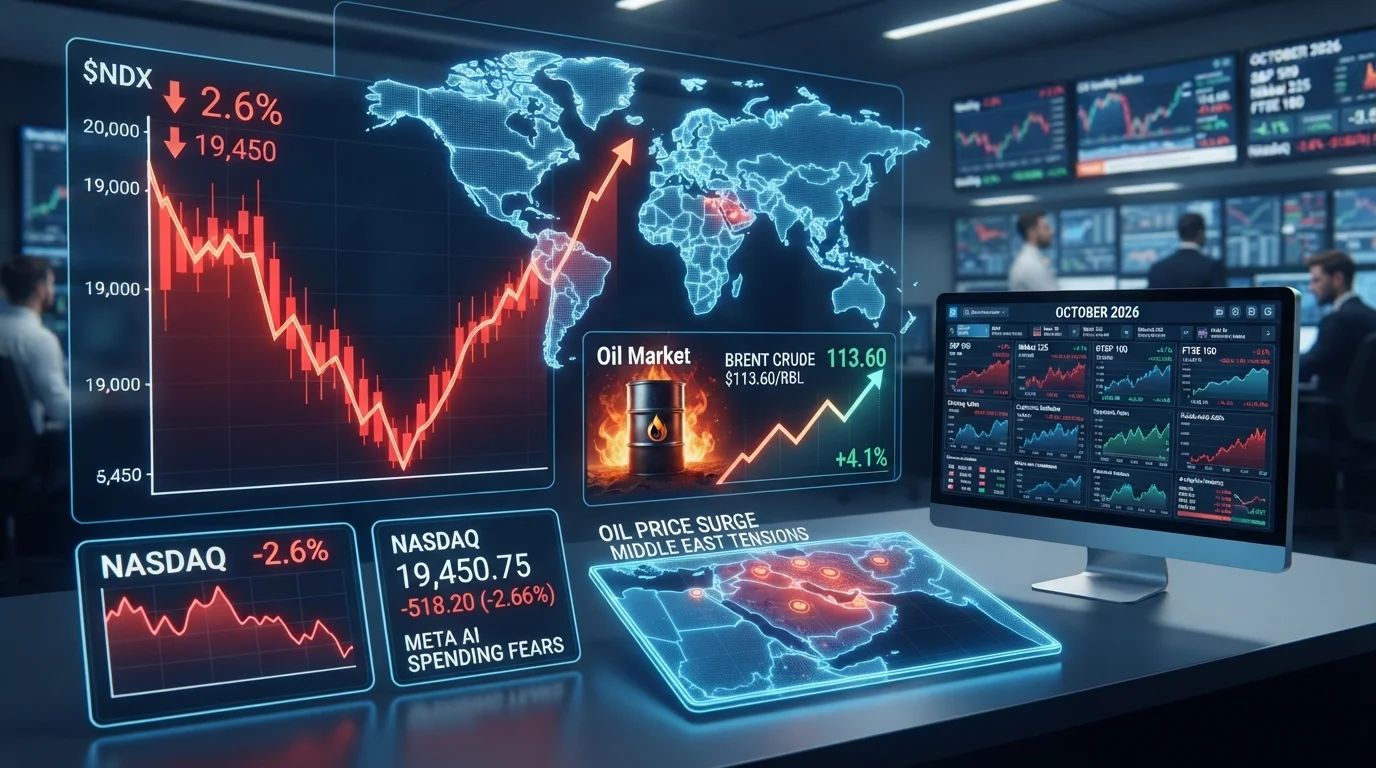
On October 22, 2026, global financial markets experienced one of the most volatile trading sessions of the year as two powerful forces converged to send shockwaves through equity markets. The Nasdaq Composite plummeted 2.58% to close at 26,008.86, its steepest single-day decline since June, while the S&P 500 shed 1.19% to end at 7,664.77. The catalyst was a perfect storm of escalating geopolitical tensions in the Middle East pushing Brent crude oil above $113 per barrel, combined with Meta Platforms' staggering disclosure of approximately $825 billion in future spending commitments tied to artificial intelligence infrastructure.
This convergence highlights a critical vulnerability in today's market structure: the tech sector's dependence on stable energy costs for its massive data center operations, and investors' growing anxiety about whether the returns on AI investments will ever justify the extraordinary capital being deployed. As money fled growth stocks and rotated into defensive sectors like consumer staples and aerospace, the 10-year Treasury yield dropped below 5%, signaling that bond markets were pricing in economic uncertainty rather than sustained inflation. For traders navigating this landscape, understanding the interplay between geopolitical risk, capital expenditure cycles, and sector rotation has become essential.
The Meta Bombshell: $825 Billion in AI Commitments
Meta Platforms delivered what appeared to be strong third-quarter results on the surface, reporting record revenue of $64.60 billion, up 26% year-over-year. However, the market's reaction was swift and brutal, with Meta's stock falling approximately 7% and wiping out roughly $124 billion in market value. The reason? A series of disclosures that painted a picture of spending on a scale rarely seen in corporate history.
The company raised the lower end of its 2026 capital expenditure guidance to $135 billion from $130 billion, while maintaining the upper bound at $145 billion. More alarmingly, regulatory filings revealed approximately $825 billion in future spending commitments related to data centers, energy agreements, and computing infrastructure, up from nearly $700 billion just three months earlier in July. This figure includes leases, computing deals, and energy contracts needed to power Meta's ambitious AI roadmap.
The market's reaction reflects a fundamental debate about the economics of AI infrastructure. While Meta and other hyperscalers have argued that massive upfront investment is necessary to build the compute capacity required for next-generation AI models, investors are increasingly questioning the timeline and magnitude of returns. The $825 billion commitment is particularly striking because it represents a binding obligation that will constrain Meta's financial flexibility for decades, regardless of how AI monetization evolves.
For investors seeking to track how major tech companies allocate capital and manage their balance sheets, tools like Alphio AI's copy trading feature can help mirror the strategies of institutional investors who closely monitor capex trends and free cash flow trajectories in the technology sector.
Chip Stocks Crater as AI Capex Fears Spread
The contagion from Meta's disclosure spread rapidly through the semiconductor ecosystem. The Philadelphia Semiconductor Index plunged 6.7%, with individual names experiencing even more severe declines. Lam Research, a critical supplier of wafer fabrication equipment, saw its stock tumble 11.8% after delivering earnings that beat expectations but offering December quarter guidance that sat close to consensus with an uncomfortably wide range.
Lam Research's guidance was particularly concerning because it suggested supply constraints were capping the company's ability to meet demand, while China's share of revenue is expected to fall sharply due to ongoing export restrictions. This dual headwind, supply limitations on one side and geopolitical barriers on the other, encapsulates the challenges facing the semiconductor equipment industry even as AI demand appears robust.
Other chipmakers fell by 8% or more as investors recalibrated their models for AI-related revenue growth. The fear is straightforward: if Meta and other hyperscalers are already committing $825 billion to infrastructure, at what point does incremental spending slow? The semiconductor industry has been riding a wave of capital expenditure from cloud providers building out AI training and inference capacity. Any slowdown in that investment cycle would have immediate and severe implications for equipment makers, memory manufacturers, and chip designers alike.
Brent Crude Surges to $113 on Middle East Escalation
While tech stocks were cratering, energy markets were experiencing their own dramatic repricing. Brent crude jumped approximately 4% to trade above $113 per barrel, its highest level since early May, as reports emerged that the United States and Israel were planning renewed military strikes against Iran following the upcoming month.
The Middle East conflict has been a persistent source of oil price volatility throughout 2026. Since the initial U.S. and Israeli attacks on Iran in late February triggered the closure of the Strait of Hormuz, oil prices have surged from approximately $70 per barrel to current levels. The Strait of Hormuz handles roughly 25% of global seaborne oil trade, making any disruption a significant threat to global energy security.
The latest escalation comes at a particularly sensitive time for global markets. Rising energy costs act as a tax on consumers and businesses, potentially slowing economic growth just as central banks are navigating the delicate balance between controlling inflation and supporting expansion. The National Energy Assistance Directors Association reported that approximately one-sixth of American households are already having trouble paying their energy bills, a concerning statistic that underscores the real-world impact of elevated oil prices.
For traders looking to automate their response to commodity price movements, Alphio AI's automations feature enables setting conditional workflows that trigger trades based on energy price thresholds or geopolitical event alerts.
Sector Rotation: Money Flees Growth for Defensives
The market's reaction to these dual shocks revealed a clear risk-off pattern. While the Nasdaq and growth-heavy sectors suffered, defensive names rallied. Lockheed Martin gained ground as geopolitical tensions increased demand for defense spending visibility. Procter & Gamble and other consumer staples names attracted capital seeking shelter from volatility. Spotify, interestingly, also rallied, suggesting investors were differentiating between technology companies with predictable subscription revenue and those with heavy infrastructure investments.
This rotation speaks to a broader reassessment of portfolio positioning as 2026 enters its final quarter. The trade that has dominated markets for much of the year, buying anything connected to AI infrastructure, is showing signs of strain. Investors are increasingly demanding proof that massive capital expenditures will translate into proportional revenue and earnings growth, rather than simply taking it on faith.
The flow into Treasuries was equally telling. The 10-year yield dropping below 5% suggests bond markets are pricing in a scenario where economic growth slows, either because high energy costs crimp consumer spending, or because the tech investment cycle cools, or both. This is a notable shift from earlier in the year when yields were rising on expectations of persistent economic strength.
The AI Spending Paradox: Investment vs. Returns
At the heart of the October 22 selloff lies a profound question about the economics of artificial intelligence. Meta's $825 billion commitment is not an isolated data point; it reflects an industry-wide arms race among hyperscalers including Google, Microsoft, and Amazon to build ever-larger training clusters and inference networks. The logic has been that scale begets capability, and capability begets competitive advantage.
However, the market's reaction suggests investors are reaching an inflection point in their willingness to fund this expansion. Several factors are driving this skepticism. First, the monetization pathway for many AI applications remains unclear. While tools like large language models have demonstrated impressive capabilities, converting those capabilities into sustainable revenue streams at a scale that justifies hundreds of billions in infrastructure spending is a different challenge entirely.
Second, the energy requirements of AI data centers are becoming an increasingly binding constraint. Meta's spending commitments include energy agreements, acknowledging that power availability, not just chip supply, may limit how quickly AI infrastructure can scale. With oil at $113 and electricity demand surging, the operating costs of these facilities are rising alongside their construction costs.
Third, competitive dynamics may compress returns. If every major tech company is building similar infrastructure, the differentiation that justifies outsized spending becomes harder to maintain. The risk is a capital expenditure bubble where massive investments chase diminishing marginal returns.
Navigating Volatility: Strategic Considerations for Investors
For investors trying to navigate this environment, several strategic considerations emerge. Diversification across sectors becomes more critical when a single narrative, AI infrastructure buildout, has driven so much of the market's performance. The October 22 session demonstrated how quickly that narrative can reverse when spending plans exceed even optimistic expectations.
Attention to free cash flow and balance sheet strength takes on renewed importance. Companies with binding multi-hundred-billion-dollar commitments will have less flexibility to adapt if economic conditions shift or if AI monetization proves slower than hoped. Conversely, companies generating strong free cash flow without massive capital obligations may be better positioned to weather volatility and capitalize on opportunities.
Geopolitical risk hedging is another dimension that investors cannot ignore. The correlation between Middle East tensions and energy prices, and the subsequent impact on both inflation expectations and equity valuations, means that geopolitical analysis is no longer optional for portfolio management. Understanding how energy markets interact with technology spending cycles provides a more complete picture of market dynamics.
For those looking to implement more sophisticated trading strategies in volatile conditions, Alphio AI's agentic trading feature offers automated portfolio management that can adapt to rapidly shifting market regimes without requiring constant manual intervention.
Conclusion
The October 22, 2026 market session will be remembered as a day when two of the year's dominant themes, the AI infrastructure boom and Middle East geopolitical risk, collided with unexpected force. The Nasdaq's 2.6% decline, Meta's $124 billion market cap evaporation, and Brent crude's surge to $113 collectively signaled that markets are entering a more discriminating phase after months of broadly favorable conditions.
For investors, the key takeaway is that the easy phase of the AI trade may be ending. Markets are no longer willing to fund unlimited capital expenditure without clearer evidence of returns. At the same time, energy markets are reminding everyone that geopolitical risk remains a persistent threat to global economic stability. Navigating this environment requires careful attention to valuation, balance sheet strength, and the interplay between macro forces and sector-specific dynamics.
Staying informed and having the right tools to respond to market movements is essential in volatile conditions. Whether you're analyzing tech earnings, tracking commodity prices, or looking to automate your trading strategies, Alphio AI's conversational trading platform enables you to execute trades and access market insights through an intuitive chat interface. For investors seeking to mirror proven strategies, Alphio's copy trading feature provides access to smart money wallets and successful trading vaults.
FAQs
Why did the Nasdaq drop 2.6% on October 22, 2026?
The Nasdaq fell 2.58% due to two converging factors: Meta Platforms disclosed approximately $825 billion in future AI spending commitments, sparking fears about returns on massive tech infrastructure investments, and Brent crude oil surged above $113 per barrel on escalating Middle East tensions, raising concerns about energy costs and economic growth.
How much did Meta stock fall after its AI spending disclosure?
Meta Platforms stock fell approximately 7% on October 22, 2026, wiping out roughly $124 billion in market value. Despite reporting record Q3 revenue of $64.60 billion (up 26% year-over-year), investors were alarmed by the company's $825 billion in future commitments and raised 2026 capex guidance of $135-145 billion.
Why did Lam Research stock drop 11.8%?
Lam Research (LRCX) fell 11.8% after delivering a narrow earnings beat but offering disappointing December quarter guidance with a wide range. Supply constraints are capping the company's outlook, and China's share of revenue is expected to fall sharply due to export restrictions, raising concerns about semiconductor equipment demand.
What caused Brent crude to surge to $113 per barrel?
Brent crude jumped to $113 amid reports that the U.S. and Israel were planning renewed military strikes against Iran. The Strait of Hormuz, which handles about 25% of global seaborne oil trade, has been a flashpoint since February 2026 when initial attacks triggered closure concerns, and renewed tensions reignited supply disruption fears.
What sectors benefited from the tech selloff on October 22?
Defensive sectors attracted capital during the tech selloff. Lockheed Martin rallied on increased defense spending visibility from geopolitical tensions. Consumer staples names like Procter & Gamble gained as investors sought shelter. Spotify also rose, as markets differentiated between subscription-revenue tech and heavy infrastructure spenders.
Related articles
- How to Rebalance a Concentrated Stock Portfolio in 2026: Mag7 Drift, Tax-Aware Trims, and Practical Rebalance a concentrated stock portfolio in 2026: Mag7 drift risk, 5pp bands, tax-aware trims, RSP/IWM diversifiers, and single-name caps.
- Small Cap Stocks Investing Guide 2026: Russell 2000, Fed Hikes, and the Financing TradeSmall-cap stocks investing guide 2026: Russell 2000 vs S&P, IWM rate sensitivity, floating-rate debt, Fed hikes, valuation discounts, and a practical checklist.
- Santa Claus Rally and the Year-End Stock Market: Investor Guide for Late 2026Santa Claus rally explained: 7-day window stats since 1950, Nov–Dec seasonality, post-midterm 2026 setup, and a risk-managed year-end investing playbook.
- Moderna Stock Skyrockets 177% on Landmark Cancer Vaccine Breakthrough: Investment AnalysisModerna (MRNA) stock jumped 177% after Phase 3 melanoma vaccine success with Merck. Analysis of the breakthrough, market impact, and investment outlook for 2026.
- Nvidia Earnings & Jackson Hole: The Perfect Storm Testing AI Stocks Against Rising RatesNvidia earnings and Jackson Hole symposium converge this week. Discover how Fed policy and AI chip demand could reshape the stock market rally in August 2026.
- Amazon Stock Analysis: AWS 37% Growth Powers AMZN to New Highs in 2026Amazon (AMZN) stock analysis for August 2026. Discover how AWS's record 37% growth and AI investments are driving Amazon's $200B quarterly revenue milestone.