

Fed Rate Hike and the Stock Market: What Investors Should Know Before December 2026
A December Fed rate hike looks likely. Learn how rate hikes move stocks, what past tightening cycles show, which sectors hold up, and how to plan ahead.


Key Takeaway
The Federal Reserve is close to doing something most investors have not seen since 2023: raising interest rates for a second time in one cycle. The Fed lifted its target range for the federal funds rate by a quarter point to 3.75%–4.00% in September 2026, then held it there at its October 28 meeting in a 10–2 vote in which Governor Lisa Cook and Cleveland Fed President Beth Hammack dissented in favor of another hike, according to the Fed's own statement. After the October consumer price index showed core inflation rising 0.3% for a third straight month, CME FedWatch data cited by Mortgage Professional America on November 10 priced an 89% chance of a quarter-point increase at the December 8–9 meeting and an 11% chance of a half-point move. A Reuters poll taken November 6–10 found all 101 economists surveyed expecting a hike to 4.00%–4.25%.
For stock investors, the question is not whether a Fed rate hike is coming but what it does to the stock market once it arrives. History offers a more nuanced answer than headlines suggest. Across the hiking cycles since 1994, the S&P 500 has usually stumbled in the first months after tightening begins and then recovered, and RBC Wealth Management research cited by The Motley Fool found positive 12-month returns after the first hike in every cycle except 2022. The exception matters, though, because 2022 is the cycle in which valuations were stretched and inflation was the dominant problem, which looks uncomfortably similar to parts of today's market.
This guide explains where Fed policy stands in November 2026, how rate hikes move stock prices, what past cycles actually show, which sectors tend to hold up and which struggle, and how to build a rules-based plan around the December decision. Market data are as of the close on Tuesday, November 10, 2026 (America/New_York) unless noted. Market-implied odds and economist forecasts are projections, not guarantees, and nothing here is personalized investment advice.
Where the Fed Stands in November 2026
From cuts to hikes in a single year
The shift in Fed policy over the past few months has been sharp. The September 2026 increase was the first rate hike since 2023, according to Mortgage Professional America, ending a stretch in which investors had spent most of the prior two years debating how quickly the Fed would cut. The October 28 statement explained why the committee turned hawkish in language that leaves little room for interpretation. It said "inflation remains elevated" and described economic activity as "expanding at a strong pace," with productivity growth strong, capital investment robust and domestic spending resilient. That is the profile of an economy running hot rather than one that needs support.
The two October dissents were an important signal. When members vote against a hold because they want to tighten immediately, markets read it as a sign that the center of the committee is leaning toward another move. The statement also stressed the goal of "a timely return of inflation" to the Fed's 2% target, wording that emphasizes speed. Investors who were positioned for a long pause after September had to reprice quickly, and that repricing has been one of the forces behind the volatility in long-duration growth stocks this autumn.
The October CPI report raised the stakes
The October consumer price index, released by the Bureau of Labor Statistics on November 10, showed headline prices up 0.4% for the month and core prices, which exclude food and energy, up 0.3% for a third consecutive month, according to Stock Titan's coverage of the BLS release. Because prices could not be collected in October 2025 during the government shutdown, the report carried no year-over-year rate for either measure, which makes the monthly trend even more important to policymakers. A core pace of 0.3% a month annualizes to well above the Fed's goal, and it has now persisted long enough that officials can no longer treat it as noise.
Stocks reacted modestly but clearly. The S&P 500 fell 0.4% to about 7,521 on November 10 and the Nasdaq Composite slipped 0.7% to about 25,066, according to closing data reported by the Washington Post and CNBC, a day after the S&P 500 had rallied roughly 2.4%.
What Fed officials and economists expect next
Governor Christopher Waller, speaking in London on November 10, said he would still support a 25 basis point increase in December even if inflation improves, and that a 50 basis point hike should be considered if core CPI ran at 0.3% or higher. He warned that a smaller move could leave the Fed's credibility at risk, according to Mortgage Professional America. Dallas Fed President Lorie Logan has separately called for at least two more quarter-point increases.
The Reuters poll offers the consensus view. All 101 economists expected a quarter-point hike in December, and 56 of them expected that move to end the cycle, while 45 saw at least two more increases. The same poll projected PCE inflation, the Fed's preferred gauge, averaging 3.5% this year and 2.6% next year, and not returning to 2% until at least 2028. Those numbers frame the debate for the next several months: one more hike and a long hold is the base case, but a meaningful minority of forecasters sees a longer tightening path.
How a Fed Rate Hike Moves the Stock Market
The discount-rate channel
The most direct way a Fed rate hike affects stocks is through valuation. A stock's price reflects the present value of the cash it is expected to generate in the future, and the interest rate used to discount those cash flows rises when short-term rates and bond yields rise. Companies whose profits sit far in the future, such as fast-growing technology firms or early-stage businesses, are hit hardest because more of their value depends on distant cash flows. Mature companies that pay steady dividends today are less sensitive, because a larger share of their value is collected sooner.
This is why the stock market sometimes falls on a rate hike even when profits are strong. The earnings outlook may not change at all, but the multiple investors are willing to pay for each dollar of earnings can compress. FactSet reported that the S&P 500 traded at 17.7 times forward 12-month earnings as of November 5, its lowest forward P/E in more than three years. That decline already reflects some of the higher-rate environment, which is one reason the December hike may land on a market that has partly adjusted rather than one priced for perfection.
The competition from cash and bonds
Higher rates also change the alternatives available to investors. When money market funds and Treasury bills pay around 4%, the hurdle for owning stocks goes up. U.S. Treasury data show the 10-year Treasury yield closed at 4.88% on November 9, after touching 5.31% in early October. With the S&P 500's forward earnings yield near 5.6% based on that 17.7 multiple, the extra reward for taking equity risk instead of holding a government bond is unusually thin by recent standards.
That does not mean stocks must fall, because earnings grow over time while a bond's coupon is fixed. But it does mean investors are less willing to pay any price for growth, and they demand clearer evidence that profits will rise.
What History Says About Stocks After the Fed Starts Hiking
The first few months are usually bumpy
Market history since the mid-1990s shows a fairly consistent early pattern. RBC Wealth Management research cited by The Motley Fool found that the S&P 500 declined by 8% to 14% in the five rate-hike cycles before 2022, and noted that the initial downturns tended to be short, typically bottoming between one and three and a half months after they began. In other words, the market usually digests the start of a tightening campaign with a meaningful but temporary pullback rather than an immediate bear market.
The 1994 cycle is the classic example. The Fed doubled the federal funds rate from 3% to 6% between February 1994 and February 1995, catching bond investors badly off guard. Ben Carlson of Ritholtz Wealth Management noted that stocks suffered a correction of roughly 8.5% in early 1994, while the aggregate bond market fell 6.4% and junk bonds dropped 7.7%. Yet the economy avoided recession, and the late 1990s became one of the strongest periods for U.S. stocks on record.
Twelve months later, the picture usually improves
The longer view is more encouraging. According to RBC data cited by The Motley Fool, the S&P 500 produced positive returns in the 12 months following an initial rate hike in each tightening cycle since 1994 except 2022, and the average 12-month return after an initial hike was about 6.7%. The strongest example was a roughly 42% gain in the year after the Fed's March 1997 hike, a period when strong productivity and corporate profits outweighed higher borrowing costs.
The 2004–2006 cycle tells a similar story. The Fed raised rates 17 times, from 1% to 5.25%, and stocks kept climbing for much of that period; the S&P 500 did not reach its cycle peak until October 2007, more than a year after the final hike in June 2006. The 2015–2018 cycle was gradual and largely absorbed by the market until late 2018, when the combination of hikes and balance-sheet runoff triggered a sharp fourth-quarter selloff. The lesson is that slow, well-telegraphed hikes during a growing economy have rarely been fatal for stocks on their own.
Why 2022 is the warning, and 1997 is the hope
The 2022 cycle is the exception every investor should study. The Fed began hiking in March 2022 from near zero and moved aggressively to fight the highest inflation in four decades. The S&P 500 fell more than 25% from its peak before bottoming in October 2022, and the Nasdaq suffered even worse. Valuations entering 2022 were elevated, inflation was the main problem, and the Fed was willing to accept slower growth to restore price stability.
Today's setup sits somewhere between the two templates. Like 1997, the economy is growing strongly, productivity is rising and corporate investment is robust, according to the Fed's own description. Like 2022, inflation is above target and sticky, and parts of the market, especially AI-linked technology, still carry premium valuations. Analysts at The Motley Fool argued that 1997 may be the better comparison, but that is a judgment, not a certainty. A sensible plan acknowledges both paths rather than betting everything on one.
Sectors That Tend to Win and Lose When Rates Rise
Financials and the net-interest-margin story
Banks are the most commonly cited beneficiaries of rising rates, and for good reason. When short-term rates rise, banks can often charge more on loans faster than they raise what they pay depositors, widening the net interest margin that drives much of their profit. Large, diversified banks with strong deposit franchises tend to benefit most. The benefit is not unlimited, however. If higher rates flatten or invert the yield curve, or push borrowers into default, the gains in margin can be offset by weaker loan growth and higher credit losses.
That nuance is why investors should look at valuation and balance-sheet quality rather than buying the whole sector on the headline. A bank trading at a reasonable multiple of tangible book value with conservative credit underwriting is a very different proposition from a regional lender with concentrated commercial real estate exposure. Checking how a large money-center bank is valued relative to its own history is a useful starting point.
Long-duration growth and highly indebted companies
The sectors most exposed to a Fed rate hike are those whose value depends on distant profits or cheap borrowing. Unprofitable technology firms, speculative growth stocks and companies with heavy floating-rate debt all face pressure when rates rise. This autumn has already provided a reminder: the AI-linked selloff in early November hit the Nasdaq harder than the broader market, and higher financing costs were one of the concerns cited as large technology firms increasingly turned to debt markets to fund data-center spending.
Real estate and utilities are also traditionally rate-sensitive, because they carry substantial debt and investors often own them for their yields, which look less attractive when Treasuries pay close to 5%. That does not make them automatic sells, since some have pricing power and inflation-linked revenue, but it does mean their share prices tend to react strongly to moves in bond yields.
Defensive quality and pricing power
Between those extremes sit companies with strong balance sheets, steady cash flows and the ability to raise prices without losing customers. Consumer staples, health care and high-quality industrials often fall into this group. In an environment where inflation is sticky and the Fed is tightening, pricing power becomes one of the most valuable traits a business can have, because it protects margins against rising input and labor costs. Investors looking for steadier exposure often check how analysts view such companies before adding them.
A Rules-Based Plan for the December Fed Meeting
Decide your actions before the headline
Fed days are among the most emotionally charged sessions for investors, because the decision, the statement and the press conference can swing prices in opposite directions within an hour. The best defense is to make decisions in advance. Write down what you will do if the Fed hikes 25 basis points with a dovish tone, if it hikes 25 with hawkish guidance, and if it surprises with 50. A predefined plan prevents the most common mistake, which is selling into a temporary drop or chasing a short-lived rally.
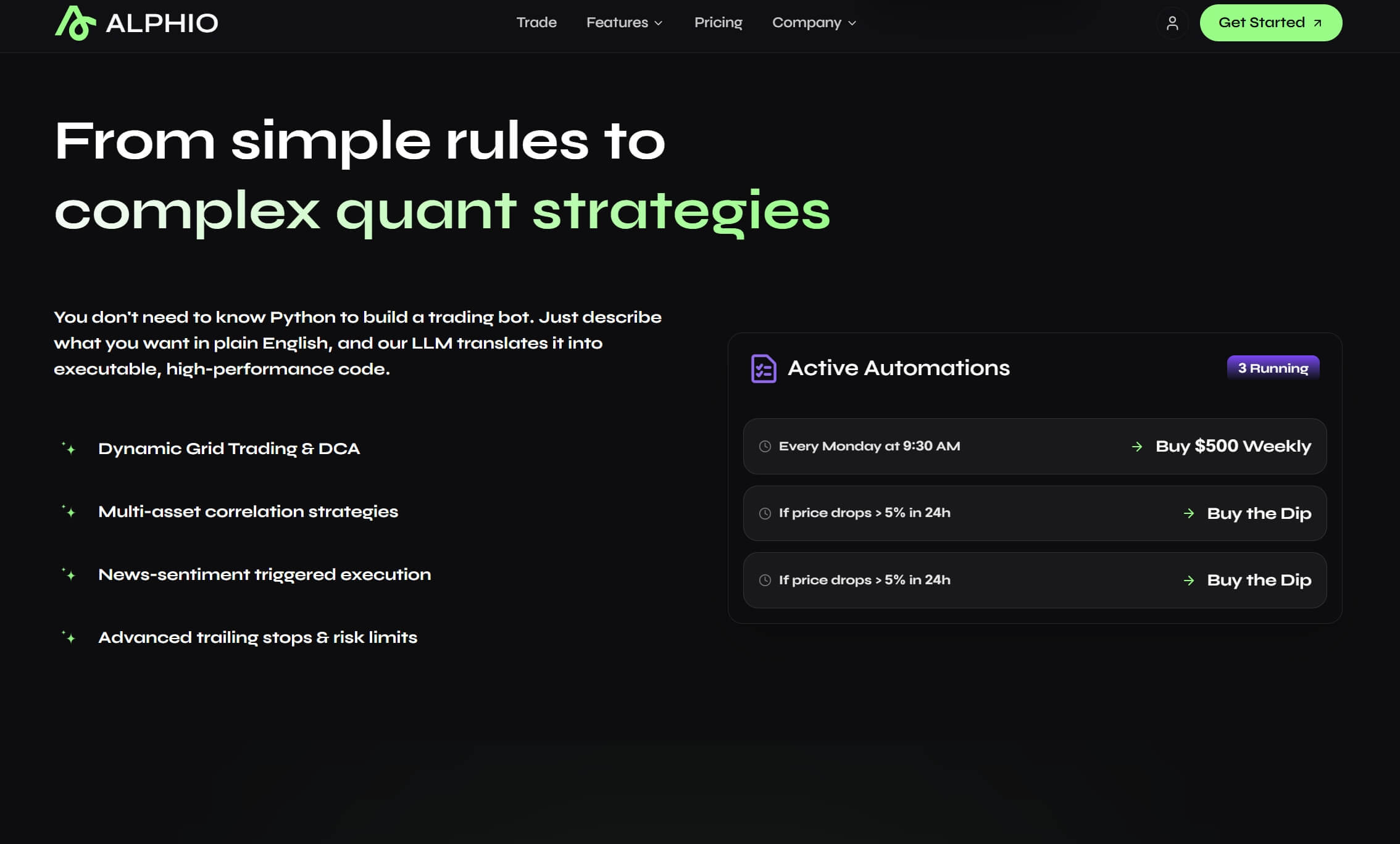
Automation can help keep that discipline. With Alphio's Scheduled Task feature, you can set recurring reviews around key dates such as the December 8–9 FOMC meeting or the next CPI release, so you check positions on a schedule instead of reacting to every headline.

Rebalance instead of predicting
Rebalancing is one of the few strategies that works without needing to forecast the Fed. If stocks fall after a hike and your equity weight drops below target, rebalancing means buying more at lower prices. If stocks rally and your weight rises, it means trimming. A simple checklist can make the process repeatable:
- Set target weights for stocks, bonds and cash, and a tolerance band such as five percentage points.
- Review allocations on fixed dates, such as after each Fed meeting or at month-end.
- Prefer adding new contributions to underweight assets before selling, to limit taxes.
- Keep a separate cash reserve for near-term spending so you are never forced to sell in a drawdown.
Risks and Scenarios Investors Should Watch
A hawkish surprise or a longer cycle
The main upside risk to rates is that inflation keeps running hot. If the November CPI report, due before the December meeting, shows core prices rising 0.3% or more again, the case for a 50 basis point hike or for additional increases in early 2027 strengthens. Waller's comments make clear that at least some officials are open to larger moves. In that scenario, long-duration growth stocks and rate-sensitive sectors would likely face renewed pressure, and bond yields could retest October highs.
A policy mistake and slower growth
The opposite risk is that the Fed tightens into a slowdown. The Reuters poll projected growth easing to 2.2% in the fourth quarter after a 3.4% annualized pace in the third quarter. If the lagged effect of higher rates bites harder than expected, earnings estimates could fall in 2027, and defensive sectors with stable cash flows would likely outperform cyclicals. This is the scenario in which high-quality bonds tend to provide the most diversification for equity investors.
Using conversation to test your thesis
Because the outcomes depend on data that change week to week, it helps to stress-test your portfolio against each scenario before it happens. Alphio's Conversational Trading lets you ask plain-language questions, such as how a holding performed during past rate shocks or how exposed a position is to higher borrowing costs, and then act on the answer in the same workflow.
Conclusion
A Fed rate hike in December 2026 now looks close to certain, with CME FedWatch pricing and a unanimous Reuters economist poll pointing to a move to 4.00%–4.25%. History suggests that the start of a tightening cycle tends to bring short, sharp pullbacks rather than lasting damage, and that the S&P 500 has usually been higher 12 months after the first hike. The glaring exception, 2022, shows what can happen when inflation is the dominant problem and valuations are stretched, so investors should treat history as a guide rather than a promise.
The most durable approach is to focus on what you can control: valuation discipline, sector balance, cash flow quality and a written plan for Fed days. Let rate-sensitive positions earn their place, favor companies with pricing power and strong balance sheets, and use today's higher yields on cash and short-term bonds as a buffer rather than a source of regret.
If you want to put that discipline into practice, Alphio offers tools that can help. Copy Trade lets you follow strategies from experienced investors with transparent track records, while Autonomous Trading can execute a rules-based plan around events like FOMC meetings without emotion getting in the way. Combined with careful research, those tools can help you navigate a rising-rate market with a process instead of a guess.
FAQs
Will the Fed raise rates in December 2026?
Markets and economists widely expect it. CME FedWatch data cited on November 10 priced an 89% chance of a quarter-point hike and an 11% chance of a half-point move, and all 101 economists in a Reuters poll expected an increase to 4.00%–4.25% at the December 8–9 meeting. Those are projections, and the November inflation data could still shift expectations.
What happens to the stock market when the Fed raises rates?
Stocks often dip in the first few months after a tightening cycle begins as valuations adjust to higher discount rates. Historically, the S&P 500 has usually recovered within a year, with RBC data showing positive 12-month returns after the first hike in every cycle since 1994 except 2022.
Which sectors do best when interest rates rise?
Banks and other financials can benefit from wider net interest margins, while companies with strong pricing power and solid balance sheets tend to hold up well. Long-duration growth stocks, heavily indebted companies, real estate and utilities are usually the most rate-sensitive.
Should I sell stocks before a Fed rate hike?
Trying to time a Fed decision is risky because markets often price in a hike well before it happens and can rally on the announcement. A written plan with target allocations and rebalancing rules is generally more reliable than selling ahead of a single meeting. This is general information, not personalized advice.
How do higher interest rates affect stock valuations?
Higher rates increase the discount rate applied to future earnings, which tends to lower price-to-earnings multiples, especially for fast-growing companies. They also make cash and bonds more competitive, so investors demand more evidence of earnings growth before paying premium valuations.
Related articles
- Retail Stocks and the 2026 Holiday Shopping Season: What Investors Should WatchNRF forecasts $1.013 trillion in 2026 holiday sales, but consumers are stretched. Learn how retail stocks trade around the holidays and what to watch now.
- AI Stocks Correction: How to Invest After the November 2026 Tech SelloffThe Nasdaq slid into correction as AI and chip stocks plunged in November 2026. Learn what drove the selloff, how valuations compare, and how to invest now.
- How to Invest in Gold in 2026: A Guide After the Price Pullback and Fed Hike FearsGold fell about 30% from its January 2026 record as Fed hike odds rose. Learn what drives gold, ETFs vs miners, taxes, and a rules-based plan to invest in gold.
- NVIDIA Stock Analysis August 2026: AI Chip Demand Surge and Valuation InsightsComprehensive NVIDIA stock analysis for August 2026. Explore AI chip demand trends, data center revenue growth, competitive positioning, and valuation metrics for NVDA investors.
- Federal Reserve Interest Rate Policy 2026: A Comprehensive Market GuideComprehensive analysis of Federal Reserve interest rate policy in 2026. Learn how Fed decisions impact stocks, bonds, forex, and your investment portfolio.
- Fed Interest Rate Outlook 2026: A Comprehensive Guide for InvestorsExplore the Federal Reserve's interest rate outlook for 2026. Learn how Fed policy decisions impact stocks, bonds, and your investment portfolio.