

How to Invest in Gold in 2026: A Guide After the Price Pullback and Fed Hike Fears
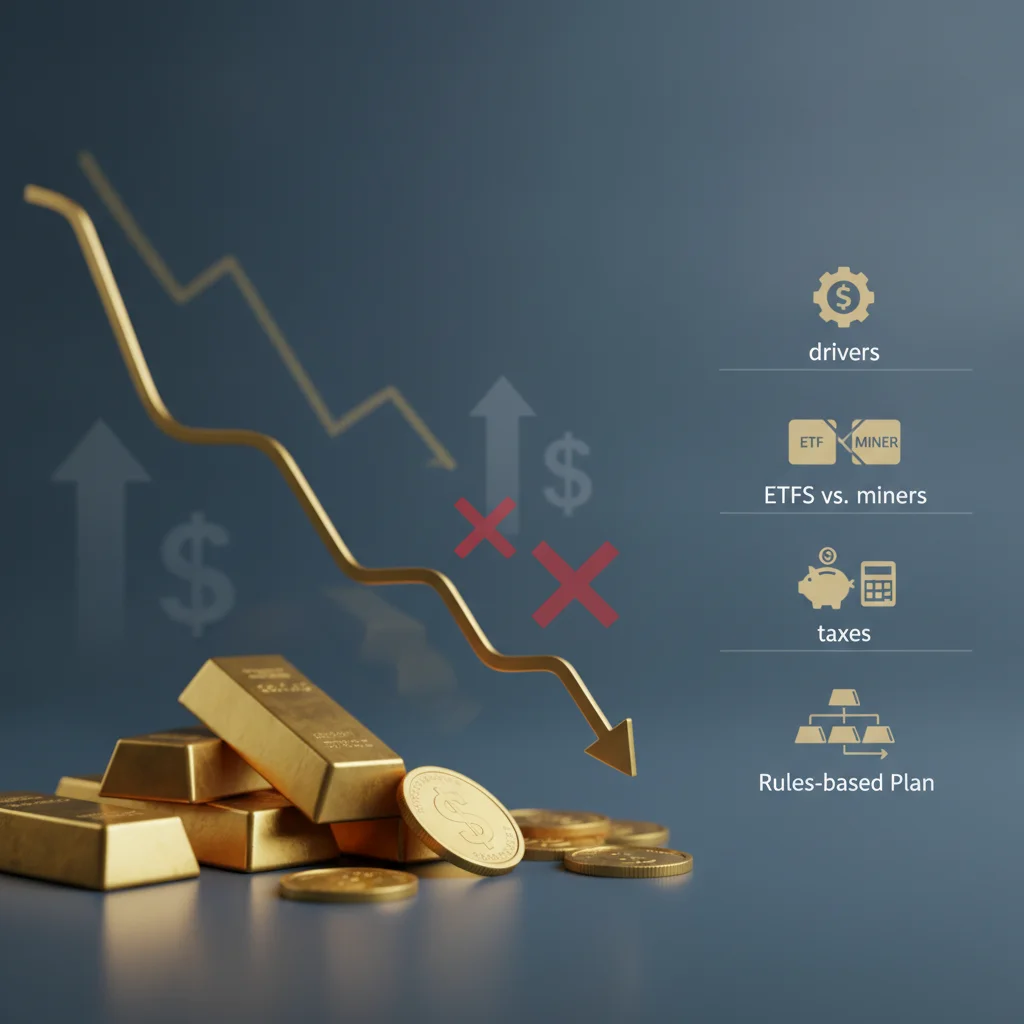
Gold fell about 30% from its January 2026 record as Fed hike odds rose. Learn what drives gold, ETFs vs miners, taxes, and a rules-based plan to invest in gold.

Key Takeaway
Gold has given investors a full market cycle in a single year. The metal broke above $5,000 an ounce for the first time on January 26, 2026, according to Reuters, and kept climbing to a record just shy of $5,600 in late January before a sharp reversal. By November 3, spot gold had slipped to roughly $3,927, according to Reuters figures cited by Discovery Alert, as traders priced in a possible Federal Reserve rate hike in December. A rebound followed: spot gold traded near $4,130 early on November 9, about 5% above that low. Anyone asking how to invest in gold right now is asking the question after a drawdown of roughly 30% from the peak, not at the top.
The underlying demand picture is more interesting than the price chart. The World Gold Council's Q3 2026 Gold Demand Trends report, published November 3, shows central banks bought 321 tonnes in the third quarter, up 42% from a year earlier, while gold ETFs added 211 tonnes. At the same time, bar and coin demand fell 19% to 268 tonnes and jewelry consumption dropped to its weakest third quarter in the WGC's data series. In plain terms, official institutions and fund investors kept buying while price-sensitive households pulled back.
This guide explains what drives the gold price in a rate-hike environment, how gold behaves next to stocks and bonds, the main ways to own it (bullion, ETFs, miners, and royalty companies), what the costs and taxes really look like, and how to size and rebalance a position with rules instead of headlines. Market data are as of November 9, 2026 (America/New_York) unless noted. Bank forecasts and Fed pricing cited here are projections, not guarantees, and nothing in this article is personalized investment advice.
Where the Gold Price Stands in November 2026
From the January record to the autumn slide
The first weeks of 2026 were a classic safe-haven rush. Reuters reported gold topping $5,000 on January 26 and setting another record above $5,400 on January 28, with sources putting the final late-January peak just under $5,600. Geopolitical stress, heavy central bank buying, and expectations that the Fed would keep easing all pushed in the same direction. When those expectations changed, the price changed with them, and the decline from that peak has been deep enough to test the conviction of anyone who bought near the highs.
The slide was not a straight line. The LBMA gold price still averaged $4,262 an ounce in the third quarter, according to the World Gold Council, which was 23% higher than a year earlier and the third-strongest quarterly average on record. The bigger damage came in October and early November, as the market moved from debating rate cuts to pricing a hike. Reports citing CME FedWatch put the odds of a December increase at roughly 77% to 80% around November 9, a striking shift for an asset that pays no interest.
Why Wall Street trimmed its targets
Forecasters have adjusted. On November 6, Goldman Sachs cut its end-2026 gold forecast to $4,150 an ounce from $4,650 and lowered its end-2027 target to $4,800 from $5,400, according to Mining Weekly. The bank's base case now assumes the Fed hikes in December, with cuts not starting until late 2027. Importantly, Goldman kept a constructive long-run view tied to continued central bank demand, so the cut is better read as a reset of timing than as a call that the bull market is over.
That nuance matters for individual investors. A lower year-end target near today's price implies limited short-term upside in the bank's view, but a higher 2027 target implies the analysts still see structural support. Both numbers are projections. They can and do change, and Goldman itself had already revised its 2026 path more than once this year.
What the next few weeks hold
The calendar is crowded. The October CPI report was scheduled for 8:30 a.m. ET on November 10, followed by producer prices on November 13, and the Fed's December decision looms over everything. A hotter inflation print would likely strengthen the case for a hike, lift real yields, and pressure gold. A cooler one could revive the rebound. Investors who want exposure should expect volatility around each of these dates rather than a smooth trend.
What Actually Drives the Gold Price
Real interest rates and the opportunity cost of holding gold
Gold produces no cash flow, so its biggest competitor is a safe asset that does. When inflation-adjusted Treasury yields rise, the cost of holding a non-yielding metal goes up, and gold usually struggles. That is the core reason a possible December hike has hit gold harder than many other assets. With the 10-year Treasury yield at 4.88% on November 9, according to U.S. Treasury data, investors can lock in a nominal return close to 5% with essentially no credit risk, and gold has to justify itself against that.
This relationship is a tendency rather than a law. In recent years, gold has at times rallied even as real yields rose, during a period when central bank purchases ran at historically high levels. The lesson is that rates set the headwind or tailwind, but buyer composition can overpower it for long stretches.
Central banks as the marginal buyer
The most powerful demand story of the past few years is official buying. The WGC reports that central banks purchased 321 tonnes in Q3 2026 and 675 tonnes in the first nine months, up 6% from the same period last year. Kitco, summarizing the WGC data, noted that only a fraction of those purchases were formally reported, with China's central bank and Poland's among the disclosed buyers. Reserve managers diversifying away from dollar assets tend to be less price-sensitive than retail buyers, which helps explain why dips have attracted buying.
For investors, this is a double-edged sword. Central bank demand can put a floor under prices during selloffs, but it is also opaque and policy-driven. If the pace slowed materially, one of gold's main supports would weaken, so it is worth watching each quarterly WGC release rather than assuming the trend continues forever.
The dollar, geopolitics and fear
A stronger U.S. dollar generally makes gold more expensive for buyers using other currencies, which can dampen demand. Geopolitical shocks push the other way: when investors fear conflict, sanctions or financial instability, gold often benefits from safe-haven flows. In 2026, both forces have been active at once, alongside volatile oil prices, which is part of why day-to-day moves have been so large. Treating any single driver as the whole story is the most common analytical mistake in gold coverage.
Who Is Buying Gold and Who Is Selling
ETF investors came back
Exchange-traded funds were a big swing factor in the third quarter. The WGC reports 211 tonnes of net ETF inflows in Q3 2026, reversing outflows of about 47 tonnes in Q2. Kitco added that global gold ETF holdings reached a record, with Europe and North America leading the inflows. Fund flows tend to be more momentum-driven than central bank purchases, which means they can amplify both rallies and declines.
Households stepped back
The weak spot was physical retail demand. Bar and coin purchases fell 19% year over year to 268 tonnes, the lowest quarter in four years according to Kitco's summary, and jewelry consumption fell 17% to 313 tonnes, the weakest third quarter in the WGC's records. Spending on jewelry in dollar terms still rose 2% to $43 billion, which shows that high prices, not a lack of interest, were the main constraint. Price-sensitive buyers in India and China tend to wait for dips, and their behavior can help stabilize the market when prices fall.
Reading the demand mix
Overall, total Q3 demand including over-the-counter trading was 1,369 tonnes, down about 1% from a year earlier, while year-to-date demand of 3,881 tonnes almost matched the record pace of 2025. The WGC described its outlook for ETFs, bars and coins as "resilient, albeit caught in competing crosswinds," and Kitco reported that the council cut its expected increase in 2026 investment demand to about 200 tonnes from roughly 400. The mix suggests institutional buyers are carrying the market while retail waits for clearer signals.
How Gold Fits Next to Stocks and Bonds
A diversifier, not a growth engine
Gold's long-term case is diversification. It has often moved independently of stocks, and it has sometimes rallied during equity stress, which can soften portfolio drawdowns. But over long horizons, broad equity indexes have generally compounded faster because companies retain and reinvest earnings while gold simply sits in a vault. Investors should think of gold as insurance with a premium, not as a substitute for productive assets.
When the hedge fails
Diversification is not guaranteed. In 2026, gold and stocks have at times fallen together as rising rate expectations hit both. On November 9, by contrast, the S&P 500 jumped about 2.3% to roughly 7,550, its best day since April according to The Washington Post, while gold also rose. Correlations shift with the macro regime. When the dominant fear is inflation and tighter policy, gold's hedging value can shrink exactly when investors expect it to work.
Typical allocation ranges
Most mainstream allocation frameworks put gold somewhere between zero and about 10% of a diversified portfolio, with a few strategies, such as the permanent portfolio, going much higher. The right number depends on time horizon, existing exposures, tax situation and tolerance for long flat periods. Gold has historically endured multi-year stretches of poor performance, so a position sized too large can test patience as much as a stock market crash does.
The Main Ways to Invest in Gold
Physical bullion and coins
Owning bars or coins gives direct exposure with no counterparty inside a fund. The trade-offs are dealer premiums above spot, bid-ask spreads when selling, and the cost of secure storage and insurance. Physical gold suits investors who value possession and plan to hold for many years. It is a poor tool for frequent rebalancing because transaction costs can eat into returns quickly.
Gold ETFs backed by bullion
For most investors, physically backed ETFs are the simplest route. They trade like stocks, hold allocated bullion, and charge annual expense ratios that typically range from about 0.1% to 0.4% depending on the fund, so it pays to compare. They make rebalancing easy and avoid storage logistics. The main considerations are fees, liquidity, and, in the U.S., tax treatment, which we cover below.
Gold miners and royalty companies
Mining stocks offer leveraged exposure to the gold price because their costs are partly fixed, so profits can rise faster than the metal in a rally and fall faster in a decline. They also carry company-specific risks such as operating problems, cost inflation, political risk in host countries, and acquisition missteps. Royalty and streaming companies take a different approach, financing mines in exchange for a share of output, which can reduce operating risk but adds valuation risk. Before buying any miner, it helps to compare its multiples with the sector and to understand its all-in sustaining costs.
When reviewing a miner like Newmont, the largest U.S.-listed producer, investors should ask whether the share price already discounts a higher gold price than today's spot level. If it does, the stock can disappoint even if gold holds steady. Analyst ratings are a useful cross-check but should never replace your own reading of company filings.
Costs, Taxes and Hidden Frictions
The collectibles tax rule
U.S. investors are often surprised by gold taxes. The IRS treats physical gold as a collectible, and long-term gains on collectibles can be taxed at a maximum federal rate of 28%, higher than the top long-term rate on most stocks. Many physically backed gold ETFs structured as grantor trusts pass through the same collectibles treatment. Mining stocks, by contrast, are taxed as ordinary equities. Holding gold inside a tax-advantaged account can change the math, so it is worth checking with a tax professional before choosing a vehicle.
Spreads, premiums and storage
Beyond taxes, the frictions vary by vehicle. Coins and small bars typically carry higher premiums than large bars. Storage fees and insurance add up for physical holders. ETFs embed costs in the expense ratio and the bid-ask spread. Futures and options introduce leverage, margin requirements, and roll costs that can surprise newcomers. A realistic comparison of total cost over a five-year holding period often points most investors toward ETFs.
Beware of sales-driven products
Gold attracts aggressive marketing, especially during periods of fear. High-commission coin programs, numismatic markups, and some self-directed gold IRA offerings can carry costs far above the metal's spot value. A simple rule helps: if you cannot easily see the premium you are paying over spot, or the price at which you could sell back, treat the product with caution.
A Rules-Based Plan for Investing in Gold
Decide the job before the size
Start with the role. If gold is a portfolio hedge, size it modestly and focus on cheap, liquid vehicles. If it is a tactical view on Fed policy or central bank demand, define what would prove the view wrong, such as a sustained rise in real yields or a sharp slowdown in official buying. Writing this down before buying is the best defense against chasing price moves in either direction.
Build gradually and rebalance on a schedule
After a 30% pullback, some investors are tempted to buy all at once, while others are scared off entirely. A middle path is to build a target allocation in tranches over several months and then rebalance back to target once or twice a year, or when the position drifts by a set band. Calendar discipline matters more than precision. Investors who want reminders tied to data dates such as CPI releases and Fed meetings can automate those check-ins with an Alphio Scheduled Task, so reviews happen on rules rather than on headlines.

Track the signals that matter
A short dashboard keeps the analysis honest. Watch real Treasury yields, the dollar, CME FedWatch probabilities, ETF flows, and quarterly WGC central bank data. If you want to test a scenario quickly, such as how a miner, a gold ETF, and the S&P 500 have moved around past Fed hikes, you can ask questions in plain English with Conversational Trading and then verify the answers against primary sources before acting.

Risks That Could Change the Gold Outlook
A longer hiking cycle
The biggest near-term risk is a Fed that hikes more than once. Goldman's more restrictive scenario, which includes another hike in 2027 and delayed cuts, points to a lower end-2027 price than its base case, according to Mining Weekly. Higher-for-longer real yields would keep raising the opportunity cost of gold and could push ETF investors back toward cash and Treasuries.
A slowdown in official buying
Central bank demand has been the backbone of the bull market. If reserve managers paused, perhaps because prices stayed high or diversification goals were met, the market would lose its most reliable buyer. The WGC releases quarterly data, so investors have a regular checkpoint rather than needing to guess.
Upside surprises
Risk runs both ways. A sharp economic slowdown, a financial accident, or escalating geopolitical conflict could quickly flip the rate outlook and revive safe-haven demand. That asymmetry is why many investors keep a core allocation even when the short-term outlook looks soft: the scenarios where gold helps most are often the hardest to predict.
Conclusion
Investing in gold in late 2026 means investing after a historic spike and a painful reset. The price fell as much as roughly 30% from its January record as the market priced a possible December Fed hike, and major banks such as Goldman Sachs have lowered near-term targets. Yet the demand data tell a more balanced story: central banks bought 321 tonnes in the third quarter, ETF investors returned, and only price-sensitive households stepped back. That mix argues for treating gold as a deliberate, modestly sized diversifier rather than a momentum trade.
The practical playbook is simple to state and harder to follow. Decide the role gold plays, pick a low-cost vehicle that fits your tax situation, build the position gradually, and rebalance on a calendar. Watch real yields, the dollar, Fed pricing and central bank buying, and be honest about what would change your mind. Investors who want to see how experienced traders are positioning around metals can study strategies through Copy Trade, and those who have already defined strict rules and risk limits can explore Autonomous Trading to execute them consistently. Whatever tools you use, gold rewards patience and discipline far more than prediction.
FAQs
Is it a good time to invest in gold after the 2026 pullback?
Nobody can time gold reliably. Gold fell as much as roughly 30% from its January 2026 record at the early-November low, which lowers the entry price, but a possible December Fed hike could keep pressure on prices in the near term. Many investors build a position gradually rather than trying to pick the bottom.
Why does a Fed rate hike hurt the gold price?
Gold pays no interest, so higher rates raise the opportunity cost of holding it compared with Treasury bills and bonds. Rate hikes can also strengthen the U.S. dollar, which makes gold more expensive for overseas buyers. Strong central bank buying can offset these effects for long periods, but it does not remove them.
How much of a portfolio should be in gold?
Many mainstream allocation frameworks use a range of zero to about 10%, although some strategies hold more. The right level depends on your time horizon, other holdings, taxes and tolerance for long flat stretches. A financial professional can help tailor the number to your situation.
What is the difference between gold ETFs and gold mining stocks?
Physically backed gold ETFs track the metal's price minus fees, while mining stocks are companies whose profits depend on gold prices, costs and execution. Miners tend to amplify gold's moves in both directions and add company-specific risks. In the U.S., the two are also taxed differently.
How are gold investments taxed in the U.S.?
The IRS treats physical gold as a collectible, so long-term gains can be taxed at a maximum federal rate of 28%. Many physically backed gold ETFs structured as grantor trusts receive the same treatment, while gold mining stocks are taxed like other equities. Check with a tax professional before choosing a vehicle.
Related articles
- AI Stocks Correction: How to Invest After the November 2026 Tech SelloffThe Nasdaq slid into correction as AI and chip stocks plunged in November 2026. Learn what drove the selloff, how valuations compare, and how to invest now.
- Treasury Yields and the Stock Market: What a Near-5% 10-Year Yield Means for Investors in 2026The 10-year Treasury yield hit 5.31% in October 2026 before easing to 4.88%. Learn how Treasury yields affect stocks, which sectors react and how to plan.
- CPI Report and the Stock Market: How to Read October 2026 Inflation Data Before the Fed DecidesOctober 2026 CPI lands Nov 10 with no year-over-year number and Fed hike odds near 80%. Learn how to read CPI, which stocks react, and how to plan for it.
- S&P 500 Forecast 2026: Can AI Stocks Power the Market to 8,100?Wall Street analysts forecast S&P 500 reaching 8,100 by year-end 2026. Discover how AI stocks like Nvidia and AMD are powering this bull market rally.
- Gold Price Forecast August 2026: Will Fed Policy Drive Gold to $4,900?Gold price forecast for August 2026: Analysis of Fed rate policy impact, inflation hedge demand, and expert predictions targeting $4,500-$4,900 range.
- S&P 500 Hits Record High in August 2026: What's Driving the Historic Rally?S&P 500 hits all-time high in August 2026 driven by cooling inflation, falling oil prices, and strong AI earnings. Discover what's fueling the market rally and investment opportunities.