

Berkshire Hathaway Under Greg Abel: A New Investment Era Begins
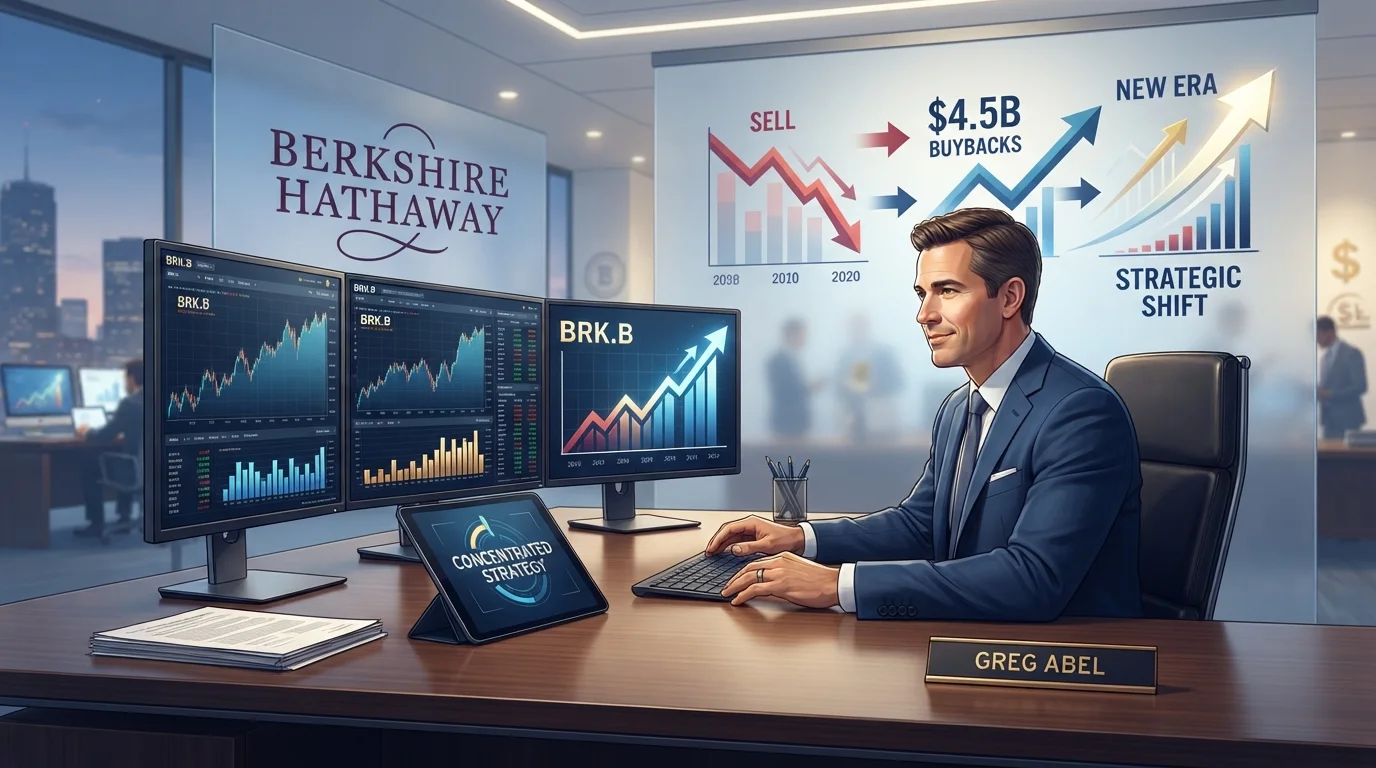
Greg Abel ended Berkshire's 14-quarter selling streak with $4.5B buybacks. Discover how Abel's concentrated portfolio strategy signals a new era for BRK.B investors.

Key Takeaway
Berkshire Hathaway has just made a move that sent ripples through Wall Street, marking a definitive turning point in the post-Buffett era. Greg Abel, who officially took the reins as CEO in 2025, has ended the company's historic 14-quarter streak of net stock selling—a pattern that had defined Berkshire's strategy since early 2022. This shift isn't merely symbolic; it represents a fundamental change in how the $800 billion conglomerate approaches capital allocation in today's complex market environment.
The most striking evidence of this strategic pivot came in the form of a massive $4.5 billion share buyback program, the largest repurchase authorization Berkshire has executed in over three years. Combined with Abel's decision to concentrate 63% of Berkshire's $355 billion equity portfolio into just five core holdings, these actions paint a clear picture of a leader who is confident in the company's intrinsic value and willing to deploy capital aggressively when opportunities arise. For investors watching from the sidelines, this could be the strongest buy signal Berkshire has flashed in years.
The End of an Era: Breaking the 14-Quarter Selling Streak
For nearly three and a half years, Berkshire Hathaway had been a consistent net seller of stocks, amassing a record cash position that peaked at over $180 billion in mid-2025. This extended period of caution, initiated during the final years of Warren Buffett's tenure, reflected concerns about elevated valuations across equity markets and a disciplined refusal to overpay for assets. While this approach preserved capital and built an unprecedented war chest, it also led to questions about whether Berkshire's legendary growth machine had shifted into permanent capital-preservation mode.
Greg Abel's decision to reverse this trend signals a profound shift in market assessment. The new CEO appears to view current valuations, at least in select opportunities, as attractive enough to warrant deploying Berkshire's massive cash reserves. This change coincides with broader market dynamics, including moderating inflation readings, potential Federal Reserve rate cuts on the horizon, and a repricing of risk assets following the volatility of 2025. Abel's willingness to break from his predecessor's extended caution suggests either increased confidence in specific opportunities or a different interpretation of macroeconomic conditions.
The significance of this reversal cannot be overstated. Berkshire's selling streak was the longest in the company's modern history, spanning periods of both market turbulence and recovery. To break this pattern with such conviction—through both portfolio repositioning and substantial buybacks—indicates that Abel is comfortable making bold capital allocation decisions that may diverge from recent precedent. This is precisely what Berkshire shareholders had hoped for in a successor: someone who honors the company's value-investing heritage while maintaining the flexibility to act decisively when circumstances warrant.
The $4.5 Billion Buyback: Reading Between the Lines
Berkshire's decision to repurchase $4.5 billion of its own shares represents more than just returning capital to shareholders—it is a powerful statement about how management views the company's current valuation. Share buybacks at Berkshire have historically been infrequent and deliberate, occurring only when Buffett and his team believed the stock was trading at a meaningful discount to intrinsic value. The scale of this latest authorization, the largest since 2022, suggests that Abel sees significant value in Berkshire's diversified collection of businesses.
The timing of this buyback is particularly instructive. Berkshire's Class B shares (BRK.B) had experienced modest pressure in early 2026, trading at price-to-book ratios that approached the lower end of their five-year historical range. For value investors, this compression presented an opportunity, and Abel clearly agreed. By deploying billions into repurchases rather than sitting on cash earning Treasury yields, he is signaling confidence in the earnings power of Berkshire's operating companies, which include insurance giants GEICO and Berkshire Hathaway Reinsurance, railroad operator BNSF, and an extensive portfolio of manufacturing and service businesses.
This buyback strategy also addresses a long-standing concern among Berkshire shareholders: the challenge of deploying capital at scale in public markets. With a market capitalization exceeding $800 billion and cash reserves still substantial despite recent deployments, finding attractively priced acquisitions or public market investments that can meaningfully impact returns has become increasingly difficult. Buybacks offer an elegant solution to this problem, allowing Berkshire to invest in its own proven business model while avoiding the integration risks and premium valuations that often accompany large acquisitions.
Portfolio Concentration: Abel's High-Conviction Bets
Perhaps the most revealing aspect of Abel's early tenure is his approach to Berkshire's equity portfolio. Rather than maintaining the broad diversification that characterized previous years, Abel has concentrated 63% of the $355 billion equity book into just five holdings. This level of concentration represents a departure from typical institutional portfolio management and aligns more closely with the high-conviction approach that generated Berkshire's legendary returns in earlier decades.
While the exact composition of these top five holdings continues to evolve, market filings indicate that Apple remains Berkshire's largest equity position despite significant trimming in 2024 and 2025. American Express, Bank of America, Coca-Cola, and Chevron round out the core holdings, representing a mix of financial services, consumer staples, and energy exposure. What unites these investments is not just their scale but their durability—each company possesses durable competitive advantages, strong cash flow generation, and management teams aligned with long-term value creation.
This concentration strategy carries both opportunities and risks. On the positive side, it allows Berkshire to benefit most from its best ideas, avoiding the dilution that comes from maintaining dozens of smaller positions. When the investment team identifies truly exceptional businesses trading at reasonable prices, they now have the conviction to back those judgments with substantial capital commitments. However, concentration also increases portfolio volatility and creates exposure to company-specific risks that diversification would otherwise mitigate. Abel's willingness to accept these risks suggests a management team focused on maximizing returns rather than minimizing quarterly fluctuations.
The Apple Factor: Managing Berkshire's Tech Exposure
No analysis of Berkshire's current portfolio would be complete without examining its position in Apple, which has been both a crown jewel and a source of complexity for the investment conglomerate. At its peak, Berkshire owned over 900 million Apple shares, representing a position worth more than $150 billion. However, beginning in 2024 and continuing through 2025, Berkshire systematically reduced this holding, selling approximately 60% of its stake over eighteen months.
These sales fueled the cash accumulation that defined Berkshire's recent strategy and contributed to the company's massive liquidity position. While Buffett publicly maintained that Apple remained an excellent business, the tax considerations of realizing gains and the desire to maintain appropriate position sizing appeared to drive the reduction. Under Abel, the pace of Apple sales has slowed considerably, suggesting that the new CEO may view the remaining position as appropriately sized for Berkshire's portfolio.
The Apple position illustrates the delicate balance Abel must strike as he manages Berkshire's equity portfolio. On one hand, Apple continues to generate extraordinary cash flows, maintains a dominant market position in premium consumer electronics, and has successfully built a services ecosystem that generates recurring revenue. On the other hand, the company's valuation had reached levels that tested traditional value investing criteria, and regulatory scrutiny of Apple's App Store practices creates ongoing business risks. Abel's decision to maintain a meaningful but reduced position suggests a nuanced approach that acknowledges both Apple's quality and the importance of valuation discipline.
Macroeconomic Context: Why Now?
Understanding Abel's strategic shift requires examining the broader economic environment in which these decisions were made. After years of elevated inflation and aggressive Federal Reserve tightening, 2026 has brought signs of moderating price pressures and increasing expectations for monetary easing. The Consumer Price Index has gradually moved closer to the Fed's 2% target, while labor market data shows signs of cooling that could prompt rate cuts in coming quarters.
This macroeconomic backdrop creates favorable conditions for value-oriented investors like Berkshire. Lower interest rates typically benefit the insurance operations through reduced claim costs and improved bond portfolio values. They also tend to support equity valuations, particularly for the high-quality businesses that populate Berkshire's portfolio. Abel's decision to deploy capital aggressively may reflect anticipation of this more favorable environment, positioning Berkshire to benefit from potential multiple expansion in its equity holdings.
For investors seeking to capitalize on shifting market conditions, consider using Alphio AI's copy trading feature to mirror successful traders who are positioning for the next phase of the market cycle.

Additionally, labor market dynamics have shifted meaningfully, with workforce participation showing signs of strain following recent policy changes. Recent data indicates the American workforce has contracted by over one million people in the past year, a development that could have significant implications for wage growth, inflation trajectories, and corporate profitability. Abel's investment decisions may be partially informed by expectations that these labor market changes will create opportunities for Berkshire's operating companies to gain market share or improve pricing power.
The Warren Buffett Factor: Continuity and Change
While Greg Abel now holds the CEO title, Warren Buffett remains actively involved as Chairman and continues to influence Berkshire's investment philosophy. The transition between these two leaders represents one of the most closely watched successions in corporate history, and early indications suggest a thoughtful evolution rather than revolutionary change.
Buffett built Berkshire through a combination of acquiring exceptional businesses at fair prices, maintaining fortress-like balance sheet strength, and allowing acquired companies to operate with autonomy. Abel appears committed to these core principles while demonstrating a greater willingness to act decisively on opportunities when they present themselves. The buybacks and portfolio repositioning of early 2026 suggest a leader who shares Buffett's value orientation but may interpret its application differently in current market conditions.
The investment community has responded positively to this evolution. Berkshire's shares have outperformed the S&P 500 since Abel's promotion, suggesting that investors view the new leadership as a net positive. Analysts have noted that Abel's background in Berkshire's utility and energy operations provided him with deep insight into capital-intensive businesses and long-term infrastructure investing—perspectives that appear to be informing his approach to the broader portfolio.
What This Means for BRK.B Shareholders
For investors holding Berkshire Hathaway Class B shares, the developments of 2026 offer several reasons for optimism. First, the resumption of meaningful buyback activity provides ongoing support for share prices and demonstrates management's confidence in the company's value. Unlike dividends, which Berkshire has historically avoided, buybacks offer tax-efficient returns of capital while maintaining flexibility to adjust capital allocation as conditions change.
Second, the concentrated portfolio approach suggests that Berkshire's equity investments are focused on its highest-conviction ideas. While this increases volatility, it also positions the company to benefit most from successful investment theses. Shareholders who believe in Berkshire's analytical capabilities should view this concentration as a positive development that aligns management incentives with long-term value creation.
Alternatively, explore agentic trading to automate your portfolio management with AI-powered strategies that can adapt to changing market conditions.

Third, Abel's willingness to deploy capital after years of accumulation suggests that Berkshire's growth engine may be reigniting. The company's operating businesses continue to generate substantial free cash flow, and finding productive uses for this capital has been a persistent challenge. The combination of portfolio repositioning, buybacks, and potential future acquisitions could drive meaningful per-share value growth in coming years.
Risks and Considerations
Despite the positive developments, Berkshire shareholders should remain mindful of the challenges facing the company. The concentrated portfolio, while potentially rewarding, creates vulnerability to significant drawdowns if any of the major holdings experiences company-specific difficulties. Apple's exposure to Chinese market dynamics, Bank of America's interest rate sensitivity, and Chevron's commodity price dependence all represent risks that could impact Berkshire's results.
Additionally, the sheer scale of Berkshire's operations makes transformative growth increasingly difficult. With equity holdings exceeding $355 billion and operating companies generating tens of billions in annual profits, finding investments that can meaningfully move the needle requires either exceptional returns on smaller positions or massive capital deployments. The latter category, large acquisitions, has become increasingly competitive as private equity firms and strategic buyers drive up valuations.
Regulatory and political risks also warrant consideration. Berkshire's insurance operations face ongoing scrutiny from state regulators, while its utility businesses navigate complex federal and state policy environments. Changes in corporate tax policy could impact the after-tax returns on Berkshire's equity portfolio, and antitrust considerations may limit future acquisition opportunities in concentrated industries.
Looking Ahead: The Abel Era Takes Shape
As 2026 progresses, investors will gain additional insight into how Greg Abel intends to shape Berkshire Hathaway's future. The early signals—buybacks, portfolio concentration, and an end to the selling streak—suggest a leader who combines value discipline with decisive action. This approach honors Buffett's legacy while adapting to contemporary market realities.
For those considering Berkshire as a long-term investment, the current environment presents an interesting entry point. Shares trade at valuations that appear reasonable by historical standards, particularly given the quality of the underlying businesses and the resumed capital return program. Abel's early moves suggest that Berkshire remains committed to the shareholder-friendly policies that have generated decades of market-beating returns.
You can also set up conditional workflows for your investments using Alphio's automation features to execute trades based on predefined criteria without constant monitoring.

The true test of Abel's leadership will come during the next market downturn or economic crisis. Buffett's genius was partly defined by his willingness to deploy capital aggressively when others were panicking, and shareholders will watch to see whether Abel demonstrates similar contrarian courage. The foundation being laid in 2026—maintaining financial strength while selectively deploying capital—suggests preparation for whatever challenges may lie ahead.
Conclusion
Berkshire Hathaway's recent strategic shift under Greg Abel marks the beginning of a new chapter for one of the world's most respected investment vehicles. The $4.5 billion buyback, the end of the 14-quarter selling streak, and the concentrated portfolio approach all signal a leadership team confident in the company's prospects and willing to act on that confidence.
For investors, these developments offer a compelling case for Berkshire as a core portfolio holding. The combination of fortress-like balance sheet strength, world-class operating businesses, and a renewed focus on capital deployment creates favorable conditions for long-term value creation. While risks remain—including portfolio concentration and the challenges of scaling growth at Berkshire's size—the early indications from Abel's tenure are encouraging.
To execute trades more efficiently and access real-time market insights, try Alphio's conversational trading platform where you can interact with AI to make informed investment decisions.

As markets continue to evolve in 2026 and beyond, Berkshire Hathaway appears well-positioned to navigate whatever conditions emerge. The transition from Buffett to Abel has been executed thoughtfully, preserving the company's core values while adapting its strategy to current opportunities. For value investors seeking exposure to high-quality businesses at reasonable valuations, BRK.B deserves serious consideration as a foundational portfolio position.
FAQs
Why did Greg Abel end Berkshire's 14-quarter selling streak?
Greg Abel ended the selling streak because he identified attractive investment opportunities that warranted deploying Berkshire's massive cash reserves. This shift signals increased confidence in current market valuations and represents a strategic pivot from the capital-preservation mode that characterized the final years of Buffett's tenure. The $4.5 billion buyback and concentrated portfolio approach demonstrate Abel's willingness to act decisively when he sees value.
What are Berkshire Hathaway's top 5 stock holdings under Greg Abel?
Greg Abel has concentrated 63% of Berkshire's $355 billion equity portfolio into five core holdings. While exact allocations fluctuate, these typically include Apple (the largest position despite recent trimming), American Express, Bank of America, Coca-Cola, and Chevron. This concentration strategy reflects high conviction in these companies' durable competitive advantages and cash flow generation capabilities.
Is BRK.B stock a good buy after the recent buyback announcement?
The $4.5 billion buyback announcement suggests that management views BRK.B as undervalued relative to intrinsic worth, which is typically a positive signal for investors. Shares trade at reasonable valuations by historical standards, and the combination of quality operating businesses, fortress balance sheet, and resumed capital deployment makes Berkshire an attractive long-term holding. However, investors should consider their own risk tolerance and portfolio diversification needs.
How is Greg Abel different from Warren Buffett as Berkshire CEO?
While Abel shares Buffett's value investing philosophy, he appears more willing to act decisively on opportunities. Where Buffett accumulated a record cash position over 14 quarters of net selling, Abel has quickly moved to deploy capital through buybacks and portfolio repositioning. Abel's background in Berkshire's utility operations also gives him distinct expertise in capital-intensive infrastructure investing that informs his broader capital allocation decisions.
What risks should Berkshire Hathaway investors be aware of in 2026?
Key risks include the concentrated portfolio structure, which increases vulnerability to company-specific issues; the challenge of finding meaningful growth opportunities at Berkshire's massive scale; regulatory scrutiny of insurance and utility operations; and exposure to macroeconomic factors including interest rates, inflation, and labor market dynamics. Additionally, major holdings like Apple and Bank of America face their own industry-specific challenges that could impact Berkshire's results.
Related articles
- How to Rebalance a Concentrated Stock Portfolio in 2026: Mag7 Drift, Tax-Aware Trims, and Practical Rebalance a concentrated stock portfolio in 2026: Mag7 drift risk, 5pp bands, tax-aware trims, RSP/IWM diversifiers, and single-name caps.
- Small Cap Stocks Investing Guide 2026: Russell 2000, Fed Hikes, and the Financing TradeSmall-cap stocks investing guide 2026: Russell 2000 vs S&P, IWM rate sensitivity, floating-rate debt, Fed hikes, valuation discounts, and a practical checklist.
- Santa Claus Rally and the Year-End Stock Market: Investor Guide for Late 2026Santa Claus rally explained: 7-day window stats since 1950, Nov–Dec seasonality, post-midterm 2026 setup, and a risk-managed year-end investing playbook.
- Moderna Stock Skyrockets 177% on Landmark Cancer Vaccine Breakthrough: Investment AnalysisModerna (MRNA) stock jumped 177% after Phase 3 melanoma vaccine success with Merck. Analysis of the breakthrough, market impact, and investment outlook for 2026.
- Nvidia Earnings & Jackson Hole: The Perfect Storm Testing AI Stocks Against Rising RatesNvidia earnings and Jackson Hole symposium converge this week. Discover how Fed policy and AI chip demand could reshape the stock market rally in August 2026.
- Amazon Stock Analysis: AWS 37% Growth Powers AMZN to New Highs in 2026Amazon (AMZN) stock analysis for August 2026. Discover how AWS's record 37% growth and AI investments are driving Amazon's $200B quarterly revenue milestone.