



$SKHY is in a short-term downtrend, with weak rebounds. I'm waiting patiently for a right-side bottom-fishing signal.
もっと見る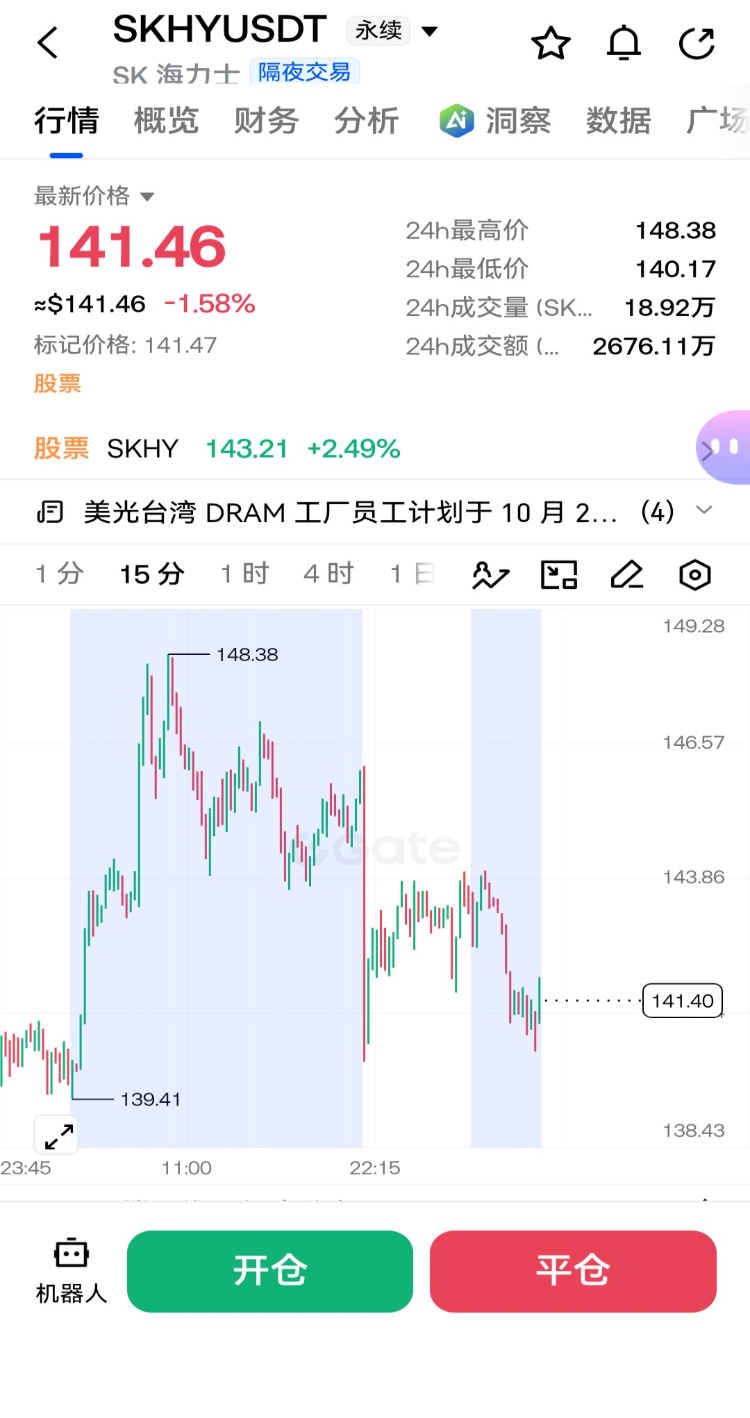
$139.790
-3.019 (-2.16%)終値時点
SK hynix Inc is a Korea-based company primarily engaged in the manufacturing and sale of memory semiconductor products. The Company's product portfolio includes semiconductor products, such as dynamic random access memory (DRAM) and NAND Flash products, used mainly in industrial electronic devices, as well as multi-chip packages (MCPs). The Company also engages in the foundry business. Additionally, the Company is engaged in the manufacturing and sale of complementary metal oxide semiconductor image sensors (CISs). CISs are used in mobile phones, laptops, tablets, medical devices, digital single-lens reflex (DSLR) cameras, camcorders, automobiles, security equipment, gaming consoles, and home appliances. The Company sells its products in both domestic and overseas markets.
Given the current price of $136.49, a low forward P/E of 5.44, and a gross margin of 83.20%, SK Hynix presents a compelling buying opportunity. The stock has seen a substantial decline of 19.25% over the past five days, which may present a favorable entry point for long-term investors. However, the main risk is the recent market sentiment reflected in the RSI of 8.814, indicating oversold conditions, which could lead to further volatility in the short term.
SK hynix Inc is a Korea-based company primarily engaged in the manufacturing and sale of memory semiconductor products. The Company's product portfolio includes semiconductor products, such as dynamic random access memory (DRAM) and NAND Flash products, used mainly in industrial electronic devices, as well as multi-chip packages (MCPs). The Company also engages in the foundry business. Additionally, the Company is engaged in the manufacturing and sale of complementary metal oxide semiconductor image sensors (CISs). CISs are used in mobile phones, laptops, tablets, medical devices, digital single-lens reflex (DSLR) cameras, camcorders, automobiles, security equipment, gaming consoles, and home appliances. The Company sells its products in both domestic and overseas markets. It operates in the Technology sector.
Given the current price of $136.49, a low forward P/E of 5.44, and a gross margin of 83.20%, SK Hynix presents a compelling buying opportunity. The stock has seen a substantial decline of 19.25% over the past five days, which may present a favorable entry point for long-term investors. However, the main risk is the recent market sentiment reflected in the RSI of 8.814, indicating oversold conditions, which could lead to further volatility in the short term.
$SKHY is in a short-term downtrend, with weak rebounds. I'm waiting patiently for a right-side bottom-fishing signal.
もっと見る
BTC scenario, perfectly validated! The rebound played out easily. Precisely positioned at the bottom range, fully captured the 2,500-point move. Personal live account, 220K USDT securely banked🔥 For a train to go fast, the engine must lead. Markets never stay on one trend forever, only consistently reliable execution does. Follow the trend to seize opportunities; those standing at the top never rely on luck, but on the confidence built from every single trade. #SKHynixUpOver7%
もっと見る

#MicronHostsTechnicalWebinar Micron Technology CTO Scott DeBoer hosted a technical webinar highlighting a key inflection point for the memory industry. The presentation focused on a multi-generation roadmap, including high-bandwidth memory (HBM), advanced DRAM, and NAND technologies designed to support next-generation AI infrastructure. Here is what this signals for Micron and the broader memory market: Memory Industry Takeaways 1. HBM Competition Accelerates Alongside the Technology Roadmap * Next-Generation Transition: The emphasis on HBM innovation underscores that high-bandwidth memory has become the primary bottleneck and performance differentiator for AI accelerators. * Customer Co-Design: Micron's focus on co-designing hardware directly with major hyperscalers and GPU designers indicates the market is moving away from commoditized memory. Memory stacks tailored to specific server architectures are creating higher switching costs and stronger customer relationships. 2. Disciplined Capacity Planning * Capital Intensity and Oversupply: The market is scrutinizing Micron's capacity expansion. Higher HBM wafer consumption naturally absorbs DRAM capacity. * Tight DRAM Supply: Prioritizing advanced HBM nodes keeps general-purpose DRAM capacity constrained across the industry, which helps support average selling prices in the standard server and enterprise memory markets. 3. Focus on Energy and Thermal Efficiency * Data Center Power Constraints: Power limits in data centers make performance-per-watt a key metric for memory. Advances in advanced packaging, process nodes, and energy-efficient NAND/DRAM help address thermal constraints in ultra-high-density AI racks. 4. Competitive Positioning Relative to Peers * Market Share Dynamics: Micron continues to challenge incumbents SK Hynix and Samsung in high-end HBM. Technical updates on yields, customer qualification, and roadmap execution will indicate whether Micron can maintain or grow its share in advanced memory. Broader Industry Implications High-Bandwidth Memory Transition Shifting toward higher-margin custom HBM products rather than commoditized DRAM. Supply Displacement / Wafer Allocation HBM production consumes roughly 3x the wafer capacity of standard DRAM, tightening global supply. AI Infrastructure Demand Expansion Enterprise storage and high-density DRAM demand extends beyond GPUs into servers. Questions for Further Discussion For further discussion, consider analyzing: 1. Financial Impact: How the HBM revenue mix affects Micron's gross margins compared with traditional DRAM/NAND. 2. Competitive Comparison: A detailed comparison of Micron's HBM roadmap versus SK Hynix and Samsung. 3. Supply Chain Impact: How equipment suppliers (such as ASML or Applied Materials) benefit from HBM packaging capacity expansion. $HBM $DRAM $SKHY $SAMSUNG
もっと見る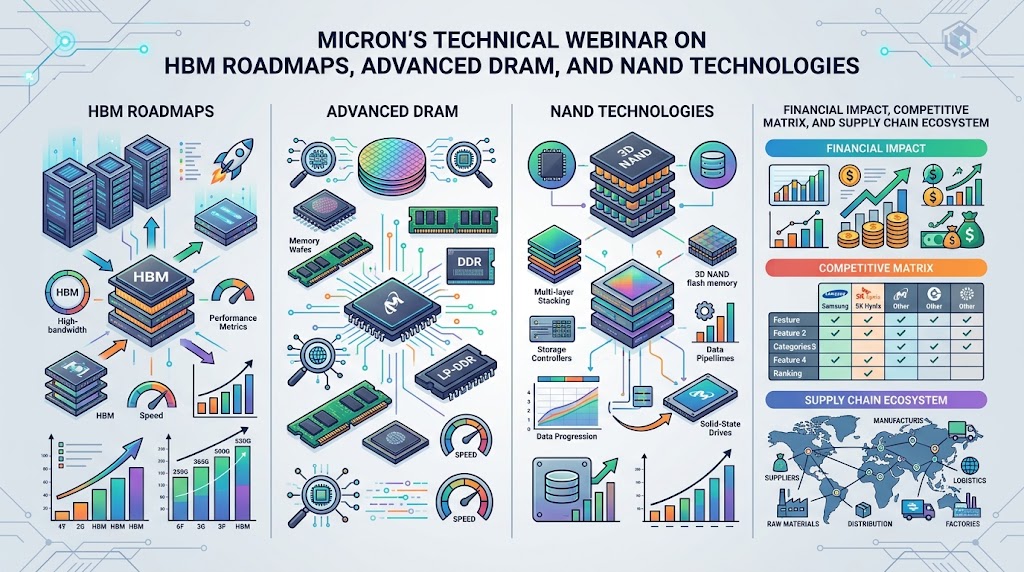

#MicronHostsTechnicalWebinar Micron Technology's technical webinar, led by CTO Scott DeBoer, highlighted a key inflection point for the memory industry. The presentation focused on a roadmap spanning multiple product generations, including high-bandwidth memory (HBM), advanced DRAM, and NAND technologies designed for next-generation AI infrastructure. Here is what this signals for Micron and the broader memory market: Key Takeaways for the Memory Industry 1. Accelerating HBM Competition and Technology Roadmap * Next-Generation Transition: The emphasis on HBM innovation underscores that high-bandwidth memory has become the primary bottleneck and performance differentiator for AI accelerators. * Customer Co-Design: Micron's focus on directly co-designing hardware with major hyperscalers and GPU designers indicates a shift away from commoditized memory. Memory stacks tailored to specific server architectures are raising switching costs and strengthening customer stickiness. 2. Disciplined Capacity Planning * Capital Intensity and Oversupply: The market is scrutinizing Micron's capacity expansion. Higher HBM wafer consumption naturally absorbs DRAM capacity. * Tight DRAM Supply: By prioritizing advanced HBM nodes, industry-wide general-purpose DRAM capacity remains constrained, helping to support average selling prices in standard server and enterprise storage markets. 3. Focus on Power and Thermal Efficiency * Data Center Energy Constraints: Power limits in data centers make performance-per-watt a key metric for memory. Updates in advanced packaging, process nodes, and energy-efficient NAND/DRAM help address thermal constraints in ultra-high-density AI racks. 4. Competitive Positioning Relative to Peers * Market Share Dynamics: Micron continues to challenge incumbent leaders SK Hynix and Samsung in high-end HBM. Technical updates on yields, customer qualification, and roadmap execution will indicate whether Micron can maintain or expand its share in advanced memory. Broader Industry Implications High-Bandwidth Memory Transition Shift toward higher-margin, customized HBM products rather than commoditized DRAM. Supply Reduction / Wafer Allocation HBM production consumes roughly 3x the wafer capacity of standard DRAM, tightening global supply. AI Infrastructure Demand Expansion Enterprise storage and high-density DRAM demand extends from GPUs to servers. Potential Follow-Up Analysis For further exploration, consider analyzing: 1. Financial Impact: How the HBM revenue mix affects Micron's gross margins compared with traditional DRAM/NAND. 2. Competitive Comparison: A direct comparison of Micron's HBM roadmap with SK Hynix and Samsung. 3. Supply Chain Impact: How equipment suppliers (such as ASML or Applied Materials) benefit from HBM packaging capacity expansion. $HBM $DRAM $SKHY $SAMSUNG
もっと見る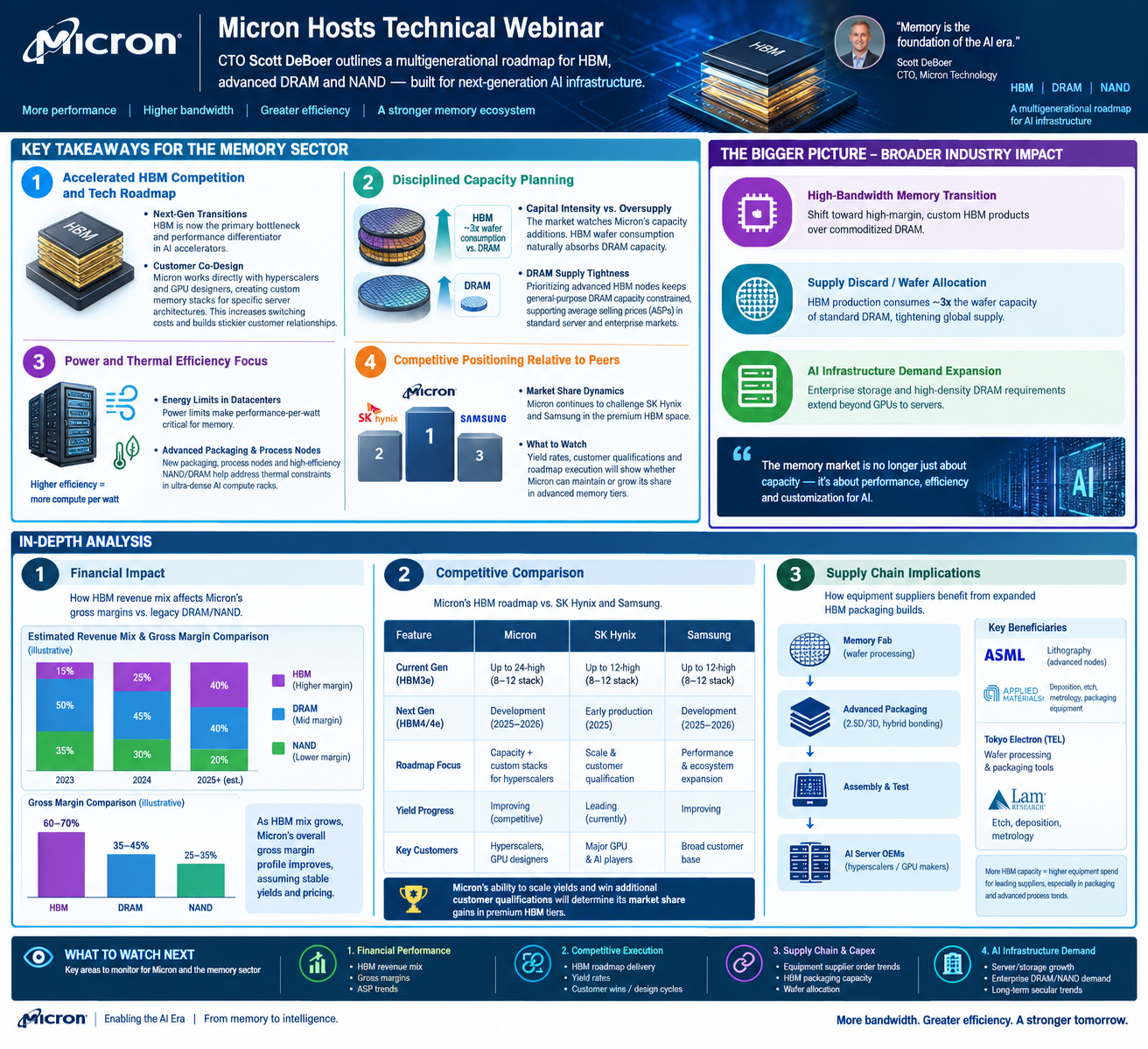

$SKHY is facing a wave of negative news on multiple fronts: month-end corporate earnings, the interest rate meeting, and the midterm elections. A golden pit may be forming. Many say the AI bubble is too big and valuations are too high, capital is selling off, and fear is spreading. Opportunity emerges from risk. Buy big on big drops, buy small on small drops. Could it really go to zero?
もっと見る本ページは調査目的であり、投資助言ではありません。モデルは誤ることがあります。過去の実績は将来の成果を保証しません。