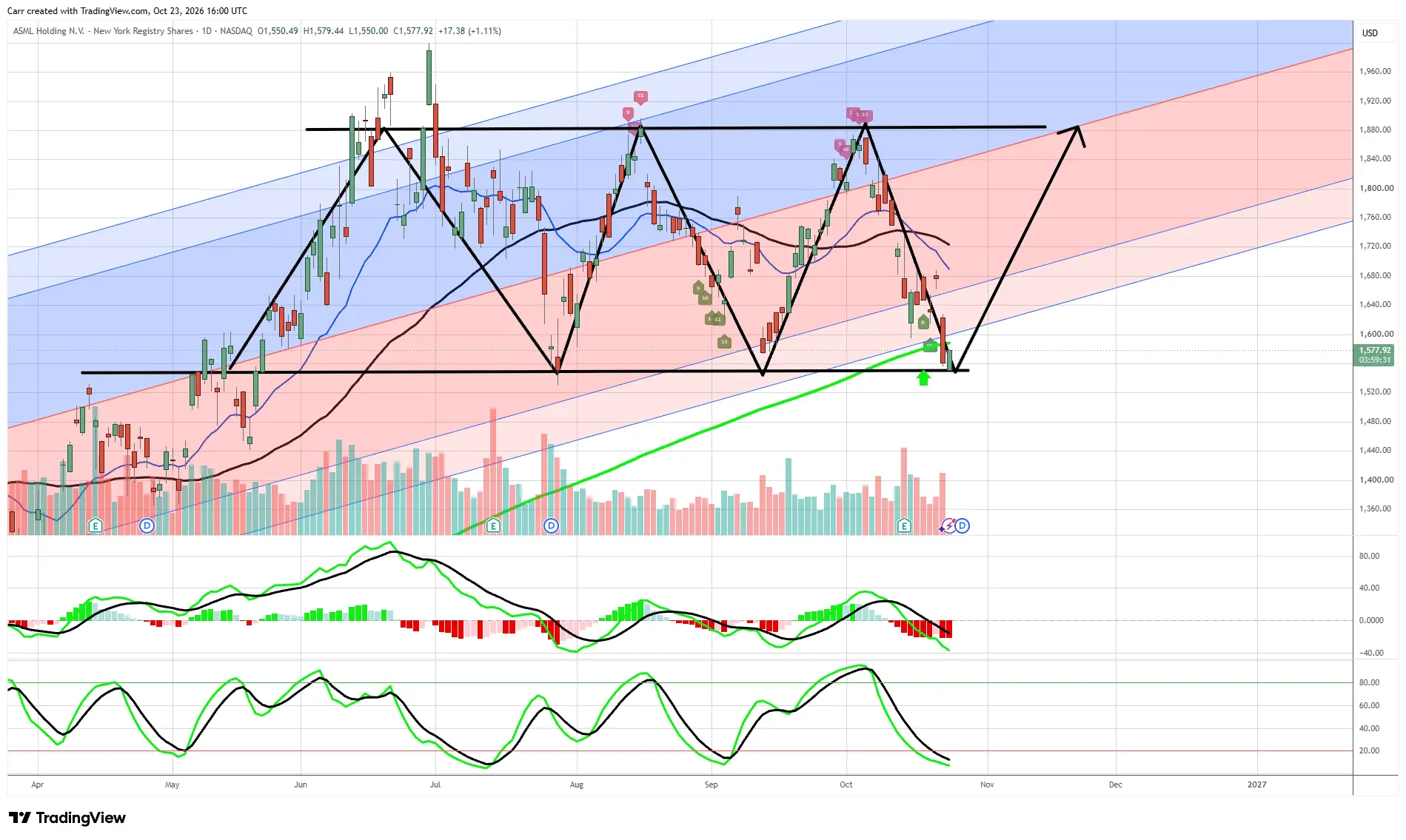
B
Bullisch
Bullisch · 25%ASML
$987.59
Szenariopreis
$1,325.820
+23.202 (+1.75%)Zum Schluss
ASML Holding N.V. is a holding company based in the Netherlands. The Company operates through its subsidiaries in the Netherlands, the United States, Italy, France, Germany, the United Kingdom, Ireland, Belgium, South Korea, Taiwan, Singapore, China, Hong Kong, Japan, Malaysia and Israel. The Company operates through one business segment which is engage in development, production, marketing, sales, upgrading and servicing of advanced semiconductor equipment systems, consisting of lithography, metrology and inspection systems. The Company offers TWINSCAN systems, equipped with lithography system with a mercury lamp as light source (i-line), Krypton Fluoride (KrF) and Argon Fluoride (ArF) light sources for processing wafers for manufacturing environments for which imaging at a small resolution is required. TWINSCAN systems also include immersion lithography systems (TWINSCAN immersion systems).
ASML is currently trading at $1,325.82, which is about 31.9% of its 52-week range. The RSI is at 40.14, indicating that the stock is nearing oversold territory, which could suggest a potential rebound. However, the forward P/E ratio is 21.37, suggesting that while the stock is not overly expensive, it is not at a significant discount either. The main risk is the potential impact of new chip export controls, which could affect ASML's market share, especially since approximately 20% of its sales come from China. Given these factors, it may be prudent to hold off on buying until more clarity on market conditions emerges.
Szenariopreise sind das letzte monatliche Prognoseband des laufenden Jahres. Die Wahrscheinlichkeiten sind feste Modellgewichte (25 / 50 / 25), keine Garantien.

AMD vs. ASML: Chip Stock Prospects for 2027
Nvidia Scandal Triggers Chip Export Controls in Congress

Tech Sell-Off Creates Best Buying Opportunity in Two Years
ASML: A Key Player in the AI Market
ASML Stock Rises on Surge in AI Demand Following Jensen Huang's Return
ASML Holding N.V. is a holding company based in the Netherlands. The Company operates through its subsidiaries in the Netherlands, the United States, Italy, France, Germany, the United Kingdom, Ireland, Belgium, South Korea, Taiwan, Singapore, China, Hong Kong, Japan, Malaysia and Israel. The Company operates through one business segment which is engage in development, production, marketing, sales, upgrading and servicing of advanced semiconductor equipment systems, consisting of lithography, metrology and inspection systems. The Company offers TWINSCAN systems, equipped with lithography system with a mercury lamp as light source (i-line), Krypton Fluoride (KrF) and Argon Fluoride (ArF) light sources for processing wafers for manufacturing environments for which imaging at a small resolution is required. TWINSCAN systems also include immersion lithography systems (TWINSCAN immersion systems). It operates in the Technology sector (SPECIAL INDUSTRY MACHINERY, NOT ELSEWHERE CLASSIFI industry).
ASML is currently trading at $1,325.82, which is about 31.9% of its 52-week range. The RSI is at 40.14, indicating that the stock is nearing oversold territory, which could suggest a potential rebound. However, the forward P/E ratio is 21.37, suggesting that while the stock is not overly expensive, it is not at a significant discount either. The main risk is the potential impact of new chip export controls, which could affect ASML's market share, especially since approximately 20% of its sales come from China. Given these factors, it may be prudent to hold off on buying until more clarity on market conditions emerges.

ASML sold 113 new lithography systems in Q3, up from 66 a year ago. Every advanced AI chip at 3nm or 4nm runs through its EUV machines, where it holds a near monopoly. Nvidia demand is visible. ASML capacity is the gate. $ASML $NVDA
Mehr anzeigen
Must read on the importance of semiconductors and the supply chain. $SMH $NVDA $AMAT $ASML $QQQ
Mehr anzeigen

#StockEarningsSeason Looking at the Q3 2026 earnings so far, my take is: On the US side, TSMC and ASML have confirmed AI demand is real, and the chip shortage continues — this is the strongest fundamental area. But Netflix growth is starting to slow, and while Meta's revenue is strong, it's spending heavily on AI infrastructure, with profits squeezed by both legal costs and capex — showing that tech giants have moved from a profit-making phase into a spend-to-buy-the-future phase. A-shares are even more extreme. ChangXin Technology has pushed the DRAM cycle to its limit, with Q1-Q3 net profit guidance reaching over 130 billion, the most direct case of upcycle delivery; CATL's volumes are still surging and energy storage is strong, but profit growth has dropped quickly, showing that price wars and cost pressure are already hurting margins. From an investor's perspective on what comes next, my personal view: 1. The semiconductor memory chain (especially DRAM) currently has the clearest logic — volume and price are both rising, and no inflection point is visible short term. 2. US tech stocks will focus more on spending efficiency; Google, Microsoft, and Amazon's capex guidance next week is key — if they keep ramping spending without clear returns, valuations will come under pressure. 3. Profit elasticity in consumer and some new energy segments is declining, and the market will keep diverging — no more broad growth bets; pick names with real pricing power or where the upcycle is still rising. Simply put: AI hardware remains in a strong upcycle, while software and some consumer segments are starting to diverge. The next move is likely not a broad rally, but continued strength for the strong and elimination of the weak. $ASML (ASMLUSDT) $TSLAB $SPCXB
Mehr anzeigen
#MicronHostsTechnicalWebinar Micron Technology CTO Scott DeBoer hosted a technical webinar highlighting a key inflection point for the memory industry. The presentation focused on a multi-generation roadmap, including high-bandwidth memory (HBM), advanced DRAM, and NAND technologies designed to support next-generation AI infrastructure. Here is what this signals for Micron and the broader memory market: Memory Industry Takeaways 1. HBM Competition Accelerates Alongside the Technology Roadmap * Next-Generation Transition: The emphasis on HBM innovation underscores that high-bandwidth memory has become the primary bottleneck and performance differentiator for AI accelerators. * Customer Co-Design: Micron's focus on co-designing hardware directly with major hyperscalers and GPU designers indicates the market is moving away from commoditized memory. Memory stacks tailored to specific server architectures are creating higher switching costs and stronger customer relationships. 2. Disciplined Capacity Planning * Capital Intensity and Oversupply: The market is scrutinizing Micron's capacity expansion. Higher HBM wafer consumption naturally absorbs DRAM capacity. * Tight DRAM Supply: Prioritizing advanced HBM nodes keeps general-purpose DRAM capacity constrained across the industry, which helps support average selling prices in the standard server and enterprise memory markets. 3. Focus on Energy and Thermal Efficiency * Data Center Power Constraints: Power limits in data centers make performance-per-watt a key metric for memory. Advances in advanced packaging, process nodes, and energy-efficient NAND/DRAM help address thermal constraints in ultra-high-density AI racks. 4. Competitive Positioning Relative to Peers * Market Share Dynamics: Micron continues to challenge incumbents SK Hynix and Samsung in high-end HBM. Technical updates on yields, customer qualification, and roadmap execution will indicate whether Micron can maintain or grow its share in advanced memory. Broader Industry Implications High-Bandwidth Memory Transition Shifting toward higher-margin custom HBM products rather than commoditized DRAM. Supply Displacement / Wafer Allocation HBM production consumes roughly 3x the wafer capacity of standard DRAM, tightening global supply. AI Infrastructure Demand Expansion Enterprise storage and high-density DRAM demand extends beyond GPUs into servers. Questions for Further Discussion For further discussion, consider analyzing: 1. Financial Impact: How the HBM revenue mix affects Micron's gross margins compared with traditional DRAM/NAND. 2. Competitive Comparison: A detailed comparison of Micron's HBM roadmap versus SK Hynix and Samsung. 3. Supply Chain Impact: How equipment suppliers (such as ASML or Applied Materials) benefit from HBM packaging capacity expansion. $HBM $DRAM $SKHY $SAMSUNG
Mehr anzeigen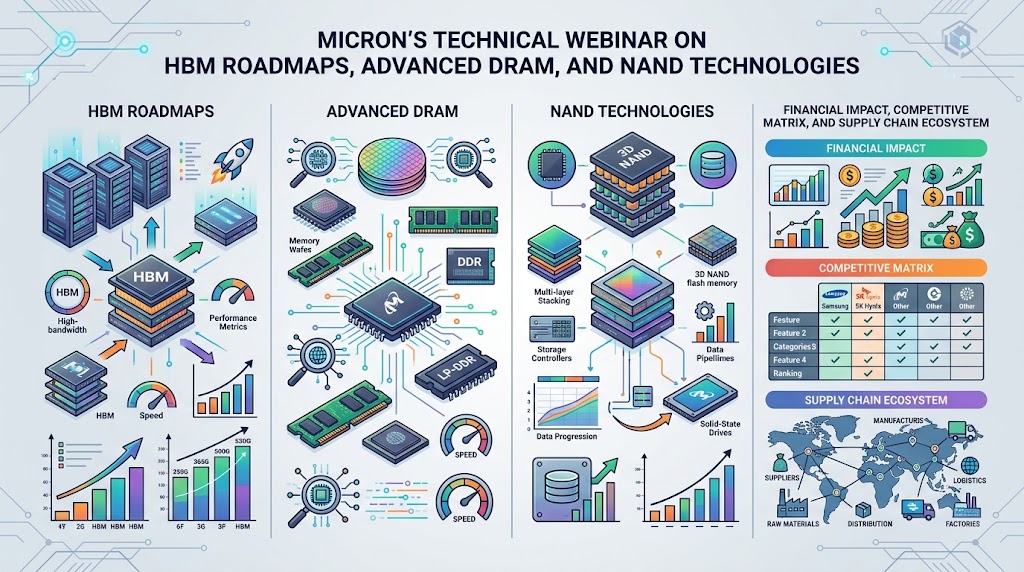
Diese Seite dient nur der Recherche und ist keine Anlageberatung. Modelle können falsch liegen. Vergangene Wertentwicklung ist kein Indikator für die Zukunft.