
B
Bullisch
Bullisch · 25%AMAT
$154.07
Szenariopreis
$322.040
+11.239 (+3.49%)Zum Schluss
Applied Materials, Inc. is a materials engineering solution company. The Company provides equipment, services and software to the semiconductor, display, and related industries. It operates through two segments: Semiconductor Systems and Applied Global Services (AGS). The Semiconductor Systems segment includes semiconductor capital equipment to enable materials engineering steps including etch, rapid thermal processing, deposition, chemical mechanical planarization, metrology and inspection, wafer packaging, and ion implantation. The AGS segment provides integrated solutions to optimize equipment and fab performance and productivity, including services, spares and factory automation software for semiconductor and other products. Its products include personal computing devices, mobile phones, artificial intelligence (AI) and data center servers, automobiles, connected devices, industrial applications and consumer electronics.
Applied Materials Inc is currently a hold. The stock is priced at $322.04, which is significantly below its 52-week high of $739.67, indicating potential for recovery. However, the RSI is at 41.79, suggesting it is nearing oversold territory, but still lacks momentum. The forward P/E ratio of 18.28 suggests it is fairly valued relative to its earnings growth potential, but the recent insider selling has surged by 2781.51%, raising concerns about future performance. Given these mixed signals, it may be wise to wait for clearer indicators before making a buy decision.
UBS
$575
2026-11-25
UBS
2026-11-25
Kursziel
$575
Freedom Broker
$490
2026-11-16
Freedom Broker
2026-11-16
Kursziel
$490
Morgan Stanley
$507
2026-11-13
Morgan Stanley
2026-11-13
Kursziel
$507
B. Riley
$500
2026-11-13
B. Riley
2026-11-13
Kursziel
$500
Evercore ISI
$430
2026-11-13
Evercore ISI
2026-11-13
Kursziel
$430
Szenariopreise sind das letzte monatliche Prognoseband des laufenden Jahres. Die Wahrscheinlichkeiten sind feste Modellgewichte (25 / 50 / 25), keine Garantien.

Applied Materials Stock Drops 17% Despite Record Quarter
Nvidia Scandal Triggers Chip Export Controls in Congress

Applied Materials vs. Intel: Which Stock to Buy for 2027?

Nvidia CEO Return Sparks 31% Stock Surge

Applied Materials Stock Recommended for Purchase
Applied Materials, Inc. is a materials engineering solution company. The Company provides equipment, services and software to the semiconductor, display, and related industries. It operates through two segments: Semiconductor Systems and Applied Global Services (AGS). The Semiconductor Systems segment includes semiconductor capital equipment to enable materials engineering steps including etch, rapid thermal processing, deposition, chemical mechanical planarization, metrology and inspection, wafer packaging, and ion implantation. The AGS segment provides integrated solutions to optimize equipment and fab performance and productivity, including services, spares and factory automation software for semiconductor and other products. Its products include personal computing devices, mobile phones, artificial intelligence (AI) and data center servers, automobiles, connected devices, industrial applications and consumer electronics. It operates in the Technology sector (SEMICONDUCTORS & RELATED DEVICES industry).
Applied Materials Inc is currently a hold. The stock is priced at $322.04, which is significantly below its 52-week high of $739.67, indicating potential for recovery. However, the RSI is at 41.79, suggesting it is nearing oversold territory, but still lacks momentum. The forward P/E ratio of 18.28 suggests it is fairly valued relative to its earnings growth potential, but the recent insider selling has surged by 2781.51%, raising concerns about future performance. Given these mixed signals, it may be wise to wait for clearer indicators before making a buy decision.
21 analysts cover AMAT: 20 rate it Buy, 1 Hold and 0 Sell. The average price target is 288.05.

Dividend settlements for CGNX, AMAT, MSFT, BWXT, and MAR: What perpetual futures holders should know Imagine holding a perpetual futures contract and seeing a dividend-related adjustment in your account. It may look like a small account update, but understanding why it happens can help you track your positions and account balance. 💡 Key information Gate has announced dividend settlements for five perpetual futures contracts linked to CGNX, AMAT, MSFT, BWXT, and MAR. A dividend settlement is an adjustment related to a dividend distribution by the underlying stock. Simply put, when a company distributes part of its earnings to shareholders, that event can also affect financial products linked to its stock. Perpetual futures are contracts that allow users to track an asset's price without holding the actual stock. They have no traditional expiry date, so settlement adjustments are an important part of understanding how these products work. 📈 Advantages Dividend settlements help address corporate actions that could otherwise create discrepancies between the underlying stock and the related perpetual futures contracts. For users, this offers some benefits: A better understanding of dividend-related adjustments. Clearer insight into important contract events. A clearer view of how stock-linked perpetual futures work. An opportunity to review account activity and understand balance changes. These details matter because participating successfully in financial markets is not just about watching price movements. Understanding contract rules is equally important. ⚠️ Disadvantages Dividend settlements should not automatically be treated as extra gains. The actual impact depends on the contract's settlement rules and the user's position. Dividend-related adjustments do not guarantee a positive outcome for every participant. Other factors also need to be considered: Stock prices may change around dividend events. Perpetual futures carry market risk and leverage risk. Account adjustments may affect overall position value. Users who do not understand settlement rules may misinterpret account changes. Based on a dividend announcement alone, users cannot determine whether a particular position will benefit. 📊 A balanced view The five contracts involved relate to different companies: CGNX: Cognex Corporation AMAT: Applied Materials MSFT: Microsoft BWXT: BWX Technologies MAR: Marriott International This announcement highlights that traditional stock market events can also affect products built around stock prices. The practical approach is simple: review the relevant contract information, understand the settlement conditions, and check account activity rather than assuming every adjustment represents a reward. 🔍 What to watch next Keep an eye on follow-up contract announcements, settlement details, and any account adjustments related to these five perpetual futures contracts. Understanding the rules behind each settlement is as important as understanding the market itself. #Gate #PerpetualFutures #DividendSettlement #StockFutures #CryptoTrading
Mehr anzeigen

$AMAT | APPLIED MATERIALS, INC. Q4 2026 EARNINGS HIGHLIGHTS ◆ EPS: $4.16 vs. $4.06 est. ✅ ◆ Revenue: $10.41B vs. $10.30B est. ✅ ◆ Net Income: $2.72B (+43.3% YoY) ◆ Operating Income: $3.66B (+113.7% YoY) ◆ Operating Expenses: $1.59B (+2.6% YoY) ◆ Operating Cash Flow: $3.30B (+16.7% YoY) Segment Performance: ◆ Semiconductor Systems: $8.00B (+63.9% YoY) ◆ Applied Global Services: $1.90B (+25.9% YoY) ◆ Other: $517M (+24.6% YoY) Key Metrics: ◆ Non-GAAP free cash flow was $2.62B in Q4 FY2026, up 28% from $2.04B in Q4 FY2025. ◆ Share repurchases totaled $2.00B in Q4 FY2026, the largest quarterly buyback in more than eight years; $421M in dividends also paid. ◆ Capital expenditures were $684M in Q4 FY2026, down from $785M in Q4 FY2025. Forward Guidance: ◆ Q1 FY2027 total revenue guidance: $11.1B +/- $500M. ◆ Q1 FY2027 non-GAAP diluted EPS guidance: $4.35 +/- $0.20. ◆ Semiconductor Systems business on track to grow more than 40% in calendar 2026.
Mehr anzeigen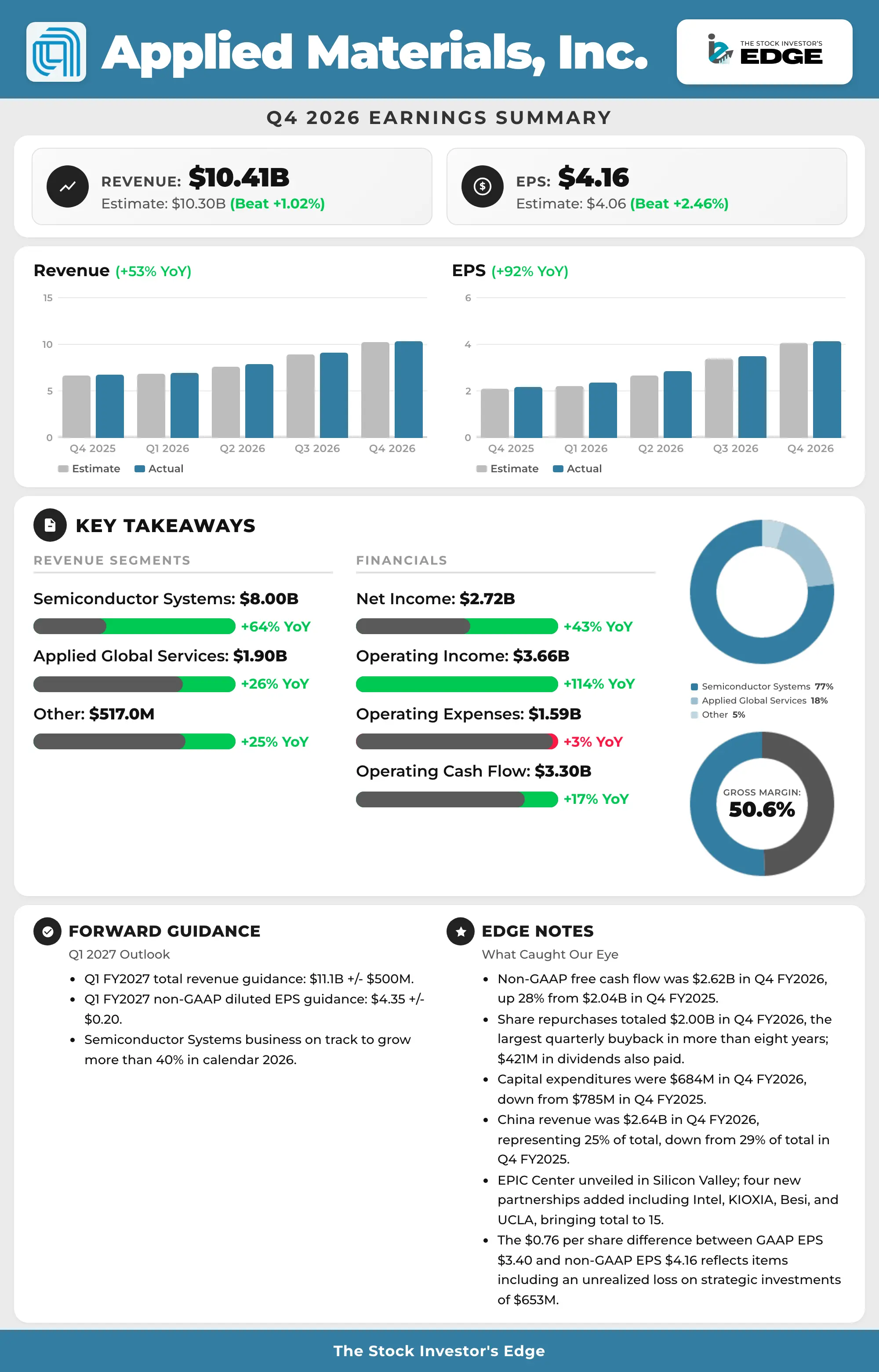

📈 Another busy week ahead for US markets 👀 CPI / PPI + AI and chip earnings Will inflation data shake rate-cut expectations? Can earnings from CoreWeave, Applied Materials, and Nebius keep the AI momentum going? 🍿 What are you watching more closely: inflation data or AI earnings? Share your pick. I'll pass your questions along to the host 🔴 Mark your calendar. See you up front. #GateLive #USStocks #CPI #AI
Mehr anzeigen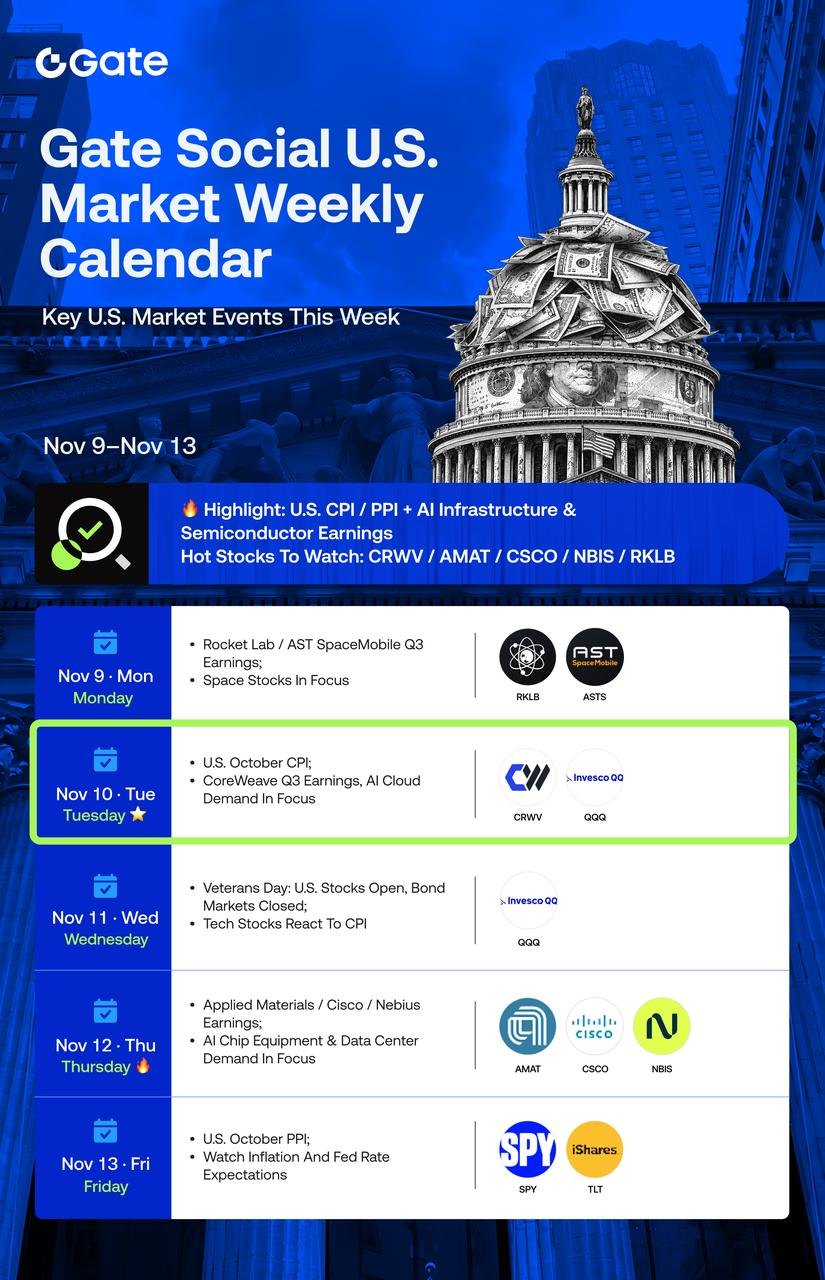

US stocks face a key week: can inflation data and major tech earnings restore market confidence? With investors facing growing uncertainty around inflation, interest rates, and AI infrastructure spending, US equities are heading into another important week. Tech stocks have struggled recently, with the Nasdaq down for four consecutive weeks. Despite a small rebound on Friday, the broader market remains under pressure. 📊 Three key events to watch next week: 1️⃣ CPI and PPI inflation data: Strong jobs data has heightened concerns that inflation remains elevated and the Fed may adopt tighter policy. Softer inflation readings could help revive bullish sentiment. 2️⃣ CoreWeave earnings: Investors will closely watch AI infrastructure spending, financing conditions, capital expenditure, and GPU deployment. Strong guidance could boost confidence in the broader AI sector. 3️⃣ Applied Materials and Cisco earnings: Semiconductor demand and AI networking revenue will be key indicators to help judge whether massive AI investments are translating into sustainable business growth. ⚠️ What could go wrong? - Higher-than-expected inflation could increase rate pressure. - Rising financing costs could hurt AI infrastructure companies. - Weak guidance could trigger further pullbacks in tech stocks. - Semiconductor valuations could face risk if earnings expectations are revised lower. 🚀 Bullish scenario: Cooling inflation, strong earnings, and improving AI infrastructure demand could drive a tech rebound. 🐻 Bearish scenario: Persistent inflation, growing financing concerns, and disappointing corporate guidance could extend the current market pullback. My view: The coming week could be a major test for the AI and semiconductor rally. Investors should focus not only on earnings figures but also on forward guidance, financing conditions, and actual AI demand. The market needs more than promises about AI growth — it needs real revenue, sustainable profitability, and stronger confidence. Stay cautious, manage risk, and let the data guide your decisions. What do you think? Will US tech stocks rebound next week, or are we in for another pullback? 📉📈
Mehr anzeigen

Next week, can AI trades emerge from the gloom? US tech stocks suffered a sharp selloff this week, and the AI investment boom is facing a dual test from changes in the policy environment and wavering confidence in capital markets. Although chip stocks rebounded on Friday, the Nasdaq remains in a technical correction range, and doubts about returns on AI infrastructure investment, financing capacity, and future growth prospects have not dissipated. Looking ahead to next week, US October CPI, PPI, and earnings from companies including CoreWeave, Applied Materials, and Cisco will be important factors affecting market direction. At the same time, whether the US-Iran conflict can avoid further escalation and whether shipping through the Strait of Hormuz can resume will also affect international oil prices and global inflation expectations. CPI to test December rate hike bets Next Tuesday, the US will release October CPI, and on Friday it will release October PPI. With expectations for Federal Reserve monetary policy clearly shifting, the two inflation readings will be important evidence for judging the future path of interest rates. US inflation pressure is still being affected by factors including energy prices and tariff costs. Meanwhile, the latest nonfarm payrolls data came in strong, further weakening market expectations for the Fed to shift toward easing in the near term. After the employment report, bets in interest rate futures markets on a 25 basis point Fed rate hike in December increased noticeably. According to the CME FedWatch tool, market expectations for a December hike are now close to 80%. Economists generally expect US headline and core CPI to both rise 0.3% month over month in October. ING believes such an increase would be enough to make a December hike a relatively high-probability event. Nick Rees, head of macro research at Monex, said that unless next Tuesday's CPI is clearly below expectations or November nonfarm payrolls show a major downside surprise, expectations for a 25 basis point Fed hike in December may be largely priced in by the market before the policy meeting. For investors, if inflation reaccelerates, the market may further raise rate hike expectations. With tech valuations under pressure and rising sensitivity to financing costs, this would add further pressure on growth stocks. AI investment logic faces repricing The political landscape after the midterm elections is bringing new uncertainty to the AI supply chain. Energy consumption, environmental issues, and community impact caused by data center construction have become important election issues, and investors are beginning to worry that related projects may face stricter regulation and local approval limits in the future. This concern intensified on Thursday, with the S&P 500 information technology sector falling 7.3% in a single day and the Philadelphia Semiconductor Index plunging 12.2%, both marking their largest one-day drops in more than six years. The Nasdaq fell 5.5% that day and was nearly 12% below its record high set in October, entering a technical correction range. The pressure on tech stocks is not only regulatory risk. The previously continuous expansion of AI investment has already raised market concerns about return on capital, financing capacity, and cash flow. As data center construction costs continue to rise, investors are paying closer attention to whether massive capital expenditure can actually translate into real revenue and profit. Keith Lerner, chief investment officer at Truist Advisory Services, noted that the performance gap between tech stocks and the S&P 500 over the past month has reached its largest level since May 2002, suggesting investors appear to be collectively avoiding tech stocks, with market buying clearly insufficient.
Mehr anzeigen
Diese Seite dient nur der Recherche und ist keine Anlageberatung. Modelle können falsch liegen. Vergangene Wertentwicklung ist kein Indikator für die Zukunft.