B
Bullisch
Bullisch · 25%AMD
$167.59
Szenariopreis
$528.750
-31.461 (-5.95%)Zum Schluss
Advanced Micro Devices, Inc. is a global semiconductor company. The Company is focused on high-performance computing and artificial intelligence (AI). Its segments include Data Center, Client and Gaming, and Embedded. Data Center segment includes AI accelerators, microprocessors (CPUs) for servers, graphics processing units (GPUs), accelerated processing units (APUs), data processing units (DPUs), Field Programmable Gate Arrays (FPGAs), and Adaptive system-on-Chip (SoC) products for data centers. Client and Gaming segment includes CPUs, APUs, chipsets for desktops and notebooks, discrete GPUs, and semi-custom SoC products and development services. Embedded segment includes embedded CPUs, APUs, FPGAs, system on modules (SOMs), and Adaptive SoC products. It markets and sells its products under the AMD trademark. Its products include AMD EPYC, AMD Ryzen, AMD Ryzen PRO, Virtex UltraScale+, among others.
Currently, AMD's price is $528.75, which is significantly below the lowest analyst target of $705, indicating potential upside. However, the RSI is at 17.965, suggesting the stock is oversold, and the recent 5-day change is -13.05%, indicating short-term weakness. The main risk is the insider selling, which has increased by 221.49% over the last month, signaling potential concerns among insiders.
Mizuho
$705
2026-10-06
Mizuho
2026-10-06
Kursziel
$705
Citi
$800
2026-10-06
Citi
2026-10-06
Kursziel
$800
Stifel
$700
2026-10-05
Stifel
2026-10-05
Kursziel
$700
BofA
$720
2026-09-25
BofA
2026-09-25
Kursziel
$720
Piper Sandler
$600
2026-09-09
Piper Sandler
2026-09-09
Kursziel
$600
Szenariopreise sind das letzte monatliche Prognoseband des laufenden Jahres. Die Wahrscheinlichkeiten sind feste Modellgewichte (25 / 50 / 25), keine Garantien.

TSMC Reports Record Profits Amid AI Boom, Strong Growth Forecast
Diversification Strategy for AI Investment Trends

Investors Shift to Low-Risk Fixed-Income Investments Amid Rising Rates

AMD Stock Overvaluation Raises Investor Caution

Top Performing Nasdaq-100 Stocks of 2026
Advanced Micro Devices, Inc. is a global semiconductor company. The Company is focused on high-performance computing and artificial intelligence (AI). Its segments include Data Center, Client and Gaming, and Embedded. Data Center segment includes AI accelerators, microprocessors (CPUs) for servers, graphics processing units (GPUs), accelerated processing units (APUs), data processing units (DPUs), Field Programmable Gate Arrays (FPGAs), and Adaptive system-on-Chip (SoC) products for data centers. Client and Gaming segment includes CPUs, APUs, chipsets for desktops and notebooks, discrete GPUs, and semi-custom SoC products and development services. Embedded segment includes embedded CPUs, APUs, FPGAs, system on modules (SOMs), and Adaptive SoC products. It markets and sells its products under the AMD trademark. Its products include AMD EPYC, AMD Ryzen, AMD Ryzen PRO, Virtex UltraScale+, among others. It operates in the Technology sector (SEMICONDUCTORS & RELATED DEVICES industry).
Currently, AMD's price is $528.75, which is significantly below the lowest analyst target of $705, indicating potential upside. However, the RSI is at 17.965, suggesting the stock is oversold, and the recent 5-day change is -13.05%, indicating short-term weakness. The main risk is the insider selling, which has increased by 221.49% over the last month, signaling potential concerns among insiders.
31 analysts cover AMD: 11 rate it Buy, 15 Hold and 5 Sell. The average price target is 289.13.

DeepSeek's new model is pushing the frontier on efficiency: only 8-16B active parameters per token vs 30-100B for most competitors, yet it competes on agentic coding while being far cheaper and easier to serve. $NVDA $AMD
Mehr anzeigen

#ASMLTSMCQ3EarningsSoon Two AI giants, two very different growth stories The semiconductor market has taught investors an important lesson: being essential to the AI boom does not mean every company benefits in the same way or on the same timeline. ASML and TSMC both sit at critical points in the advanced chip supply chain, but their businesses work differently. ASML builds the complex lithography machines needed to produce advanced chips, while TSMC manufactures chips for customers that design processors powering AI, smartphones, and data centers. After ASML reported third-quarter results on October 14, my attention turned to TSMC's earnings release on October 15. ASML delivered strong figures, but the market reaction matters just as much. Based on the data provided, ASML reported quarterly sales of EUR 11.7 billion, a gross margin of 57.5%, and EUR 5.7 billion in new orders. It reported earnings per share of $14.65, also above the cited estimate of about $12.13. Strong service and upgrade revenue helped support the results. These figures suggest demand for advanced chipmaking equipment remains substantial. Still, I would not judge ASML only on beating expectations. Semiconductor equipment orders, fab expansion plans, and installation timelines run on longer cycles. Customers may be investing heavily in AI, but the resulting equipment revenue takes several quarters to show up. That is why even impressive results do not automatically translate into an immediate stock price move. Investors also weigh valuation, forward guidance, and how much growth is already reflected in the share price. TSMC is heading into its report with different strengths. Its preliminary quarterly revenue data points to strong demand. Based on the data provided, third-quarter revenue reached about NT$1.49 trillion, equivalent to roughly $46.7 billion, exceeding the cited market consensus and the upper end of its published guidance range. For me, the key question is whether revenue growth is translating into stronger profitability, and whether management remains confident about future demand. Advanced 3nm and 5nm manufacturing processes, plus advanced packaging capacity, all matter because AI chipmakers need not only chip designs but also the manufacturing capacity to produce increasingly complex processors at scale. If demand stays strong and capacity constraints persist, TSMC may retain meaningful pricing power. But higher capital expenditure, manufacturing costs, and the difficulty of expanding capacity efficiently are risks I would not overlook. Why does TSMC look attractive in this earnings context? The difference comes down to how the two companies capture the AI investment cycle. ASML benefits when chipmakers invest in the equipment needed to expand or upgrade production. TSMC is more directly involved in manufacturing the chips customers order. That does not mean one business is broadly better than the other. ASML's advanced equipment is hard to replace, while TSMC's manufacturing capability and advanced packaging are central to delivering cutting-edge chips. Both depend on continued investment in computing infrastructure, but their earnings drivers and timing differ. For this particular earnings event, I will be watching TSMC's profit growth, gross margin outlook, advanced node demand, packaging capacity, and management commentary on future capital expenditure. Strong revenue alone is not enough; guidance needs to support the growth expectations already reflected in the share price. My view is that TSMC has a highly attractive near-term earnings catalyst, because its results can reveal how much AI demand is translating directly into manufacturing revenue and profit. At the same time, ASML's results provide a valuable signal about the long-term investment cycle behind advanced chip production. I would not buy either stock just because AI demand remains strong. Valuation, forward guidance, and the market's reaction to results still matter. The real opportunity lies in identifying which company can convert AI demand into sustainable earnings growth without making investors pay too much for that growth. $ASML $TSM $AMD
Mehr anzeigen


The overall market trend is currently very close to the same stage last year. It looks very weak, and it is also quite possible that it is only similar. However, the super trend line has appeared. In the short term, I still need to observe for another 1-2 days to see whether the remaining 2 support levels can hold 2217-2315. Only then can the support be considered formed, so I need to wait a bit longer. $ETH $NVDA $AAPL $AMD
Mehr anzeigen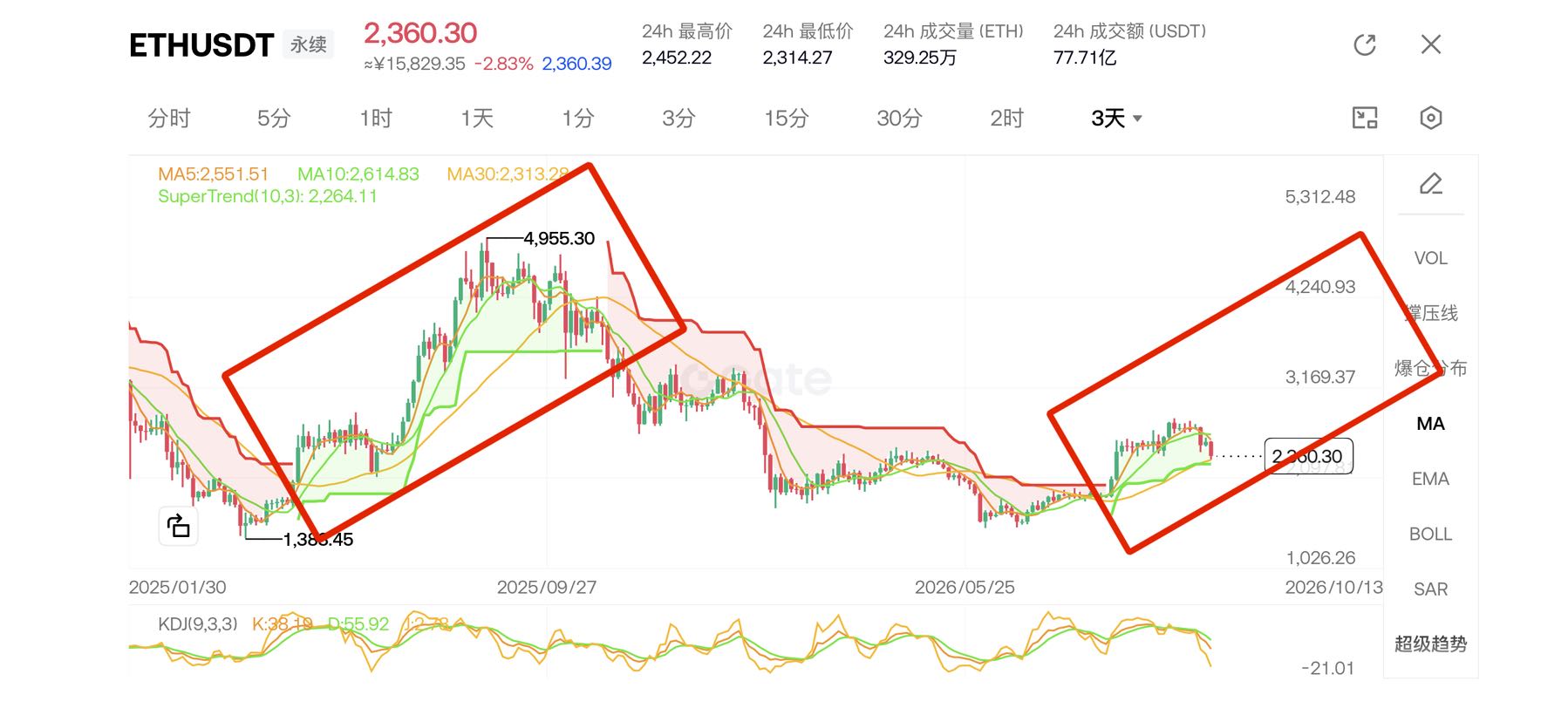
Diese Seite dient nur der Recherche und ist keine Anlageberatung. Modelle können falsch liegen. Vergangene Wertentwicklung ist kein Indikator für die Zukunft.