

SpaceX IPO 2026: How Starship and Starlink Are Powering a $1.75 Trillion Valuation
SpaceX's historic IPO approaches with Starship V3 testing and 10M+ Starlink subscribers. Explore the growth story behind the $1.75 trillion valuation and investment thesis.

Key Takeaway
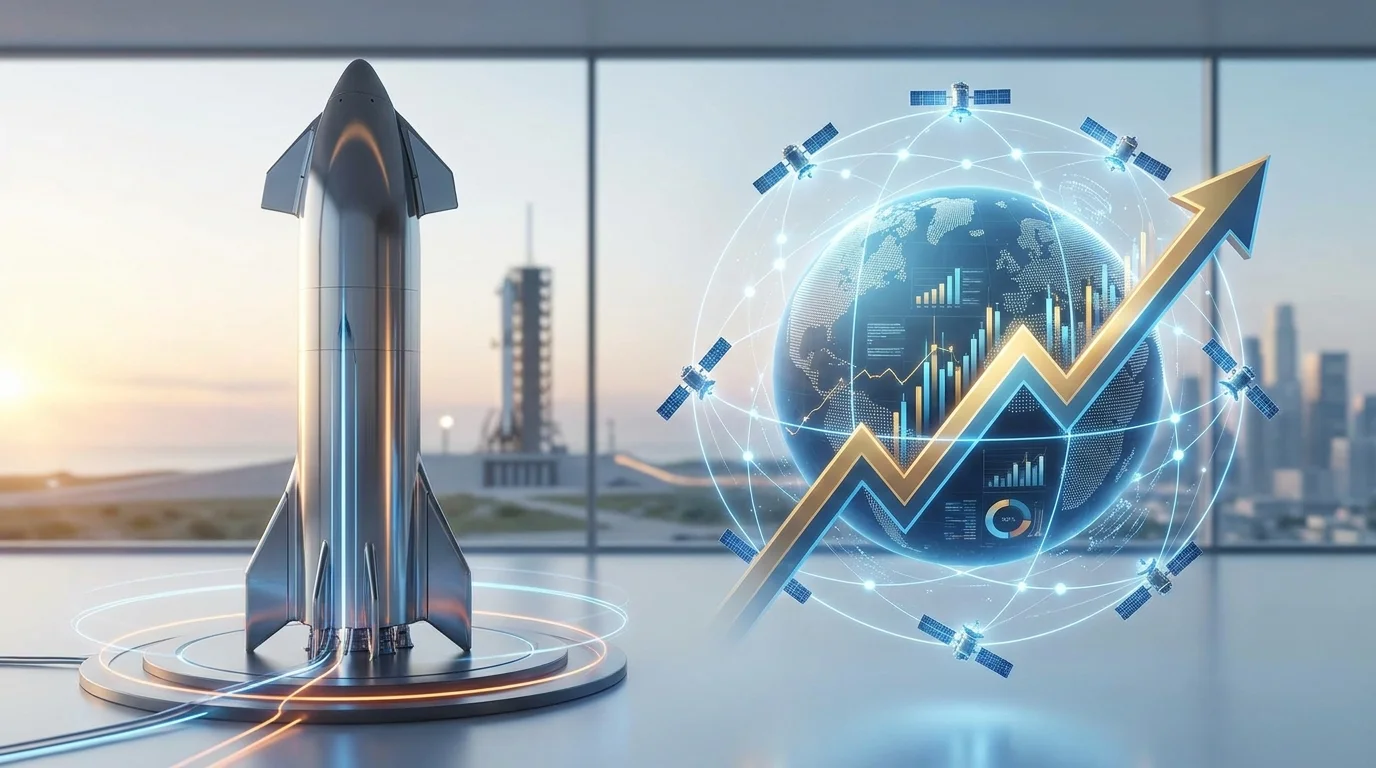
SpaceX is poised to execute the largest IPO in market history, targeting a valuation of $1.75 trillion that would instantly make it the seventh-largest company in the United States. This extraordinary valuation rests on two transformative pillars: the Starship rocket program, which achieved a major milestone with the successful Version 3 test flight in May 2026, and Starlink, the satellite internet constellation that has grown to over 10.3 million subscribers and generates approximately $11.4 billion in annual revenue. Together, these programs represent a fundamental reimagining of space economics, from reusable launch vehicles to global broadband infrastructure.
For investors evaluating the SpaceX opportunity, understanding the interplay between these core programs is essential. Starlink currently provides the financial foundation, contributing roughly 61% of total revenue and serving as the company's only profitable segment. Meanwhile, Starship represents the technological breakthrough that could unlock entirely new markets, from orbital data centers to Mars colonization. The $1.75 trillion valuation reflects not just current performance but the expectation that SpaceX will dominate the emerging space economy across multiple verticals. However, with the company trading at approximately 94 times trailing revenue and remaining unprofitable overall, investors must weigh extraordinary growth potential against significant valuation risk.
The Historic IPO: Breaking Down the Numbers
SpaceX's planned initial public offering represents a watershed moment for both the company and capital markets. The offering targets a valuation between $1.75 trillion and $1.77 trillion, with shares priced at approximately $135 each. This would raise at least $75 billion in primary capital, making it the largest IPO in history by proceeds. At this valuation, SpaceX would surpass established giants like Berkshire Hathaway and Tesla to become the seventh-most valuable company in the United States.
The financial metrics underlying this valuation are staggering. SpaceX generated approximately $18.7 billion in revenue for 2025, representing a 33% year-over-year increase from 2024. However, the company remains deeply unprofitable on a consolidated basis, with losses expanding as it funds aggressive growth initiatives. The implied price-to-sales ratio of roughly 94 times trailing revenue dwarfs even the most aggressive technology valuations seen during the 2021 market peak.
What justifies such a premium? Investors are essentially paying for optionality on multiple transformative technologies. Starlink is already demonstrating commercial viability with positive unit economics. Starship, while still in development, has shown sufficient progress to suggest it will achieve the full reusability that could reduce launch costs by orders of magnitude. And the company's nascent orbital data center and Mars colonization initiatives, while speculative, represent potentially trillion-dollar addressable markets if successful.
Starship Version 3: The Engineering Marvel
SpaceX achieved a critical milestone on May 22, 2026, with the successful test flight of Starship Version 3, the largest and most powerful rocket ever built. This 12th test flight of the Starship program marked the debut of the upgraded design, which features enhanced capabilities essential for the company's most ambitious missions. The successful test demonstrated significant progress toward full and rapid reusability, the key innovation that could transform space economics.
Starship Version 3 represents a substantial upgrade over previous iterations. The vehicle is taller, wider, and more powerful than its predecessors, with increased payload capacity and improved thermal protection systems. During the test flight, the rocket successfully deployed 20 Starlink simulator satellites on a sub-orbital trajectory, demonstrating its capability to carry substantial payloads. The test also validated critical systems including in-space propellant transfer, a technology essential for lunar and Mars missions.
The significance of Starship extends beyond technical achievement. NASA has selected Starship as the lunar lander for its Artemis program, which aims to return humans to the Moon. The successful Version 3 test flight strengthens confidence that SpaceX can meet its commitments to the space agency. Additionally, Starship's massive payload capacity opens entirely new markets, from deploying large space telescopes to establishing orbital manufacturing facilities.
Elon Musk has stated that he foresees Starship making its first uncrewed voyage to Mars by the end of 2026, though this timeline appears increasingly ambitious. Regardless of the exact schedule, each successful test flight brings SpaceX closer to achieving the full reusability that has been the company's core mission since its founding in 2002.
Starlink: The Revenue Engine
While Starship captures headlines with its dramatic test flights, Starlink has quietly become the financial engine powering SpaceX's growth. The satellite internet constellation generated $11.39 billion in revenue in 2025, accounting for approximately 61% of SpaceX's total sales. More importantly, Starlink is the company's only profitable segment, providing the cash flow that funds Starship development and other speculative initiatives.
The growth trajectory has been remarkable. Starlink's subscriber base reached 10.3 million in the first quarter of 2026, doubling from the previous year. This rapid adoption reflects the service's unique value proposition: high-speed internet access in locations where traditional broadband infrastructure is unavailable or unreliable. From rural households to maritime vessels to military applications, Starlink has found product-market fit across diverse customer segments.
However, the growth story includes important nuances. Average revenue per user (ARPU) has declined 18% to $81 per month between 2023 and 2025, reflecting a deliberate trade-off between pricing and volume. This strategy has enabled rapid subscriber growth but puts pressure on unit economics. At current ARPU levels, the 10.3 million subscriber base generates approximately $810 million in monthly revenue, or $9.7 billion annualized, suggesting that hardware sales and enterprise contracts contribute meaningfully to the $11.4 billion total.
The competitive landscape is also evolving. Traditional satellite operators are launching competing constellations, while terrestrial providers are expanding coverage in previously underserved areas. Amazon's Project Kuiper, backed by substantial resources, represents a particularly credible threat. Starlink's first-mover advantage and established manufacturing capabilities provide important competitive moats, but maintaining growth and margins will require continued innovation and operational excellence.
The Space Economy: Market Opportunity
SpaceX's valuation reflects investor confidence that the company will dominate the emerging space economy, a market that could grow from approximately $400 billion today to over $1 trillion by 2040. This expansion encompasses multiple verticals, each representing substantial commercial opportunity.
Satellite communications, Starlink's core market, is the most mature segment. Global demand for connectivity continues to grow, particularly in developing regions where terrestrial infrastructure remains limited. Starlink's low-earth orbit constellation offers meaningful advantages over traditional geostationary satellites, including lower latency and higher bandwidth. The service is already demonstrating military applications, with contracts from the U.S. Department of Defense and allied nations providing both revenue and strategic validation.
Launch services represent another significant opportunity. As Starship achieves full reusability, launch costs could decline from current levels of thousands of dollars per kilogram to hundreds or even tens of dollars. This cost reduction would democratize access to space, enabling new applications from space-based solar power to orbital manufacturing. SpaceX's Falcon family of rockets already dominates the commercial launch market, and Starship's capabilities should extend this leadership.
Perhaps most speculatively, SpaceX is developing plans for orbital data centers and Mars colonization. These initiatives, while years from commercialization, represent potentially transformative applications. Orbital data centers could leverage the vacuum and cold of space for high-performance computing, while Mars colonization would establish humanity as a multi-planetary species. The IPO valuation implicitly assigns significant value to these long-term opportunities, though their realization remains uncertain.
Investment Thesis: Growth vs. Valuation
Evaluating SpaceX as an investment requires balancing extraordinary growth potential against equally extraordinary valuation. The bull case rests on the company's technological leadership, first-mover advantages, and the transformative potential of its core programs. The bear case focuses on valuation metrics that dwarf even the most aggressive technology companies and the operational challenges inherent in space exploration.
Growth catalysts are substantial and visible. Starlink continues to add subscribers at a rapid pace, with international expansion providing a long runway for growth. Starship's successful test flights suggest the vehicle will achieve full reusability, opening new markets and reducing costs. The company's relationships with NASA and the U.S. military provide both revenue and strategic positioning. And the potential for entirely new applications, from orbital data centers to Mars colonization, offers optionality that is difficult to quantify but potentially enormous.
However, valuation metrics are demanding. At 94 times trailing revenue, SpaceX trades at a multiple that assumes years of continued hypergrowth and eventual margin expansion. The company remains unprofitable on a consolidated basis, with Starship development and other initiatives consuming substantial capital. Competition is intensifying across all segments, from satellite internet to launch services. And the technical challenges of space exploration, from vehicle reliability to regulatory approval, remain significant.
For investors considering the IPO, position sizing and time horizon are critical considerations. SpaceX is likely to remain a volatile stock, with significant upside potential but equally significant downside risk. Those with long time horizons and tolerance for volatility may find the growth story compelling. More risk-averse investors may prefer to wait for post-IPO price discovery or focus on more established companies with clearer paths to profitability.
IPO Structure: Limited Float and Lockup Dynamics
SpaceX's IPO structure presents unique characteristics that prospective investors should understand. The public offering represents only 4.2% of total shares outstanding, with the remaining 95.8% held by Elon Musk and internal stakeholders. This extremely limited float creates several dynamics that will influence trading behavior.
The scarcity premium could drive significant first-day volatility. With institutional demand reportedly overwhelming supply by multiples, the stock could experience a substantial pop on opening. Historical precedents for high-profile technology IPOs suggest initial premiums of 20-50% above offering price are possible. While this creates immediate paper gains for fortunate allocators, it also means secondary market buyers may face less attractive entry points.
The lockup structure employs a staggered release mechanism designed to manage selling pressure. Shares unlock in tranches beginning 70 days post-IPO, with 7% releases at intervals thereafter. This gradual approach aims to stabilize the stock price as insiders monetize positions, but it also means persistent selling pressure will weigh on shares for at least a year following the offering.
The cost basis disparity between insiders and public investors is extreme. Early investors and employees hold shares with an average cost basis of approximately $6.48, compared to the $135 IPO price. This 20-fold difference creates powerful incentives for profit-taking at virtually any price level above the IPO, potentially capping upside momentum as these holders diversify their concentrated positions.
Risk Factors: What Could Go Wrong
SpaceX's investment proposition, while compelling, carries substantial risks that prospective shareholders must consider. Understanding these risks is essential for proper position sizing and risk management.
Technical risks are significant and ever-present. Space exploration is inherently dangerous, with complex systems operating in hostile environments. A catastrophic failure of Starship, whether during testing or operational missions, could delay programs, increase costs, and damage the company's reputation. While SpaceX has demonstrated impressive engineering capabilities, the history of space exploration includes numerous setbacks and failures.
Regulatory risks are also material. SpaceX operates in a highly regulated environment, from FAA launch approvals to FCC spectrum licenses to international trade restrictions. Changes in regulatory posture, whether driven by safety concerns, national security considerations, or geopolitical tensions, could impact the company's operations and growth prospects. The company's role as a defense contractor subjects it to ITAR restrictions that could complicate international expansion.
Competitive risks are intensifying. While SpaceX currently leads in reusable rockets and satellite internet, well-funded competitors are pursuing similar capabilities. Amazon's Project Kuiper, backed by virtually unlimited resources, represents a particularly credible threat to Starlink. Traditional aerospace companies and emerging startups are developing competing launch vehicles. Maintaining technological and operational leadership will require continued innovation and substantial investment.
Financial risks center on valuation and profitability. At 94 times trailing revenue, SpaceX's stock price reflects enormous expectations for future growth. Any disappointment, whether in subscriber additions, launch cadence, or program milestones, could trigger significant price declines. The company's ongoing losses and substantial capital requirements mean it will remain dependent on external funding for the foreseeable future.
Conclusion: The Final Frontier of Investing
SpaceX's IPO represents a unique opportunity to invest in the commercialization of space, a frontier that has captivated humanity for generations. The company's achievements to date, from reusable rockets to a global satellite constellation, demonstrate that space can be a viable commercial endeavor, not merely a government-funded exploration program. The $1.75 trillion valuation reflects investor confidence that SpaceX will continue to lead this transformation.
For those considering participation in the IPO, the investment case rests on three pillars: Starlink's demonstrated commercial viability and growth trajectory, Starship's potential to unlock entirely new markets through dramatically reduced launch costs, and the optionality inherent in speculative initiatives like orbital data centers and Mars colonization. Each of these pillars offers substantial upside potential for patient investors with appropriate risk tolerance.
However, the valuation demands careful consideration. SpaceX is not a value investment; it is a growth story priced for perfection. Investors should expect volatility, potential disappointments, and a long path to profitability. Position sizing should reflect these risks, with SpaceX representing a speculative rather than core portfolio holding for most investors.
The space economy is no longer science fiction. It is a real and growing market, and SpaceX has established a commanding position across its most attractive segments. Whether that position justifies a $1.75 trillion valuation will be determined over the coming years as the company executes on its ambitious roadmap. For those who believe in the transformative potential of space commercialization, SpaceX offers a pure-play opportunity unlike any other in public markets.
To stay informed on SpaceX and other space economy investment opportunities, consider using Intellectia AI's stock screener to track relevant companies and monitor market developments. Our AI stock picker can help identify optimal entry points and manage risk in this volatile but potentially transformative sector. Sign up today to access real-time analysis and personalized investment recommendations tailored to your risk tolerance and investment objectives.
The final frontier is now investable. The question for investors is whether the potential rewards justify the substantial risks.
FAQs
What is SpaceX's IPO valuation and when is it happening?
SpaceX is targeting a valuation of $1.75 trillion with shares priced at approximately $135 each. The IPO is expected to price around June 11, 2026, with trading commencing shortly thereafter. This would make it the largest IPO in history by proceeds, raising at least $75 billion.
How does Starlink contribute to SpaceX's business?
Starlink is SpaceX's primary revenue driver, generating $11.39 billion in 2025 (61% of total revenue) and serving as the company's only profitable segment. The satellite internet service has grown to over 10.3 million subscribers as of Q1 2026, with average revenue per user at $81 per month.
What is Starship Version 3 and why is it important?
Starship Version 3 is SpaceX's largest and most powerful rocket, successfully tested on May 22, 2026. It features enhanced capabilities for full reusability, in-space propellant transfer, and deployment of large payloads. Starship is critical for NASA's Artemis lunar program and potential Mars missions.
What are the main risks of investing in SpaceX?
Key risks include: (1) Extreme valuation at 94x trailing revenue, (2) Ongoing unprofitability and capital intensity, (3) Technical risks inherent in space exploration, (4) Regulatory challenges including FAA approvals and ITAR restrictions, (5) Intensifying competition from Amazon's Project Kuiper and others, (6) Limited float (4.2%) creating potential volatility.
Should I buy SpaceX stock at the IPO price?
This depends on your risk tolerance and investment horizon. SpaceX offers exposure to the growing space economy with demonstrated leadership in rockets and satellite internet. However, the valuation is demanding and the stock will likely be volatile. Consider position sizing appropriately as a speculative holding rather than a core portfolio position.
Related articles
- Stock Market Surges After 2026 Midterms: What the Democratic Sweep Means for Your PortfolioThe stock market rallied after Democrats won the 2026 midterms. Discover what the election means for investors, tech stocks, and the S&P 500 outlook.
- Stock Market Surges After 2026 Midterms: What the Democratic Sweep Means for Your PortfolioThe stock market rallied after Democrats won the 2026 midterms. Discover what the election means for investors, tech stocks, and the S&P 500 outlook.
- Oil Prices Surge Above $105 Amid US-Iran Conflict: Energy Investment Opportunities in November 2026Oil prices climb past $105 as US strikes Iran's Qeshm Island. Discover energy investment opportunities, top oil stocks, and market outlook for November 2026.
- Jobs Report Investing: How to Read NFP and Position for the Stock Market in 2026How investors read the U.S. jobs report (NFP)—payrolls, wages, revisions—and how stocks, bonds, and Fed hike odds react, with a Nov 2026 positioning framework.
- Intel Q3 2026 Deep Dive: DCAI +78% Couldn't Save a Guidance Cliff—Why INTC Just Posted Its Worst DayAfter the close on October 29, 2026, Intel (NASDAQ: INTC) handed Wall Street a print that should have felt like a turnaround chapter: **revenue $16.5B (+2…
- Amazon Q3 2026 Deep Dive: AWS Hits a $184B Run Rate While TTM FCF Bleeds $42.4B—Why the Tape Sold a Amazon Q3 2026 sell-side deep dive: AWS +39% to $46B ($184B run rate), record 13.9% op margin, TTM FCF -$42.4B after AI CapEx, and why AMZN fell ~6–7% after hou