

Intel Q3 2026 Deep Dive: DCAI +78% Couldn't Save a Guidance Cliff—Why INTC Just Posted Its Worst Day
After the close on October 29, 2026, Intel (NASDAQ: INTC) handed Wall Street a print that should have felt like a turnaround chapter: **revenue $16.5B (+2…

Intel Q3 2026 Deep Dive: DCAI +78% Couldn't Save a Guidance Cliff—Why INTC Just Posted Its Worst Day Since 1974
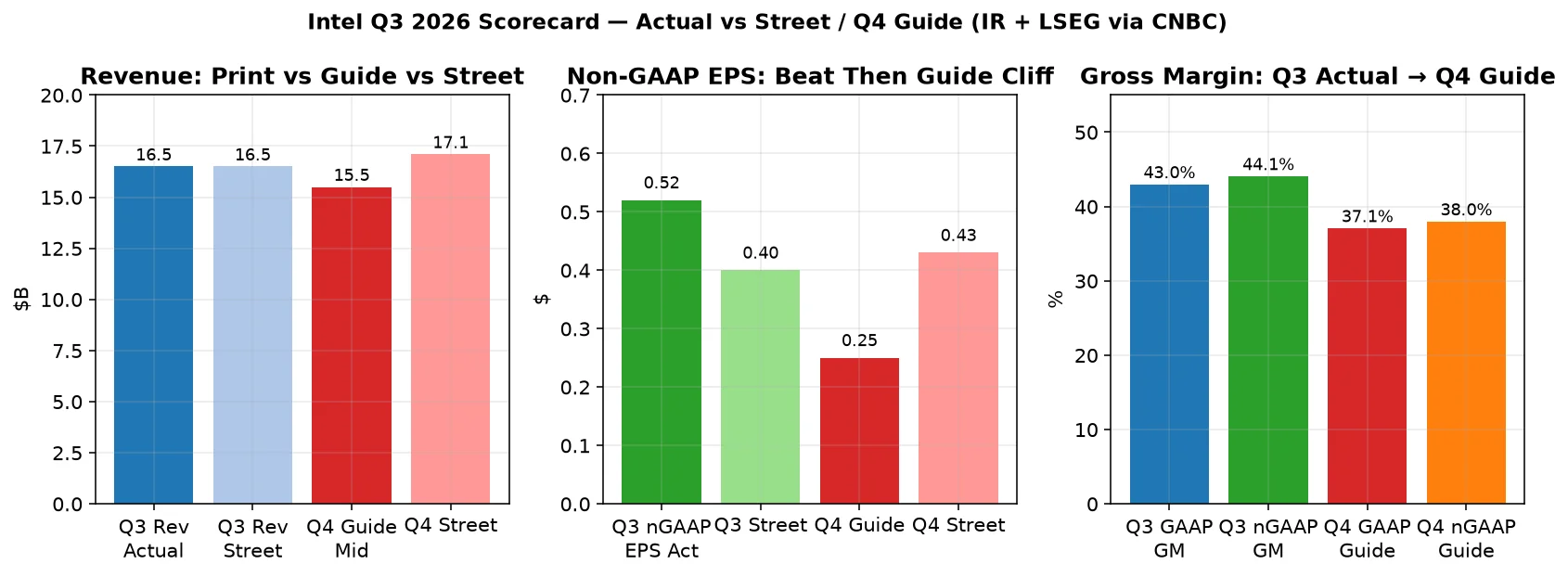
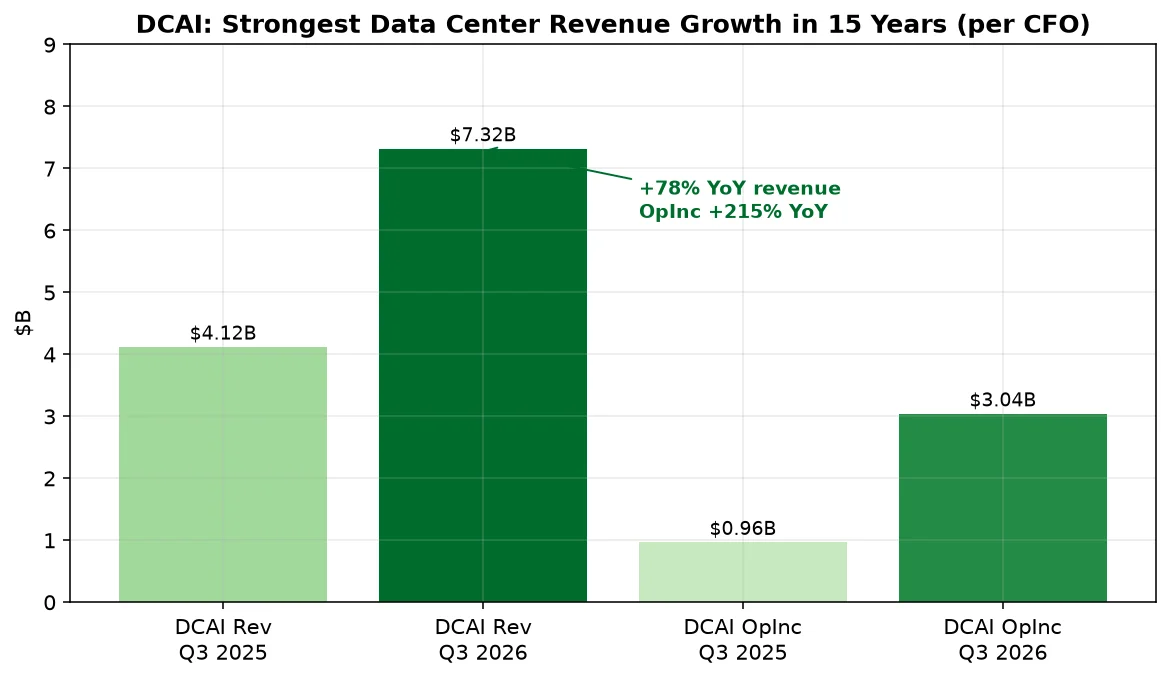
After the close on October 29, 2026, Intel (NASDAQ: INTC) handed Wall Street a print that should have felt like a turnaround chapter: revenue $16.5B (+21% YoY), non-GAAP EPS $0.52 versus LSEG's ~$0.40 (CNBC), and Data Center and AI (DCAI) revenue +78% to $7.318B—what CFO David Zinsner called the company's strongest data center revenue growth in 15 years. Instead, the tape staged a historic purge. Shares plunged roughly 28–29% on Friday, October 30 (CNBC cited ~29%; Yahoo Finance "nearly 29%"), wiping on the order of ~$140B of market value and marking, per Yahoo Finance / Norgate Data calculations, Intel's worst session since July 1974.
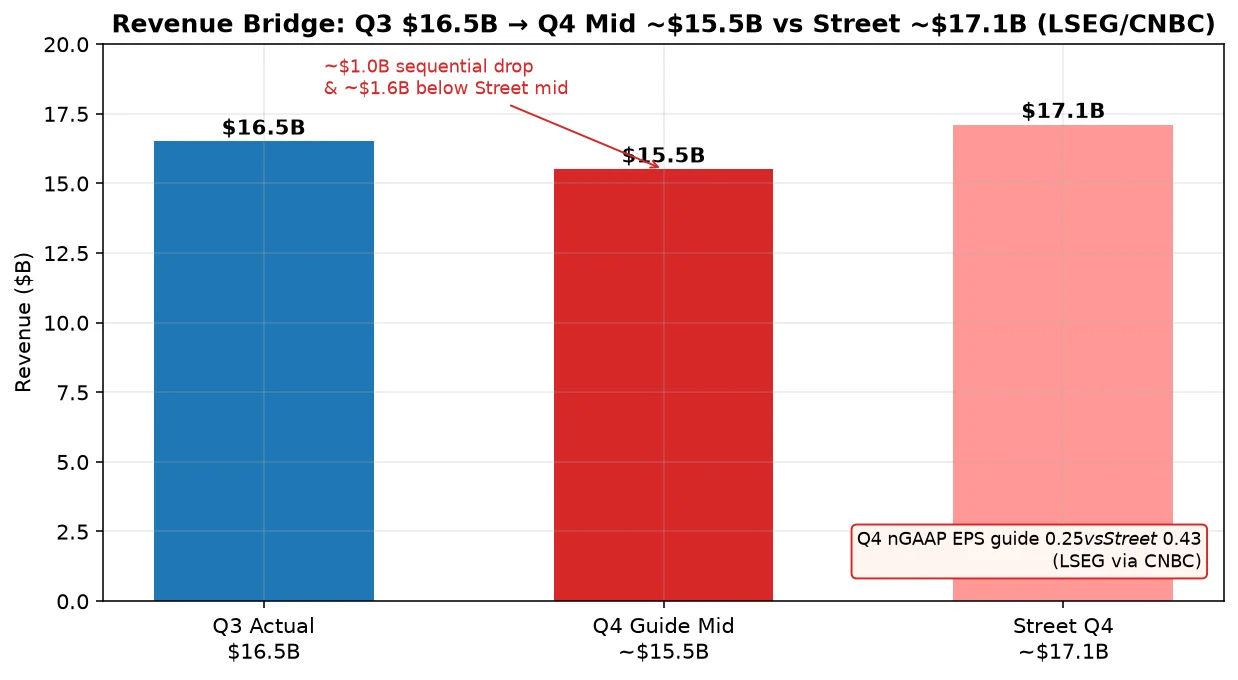
The conflict is not subtle. The quarter beat Intel's own prior guide on revenue, gross margin, and EPS. The outlook is what broke the stock: Q4 revenue $15.0–$16.0B (midpoint ~$15.5B, sequential down from $16.5B) versus LSEG's ~$17.1B, and non-GAAP EPS $0.25 versus LSEG's ~$0.43 (CNBC). Layer on a PC market that management now says stays soft at least through 1H next year, memory-cost inflation bleeding into OEM inventories, substrate constraints capping server upside, and an Israel fab incident that secondary coverage (Reuters / CNBC) pegs at roughly $600M of lost revenue over two quarters—and you get a one-day chart that looks like a crisis even when the P&L still prints growth.
This note reads the print the way the tape did—as a story conflict—then rebuilds the mechanism from Intel's October 29, 2026 IR / Business Wire release (https://www.intc.com/news-events/press-releases/detail/1786/intel-reports-third-quarter-2026-financial-results), the accompanying consolidated statements, and named Street reaction (CNBC, Yahoo Finance, Reuters via StreetInsider). Consensus anchors are LSEG as cited by CNBC. Numbers below are from the primary IR release unless attributed to a secondary source.
1. What the Market Was Afraid Of—and What It Briefly Celebrated
Heading into the print, the constructive frame was a braid of three bull narratives:
- Server / agentic CPU scarcity — customers buying Xeon capacity "regardless of product performance" in some Street previews (Bernstein / MarketWatch framing); Intel itself now expects industry server CPU units to grow >30% in both 2026 and 2027, with growth capped by supply.
- Foundry optionality — Intel 14A 0.9 PDK released in October; packaging collaborations; the multiyear "rebuild" story under CEO Lip-Bu Tan.
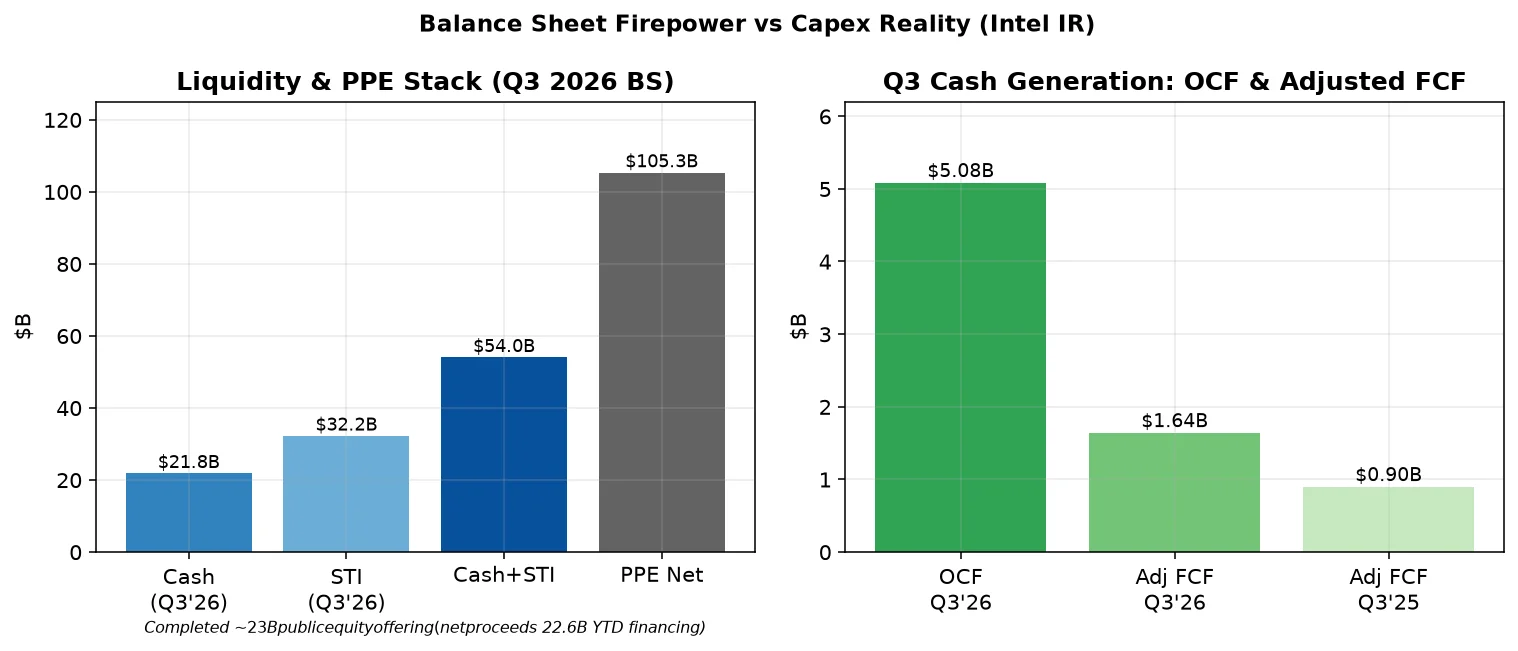
- Balance-sheet reinforcement — a completed ~$23B public equity offering and a fortress cash + short-term investments stack after the raise.
The fear set, which Friday made canonical, was the opposite braid:
- PC as the silent majority of the model — Client Computing and Physical AI Group (CCPG) is still the largest products P&L line; a memory-driven inventory correction can overwhelm a DCAI beat.
- Capacity misallocation — too much PC wafer capacity, not enough server / substrate flexibility a year into the server upcycle (Bernstein's Stacy Rasgon thesis, via CNBC).
- Guidance that refuses to clear the emotional bar — after a year when INTC had roughly tripled / nearly quadrupled off the lows into a June record (Yahoo Finance), any Q4 guide that misses Street by ~$1.6B of revenue and nearly halves Street EPS invites multiple compression, not a "buy the beat" reflex.
- Cash-burn optics into the build — Zinsner told investors (Reuters / call coverage) Intel does not expect positive cash flow for the full year as it expands manufacturing; FY CapEx still ~$20B with 2027 step-up language.
Pre-print, the stock had already given back October gains on AI-buildout anxiety (CNBC: down ~23% in October before the print, still up ~150% YTD into the report). Friday said the market was no longer willing to gloss over PC while celebrating DCAI.
2. Scorecard: Beat the Guide, Lose the Street, Crash the Multiple
| Metric | Q3 2026 actual | Benchmark / prior year | Read-through |
|---|---|---|---|
| Revenue | $16.513B | PY $13.653B; LSEG ~$16.5B (CNBC) | +21% YoY; in-line / slight beat vs Street; beat own guide |
| GAAP EPS (diluted) | $0.60 | PY $0.90 | Down YoY on share count + mix; diluted shares 5,307M vs 4,531M |
| Non-GAAP EPS | $0.52 | PY $0.23; LSEG ~$0.40 (CNBC) | Beat; +126% YoY |
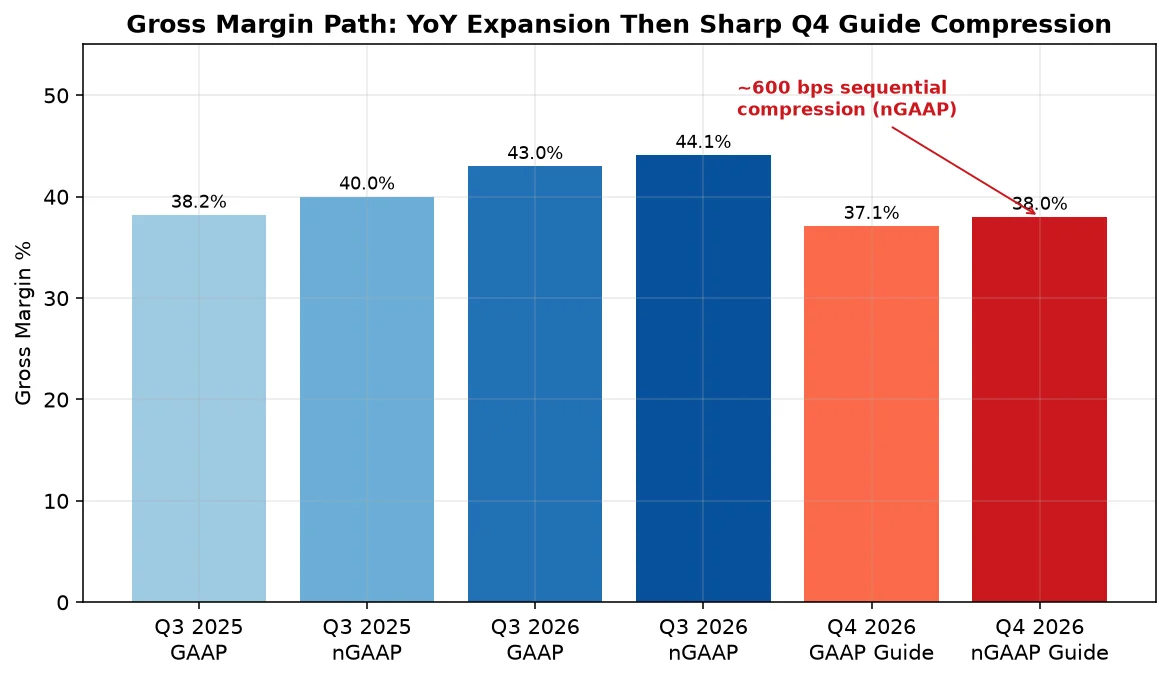
| GAAP gross margin | 43.0% | PY 38.2% | +4.8 ppts YoY |
| Non-GAAP gross margin | 44.1% | PY 40.0% | +4.1 ppts YoY |
| GAAP op margin | 15.3% | PY 5.0% | +10.3 ppts |
| Non-GAAP op margin | 19.6% | PY 11.2% | +8.4 ppts |
| NI attributable to Intel (GAAP) | $3.320B | PY $4.063B | Down 18% — noisy comps / prior gains |
| NI attributable (nGAAP) | $2.756B | PY $1.023B | +169% |
| OCF (Q3) | $5.082B | PY $2.546B | Strong quarterly cash generation |
| Adjusted FCF (Q3) | $1.639B | PY $0.896B | Positive; still small vs PPE base |
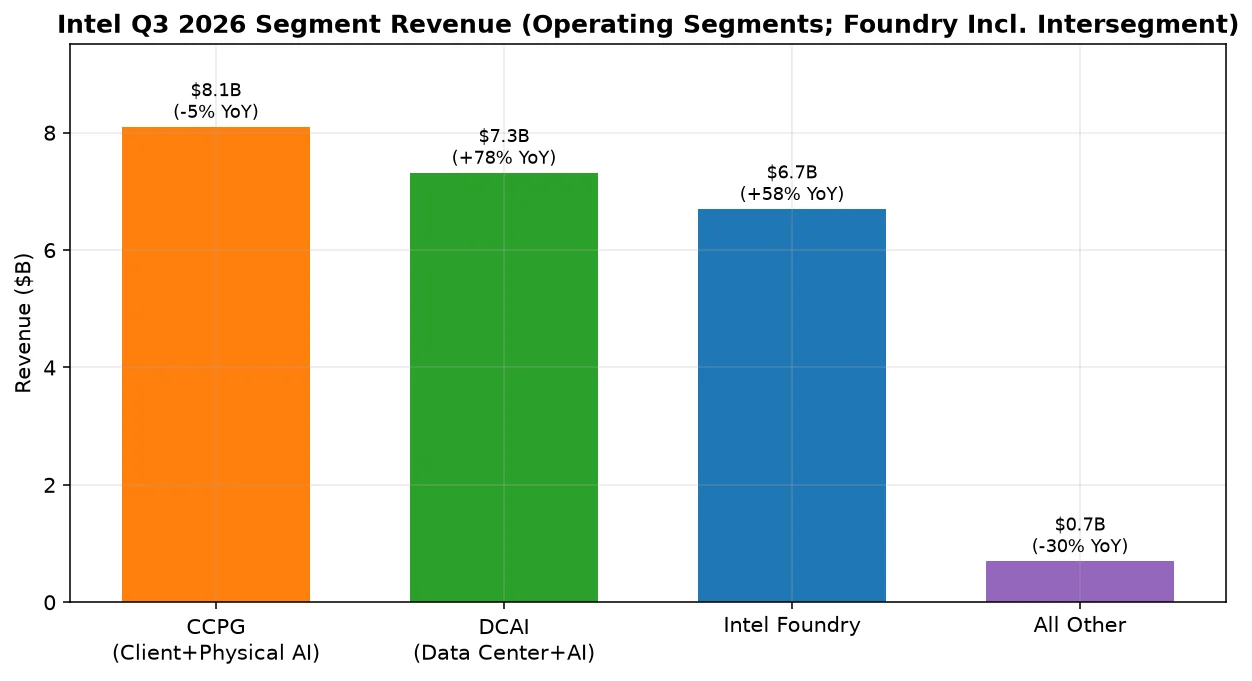
| CCPG revenue | $8.097B | −5% YoY | Soft; Street miss per CNBC |
| DCAI revenue | $7.318B | +78% YoY | Strongest DC growth in 15 yrs (CFO) |
| Intel Products total | $15.415B | +22% | DCAI carrying the print |
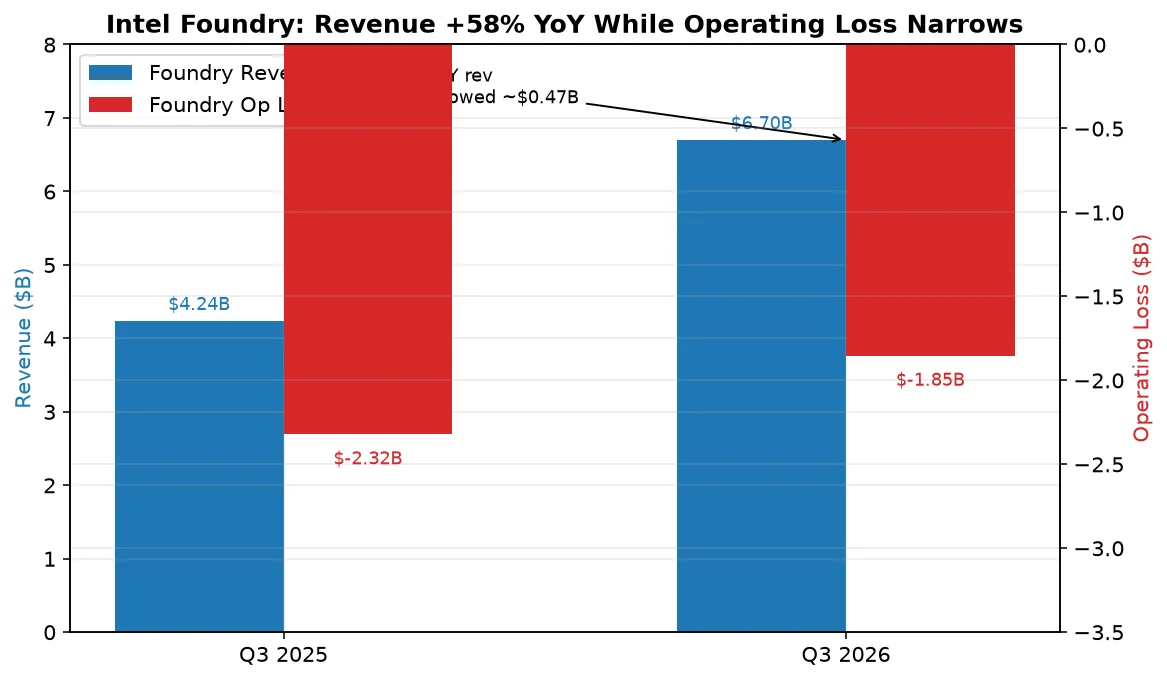
| Intel Foundry revenue | $6.697B | +58% | Incl. intersegment |
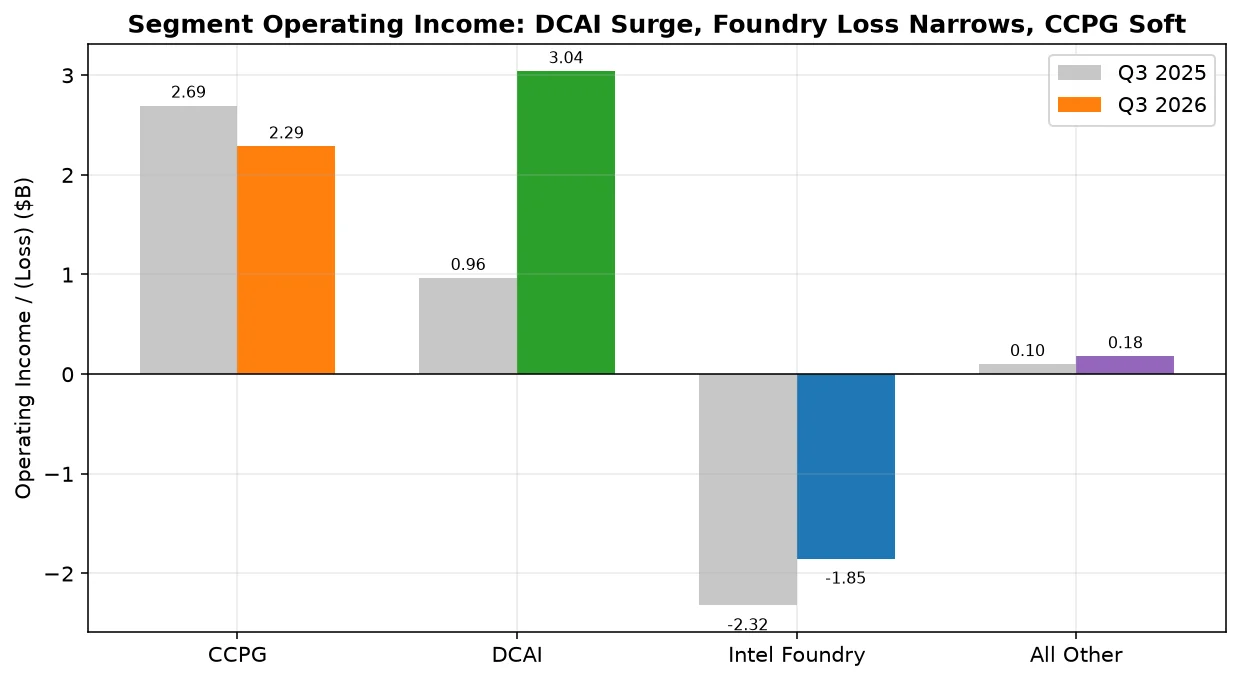
| Foundry op loss | $(1.853)B | PY $(2.321)B | Loss narrowed |
| Employees (Intel) | 76.5k | PY 83.3k | −6.8k YoY |
| Q4 revenue guide | $15.0–$16.0B | LSEG ~$17.1B (CNBC) | The kill shot |
| Q4 nGAAP EPS guide | $0.25 | LSEG ~$0.43 (CNBC) | Sharp miss vs Street |
| Q4 GAAP / nGAAP GM guide | 37.1% / 38.0% | vs Q3 43.0% / 44.1% | Sequential compression |
Trap 1: Celebrating the DCAI +78% screenshot without noticing CCPG is still ~$8.1B and guiding into a mid-20%+ sequential PC revenue contraction (management / Reuters). Trap 2: Reading GAAP EPS $0.60 as "earnings down" without separating share dilution from the equity raise, Escrowed Shares mark-to-market noise, and the Altera deconsolidation. Trap 3: Treating Q3's guide beat as proof of forecasting skill when management itself says the PC correction accelerated in the last two months and they are still aligning the manufacturing footprint.
3. Management Voice: Xeon Urgency, PC Through 1H, "Multiyear Journey"
CEO Lip-Bu Tan (IR release): "Our Q3 results demonstrate improving execution, meaningful progress expanding supply and continued advancement of our process technology… Despite near-term headwinds across the PC industry, demand for our CPUs remains robust… Our immediate priority is to unlock additional supply to meet extraordinary demand for our Xeon family…" On the call (Yahoo Finance paraphrase): "Rebuilding Intel is going to be a multiyear journey, and I remain firmly committed to making it happen."
CFO David Zinsner (IR release): "We delivered another solid quarter. Revenue, gross margin and earnings per share exceeded guidance, including our strongest data center revenue growth in 15 years… Looking ahead, we see the PC slowdown continuing at least through the first half of next year…"
Call / secondary texture that matters (Globe and Mail transcript excerpts; Reuters interview coverage):
- PC TAM framing: Intel expects 2026 PC unit TAM ~−12%, with 2H units down more than 20%; 2027 PC unit TAM ~−10%. Inventory correction heaviest in Q4 and Q1, maybe stretching into Q2.
- Server TAM: industry server CPU units >30% growth in 2026 and 2027—higher if supply were available.
- Israel fab incident: ~$600M revenue hit over two quarters; ~$300M in Q4 alone (CNBC / Reuters / Yahoo Finance). Zinsner told Reuters the company also cut Q4 revenue outlook by ~$300M and GM by ~200 bps related factors, with a similar hit expected in Q1.
- Cash flow / CapEx: not expecting positive full-year cash flow; ~$20B CapEx this year; 2027 tools spend rises as capacity is secured (Reuters).
- Client roadmap color: Panther Lake on Intel 18A ramp; Wildcat Lake demand outstripping supply; Nova Lake (18A-P) tracking ahead with design wins expected 2× Panther Lake at launch; more at CES.
Mechanism: Management is telling two true stories at once. Story A—Xeon demand is extraordinary and foundry process is advancing. Story B—the PC P&L is entering a memory-induced multi-quarter correction that the company did not fully see coming until "recent weeks." Friday priced Story B as the binding constraint.
4. DCAI vs CCPG: The Split Brain of the Print
DCAI is the bull exhibit. Revenue $7.318B (+78%) from $4.117B; operating income $3.039B from $0.964B. Product momentum language in the release—Oracle OCI multiyear Xeon collaboration (including Diamond Rapids / OCI X14), Intel GPU D-series (Crescent Island) at OCP, day-0 Muse Spark Open support, Hot Chips agentic architectures, AMD+Intel oneDNN PyTorch path—reads like a company trying to re-attach itself to the AI spend cycle without being a pure GPU name.
CCPG is the bear exhibit. Revenue $8.097B (−5%); operating income $2.285B vs $2.694B. CNBC notes the client line missed estimates even as DCAI jumped. Memory prices (AI data centers soaking DRAM/NAND) are pushing endpoint ASPs up and OEM sell-through down—Counterpoint's −4% global PC shipment print for Q2 was the early warning; Intel's own 2H unit language is far worse.
Intel Products in total still grew +22% to $15.415B because DCAI more than offset CCPG. That is exactly why pre-print bulls could celebrate—and why Friday's wipeout feels like a regime change: when the guide says PC revenue falls mid-20%+ sequentially into Q4, the mix math flips.
5. The Risk Ledger: Guidance Cliff, Memory, Supply, Dilution, Foundry Duration
| Risk | What we know | Why it matters |
|---|---|---|
| Q4 guide vs Street | Rev $15–16B vs ~$17.1B; nGAAP EPS $0.25 vs ~$0.43 (LSEG/CNBC) | Classic "beat and lower" kill shot |
| GM compression | Q4 GAAP/nGAAP GM 37.1% / 38.0% vs Q3 43.0% / 44.1% | ~600 bps sequential nGAAP hit; mix + Israel + underutilization |
| PC / memory | PC slowdown through ≥1H27; 2026 TAM −12%, 2027 −10% (mgmt) | Duration risk, not one-quarter noise |
| Server supply constraints | Substrates / manufacturing bottlenecks; Israel fab hit | DCAI can't fully monetize demand |
| Capacity misallocation | Too much PC, not enough server (Bernstein) | Structural execution doubt |
| Full-year cash burn | Not expecting +FCF for FY26; CapEx ~$20B, 2027 up (Reuters) | Equity duration of the rebuild |
| Share dilution | Diluted WASO 5.307B vs 4.531B; ~$23B equity offer; net proceeds ~$22.6B YTD | EPS math permanently reset |
| Gov Escrowed Shares MTM | GAAP EPS diluted adjusted for Escrowed Shares derivative; large YTD MTM in cash flow footnotes | Headline GAAP noise |
| Foundry proof still ahead | 14A PDK out; external customer traction debated (BofA) | Optionality ≠ bookings |
| Competitive share | AMD server share; products "not yet technically competitive" vs rivals growing 2–4× faster (BofA Arya via CNBC) | DCAI growth can still lose relative share |
The ledger's center of gravity is PC duration + guide credibility + manufacturing alignment, not whether DCAI grew. That is why a 15-year DC growth record coexisted with a 1974-style crash.
6. Long vs Short Debate (Named Sources)
The short / skeptic case (tape + PT cuts): Bernstein's Stacy Rasgon called the outlook "(in a word) terrible," cut his target to $75 from $110, and argued investors had glossed over PC while celebrating servers and foundry narrative—this was the quarter they "hit the wall," with manufacturing still misaligned (CNBC / Yahoo Finance). Bank of America's Vivek Arya downgraded to Neutral from Buy, PT $100 from $145, citing insufficient external foundry traction, PC shipments down 25–30% QoQ in Q4 with further 1H27 correction, and server products not yet competitive vs faster-growing rivals (CNBC). UBS Timothy Arcuri (Neutral, $80 from $100) said the guide was below even bearish expectations and saw no near-term memory relief. Goldman (Neutral, $100) expected the stock to trade "meaningfully lower." Wells Fargo Joe Quatrochi (Equal Weight, $80 from $120) and Barclays Tom O'Malley (Equal Weight, $75 from $100) echoed PC surprise and supply-held DCAI. Benzinga's roundup added Seaport Jay Goldberg (Buy→Neutral), DA Davidson Gil Luria (Neutral, $70 from $100), Cantor C.J. Muse (Neutral, $90 from $125), Rosenblatt Kevin Cassidy (Sell, $70 from $80). The tape's ~29% wipeout is the unanimous short argument in price form.
The long / rebuild case (management + residual Overweights): KeyBanc's John Vinh kept Overweight while cutting PT $155→$140 (Benzinga)—a reminder that not every desk abandoned the multiyear foundry / server scarcity thesis on one print. Management's own rebuttal is supply-constrained Xeon demand, Foundry revenue +58% with losses narrowing, 18A client roadmap (Panther / Nova Lake), Classiq quantum stack optionality, and a balance sheet reloaded by the $23B raise. The long mechanism: if memory normalizes slower than feared or server substrate relief lets DCAI convert the >30% industry unit growth into Intel billings, Friday's crash is a violent recalibration of PC duration—not a falsification of the rebuild.
Synthesis: Bears are not arguing DCAI is fake. They are arguing the equity story was priced as a server/foundry call option while the P&L is still a PC company in guidance, and that management's forecasting credibility just took another hit. Bulls are arguing the same crash reprices the option after a year of heroic multiple expansion—cash + STI ~$54B, Foundry loss narrowing, and Xeon urgency intact.
7. Side Plots: $23B Raise, Gov Stake, Altera, Classiq, Foundry PDK
Equity offering and liquidity. Intel completed a $23B public equity offering "to support future growth opportunities while maintaining a strong balance sheet and investment-grade rating." Q3 cash $21.846B, short-term investments $32.159B; PPE net $105.314B. Financing cash flows show net proceeds from the public offering of common stock ~$22.617B. Diluted share count jumped—EPS comparability is permanently altered.
U.S. government Escrowed Shares / CHIPS Secure Enclave. GAAP diluted EPS calculations adjust for mark-to-market on contingent Escrowed Shares tied to the DOC Secure Enclave agreement. Yahoo Finance notes Friday's drop shaved >$10B off the value of the U.S. government's ~9.9% stake (acquired ~$20.47/share context)—still worth multiples of cost even after the crash. This is political-narrative fuel, not Q4 EPS salvation.
Altera deconsolidation. Sale of 51% of Altera common stock on September 12, 2025 removed Altera from consolidation thereafter; "All Other" revenue $0.692B (−30%) partly reflects that perimeter change. Do not read All Other weakness as a pure Mobileye story without that footnote.
Classiq. Plans to acquire Classiq, combining quantum software synthesis with Intel's spin-qubit manufacturing/software stack—optionality for a "full-stack quantum" pitch. Nice for CES decks; not a Q4 bridge.
Foundry momentum checklist. Intel 14A 0.9 PDK released October; Lens Technology advanced packaging collaboration; RAMP-C Secure Enclave prototypes completed; ASML High-NA EUV readiness collaboration; Lam / Applied Materials facility collaborations. Revenue $6.697B (+58%), op loss $(1.853)B vs $(2.321)B. Progress is real; external customer bookings proof remains the Street's ask (BofA).
8. Braided Thesis
Intel Q3 2026 is a dual-track company colliding with a single-track multiple. Track one—DCAI +78%, Foundry +58% with narrowing losses, Xeon supply urgency, 18A client roadmap—is the turnaround the 2025–26 rally paid for. Track two—CCPG −5% accelerating into a memory-driven multi-quarter PC correction, Q4 guide ~$1.6B light of Street revenue and ~$0.18 light of Street nGAAP EPS, GM compressing ~600 bps sequentially, full-year cash still set to burn—is what Friday priced.
The braided read: this was not a demand collapse in data center; it was a credibility and mix-duration event. Management beat its own Q3 guide and still lost the room because the Q4 bridge admitted the PC inventory washout and the Israel supply shock at the same time the stock was priced for uninterrupted server/foundry compounding. Dilution from the $23B raise makes every EPS print harder; Escrowed Shares MTM makes GAAP noisier; neither changes the industrial question—can Intel realign wafers toward servers fast enough while PC TAM shrinks into 2027?
For Alphio readers thinking in copy-trade / budget terms: INTC after a ~29% day is no longer the "AI foundry momentum" ticker it was in June. It is a high-beta execution name where position sizing has to respect guidance volatility, memory-cycle duration, and the fact that named desks just reset PTs into the $70–$100 band (CNBC / Benzinga). The DCAI chart is still the bull screenshot. The Q4 guide table is still the bear screenshot. Both are true.
9. Falsifiable Watchpoints
- Q4 revenue print vs $15.0–$16.0B guide — a clear beat toward the high end with GM better than 38% nGAAP would argue Israel + PC inventory were over-discounted; a miss below $15B re-opens downside.
- CCPG sequential trajectory into Q1 — management flagged Q4/Q1 as peak inventory correction; if CCPG keeps mid-20%+ declines into spring, the "through 1H" language becomes "through 2027."
- DCAI supply relief — substrate / Israel recovery that lets DCAI re-accelerate would validate the >30% server unit industry call as an Intel billings story, not just an industry TAM story.
- External foundry commitments — named volume customers / 14A design-win disclosures are the falsifier for the BofA "not enough traction" critique.
- Memory price / availability normalization markers — OEM commentary (Dell/HP already sold off with INTC) and DRAM contract prints; without relief, Intel's −10% 2027 PC TAM plan is the base case.
- Adjusted FCF path vs CapEx — if 2027 CapEx steps up while Adj FCF stays thin, the $23B raise was bridge financing, not a permanent fix.
- Competitive server share vs AMD — DCAI can grow 78% and still lose relative narrative if rivals grow 2–4× faster (Arya's framing).
- CES / Nova Lake design-win math — management's "2× Panther Lake" claim is a dated checkpoint; miss it and the client roadmap premium compresses again.
Sources: Intel Corporation Q3 2026 IR press release & financial statements (Oct 29, 2026, Business Wire / intc.com); CNBC (Oct 29–30, 2026) for LSEG consensus and analyst PT table; Yahoo Finance (Oct 30, 2026) for ~29% drawdown / historical ranking; Reuters via StreetInsider for cash-burn / Israel / CapEx color; Globe and Mail transcript excerpts for TAM and inventory commentary; Benzinga for additional PT cuts. This article is independent research commentary for Alphio readers, not investment advice.
FAQs
What is the main takeaway of “Intel Q3 2026 Deep Dive: DCAI +78% Couldn't Save a Guidance ”?
After the close on October 29, 2026, Intel (NASDAQ: INTC) handed Wall Street a print that should have felt like a turnaround chapter: **revenue $16.5B (+2…
Related articles
- Stock Market Surges After 2026 Midterms: What the Democratic Sweep Means for Your PortfolioThe stock market rallied after Democrats won the 2026 midterms. Discover what the election means for investors, tech stocks, and the S&P 500 outlook.
- Stock Market Surges After 2026 Midterms: What the Democratic Sweep Means for Your PortfolioThe stock market rallied after Democrats won the 2026 midterms. Discover what the election means for investors, tech stocks, and the S&P 500 outlook.
- Oil Prices Surge Above $105 Amid US-Iran Conflict: Energy Investment Opportunities in November 2026Oil prices climb past $105 as US strikes Iran's Qeshm Island. Discover energy investment opportunities, top oil stocks, and market outlook for November 2026.
- Gold Price Forecast August 2026: Fed Policy, Central Bank Demand & Expert Price TargetsGold price forecast for August 2026: Expert analysis of Fed rate policy impact, central bank buying, inflation hedge demand, and price targets from $4,500 to $6,300.
- NVIDIA Earnings August 2026: Record $96.2B Revenue Signals Unstoppable AI Infrastructure BoomNVIDIA reports record $96.2B revenue with $89B data center sales. Analysis of Blackwell chip demand, AI infrastructure spending, and NVDA stock investment outlook for 2026.
- Gold Price Forecast 2026: Will It Hit $5,000 Amid Fed Uncertainty and Central Bank Demand?Gold price forecast 2026: Analysts predict $4,900-$5,000 targets as central bank buying and inflation hedge demand drive precious metals higher. Investment strategies inside.