

How to Size Stops and Max Drawdown When Copy Trading
Learn how to size stops and max drawdown for crypto copy trading: per-trade risk, per-lead budgets, portfolio circuit breakers, and cooling-off rules.

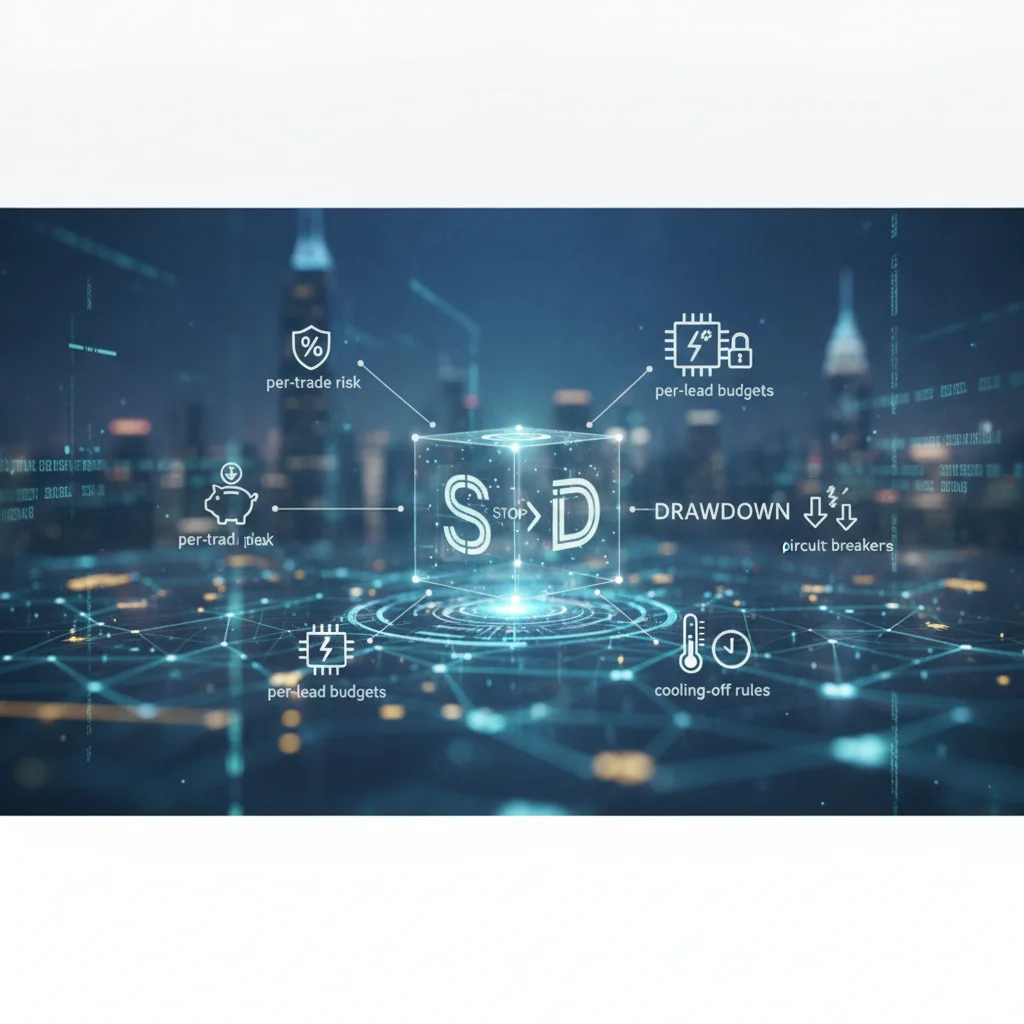
Key Takeaway
Stops and max-drawdown rules are how copy traders survive strategies that are “usually right.” Without them, a follower inherits a lead’s convictions without inheriting the lead’s bankroll or emotional resilience. Social trading interfaces make entry effortless; they rarely force you to pre-commit to the loss that ends the experiment. That pre-commitment is the product.
This checklist covers how to size stops and max drawdown when copy trading: per-trade risk, per-lead loss budgets, portfolio drawdown circuit breakers, cooling-off periods, and the operational details that make stops real rather than decorative. It assumes you may be mirroring perps where funding, leverage, and liquidation mechanics can turn a soft mental stop into a hard account event.
Separate three layers of loss control
Per-trade stops
A per-trade stop answers how wrong a single mirrored idea can be. Where the platform allows, require stops on entries—especially if margin is cross or “like the trader.” Educational copy settings sometimes refuse to start a cross-margin copy without a stop for exactly this reason. Even on isolated margin, a stop converts a vague discomfort into a defined risk amount that should match your sizing math.
Do not move stops because the lead “always comes back.” If you sized for one R of risk, widening the stop silently increases R. That is a new trade.
Per-lead loss budgets
A lead can be broadly right and still be wrong for your sleeve if losses cluster. Set a cumulative loss budget for each relationship—often framed in educational material as a few percent of portfolio or a streak-based pause after consecutive losers. When the budget trips, pause new copies even if lifetime ROI still looks impressive. Lifetime ROI is how loyalty sneaks past risk policy.
Portfolio max drawdown
Portfolio drawdown handles the correlated failure mode: several leads lose together in the same tape. Choose a maximum drawdown for the copy book and a cooling-off period after it trips. Conservative educational examples discuss pauses after roughly ten to twenty percent copy-book drawdowns; your number should be the one you will actually obey. The pause is mandatory. Immediate re-entry to “earn it back” is how people graduate from a controlled drawdown to an uncontrolled spiral.
Sizing stops so the numbers rhyme
Risk per trade as a fraction of sleeve
Decide the dollars you are willing to lose on a typical mirrored trade. Back into position size from that stop distance rather than from the lead’s raw size. If the lead’s stop is wide in percent terms, your notional must shrink. If the product cannot set an independent stop, your only real stop may be the relationship budget and the portfolio breaker—so those must be tighter.
Leverage makes soft stops fake
High leverage can liquidate you before a discretionary stop is honored, especially in gaps and liquidation cascades. Independent leverage caps are part of stop design. So is margin mode. Isolated margin keeps a disaster more local. Cross margin turns one failed mirror into a wallet event. Choose consciously.
Making drawdown rules operational
Measure what you will actually check
Define whether drawdown includes unrealized marks, how often you compute it, and what “pause” means—no new entries, flatten all, or flatten only the offending lead. Ambiguity is how people talk themselves into staying live. Write the definition beside the number.
Automate the review, humanize the re-enable
Use Alphio Scheduled Task to force a drawdown check on a cadence. Re-enabling after a breaker should require a short written post-mortem in Alphio Conversational Trading: what failed, what changes, what new cap applies. If you cannot write it, you are not ready to turn risk back on.
Bind the practical ceilings when you follow on Alphio Copy Trade and when you run agents on Alphio Autonomous Trading.

Special cases: missing copies and asymmetric stops
Sometimes your stop matters more because you did not receive the lead’s winning add or early exit. Follower equity curves diverge. Design stops for your fills, not for the lead’s ideal path. If divergence is chronic, reduce size or unfollow—do not “compensate” by widening risk.
Funding on perps can also bleed accounts that are directionally correct. A stop system that ignores funding will overstate how much pain a hold can tolerate. Include funding in weekly reviews when mirroring perps.
Behavioral failure modes
The two classic failures are moving stops and resetting drawdown clocks after a partial recovery. Both feel reasonable in the moment. Both convert a risk system into a story. If you need discretion, schedule a rules meeting while flat, not while underwater. Social feeds will not help; they are optimized for courage, not for capital preservation.
Keep agent drawdown halts on Alphio
Field notes from followers who learned the hard way about size stops max drawdown copy trading
The most expensive lessons in crypto automation rarely come from a single bad tick. They come from missing controls that looked optional during a calm onboarding. Someone funded a hot sleeve without a revoke drill. Someone raised a budget after three green days. Someone treated a leaderboard as a due-diligence report. Someone kept a lead through style drift because lifetime ROI still sparkled. Each story is specific; the pattern is identical: evidence was replaced by narrative at the moment capital scaled.
You can interrupt that pattern with ceremony that feels almost bureaucratic. Before every increase in size related to size stops max drawdown copy trading, require two artifacts: a one-page note of what changed since the last review, and a dust-sized test that proves the control you think you have still works. If either artifact is missing, the increase does not happen. Alphio’s Scheduled Task surface exists to make the ceremony recur, and Conversational Trading exists to make the note attach to the same place you act.
How this checklist connects to Alphio workflows
Checklists fail when they live only in blog tabs. They work when they become defaults in the product path you actually click. For followers, that usually means evaluating a lead, binding a budget, then mirroring—not mirroring first. For agent users, it means external caps before autonomy theater. Use Alphio Copy Trade when the object is a vault, whale, or followable strategy, and Alphio Autonomous Trading when the object is an agent loop that must be fenced.
Apply the checklist in Alphio Copy Trade
Fence agents in Alphio Autonomous Trading
Keep liquid market context honest while you do it. Crypto-sensitive equities such as
and
will not manage your risk for you, but they will remind you that beta clusters. If your notes on size stops max drawdown copy trading ignore that clustering, your diversification claims are probably cosmetic.
A thirty-day adoption plan you can actually finish
Week one: write the one-pager and run dust drills only. No scaling. Week two: allow a tiny live sleeve under the strictest caps you wrote, and log every reject or skip. Week three: compare your fills and drawdowns to the thesis; demote anything that drifted. Week four: decide whether to promote, hold, or kill—then schedule the next monthly review before you celebrate. The plan is deliberately slow. Speed is how social trading apps sell. Slowness is how educational capital survives.
If you skip weeks, do not “catch up” by jumping to week four size. Restart at the last honest week. Ambition is cheap; repaired process is not. Store the week-four decision where you will see it again, ideally beside an Alphio reminder via Scheduled Task.
Questions to ask support before you increase size
Ask where funds sit overnight, how to revoke trading permissions, what happens on engine outages, how skipped copies are surfaced, whether profit share and fees are netted in displayed ROI, and how to flatten without the happy-path UI. Write the answers into your size stops max drawdown copy trading file. If support cannot answer without delay or deflection, treat that as a soft veto on scaling. Good teams are boringly specific. Vague poetry is a risk factor.
Also ask what changed in the last ninety days: custody model, fee schedule, margin defaults, or authorization scope. Quiet changes are where yesterday’s checklist becomes today’s false comfort. A quarterly diff review is as important as the initial review.
Closing synthesis before the formal conclusion
By now the through-line should be obvious. Whether the page title centers on size stops max drawdown copy trading or on a neighboring evaluation theme, durable copy and agent trading is a stack: custody, budgets, sizing, stops, fees, and unfollow rules. Removing one layer does not make you agile; it makes you leveraged to a single point of failure. Prefer products and habits that make the stack visible. Prefer Alphio paths that bind capital to limits before narratives get loud.
If a friend forwards a perfect curve tomorrow, you already know the response: open the checklist, run the drills, and only then discuss size. That response is the entire educational edge available to most retail followers.
Another practical reminder on size stops max drawdown copy trading: after any platform incident in the wider market—an exchange outage, a bridge failure, a sudden venue rule change—re-run your revoke and withdraw drills even if your own stack seemed fine. Contagion often shows up as stuck exits and confused support queues. Cap size first, ask questions second.
Another practical reminder on size stops max drawdown copy trading: after any platform incident in the wider market—an exchange outage, a bridge failure, a sudden venue rule change—re-run your revoke and withdraw drills even if your own stack seemed fine. Contagion often shows up as stuck exits and confused support queues. Cap size first, ask questions second.
Another practical reminder on size stops max drawdown copy trading: after any platform incident in the wider market—an exchange outage, a bridge failure, a sudden venue rule change—re-run your revoke and withdraw drills even if your own stack seemed fine. Contagion often shows up as stuck exits and confused support queues. Cap size first, ask questions second.
Another practical reminder on size stops max drawdown copy trading: after any platform incident in the wider market—an exchange outage, a bridge failure, a sudden venue rule change—re-run your revoke and withdraw drills even if your own stack seemed fine. Contagion often shows up as stuck exits and confused support queues. Cap size first, ask questions second.
Another practical reminder on size stops max drawdown copy trading: after any platform incident in the wider market—an exchange outage, a bridge failure, a sudden venue rule change—re-run your revoke and withdraw drills even if your own stack seemed fine. Contagion often shows up as stuck exits and confused support queues. Cap size first, ask questions second.
Another practical reminder on size stops max drawdown copy trading: after any platform incident in the wider market—an exchange outage, a bridge failure, a sudden venue rule change—re-run your revoke and withdraw drills even if your own stack seemed fine. Contagion often shows up as stuck exits and confused support queues. Cap size first, ask questions second.
Another practical reminder on size stops max drawdown copy trading: after any platform incident in the wider market—an exchange outage, a bridge failure, a sudden venue rule change—re-run your revoke and withdraw drills even if your own stack seemed fine. Contagion often shows up as stuck exits and confused support queues. Cap size first, ask questions second.
Another practical reminder on size stops max drawdown copy trading: after any platform incident in the wider market—an exchange outage, a bridge failure, a sudden venue rule change—re-run your revoke and withdraw drills even if your own stack seemed fine. Contagion often shows up as stuck exits and confused support queues. Cap size first, ask questions second.
Conclusion
Size stops from intended dollar risk, enforce per-lead loss budgets, and install a portfolio drawdown breaker with a real pause. Leverage caps and margin mode are part of the stop system. Re-enable only with a written post-mortem.
Put the layers into Alphio via capped follows on Alphio Copy Trade and halt-capable agents on Alphio Autonomous Trading. Survival is a feature. Everything else is optional.
FAQs
What is the difference between a stop-loss and a max drawdown rule?
A stop-loss limits loss on a trade or position. A max drawdown rule limits cumulative portfolio or sleeve loss and usually pauses new risk until review.
Should I use the lead trader’s stop distance?
Not blindly. Use a stop that matches your dollar risk budget. If the lead’s stop is wide, shrink notional instead of accepting larger dollar risk.
Why pause after a drawdown instead of trading to recover?
Immediate recovery trading often increases risk exactly when process quality is worst. A cooling-off period forces review before new exposure.
Do I need stops if I use isolated margin?
Isolated margin limits blast radius but does not define your intended risk. Stops and loss budgets still keep losses planned rather than accidental.
How can Alphio help with drawdown discipline?
Alphio supports budget-capped copy and agent workflows plus scheduled and conversational reviews for breaker trips and re-enable decisions.
Related articles
- How to Rebalance a Concentrated Stock Portfolio in 2026: Mag7 Drift, Tax-Aware Trims, and Practical Rebalance a concentrated stock portfolio in 2026: Mag7 drift risk, 5pp bands, tax-aware trims, RSP/IWM diversifiers, and single-name caps.
- Small Cap Stocks Investing Guide 2026: Russell 2000, Fed Hikes, and the Financing TradeSmall-cap stocks investing guide 2026: Russell 2000 vs S&P, IWM rate sensitivity, floating-rate debt, Fed hikes, valuation discounts, and a practical checklist.
- Santa Claus Rally and the Year-End Stock Market: Investor Guide for Late 2026Santa Claus rally explained: 7-day window stats since 1950, Nov–Dec seasonality, post-midterm 2026 setup, and a risk-managed year-end investing playbook.
- SpaceX Private Valuation Soars: Inside the $1 Trillion Space Economy AmbitionSpaceX's debut earnings reveal massive potential. Explore the private space market valuation, investment opportunities, and industry trends reshaping aerospace.
- Federal Reserve Interest Rate Decision August 2026: Market Impact and Investment StrategyAnalyze the Federal Reserve's August 2026 interest rate decision. Discover investment strategies for navigating the stock market in the current rate environment.
- Broadcom Stock Analysis: Why AVGO's AI Chip Dominance Could Drive 35% UpsideComprehensive Broadcom stock analysis for August 2026. Explore AVGO's AI semiconductor growth, custom chip demand, and why analysts see 35% upside potential.