

Required Minimum Distributions in a Down Market: How to Take Your 2026 RMD Without Selling Low
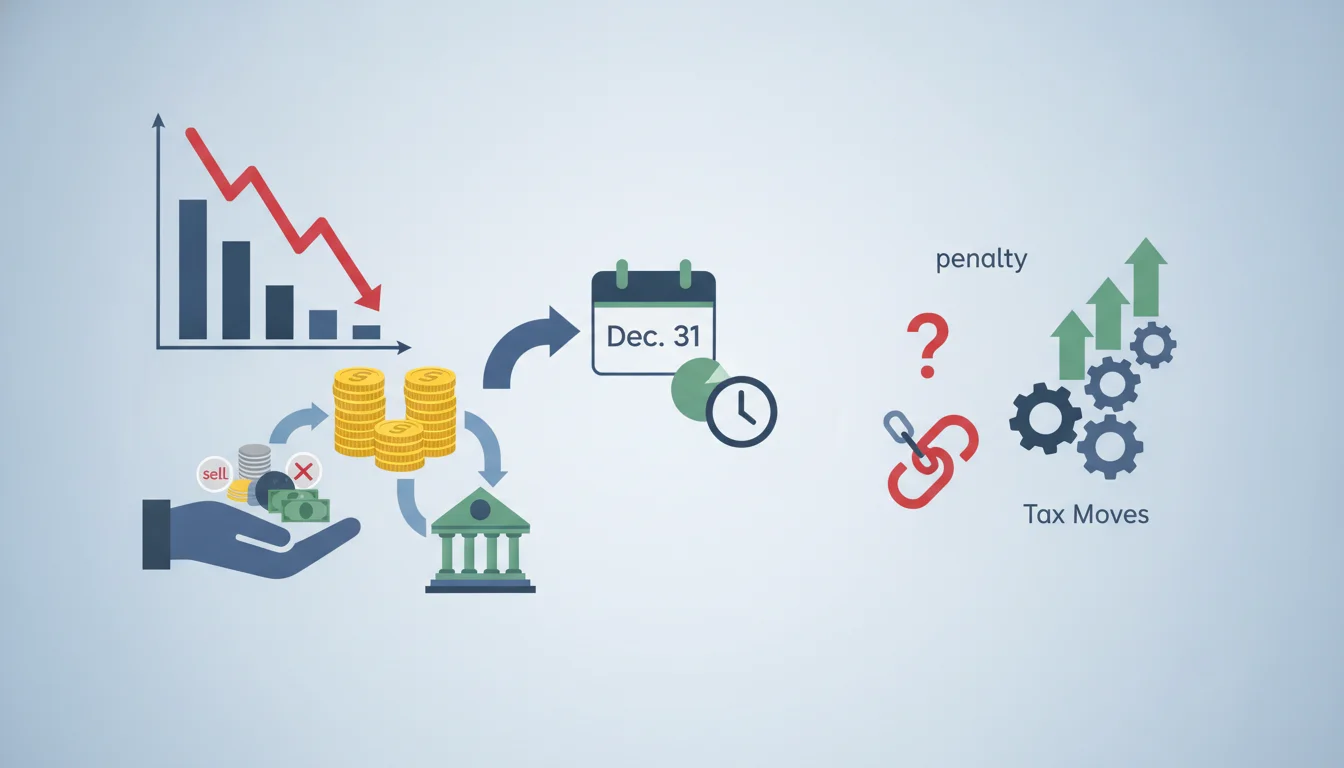
How to take required minimum distributions in a down market in 2026: what to sell, in-kind RMDs, QCDs, the Dec. 31 deadline, penalties, and tax moves to use.

Key Takeaway
Required minimum distributions do not wait for a better market. If you are 73 or older and own a traditional IRA, 401(k), or 403(b), the Internal Revenue Service expects your 2026 withdrawal to be completed by December 31, 2026, regardless of how stocks have behaved since the summer. After a volatile autumn marked by a Federal Reserve that raised its target range to 3.75%–4.00% in September and a sharp sell-off in technology shares, many retirees are facing a familiar December question: what should I sell to satisfy my RMD when prices are lower than they were a few months ago?
The good news is that an RMD is a tax rule, not an order to sell stocks at the bottom. The IRS requires a dollar amount to leave the tax-deferred account, but it does not dictate which holdings you sell, and it does not require you to spend the money or abandon the market. Retirees can draw from cash and short-term bonds, transfer shares in kind to a taxable account, give directly to charity through a qualified charitable distribution, or combine these approaches. Each choice has different consequences for taxes, rebalancing, and how much stock exposure you keep.
This guide explains how the 2026 RMD is calculated, why a falling market makes this year's withdrawal feel larger, and the practical strategies that let investors meet the deadline without turning a paper loss into a permanent change in their plan. It is educational, not tax or investment advice, and anyone with a complex situation should confirm the details with a tax professional or their account custodian.
How the 2026 RMD Is Calculated
The prior year-end balance sets the number
The formula is simple. According to the IRS required minimum distribution FAQs, each account's RMD equals the prior December 31 balance divided by a life expectancy factor. For 2026, that means the account value on December 31, 2025, not today's value, determines how much must come out. The S&P 500 finished 2025 at roughly 6,845, according to year-end market reports from Yahoo Finance and ABC News, capping a gain of about 16% for the year. Many retirees therefore entered 2026 with balances near record levels, and their 2026 RMDs were locked in at those higher values.
Most IRA owners use the Uniform Lifetime Table in IRS Publication 590-B. The divisor is 26.5 at age 73, 24.6 at age 75, 20.2 at age 80, and 16.0 at age 85. Someone who was 75 in 2026 with $1,000,000 in IRAs at the end of 2025 would owe about $40,650 this year. Account owners whose spouse is the sole beneficiary and is more than ten years younger use a different joint-life table, which produces smaller required amounts.
Why a falling market makes the RMD feel bigger
Because the amount is fixed from last year's balance, any decline during the year raises the RMD as a percentage of what you hold today. In the example above, if that $1,000,000 portfolio had slipped to $900,000 by late November, the $40,650 withdrawal would equal about 4.5% of the current balance instead of about 4.1%. The dollar figure has not changed, but the share of the portfolio leaving the tax shelter is larger.
This is the core reason down-market RMDs sting. Retirees are effectively asked to withdraw based on a richer valuation than they can sell at today. That does not make the rule unfair, since the account also grew in strong years, but it explains why the choice of which assets to liquidate matters more after a correction than after a calm year.
Who must take a distribution this year
Under current law, RMDs generally begin at age 73 for people born from 1951 through 1959, and SECURE 2.0 pushes the starting age to 75 for those born in 1960 or later, according to summaries from Mercer and Kitces. The first RMD can be delayed until April 1 of the year after you reach the starting age, but every later distribution is due by December 31. That creates a trap: people who turned 73 in 2025 and deferred their first RMD to April 1, 2026, still owe a second distribution by December 31, 2026, which can push two years of income into one tax return.
Roth IRAs are exempt during the owner's lifetime, and the IRS confirms that designated Roth accounts inside 401(k) and 403(b) plans are no longer subject to RMDs while the owner is alive. Inherited accounts follow separate beneficiary rules, so heirs should check the IRS beneficiary guidance rather than assume the owner's schedule applies.
The Deadline Is Fixed and the Penalty Is Real
No market-relief waiver has been announced for 2026
Congress has suspended RMDs before. The CARES Act waived required distributions for 2020 during the pandemic crash, and lawmakers did the same for 2009 after the financial crisis. Nothing comparable has been enacted for 2026. Investors should not plan around a waiver that does not exist. If relief ever appears, it would come through legislation or official IRS guidance, and it would be widely reported.
The 25% excise tax and how to shrink it
Missing the deadline is expensive. The IRS states that an RMD shortfall is subject to an excise tax of 25%, reduced to 10% if the distribution is timely corrected, generally within two years. The tax is reported on Form 5329, and the IRS may waive it for reasonable error if you take the missed amount and attach an explanation. Even the reduced rate is a poor trade for avoiding a few weeks of market exposure, so the deadline should be treated as firm.
Custodian cutoffs arrive before December 31
The legal deadline is the last day of the year, but brokerages often set earlier internal cutoffs for processing distributions, especially in-kind transfers and requests that require paperwork. Markets are also closed on December 25, and the weeks around the holidays bring thin trading. Retirees who wait until the final days risk a processing delay or an in-kind transfer whose value moves while the request is pending. Requesting the distribution in early-to-mid December is a sensible buffer.
Where to Take the Money From
Aggregation rules give IRA owners flexibility
The IRS lets IRA owners calculate the RMD for each traditional IRA separately and then withdraw the combined total from any one or more of those IRAs. Owners of multiple 403(b) contracts can do the same across their contracts. Workplace 401(k) plans are stricter: each plan's RMD must be satisfied from that plan. This flexibility is valuable in a down market. If one IRA holds a cash reserve or a bond ladder and another holds a stock fund that has fallen, the entire IRA requirement can come from the account with the cash.
Start with cash, T-bills, and short-term bonds
The most straightforward approach is to keep one to two years of expected withdrawals in cash-like holdings inside the IRA, often called a cash bucket. With the Fed's policy rate near 4%, short-term Treasury bill funds and money market funds have paid meaningful income while investors waited, which lowered the cost of holding that reserve. When the RMD comes due, the cash bucket funds it, and stocks that have fallen are left alone to recover.
Investors who did not build a reserve can still look first at the holdings that have held up best. In many 2026 portfolios, short-duration bonds and defensive positions will have declined less than growth stocks, so selling them first also nudges the portfolio back toward its target allocation.
Use the RMD as a rebalancing tool
A useful way to frame the decision is to compare current weights with target weights and sell whatever is overweight. If stocks have fallen and now sit below target, the withdrawal should come from bonds or cash. If a concentrated position, such as a single technology stock that ran up earlier in the year, remains above its intended weight even after a pullback, the RMD is an efficient moment to trim it, because the sale inside an IRA triggers no capital gains tax. Only the distribution itself is taxed as ordinary income.
In-Kind Distributions: Meeting the RMD Without Selling
How an in-kind transfer works
The IRS requires that value leave the account, not that it arrive as cash. Custodians such as Schwab and Fidelity allow investors to satisfy an RMD by moving shares from the IRA directly into a taxable brokerage account. The fair market value of the shares on the distribution date counts as taxable income, just as a cash withdrawal would, and that same value becomes the new cost basis in the taxable account, according to Schwab's guidance on in-kind distributions.
The appeal in a down market is obvious. Instead of selling a quality holding near a low and buying it back later, the investor keeps the same shares and the same market exposure, simply in a different account. If the stock recovers, the gain above the new basis is eventually taxed at capital gains rates rather than as ordinary income inside the IRA.
Choosing which shares to move
In-kind transfers work best with holdings the investor intends to keep for years, such as broad index funds or established dividend payers. A long-held dividend stock like Johnson & Johnson is the type of position some retirees prefer to move intact rather than sell, though any specific holding should be judged on its own valuation and role in the portfolio.
Two practical cautions apply. First, share prices move between the request and the transfer, so the value received can land slightly below the required amount; many advisors transfer a little extra or follow up with a small cash distribution to cover any shortfall. Second, keep the Form 1099-R, because the distribution value reported there anchors the cost basis you will use when you eventually sell.
The tax bill still has to be paid
An in-kind distribution does not avoid income tax, and because no cash leaves the account, there is no cash available for withholding unless you arrange it. Investors often pair the share transfer with a smaller cash distribution earmarked for federal withholding, or set aside cash from a taxable account to cover the bill. Ignoring this step is the most common way an elegant in-kind strategy turns into an unexpected April payment.
Qualified Charitable Distributions
Giving directly from the IRA
For charitably inclined retirees, a qualified charitable distribution is the most tax-efficient way to meet an RMD. IRA owners aged 70½ or older can send money directly from the IRA to an eligible charity, and the amount counts toward the RMD while being excluded from taxable income. The annual QCD limit is $111,000 per person for 2026, up from $108,000 in 2025, after an inflation adjustment under SECURE 2.0, as reported by Kiplinger and other outlets.
The exclusion matters beyond the headline tax rate. Because a QCD never appears in adjusted gross income, it can help keep retirees below thresholds that affect the taxation of Social Security benefits and the income-related surcharges on Medicare premiums. That is a benefit itemized charitable deductions cannot replicate.
Mechanics and pitfalls
The money must go straight from the IRA custodian to the charity; a check made out to the owner and then donated does not qualify. Donor-advised funds and private foundations are not eligible recipients. Timing also matters, because the QCD must be completed by December 31 to count for 2026, and charities sometimes cash checks slowly. Investors should get a written acknowledgment from the charity and tell their tax preparer, since the custodian's Form 1099-R generally does not identify the distribution as a QCD.
Smart Tax Moves Around a Down-Market RMD
Withholding as a substitute for estimated payments
Retirees with income from pensions, Social Security, and taxable investments often owe quarterly estimated payments. A widely used planning technique, described by Kitces and Kiplinger, is to withhold federal tax from a year-end RMD instead. Withholding is generally treated as paid evenly through the year, so a large December withholding can cover tax that would otherwise have been due in earlier quarters. Estimated payments, by contrast, count only when made.
Pairing the RMD with Roth conversions
An RMD cannot be converted to a Roth IRA, and the IRS is explicit that RMD amounts cannot be rolled into another tax-deferred account. The first dollars distributed in a year count toward the RMD, so a conversion only makes sense after the RMD is satisfied. Once it is, a down market can make conversions more appealing, because the same number of shares moves to the Roth at a lower taxable value. The trade-off is a higher tax bill this year, so the decision should be modeled against your expected future brackets.
Don't overlook taxable accounts and spending needs
An RMD has to leave the IRA, but it does not have to be spent. After taxes, the cash can be reinvested in a taxable account, including in the same assets that were sold. Retirees who do not need the income can use the RMD to fund a taxable portfolio aimed at long-term growth, an emergency reserve, or gifts to family. The key is to decide in advance, so that the withdrawal supports the plan instead of reacting to the latest headlines.
Building a Repeatable RMD Process for Future Years
Take distributions on a schedule
Many retirees take the entire RMD in December, which concentrates market risk into a single date. Spreading distributions monthly or quarterly smooths out the price at which assets are sold and makes cash flow more predictable. Others take the RMD early in the year and reinvest whatever they do not spend. Neither approach beats the other in every market, but a written schedule removes the temptation to make emotional decisions during a sell-off.
Investors who want reminders to review balances, rebalance, or check that distributions have posted can automate those check-ins with Alphio Scheduled Task workflows, which run recurring market and portfolio checks on a calendar you set. The tool supports the process; it does not replace the custodian's paperwork or a tax professional's review.

Keep a cash bucket refilled
A cash reserve only protects you if it is replenished. A common rule is to refill the bucket in years when stocks are near highs, harvesting gains inside the IRA and parking them in Treasury bills or short-term bond funds. That way, the next correction finds the RMD already funded. The discipline is the hard part, since refilling means selling winners when optimism is highest.
Coordinate across accounts and beneficiaries
RMD planning is easier when all accounts are visible in one place. Consolidating multiple IRAs at a single custodian can simplify aggregation, and reviewing beneficiary designations alongside the annual RMD helps heirs avoid surprises. Spouses with separate IRAs each have their own RMD, which cannot be satisfied from the other spouse's account.
Conclusion
A down market does not change the RMD deadline, but it does change which decisions matter. The 2026 requirement was fixed by your December 31, 2025 balances, so the task now is to meet it at the lowest long-term cost. Drawing from cash and bonds first, using the withdrawal to rebalance, moving shares in kind, and directing gifts through qualified charitable distributions all let retirees satisfy the IRS without abandoning investments that have temporarily fallen. Act before custodian cutoffs, keep records of every transfer, and remember that withdrawn money can be reinvested in a taxable account.
For investors who want to turn this into a habit, Alphio offers tools that support a rules-based routine. Scheduled Task can run recurring reviews of allocations and market conditions, and Conversational Trading lets you ask plain-English questions about holdings and market moves before you decide what to sell or move in kind. Use them after you have written down your withdrawal plan and risk limits, and confirm any tax-sensitive move with a qualified professional.
FAQs
Do I still have to take my RMD if the stock market is down in 2026?
Yes. No market-related RMD waiver has been enacted for 2026, so required distributions from traditional IRAs and workplace plans are still due by December 31, 2026. The amount is based on your December 31, 2025 balance, not today's value.
How is my 2026 required minimum distribution calculated?
Divide each account's December 31, 2025 balance by the life expectancy factor from the IRS Uniform Lifetime Table, such as 26.5 at age 73 or 24.6 at age 75. IRA owners can add up the RMDs from all their IRAs and take the total from any of them.
Can I take my RMD in stock instead of selling?
Yes. Many custodians allow in-kind distributions that move shares from the IRA into a taxable account. The shares' fair market value on the transfer date is taxed as ordinary income and becomes your new cost basis.
What happens if I miss the RMD deadline?
The IRS can impose a 25% excise tax on the amount not withdrawn, reduced to 10% if you correct the shortfall within the correction window. You report it on Form 5329 and may request a waiver for reasonable error.
Can a qualified charitable distribution satisfy my RMD?
Yes. If you are 70½ or older, a QCD sent directly from your IRA to an eligible charity counts toward your RMD and is excluded from taxable income. The limit is $111,000 per person for 2026.
Related articles
- Stop-Loss Orders in a Volatile Market: How to Set Stops Without Getting Whipsawed in 2026How stop-loss, stop-limit and trailing stop orders really work when the VIX is near 36, plus how to set stops, avoid gaps and whipsaws, and size positions.
- How to Buy the Dip in the 2026 Stock Market Correction Without Guessing the BottomHow to buy the dip in the November 2026 stock market correction: what history says, why a hiking Fed changes the math, and how to stage purchases safely.
- PCE Inflation Report and the Stock Market: What the Fed's Preferred Gauge Means in a CorrectionThe PCE inflation report lands Nov 25 amid a stock correction and Fed hike talk. Learn PCE vs CPI, what to watch, and how stocks, sectors and bonds react.
- Nvidia Stock August 2026: Why Analysts Predict a Major BreakoutNvidia stock could skyrocket in August 2026. Discover why analysts are bullish, with $500B in AI chip bookings and demand outpacing supply 12-to-1.
- Nuclear Energy Stocks: The Hidden Gem of Clean Energy Investment in 2026Discover why nuclear energy stocks are surging in 2026. Learn about NuScale Power (SMR), Oklo (OKLO), and emerging opportunities in the clean energy sector.
- Tesla Stock Analysis August 2026: Navigating the EV Market's Next ChapterIn-depth Tesla stock analysis for August 2026. Explore TSLA price trends, EV market growth, and investment strategies. Expert insights on Tesla's future.