

Stop-Loss Orders in a Volatile Market: How to Set Stops Without Getting Whipsawed in 2026
How stop-loss, stop-limit and trailing stop orders really work when the VIX is near 36, plus how to set stops, avoid gaps and whipsaws, and size positions.

Key Takeaway
A stop-loss order is one of the simplest risk tools an investor can use, and in a market like this one it is also one of the easiest to misuse. On Friday, November 20, 2026, the S&P 500 fell 3.70% to 6,910.39, the Nasdaq Composite dropped 5.28% to 22,617.73, and the Cboe Volatility Index jumped 26.2% to 35.89, according to The Closing Print's post-market summary. Nvidia alone fell 14.0% to $125.53 as reports of an SEC accounting probe added to an AI-led unwind. When single sessions move that much, a stop placed a few percent below the last price is not a safety net so much as a coin flip on where it will fill.
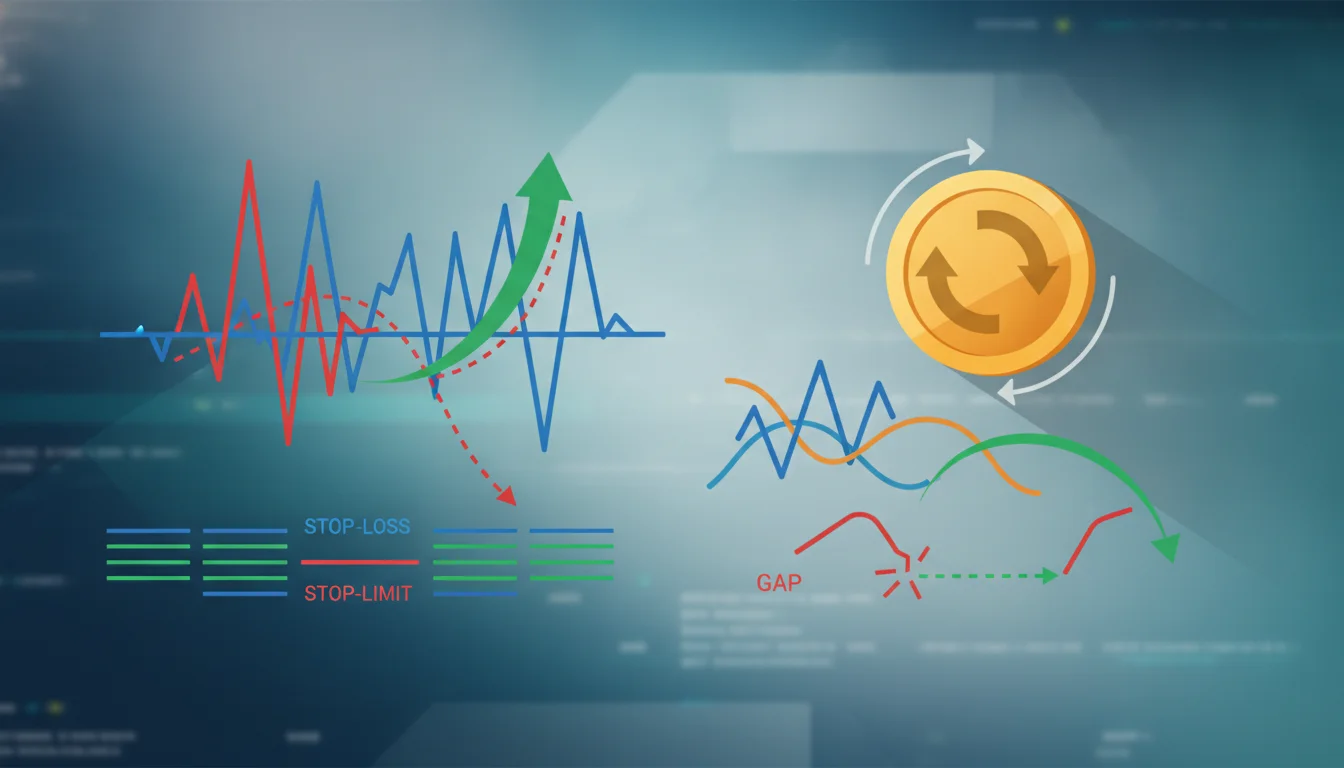
The core problem is that a standard stop order is not a promise to sell at a price. FINRA's investor guidance says the execution price "could be markedly different than your stop price," because a triggered stop becomes a market order. A stop-limit order fixes the price problem but creates a new one: it may never execute. Trailing stops automate the process but inherit both weaknesses. None of these tools is bad, but each solves a specific problem, and choosing the wrong one in a high-volatility tape can lock in the very loss an investor was trying to avoid.
This guide explains how stop, stop-limit, and trailing stop orders work, what the August 24, 2015 flash crash revealed about stops, how to set volatility-aware stop distances, and when sizing or options hedge better. It is educational content, not personal advice or a forecast.
How Stop-Loss Orders Actually Work
The stop price is a trigger, not a fill price
A sell stop order sits dormant below the current market price. When the stock trades at or below the stop price, the order "becomes a market order," in the language of FINRA Regulatory Notice 16-19, and is then filled at whatever price the market offers next. In a calm, liquid stock, that next price is usually within a few cents of the stop. In a fast market, it can be dollars away. The investor controls the trigger, but the market controls the fill, and that distinction is the single most important thing to understand before placing one.
This is why the phrase stop-loss is slightly misleading. The order does not stop the loss at a chosen level; it stops the investor from holding the position after a chosen level is breached. If the stock gaps through the stop on bad news, the order fills at the gap price. FINRA's notice puts it bluntly: "Stop prices are not guaranteed execution prices." Investors who treat a stop as a guaranteed floor are carrying more risk than they think.
Stop-limit orders trade certainty of price for certainty of execution
A stop-limit order adds a second number. When the stop price is touched, the order becomes a limit order rather than a market order, so it will only fill at the limit price or better. FINRA's investor page notes that this may help manage the risk of an unexpectedly bad fill, but warns there is no guarantee of execution. If a stock falls straight through both the stop and the limit, the order simply sits unfilled while the price keeps falling.
That trade-off is not academic. Consider a hypothetical investor holding a $146 stock with a stop at $140 and a limit at $138. If the stock opens at $126 after an overnight headline, a plain stop sells near $126, while the stop-limit sells nothing at all. The choice between the two order types is really a choice about which failure mode an investor can live with.
Trailing stops move up, never down
A trailing stop sets the trigger as a fixed dollar amount or percentage below the highest price reached since the order was placed. If a stock rises from $100 to $120 with a 10% trailing stop, the trigger rises from $90 to $108. If the stock then falls, the trigger stays at $108. Trailing stops lock in gains without constant monitoring and come in market and limit versions with the same trade-offs.
The weakness of trailing stops is that they are mechanical about the past and blind to the present. A 10% trail that made sense when the VIX sat in the teens can be triggered by an ordinary day when the VIX is near 36. In this environment, a trailing stop set months ago deserves a fresh look rather than blind trust.
Why This Market Is Hard on Stops
Volatility has roughly doubled the size of a normal day
Stops are calibrated, consciously or not, to the size of normal price swings. When those swings expand, stops set at old distances get hit by noise rather than by a genuine change in trend. On November 17, the VIX closed at 25.46 after an 11.1% jump, according to a Tapeboard market recap, and three sessions later it was near 36. A VIX of 36 implies that options traders expect annualized S&P 500 volatility of roughly 36% over the next month, which translates to typical daily moves above 2%. Individual stocks, especially AI and semiconductor names, are moving several times that.
The Closing Print reported that the Philadelphia Semiconductor Index fell 10.7% on November 20, with AMD down 13.2%, Broadcom down 12.2%, and Micron down 13.9%. A 7% stop in any of those names would have been triggered in a single session, regardless of whether the long-term thesis changed. For investors who intend to hold through volatility, that is a whipsaw risk. For investors who genuinely want out if prices fall, it is a gap risk. Either way, the stop distance matters more than usual.
Leadership stocks carry headline and gap risk
The steepest drops have come in the market's former leaders, and several were triggered by news rather than gradual selling. The Closing Print tied Nvidia's 14% decline on November 20 to reports of an SEC accounting probe and a congressional inquiry related to a chip-export case. Headline shocks like these tend to hit between sessions, when stop orders are typically not active, and the stock then opens far from the prior close. A stop placed below Thursday's close offers little protection against a Friday-morning gap.
Breadth and liquidity both thin out in a sell-off
Fast markets are also thinner markets. When volatility spikes, market makers widen quotes and post less size, so the first available bid after a stop triggers may be meaningfully lower than the last trade. The Closing Print noted that consumer staples was the only S&P 500 sector ETF to finish higher on November 20, a sign of how one-sided the selling was. In one-sided markets, a cluster of sell stops at similar levels can feed on itself, which FINRA flagged when it wrote that sell stop orders "may exacerbate price declines during times of extreme volatility."
What August 24, 2015 Taught Investors About Stops
The open was the most dangerous moment of the day
The clearest modern case study of stops in a fast market is August 24, 2015. According to the SEC staff research note on that day, the SPDR S&P 500 ETF Trust opened 5.2% below its previous close, fell to a low 7.8% below that close by 9:35 a.m., and then recovered past its opening price by 9:40, eventually closing down 4.2%. Between 9:30 and 9:45, more than 20% of S&P 500 companies and more than 40% of Nasdaq-100 companies hit daily lows at least 10% below the prior close.
Any sell stop sitting in that zone was converted into a market order during the worst ten minutes of the day, and many of those stocks were trading well higher by the afternoon. That is the textbook whipsaw: the stop did exactly what it was told to do, and the investor sold near the low. It is why FINRA later suggested firms consider "restricting the time of day during which a stop order may be triggered," especially around the open and close.
Market orders, not limit orders, drove the imbalances
The SEC note also counted 1,278 limit up-limit down trading pauses on August 24, of which 1,058 occurred in exchange-traded products. When those securities reopened, 94% of the sell-side order imbalances in reopening auctions came from market orders, while 91% of buy-side imbalances came from orders with limit prices. Put simply, sellers were demanding to get out at any price and buyers were insisting on a price. Triggered stop orders are market orders, so they sit on the wrong side of that equation.
ETFs are not automatically safer than stocks in a flash move
Many investors assume an ETF is too diversified to gap, but the SEC note found that 20 of the 50 largest ETPs declined by 10% or more on August 24, while 36.5% of more than 1,300 other ETPs also fell by 10% or more. Some large funds traded at substantial discounts to the value of their holdings for the first minutes of trading. An ETF stop is still a market order once triggered, and an ETF can briefly trade below the value of what it owns when liquidity disappears.
How to Set Stop Levels That Respect Volatility
Measure the noise before choosing the distance
The most common stop rule on retail trading sites is a fixed percentage, such as 5%, 8%, or 10% below the purchase price. Fixed percentages are easy to remember but ignore the stock in question. A utility that moves 1% a day and a semiconductor stock that moves 5% a day should not share the same stop distance. A more disciplined approach starts by measuring typical movement, often with the average true range over the past 14 or 20 sessions, and then setting the stop at a multiple of that range so that ordinary noise does not trigger it.
Volatility-scaled stops have a cost: in today's market they push stops further away, which means a larger loss if the stop is hit. That is not a flaw, it is the honest price of holding a volatile asset. The fix is not a tighter stop. The fix is a smaller position, which keeps the dollar loss at the stop within an acceptable range while giving the stock room to move.
Anchor stops to the thesis, not to round numbers
A stop should mark the price at which the reason for owning the stock is likely wrong. For a trend-following position, that might be a break below a recent swing low or a major moving average. For a valuation-based position, price may be a poor trigger at all, and a fundamental review might be more appropriate. Round numbers and obvious levels attract clusters of orders, so placing a stop exactly at $100 or exactly at a widely watched moving average can mean being filled alongside everyone else.
For a stock like Nvidia, where the debate now includes reported accounting questions as well as AI demand, a fundamental trigger such as the outcome of a regulatory review or the next earnings report may matter more than any chart level, as long as the position is sized to survive a large move.
Size the position so the stop loss is survivable
A useful exercise is to work backward. Decide the maximum dollar loss acceptable on a single position, often expressed as a small percentage of the total portfolio, then divide by the distance between the entry price and the stop. The result is the position size. In a high-volatility market, the stop distance grows, so the position shrinks. That turns a stop into part of a risk budget rather than a reflex.
Investors who want these reviews to happen on a schedule rather than when panic strikes can use Alphio's Scheduled Task to set recurring checks on volatility, distance to stop, and position size, so stop levels are updated with fresh data instead of left at last summer's settings.

Choosing the Right Order Type for the Situation
When a plain stop order makes sense
A plain stop-market order is the right tool when getting out matters more than the exact price. That usually applies to leveraged positions, concentrated positions that could cause real financial harm, and positions held on margin, where a broker may otherwise liquidate on its own terms. In those cases, an investor is buying certainty of exit and accepting slippage as the premium. The investor should still expect that in a gap the fill could be far below the stop.
When a stop-limit order makes sense
A stop-limit order fits investors who would rather keep the position than sell at a disastrous price. It is often used in less liquid stocks, where a market order could fill far below fair value, and by investors who believe sharp intraday drops tend to partially reverse, as they did on August 24, 2015. The limit should sit far enough below the stop that ordinary slippage does not block the fill. A limit set a few cents under the stop is often worse than no limit at all, because it fails exactly when the order is needed.
Practical guardrails for any stop order
A few checks apply regardless of order type, and they are worth writing down before the next volatile session:
- Confirm whether the broker's stops trigger only during regular trading hours or also in pre-market and after-hours sessions, since many default to regular hours only.
- Review good-til-canceled stops regularly; FINRA notes that firms may limit their duration, sometimes "to 90 days," so an old stop may have quietly expired.
- Avoid placing stops at the most obvious round numbers or chart levels where orders cluster.
- Consider a time-of-day restriction or a manual review rule for the first and last 15 minutes of trading.
- Recheck stop distances whenever the VIX or the stock's own volatility changes materially.
For investors who prefer to talk through these decisions before acting, Alphio's Conversational Trading lets users describe a position and an exit plan in plain language, review the order type and stop distance, and adjust before anything is sent.
Alternatives and Complements to Stop-Loss Orders
Protective puts cap the loss even through a gap
A protective put gives the holder the right to sell at the strike price until expiration, so unlike a stop it protects against gaps. The cost is the premium, and premiums rise when volatility rises. With the VIX near 36, puts are expensive by historical standards, which is the trade-off of buying insurance after the storm has started. For long-term holders with large gains, either structure may be more reliable than a stop that could fill at a gap price.
Position sizing and diversification do the quiet work
The most dependable protection is often the least dramatic. An investor who holds positions small enough that a 15% overnight gap is painful but not damaging does not need a stop to save them. Spreading exposure across sectors that do not move together also helps, as November 20 showed when consumer staples rose while technology fell 7.27%, according to The Closing Print. Stops are one tool among several, and they work best layered on top of sensible sizing rather than as a substitute for it.
What the Research Says About Whether Stops Help
Stops can lower returns when prices are random
Academic work offers a sobering perspective. In a 2014 Journal of Financial Markets paper, Kathryn Kaminski and Andrew Lo of MIT showed that if returns follow a random walk, simple stop-loss rules reduce expected returns, because they periodically force an investor out of a higher-returning asset with no offsetting benefit. In that world, a stop is pure cost.
They can help when losses tend to persist
The same paper found that stop-loss rules can add value when returns show momentum, meaning losses tend to be followed by further losses. Using monthly data from 1950 through 2004, the authors found that certain rules that rotate from stocks into bonds after losses added roughly 50 to 100 basis points per month during stop-out periods. The lesson is not that stops always work or always fail. It is that they work when they cut exposure to persistent declines and hurt when they sell into temporary panic.
The practical takeaway for 2026
That framework maps neatly onto the current debate. If the November sell-off is the start of a longer repricing of AI expectations, disciplined exits could prove valuable. If it is a sharp but temporary shakeout, tight stops will have sold near the lows, much as they did on August 24, 2015. Because no one can know which regime is unfolding in real time, the best stop strategy is one that is sized to survive both outcomes.
Conclusion
Stop-loss orders are worth using, but only with a clear understanding of what they do. A stop is a trigger that turns into a market order, not a guaranteed exit price. A stop-limit protects the price but can leave the investor holding a falling stock. A trailing stop automates discipline but needs to be recalibrated when volatility changes. In a market where the VIX is near 36 and leadership stocks are moving double digits in a day, stops set at old distances are more likely to deliver whipsaws and gap fills than protection.
For investors who want to put those rules into practice consistently, Alphio's Autonomous Trading can execute predefined risk rules without emotional second-guessing, while Copy Trade offers a way to study how experienced traders structure exits and position sizes before adapting those ideas. Whatever tools are used, the goal is the same: decide in advance how much risk a position deserves, and make sure the exit plan still makes sense in the market that actually exists today.
FAQs
What is the difference between a stop-loss order and a stop-limit order?
A stop-loss order becomes a market order once the stop price is reached, so it will usually execute but possibly at a much worse price. A stop-limit order becomes a limit order instead, so it will not sell below the limit price but may not execute at all if the stock falls through it.
Do stop-loss orders protect against overnight gaps?
No. If a stock opens below the stop price after overnight news, the stop triggers at the open and fills at the prevailing market price, which can be far below the stop. Protective puts are one of the few tools that cap losses through a gap.
How far below the current price should I set a stop-loss?
There is no single correct percentage. Many disciplined investors measure a stock's typical daily movement, such as its average true range, and set the stop at a multiple of that range, then reduce position size so the dollar loss at the stop stays acceptable.
Are trailing stops a good idea when the VIX is high?
Trailing stops can lock in gains, but a trail distance chosen in a calm market is easily triggered by normal swings when volatility is elevated. Investors using trailing stops should widen or recalibrate them when volatility rises, and pair them with smaller position sizes.
Do stop-loss orders work in pre-market and after-hours trading?
It depends on the broker. Many brokers trigger stop orders only during regular trading hours by default, so investors should confirm their broker's settings and remember that thin extended-hours liquidity can make fills worse.
Related articles
- How to Buy the Dip in the 2026 Stock Market Correction Without Guessing the BottomHow to buy the dip in the November 2026 stock market correction: what history says, why a hiking Fed changes the math, and how to stage purchases safely.
- Required Minimum Distributions in a Down Market: How to Take Your 2026 RMD Without Selling LowHow to take required minimum distributions in a down market in 2026: what to sell, in-kind RMDs, QCDs, the Dec. 31 deadline, penalties, and tax moves to use.
- PCE Inflation Report and the Stock Market: What the Fed's Preferred Gauge Means in a CorrectionThe PCE inflation report lands Nov 25 amid a stock correction and Fed hike talk. Learn PCE vs CPI, what to watch, and how stocks, sectors and bonds react.
- Stock Market Surges After 2026 Midterms: What the Democratic Sweep Means for Your PortfolioThe stock market rallied after Democrats won the 2026 midterms. Discover what the election means for investors, tech stocks, and the S&P 500 outlook.
- Oil Prices Surge Above $105 Amid US-Iran Conflict: Energy Investment Opportunities in November 2026Oil prices climb past $105 as US strikes Iran's Qeshm Island. Discover energy investment opportunities, top oil stocks, and market outlook for November 2026.
- 2026 Midterm Results Are In: What Democratic Control of Congress Means for the Stock MarketDemocrats win House and Senate in 2026 midterms: what divided government under Trump means for stocks, sectors, volatility, and investor checklists.