

Nvidia Earnings Preview August 2026: AI Chip Leader Faces Oil Market Crosswinds
Nvidia's Q2 earnings on August 26, 2026 could drive major market moves. Analysis of AI chip demand, oil price volatility, and investment strategies.

Key Takeaway
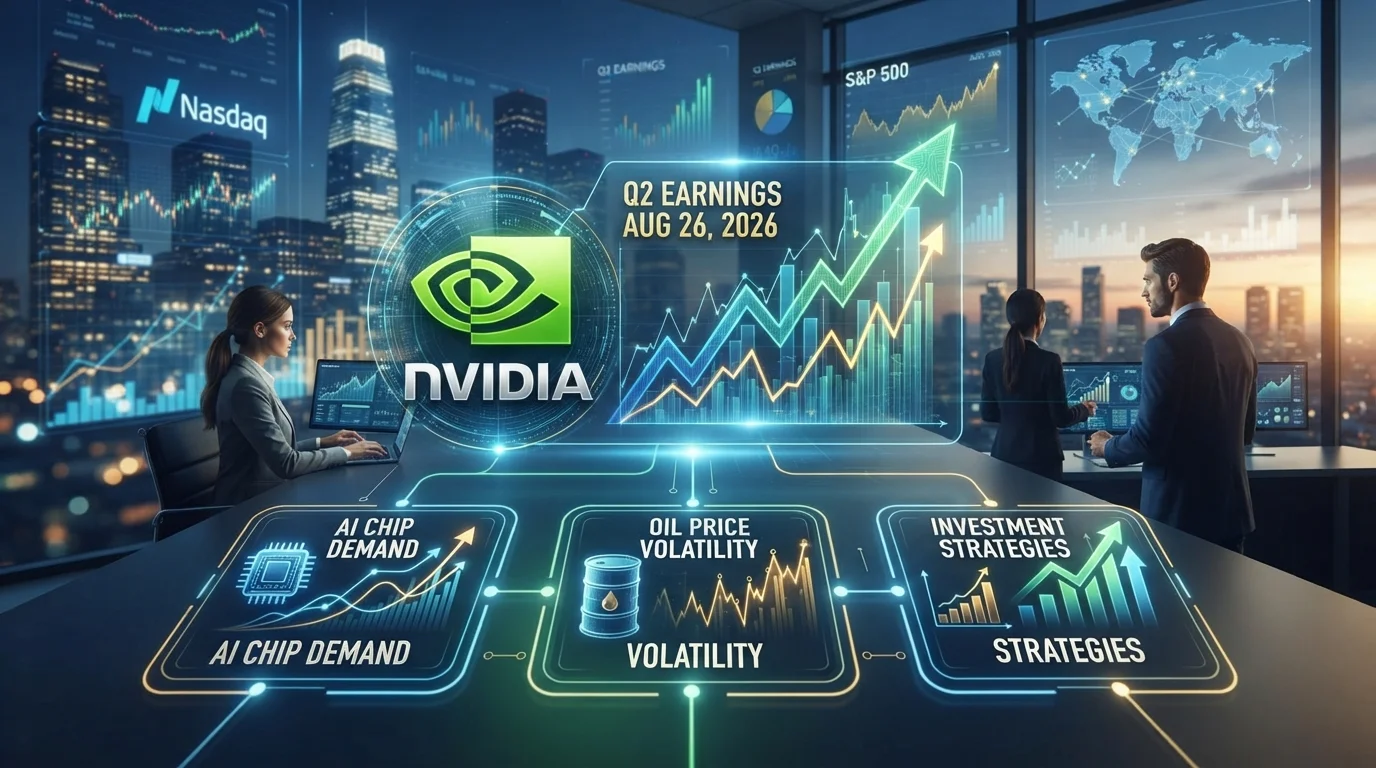
Nvidia's highly anticipated second-quarter earnings report scheduled for August 26, 2026, represents one of the most significant catalysts for both the technology sector and broader equity markets this quarter. The semiconductor giant, trading around $224 in mid-August with shares up approximately 17.7% year-to-date, faces a critical moment as investors weigh extraordinary AI infrastructure demand against mounting macroeconomic headwinds. Wall Street analysts expect Nvidia to report GAAP earnings of approximately $2.06 per share, nearly double the year-ago result, with revenue projections pointing toward a potential $91 billion quarter driven by relentless demand for AI accelerators.
However, the investment landscape has grown increasingly complex as oil prices have surged back toward $88 per barrel amid ongoing tensions surrounding the Strait of Hormuz. This energy market volatility creates a challenging backdrop for high-growth technology stocks, as rising crude prices typically fuel inflation concerns and strengthen the case for prolonged restrictive monetary policy from the Federal Reserve. The interplay between Nvidia's fundamental business momentum and these macroeconomic crosscurrents will likely determine whether the stock can achieve analyst price targets of $225-$230 by month-end or faces a more turbulent path ahead.
For investors seeking to navigate these volatile conditions, understanding both the micro drivers of Nvidia's business and the macro forces shaping risk appetite has become essential. The convergence of AI revolution tailwinds and geopolitical energy risks presents both opportunities and challenges that demand sophisticated analysis and strategic positioning.
Nvidia's AI Dominance: The Fundamental Case
Nvidia's transformation from a gaming graphics card manufacturer to the dominant provider of AI infrastructure has been one of the most remarkable corporate evolutions in modern market history. The company's data center revenue, which now constitutes the majority of total sales, has experienced explosive growth as cloud providers, enterprises, and AI startups race to acquire the computational power necessary to train and deploy large language models and other generative AI applications.
The competitive moat surrounding Nvidia's business remains formidable despite intensifying efforts from rivals. Advanced Micro Devices has made strides with its MI300 series accelerators, and custom silicon initiatives from Amazon, Google, and Microsoft pose longer-term threats. Yet Nvidia's CUDA software ecosystem, which has become the industry standard for AI development, creates powerful switching costs that protect market share even as hardware alternatives emerge. The company's introduction of its next-generation Blackwell architecture, offering substantial performance improvements over the current Hopper generation, should sustain pricing power and demand momentum through at least 2027.
Management guidance during the upcoming earnings call will be scrutinized for indications about Blackwell ramp timing and any constraints on supply availability. Previous quarters have seen Nvidia struggle to meet demand despite substantial manufacturing investments, and investors will want clarity on whether production capacity can catch up to the extraordinary order backlog. Any commentary about competitive dynamics, particularly regarding AMD's recent market share gains in certain segments, will also influence sentiment heading into the second half of the year.
For investors seeking exposure to the AI infrastructure buildout, consider using Alphio AI's copy trading feature to mirror successful traders who specialize in semiconductor and technology sector positioning.

The Oil Market Storm: Energy Prices and Equity Risk
While Nvidia's business fundamentals remain robust, the macroeconomic environment has deteriorated meaningfully over recent weeks. Brent crude oil prices have climbed from approximately $69 per barrel in early July to nearly $88 per barrel in mid-August, representing a dramatic 27% surge that has caught many market participants off guard. This price spike stems primarily from ongoing uncertainty regarding the Strait of Hormuz, through which roughly 20% of global petroleum consumption flows.
The International Energy Agency's August 2026 Oil Market Report highlighted that loadings through the strait peaked at 20 million barrels per day at the start of July but dropped to around 12 million barrels per day later in the month as shipping disruptions intensified. With an agreement enabling the reopening of Hormuz and unhindered transit through the Bab el-Mandeb Strait remaining elusive, energy analysts have lowered supply forecasts and raised price projections. The IEA now expects Brent to average $87 per barrel in 2026, with prices potentially remaining elevated into early 2027.
Rising oil prices create multiple headwinds for equity markets that could pressure Nvidia shares regardless of the company's operational performance. First, energy costs feed directly into inflation metrics, potentially complicating the Federal Reserve's path toward interest rate cuts that many investors had anticipated for late 2026. Second, higher fuel prices act as a tax on consumer spending, potentially dampening economic growth expectations. Third, technology stocks with elevated valuations are particularly sensitive to discount rate changes, making the sector vulnerable if bond yields rise on inflation concerns.
The 2-year Treasury note yield, which closely tracks short-term Federal Reserve interest rate policy, has remained elevated around 4.16%, suggesting markets have not fully priced in aggressive rate cuts. This persistent yield pressure has already contributed to recent equity market volatility, with the S&P 500 experiencing choppy trading as investors weigh inflation data against corporate earnings results.
Market Positioning: How Institutional Investors Are Preparing
Institutional positioning ahead of Nvidia's earnings reveals a market divided between AI optimism and macro caution. Options markets are pricing in substantial implied volatility for the earnings event, with the magnitude of potential price swings reflecting both the stock's historical post-earnings moves and the uncertain macro backdrop. Market makers have adjusted volatility surfaces to account for the possibility of significant moves in either direction.
Hedge funds have reportedly reduced gross exposure to technology stocks over recent weeks while maintaining selective long positions in AI leaders including Nvidia. This more defensive posture reflects concerns about valuation compression if Treasury yields continue climbing. At the same time, systematic strategies and retail investors have shown continued appetite for semiconductor exposure, creating a two-way flow environment that could amplify price volatility around the earnings release.
Analyst sentiment remains predominantly bullish, with the majority of covering firms maintaining buy ratings and price targets suggesting meaningful upside from current levels. However, the dispersion of estimates has widened considerably, reflecting uncertainty about the sustainability of current growth rates and the impact of export restrictions on sales to Chinese customers. The regulatory environment remains fluid, with potential for both tightening and relaxation of export controls depending on geopolitical developments.
For sophisticated investors looking to automate their response to these market dynamics, Alphio AI's agentic trading capabilities offer portfolio management strategies that can adapt to changing conditions without constant manual intervention.

Sector Rotation: Energy vs. Technology Trade Dynamics
The recent market action has highlighted the ongoing tension between energy and technology sectors as investors rotate capital based on macroeconomic conditions. When oil prices surge and inflation concerns mount, capital typically flows toward energy producers and away from growth-oriented technology stocks. This dynamic has played out in recent weeks, with the energy sector outperforming while many high-multiple technology names have experienced consolidation.
However, the current environment presents nuances that complicate simple sector rotation strategies. Nvidia's AI business operates with such strong fundamental momentum that it may prove more resilient to macro headwinds than other technology stocks with less compelling growth profiles. The company's data center customers, including Microsoft, Amazon, Google, and Meta, have indicated continued commitment to AI infrastructure spending despite broader cost optimization efforts. This enterprise demand provides a buffer against consumer-facing economic weakness.
The relationship between energy prices and AI demand also contains interesting paradoxes. Higher oil prices increase the cost of traditional computing infrastructure, potentially accelerating the shift toward more energy-efficient AI data centers where Nvidia's accelerators offer substantial performance-per-watt advantages. Additionally, the energy sector itself has become a significant customer for AI technology, using machine learning for exploration, production optimization, and predictive maintenance. This creates a more interconnected relationship between the sectors than simple rotation models suggest.
Investors should consider whether the current energy price surge represents a temporary supply disruption or a more persistent shift in market dynamics. If Hormuz-related tensions resolve and oil prices retreat, capital could flow back into technology stocks aggressively. Conversely, a prolonged period of elevated energy costs would likely sustain pressure on growth stock valuations and favor more defensive positioning.
Earnings Expectations: What Wall Street Wants to See
Wall Street has set a high bar for Nvidia's second-quarter results, with consensus expectations calling for revenue growth of over 100% year-over-year. Meeting these expectations will require flawless execution across the company's product lines, with particular focus on data center revenue trends and any indications about Blackwell architecture adoption timelines.
Key metrics investors will monitor include gross margin trends, which have expanded substantially as the company's product mix shifts toward higher-value AI accelerators. Management commentary about supply constraints will be equally important, as any indication that demand exceeds available production capacity could signal sustained pricing power. Conversely, evidence of demand moderation or competitive pressure would likely trigger significant stock price volatility.
The earnings call question-and-answer session typically provides the most market-moving information, as analysts probe for details about forward guidance and strategic positioning. Topics likely to generate attention include the competitive response to AMD's MI300 series, the impact of Chinese export restrictions on revenue trajectories, and the timeline for Blackwell-based product availability. Management's tone and specificity in addressing these questions will influence investor confidence in the company's multi-year growth narrative.
For investors who want to set conditional responses to earnings outcomes, Alphio AI's automation features enable sophisticated trading workflows that execute based on predefined criteria.

Risk Factors: What Could Go Wrong
Despite the compelling bull case, investors must remain cognizant of risks that could derail Nvidia's stock performance regardless of earnings results. The macroeconomic environment presents the most immediate concern, as a further surge in oil prices or deterioration in inflation data could trigger a broader risk-off move that pressures all growth stocks indiscriminately. The Federal Reserve's policy trajectory remains uncertain, with recent commentary suggesting less urgency to cut rates than markets had previously anticipated.
Competitive dynamics also warrant careful monitoring. While Nvidia's current market position appears dominant, the history of semiconductor markets suggests that leadership positions can shift more quickly than investors expect. AMD's progress in AI accelerators, combined with custom silicon initiatives from major cloud providers, could erode market share over time. The key question is whether these competitive threats materialize quickly enough to impact near-term financial results or represent a longer-term challenge.
Geopolitical risks extend beyond the Strait of Hormuz to include ongoing trade tensions between the United States and China. Export restrictions on advanced semiconductors have already impacted Nvidia's revenue from Chinese customers, and any escalation in trade restrictions could further limit market access. Conversely, a relaxation of current restrictions could provide upside surprise to revenue forecasts.
Valuation remains a persistent concern for cautious investors. Nvidia trades at multiples that substantially exceed semiconductor industry averages, implying that the market anticipates sustained high growth rates for years to come. Any indication that growth is decelerating or that margins have peaked could trigger significant multiple compression, even if absolute financial performance remains strong.
Investment Strategies: Positioning for Volatility
The confluence of Nvidia earnings and oil market volatility creates a challenging environment for portfolio positioning. Investors with existing Nvidia exposure must decide whether to maintain positions through the earnings event or reduce risk given the uncertain macro backdrop. Those without exposure face the classic dilemma of buying ahead of a potentially transformative earnings report or waiting for greater clarity.
For long-term investors who believe in the multi-year AI infrastructure buildout thesis, short-term volatility around earnings may present buying opportunities rather than reasons for concern. The fundamental drivers of Nvidia's business, including the shift toward AI computing and the company's technological leadership, remain intact regardless of quarterly fluctuations. Dollar-cost averaging into positions over time can help manage the timing risk associated with volatile earnings events.
More tactical investors might consider options strategies to express directional views while limiting downside exposure. Straddles or strangles could profit from large moves in either direction, while put spreads might provide cost-effective downside protection for existing long positions. However, the elevated implied volatility ahead of earnings means these strategies require substantial price moves to become profitable.
Sector diversification remains essential in the current environment. While Nvidia offers compelling exposure to AI trends, concentrating too heavily in any single stock or sector creates vulnerability to idiosyncratic risks. Balancing technology exposure with positions in energy, healthcare, and other sectors can help manage portfolio volatility while maintaining participation in multiple market themes.
For a seamless trading experience that allows you to execute strategies via natural language commands, explore Alphio AI's conversational trading interface.

Conclusion
Nvidia's August 26, 2026 earnings report arrives at a pivotal moment for both the company and broader equity markets. The fundamental business momentum driven by AI infrastructure demand remains extraordinarily strong, with revenue growth exceeding 100% year-over-year and new product cycles promising continued expansion. However, the macroeconomic environment has grown more challenging as oil prices surge and inflation concerns complicate the Federal Reserve's policy trajectory.
The investment thesis for Nvidia ultimately depends on whether the company's operational excellence can overcome these macro headwinds. History suggests that companies with genuinely transformative technology and strong competitive positions can outperform even in difficult market environments. Nvidia's CUDA ecosystem, manufacturing partnerships, and technological leadership create advantages that should persist regardless of short-term commodity price fluctuations.
For investors, the key question is time horizon. Those with multi-year investment horizons may view any earnings-related volatility as an opportunity to accumulate positions in a company positioned at the center of the AI revolution. More tactical investors must weigh the potential for earnings upside against the risk of macro-driven multiple compression.
The interplay between Nvidia's results and oil market developments will likely set the tone for technology sector performance through the remainder of 2026. If Nvidia can deliver strong results and constructive guidance while oil prices stabilize, the path toward analyst price targets of $225-$230 becomes considerably clearer. Conversely, disappointing results combined with persistent energy market volatility could trigger a more challenging period for growth stock investors.
To stay ahead of these market-moving developments and automate your trading strategies, consider leveraging Alphio AI's copy trading to follow successful AI and energy sector traders, or explore agentic trading to automate your portfolio management with sophisticated AI-powered strategies. For conditional trade execution based on earnings outcomes, Alphio's automation tools provide the flexibility to respond to market events without constant monitoring.
FAQs
When is Nvidia's Q2 2026 earnings report scheduled?
Nvidia is scheduled to report its second-quarter fiscal year 2027 earnings on August 26, 2026. The report will be released after market close, with a conference call to follow for analysts and investors.
What are Wall Street's expectations for Nvidia's Q2 earnings?
Analysts expect Nvidia to report GAAP earnings of approximately $2.06 per share, nearly double the year-ago result. Revenue expectations point toward a potential $91 billion quarter, driven by continued strong demand for AI chips and data center infrastructure.
How have oil prices affected the stock market in August 2026?
Brent crude oil prices have surged from approximately $69 per barrel in early July to nearly $88 per barrel in mid-August, a 27% increase. This rise has created inflation concerns and pressured growth stock valuations, particularly in the technology sector.
What is the Strait of Hormuz crisis and why does it matter for markets?
The Strait of Hormuz is a critical chokepoint through which roughly 20% of global petroleum consumption flows. Ongoing tensions have disrupted shipping, reducing loadings from 20 million barrels per day to around 12 million barrels per day, contributing to higher oil prices and market volatility.
What are the key risks for Nvidia investors ahead of earnings?
Key risks include macroeconomic headwinds from rising oil prices and inflation, competitive pressure from AMD and custom silicon initiatives, geopolitical trade restrictions affecting Chinese revenue, and high valuation multiples that leave little room for disappointment.
Related articles
- How to Rebalance a Concentrated Stock Portfolio in 2026: Mag7 Drift, Tax-Aware Trims, and Practical Rebalance a concentrated stock portfolio in 2026: Mag7 drift risk, 5pp bands, tax-aware trims, RSP/IWM diversifiers, and single-name caps.
- Small Cap Stocks Investing Guide 2026: Russell 2000, Fed Hikes, and the Financing TradeSmall-cap stocks investing guide 2026: Russell 2000 vs S&P, IWM rate sensitivity, floating-rate debt, Fed hikes, valuation discounts, and a practical checklist.
- Santa Claus Rally and the Year-End Stock Market: Investor Guide for Late 2026Santa Claus rally explained: 7-day window stats since 1950, Nov–Dec seasonality, post-midterm 2026 setup, and a risk-managed year-end investing playbook.
- SpaceX Private Valuation Soars: Inside the $1 Trillion Space Economy AmbitionSpaceX's debut earnings reveal massive potential. Explore the private space market valuation, investment opportunities, and industry trends reshaping aerospace.
- Federal Reserve Interest Rate Decision August 2026: Market Impact and Investment StrategyAnalyze the Federal Reserve's August 2026 interest rate decision. Discover investment strategies for navigating the stock market in the current rate environment.
- Broadcom Stock Analysis: Why AVGO's AI Chip Dominance Could Drive 35% UpsideComprehensive Broadcom stock analysis for August 2026. Explore AVGO's AI semiconductor growth, custom chip demand, and why analysts see 35% upside potential.