

Dividend Aristocrats Investing Guide for Late 2026: Yield Traps, Quality Screens, and the Cash-Retur
How to evaluate S&P 500 Dividend Aristocrats in late 2026: yield traps vs quality, NOBL ETF, October high yields, and a cash-return rotation checklist.

Key Takeaway
Late 2026 has reminded investors that a dividend streak is a track record, not a guarantee. As artificial-intelligence CapEx stories face sharper questions about cash conversion, capital has rotated toward companies that already return cash—consumer staples, healthcare, and utilities among them. Amundi’s late-October note captured the mood: technology indexes gave back prior gains while the MSCI World High Dividend Yield Index rose about 8% in the second half of the year as investors demanded proof that spending produces free cash flow.
That rotation makes the S&P 500 Dividend Aristocrats newly relevant, and newly easy to misuse. The index holds S&P 500 companies that have raised total dividends per share for at least 25 consecutive years—about 69 names as of mid-2026—yet roughly two-fifths of the list still yield under 2%. Chasing the highest yields on the aristocrat screen can land you in payout stress, cyclical earnings, or simply an expensive streak. The better late-2026 approach is a quality-and-coverage process: confirm the raise history, stress-test the payout, judge the moat and valuation, then size for what would falsify the thesis—not for the label on the list.
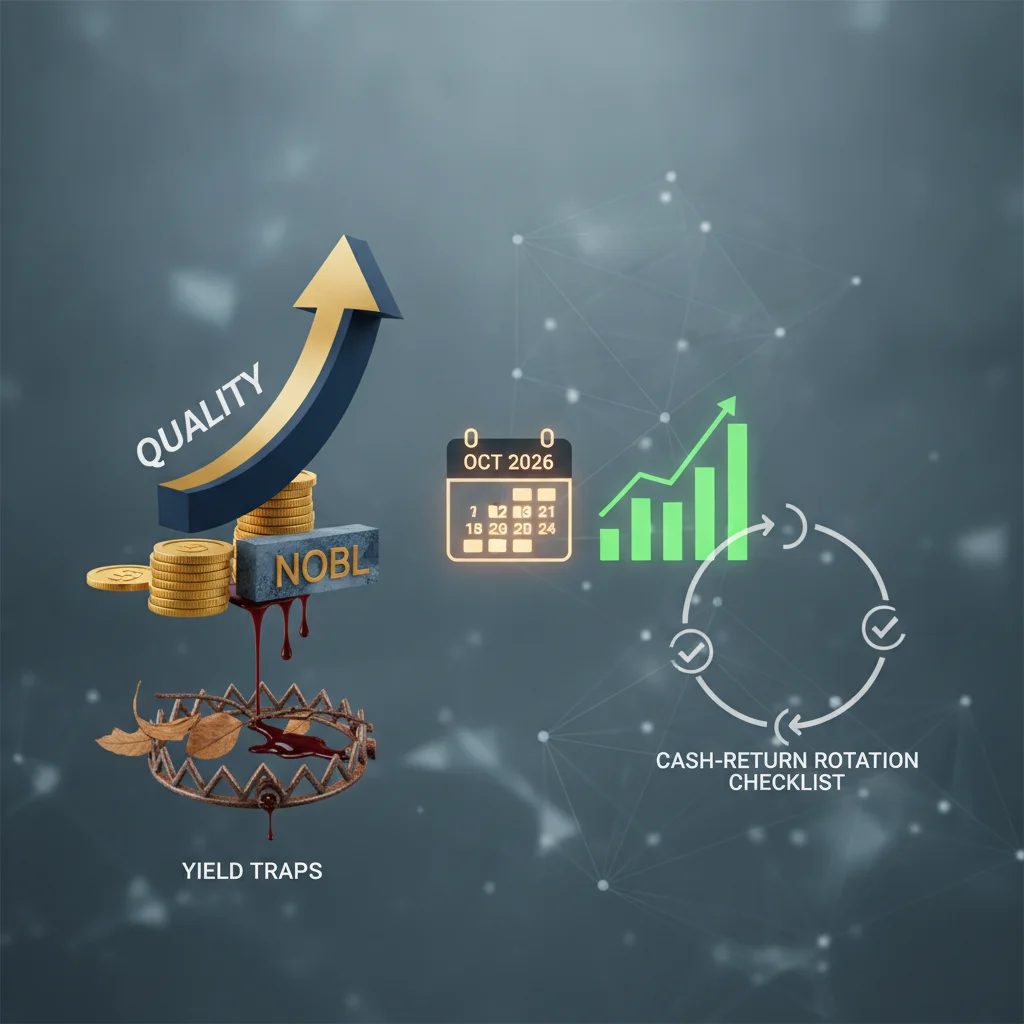
This guide is an evaluation playbook for Dividend Aristocrats investing in late 2026. It walks through definitions, yield traps, a Morningstar-style quality screen used as editorial framing (not as a personal recommendation), liquid case studies across staples, healthcare, and energy, and the role of the ProShares S&P 500 Dividend Aristocrats ETF (NOBL) as an equal-weight index vehicle. Along the way, workflow tools such as Alphio Conversational Trading can turn a watchlist of aristocrats into explicit budget and review rules rather than impulse buys after a yield screen.
What Dividend Aristocrats actually are
The formal rule, not the folklore
S&P Dow Jones Indices defines the S&P 500 Dividend Aristocrats as S&P 500 constituents that have increased total dividend per share every calendar year for at least 25 consecutive years. Eligibility also includes size and liquidity screens—typically a free-float market capitalization of at least about $3 billion and average daily value traded of at least about $5 million over the three months before the rebalancing reference date. The index is equal-weighted, reconstituted annually (with the qualifying universe reviewed in January) and rebalanced quarterly, with a sector-diversification constraint that caps any single GICS sector at 30% of index weight.
That machinery matters more than the nickname. Equal weighting means a mid-cap consumer staple can matter as much as a mega-cap healthcare name on rebalance day. The 25-year raise rule is strict: a freeze or cut that breaks the annual increase streak removes the stock at the next reconstitution. Membership is therefore a backward-looking badge of capital-allocation discipline under many regimes—not a forecast that the next decade will rhyme with the last.
How large the club is—and how uneven the yields are
As of June 30, 2026, educational trackers citing the index pointed to about 69 aristocrats, near historically high membership. That breadth is useful for diversification inside a dividend-growth sleeve, but it also dilutes the idea that “aristocrat” equals “high income.” Independent 2026 list snapshots and Morningstar commentary converge on a stubborn fact: roughly 40% of aristocrats still yield under 2% on trailing measures. Many of the longest streaks sit in consumer staples and industrials where payout ratios are moderate and share prices have compounded for decades—compressing current yield even as absolute dividends climb.
For income-first investors, that distribution is the first filter. A portfolio built only from the aristocrat label can look like a quality-growth basket with a dividend garnish. A portfolio built only from the top-yield slice can look like a value trap with a quality sticker. Late 2026 asks you to hold both truths at once.
Why late 2026 feels different for dividend growth
Tech CapEx skepticism meets cash-return demand
The market’s emotional baseline shifted when investors stopped treating AI infrastructure spend as automatically good news. Amundi’s October 26, 2026 research note argued that markets have moved past the phase when merely mentioning an AI rollout could excite buyers; clarity on cash generation from large CapEx programs now matters more. Technology’s second-half giveback contrasted with strength in high-dividend sleeves concentrated in staples, healthcare, and utilities—the traditional homes of steadier cash return.
That does not mean aristocrats are a short-tech trade. It means the relative bid for durable free-cash-flow stories has improved while discount rates and CapEx skepticism punish long-duration narratives that cannot show payback. Dividend aristocrats sit at the intersection of that mood: many already disclose multi-decade raise histories, and several trade at yields that look competitive with parts of the short- and intermediate-rate complex depending on the week.
Rotation is a process, not a permanent regime
Rotations reverse. A strong October for dividend indexes does not cancel the long-run productivity case for AI, nor does it immunize consumer staples against volume pressure, private-label competition, or commodity cost spikes. The useful framing for late 2026 is tactical rebalancing toward cash-returning quality—subject to valuation—rather than a permanent declaration that growth is over. Investors who treat aristocrats as a forever hedge against every tech drawdown tend to overpay for the streak precisely when the narrative is loudest.
Yield traps versus quality: the aristocrat paradox
What the October 2026 high-yield screen actually showed
NerdWallet’s October 16, 2026 snapshot of the highest-yielding Dividend Aristocrats—sourced from Finviz and labeled informational—put Amcor (AMCR) and Clorox (CLX) near 5.92% each, followed by Realty Income (O) near 5.86%, Hormel Foods (HRL) near 5.74%, T. Rowe Price (TROW) near 5.05%, Kimberly-Clark (KMB) near 4.89%, and PepsiCo (PEP) near 4.50%. Other late-October list trackers showed the same cluster of names at the top of the yield table, with small day-to-day differences as prices moved.
Those figures are useful as a map of where income sits inside the aristocrat universe. They are not a ranked buy list. Packaging, household products, REITs, protein brands, and asset managers live in different earnings cycles. A 5%–6% yield on an aristocrat can signal a durable cash machine that the market undervalues—or a payout ratio that is already stretched relative to free cash flow. The label “aristocrat” only tells you the raise streak survived; it does not tell you the next raise is safe.
Coverage, moat, and price risk beat yield alone
Three checks prevent yield-first mistakes. First, payout coverage: compare the dividend to free cash flow and to earnings under a stress case, not only to last year’s reported EPS. Second, competitive position: brands, switching costs, distribution scale, and regulated or contractual cash flows matter more when growth is scarce. Third, valuation: overpaying for a 40-year streak embeds price risk that can erase years of dividend income if multiples compress. Aristocrats can and do cut—Walgreens Boots Alliance reduced its dividend in early 2024 after nearly 50 years of raises and was removed from the S&P 500 Dividend Aristocrats effective January 31, 2024; the company later suspended the dividend entirely in early 2025 amid balance-sheet and litigation pressure. The streak ended; the capital loss for holders who bought for the badge was the expensive lesson.
If you screen aristocrats regularly, a conversational watchlist on Alphio Conversational Trading helps you log coverage and valuation rules before the next yield leaderboard tempts a chase.

Open Alphio Conversational Trading
A Morningstar-style quality-and-value lens (editorial, not advice)
What the screen is trying to find
Morningstar’s early-2026 aristocrat features illustrated a useful editorial filter rather than a personal recommendation engine: start from NOBL membership (or the aristocrat list), require a narrow or wide Morningstar Economic Moat rating, and prefer names trading below Morningstar’s fair-value estimate. One January 2026 list framed under that logic included Clorox (CLX), Amcor (AMCR), Brown-Forman (BF.B), Becton Dickinson (BDX), West Pharmaceutical Services (WST), Kimberly-Clark (KMB), FactSet (FDS), Air Products (APD), Automatic Data Processing (ADP), and PepsiCo (PEP). Later 2026 Morningstar pieces continued to highlight undervalued, moated aristocrats such as Clorox and Amcor when yields sat in the mid-5% area and prices traded at discounts to internal fair-value marks.
Treat those names as a research queue, not as a portfolio to copy blindly. Moat ratings and fair-value models change when fundamentals or discount rates change. The process value is the three-way intersection—raise history plus competitive advantage plus price discipline—not the ticker list on any single publication date.
How to adapt the idea without outsourcing judgment
Translate the screen into questions you can answer from filings and transcripts. Does the company still earn excess returns in its core category? Is the payout rising because cash flow is rising, or because management is defending the aristocrat badge? Relative to your own cost of capital and opportunity set, is the stock cheap enough that a mild earnings miss does not break the thesis? Those questions keep “best aristocrats 2026” articles in their proper place: as prompts for work, not as substitutes for it.
Case studies across liquid aristocrat narratives
Consumer staples: PepsiCo, Coca-Cola, and the high-yield household cohort
PepsiCo’s appearance near 4.5% on the mid-October NerdWallet yield table made it a bridge name between “quality staple” and “income candidate.” The investment debate is familiar: beverage and convenient-food pricing power versus volume elasticity, private-label competition, and the capital needed to defend shelf space. Coca-Cola (KO) typically sits lower on the yield spectrum than the aristocrat leaders, but the brand moat and global system remain the reference case for what a multi-decade raise culture looks like when distribution scale is the product. Clorox and Kimberly-Clark illustrate the other side of staples: higher yields often coincide with cost, volume, or category-growth debates that make payout coverage the first line to read in the 10-K.
For staples aristocrats in late 2026, the falsifier is usually not “will they pay this quarter?” It is whether category volume and mix can fund the next raise without leverage creeping higher or reinvestment starving the brand.
Healthcare and energy cash return: Johnson & Johnson and Exxon Mobil
Johnson & Johnson (JNJ) remains a healthcare aristocrat case study in diversified cash generation—pharmaceuticals, medtech, and the residual consumer separation story that investors still use as a quality benchmark. Yield is rarely at the top of the aristocrat leaderboard; the question is durability of the raise through patent cliffs, litigation overhangs, and pipeline timing. Exxon Mobil (XOM) and peers such as Chevron bring a different aristocrat narrative: commodity cash flows that can fund progressive dividends and buybacks when prices cooperate, with the attendant cyclicality that staples investors try to avoid. In a rotation away from CapEx-heavy tech stories, energy aristocrats can look like cash-return vehicles—until oil prices remind holders that free cash flow is not a utility coupon.
What these names share—and what they do not
Across PEP, KO, JNJ, XOM, and high-yield staples such as CLX, the shared trait is a documented culture of raising the dividend through prior cycles. The unshared traits are payout ratios, cyclicality, and valuation. Building an aristocrat sleeve as if those differences were noise is how investors invent false diversification. Sector mix inside the aristocrat list is a feature of the S&P methodology; your portfolio still needs an intentional mix.
NOBL as an index vehicle—and when stock picking still matters
What the ETF delivers
The ProShares S&P 500 Dividend Aristocrats ETF (NOBL) tracks the equal-weighted S&P 500 Dividend Aristocrats Index. ProShares materials and the April 2026 summary prospectus cite an expense ratio of 0.35%. For investors who want the raise-history filter without assembling 60-plus names, NOBL is the cleanest liquid expression of the index rules: equal weight, quarterly rebalance, annual membership refresh. You accept the index’s sector constraints and reconstitution calendar; you do not accept stock-specific concentration in the highest-yielding five names.
Equal weighting is the underappreciated design choice. It reduces mega-cap domination relative to a market-cap dividend index and forces periodic selling of outperformers and buying of underperformers inside the aristocrat club. That can feel uncomfortable in a momentum tape and helpful in a mean-reversion tape—exactly the kind of late-2026 environment dividend bulls hope for.
When single names still earn their keep
ETF ownership does not replace security analysis if your goal is income optimization, tax-lot management, or a thematic overweight to staples or healthcare. Single-name work also matters when an aristocrat’s yield spikes for company-specific reasons—coverage stress, a one-time charge, or a sector scare—that the equal-weight index will only dilute, not diagnose. A practical split many long-horizon investors use is a NOBL core plus a small satellite of researched names where payout, moat, and valuation line up. Automating the review cadence matters as much as the split: recurring coverage checks on Alphio Scheduled Task keep the satellite from becoming a forgotten yield chase.

A practical evaluation checklist before you size
Five questions that beat a yield sort
Write these answers in complete sentences before you add shares. First, is the 25-year raise streak still intact on S&P’s total-dividend definition, and is the company still inside the S&P 500 size and liquidity gates? Second, what is the payout versus free cash flow under a recession or commodity-stress case? Third, what is the competitive advantage that funds the raise when volume slows? Fourth, what price would make the yield attractive without assuming multiple expansion? Fifth, what single falsifier—coverage breach, freeze, cut, or permanent category decline—would force an exit regardless of the aristocrat label?
Those five questions turn “best dividend aristocrats 2026” headlines into a process. They also explain why roughly 40% of the list yielding under 2% is not a bug: many high-quality raisers simply are not income vehicles at current prices.
Position sizing when the narrative is crowded
When dividend stories are in fashion, sizing discipline matters more than ticker selection. Cap single-name aristocrat risk so that a cut like the WBA episode cannot dominate portfolio income. Prefer adding on coverage confirmation rather than on yield spikes alone. If any part of your aristocrat sleeve is automated—rebalancing bands, scheduled adds, or copying a liquid income strategy—bind it to hard budget limits on Alphio Autonomous Trading and evaluate leads on Alphio Copy Trade before size goes live.
Conclusion
Dividend Aristocrats investing in late 2026 is less about hunting the longest streak and more about matching raise history with payout coverage, competitive advantage, and a price that does not assume perfection. The S&P 500 Dividend Aristocrats still number about 69 companies with 25-plus years of annual increases; NerdWallet’s mid-October yield leaders clustered in the mid-4% to high-5% range; Morningstar-style moat-and-undervaluation screens offer a research queue rather than a mandate; and Amundi’s late-October rotation note explains why cash-returning staples, healthcare, and utilities are getting a second look as tech CapEx skepticism rises. None of that removes the need to remember Walgreens: aristocrats can cut, and the badge can vanish.
Keep the process heavier than the narrative. Use NOBL when you want the equal-weight index expression, use single names when coverage and valuation justify the work, and pre-commit falsifiers before the next yield leaderboard refreshes. When you are ready to turn that checklist into live workflow, start with explicit rules in Alphio Conversational Trading, keep recurring coverage reviews on Alphio Scheduled Task, bind automated follow-through to hard limits on Alphio Autonomous Trading, and evaluate any discretionary income leads first on Alphio Copy Trade.

Open Alphio Autonomous Trading

FAQs
What are S&P 500 Dividend Aristocrats?
They are S&P 500 companies that have increased total dividend per share every year for at least 25 consecutive years and meet size and liquidity screens. The S&P 500 Dividend Aristocrats Index is equal-weighted, reviewed annually for membership, and rebalanced quarterly. As of mid-2026, the club numbered about 69 companies.
Which Dividend Aristocrats had the highest yields in October 2026?
According to NerdWallet’s October 16, 2026 Finviz-based snapshot, Amcor and Clorox led near 5.92% each, followed by Realty Income near 5.86%, Hormel near 5.74%, T. Rowe Price near 5.05%, Kimberly-Clark near 4.89%, and PepsiCo near 4.50%. Yields change with price; high yield alone is not a quality signal.
What is the NOBL ETF?
NOBL is the ProShares S&P 500 Dividend Aristocrats ETF, which tracks the equal-weighted S&P 500 Dividend Aristocrats Index. ProShares materials cite an expense ratio of 0.35%. It is a liquid way to own the raise-history filter without assembling every constituent by hand.
Can Dividend Aristocrats cut their dividends?
Yes. A freeze or cut that breaks the annual increase streak removes a company from the index at reconstitution. Walgreens Boots Alliance cut its dividend in early 2024 after a multi-decade raise history and was removed from the aristocrats; it later suspended the dividend in early 2025. The label is backward-looking, not a guarantee.
How can Alphio help with dividend aristocrat investing workflows?
Alphio’s Conversational Trading, Scheduled Task, Autonomous Trading, and Copy Trade features help turn coverage checks, recurring reviews, budget caps, and lead evaluation into an explicit process—so aristocrat screens stay sized and falsifier-driven rather than yield-chasing.
Related articles
- How to Rebalance a Concentrated Stock Portfolio in 2026: Mag7 Drift, Tax-Aware Trims, and Practical Rebalance a concentrated stock portfolio in 2026: Mag7 drift risk, 5pp bands, tax-aware trims, RSP/IWM diversifiers, and single-name caps.
- Small Cap Stocks Investing Guide 2026: Russell 2000, Fed Hikes, and the Financing TradeSmall-cap stocks investing guide 2026: Russell 2000 vs S&P, IWM rate sensitivity, floating-rate debt, Fed hikes, valuation discounts, and a practical checklist.
- Santa Claus Rally and the Year-End Stock Market: Investor Guide for Late 2026Santa Claus rally explained: 7-day window stats since 1950, Nov–Dec seasonality, post-midterm 2026 setup, and a risk-managed year-end investing playbook.
- Fed October 2026 Meeting & Big Tech Earnings: A Pivotal Week for InvestorsThe Fed's October 2026 FOMC meeting coincides with major tech earnings from Microsoft, Alphabet, and Amazon. Here's what investors should watch.
- Oil Prices Surge Above $113: How Middle East Tensions and Energy Inflation Are Reshaping Markets in Brent crude surged above $113 in October 2026 as Middle East tensions escalated. Explore the market impact, inflation risks, and investment implications.
- Brent Crude Tops $116: How the Oil Rally Is Reshaping Energy Stocks in October 2026Brent crude surged past $116 as Middle East tensions escalate. Discover the best energy stocks to watch including Exxon, Chevron, and Occidental Petroleum.