樂
樂觀
樂觀 · 25%TSM
$272.63
情境價格
$412.610
-9.408 (-2.28%)收盤時
Taiwan Semiconductor Manufacturing Co Ltd is a Taiwan-based integrated circuit foundry service provider. The Company is primarily engaged in integrated circuit manufacturing services. It offers advanced process technologies, specialised process solutions, advanced photomask and silicon stacking, and packaging-related technologies, while supporting a comprehensive design ecosystem. The Company's products serve diverse electronic sectors including artificial intelligence, high-performance computing, wired and wireless communications, automotive and industrial equipment, personal computing, information applications, consumer electronics, smart internet of things, and wearable devices.
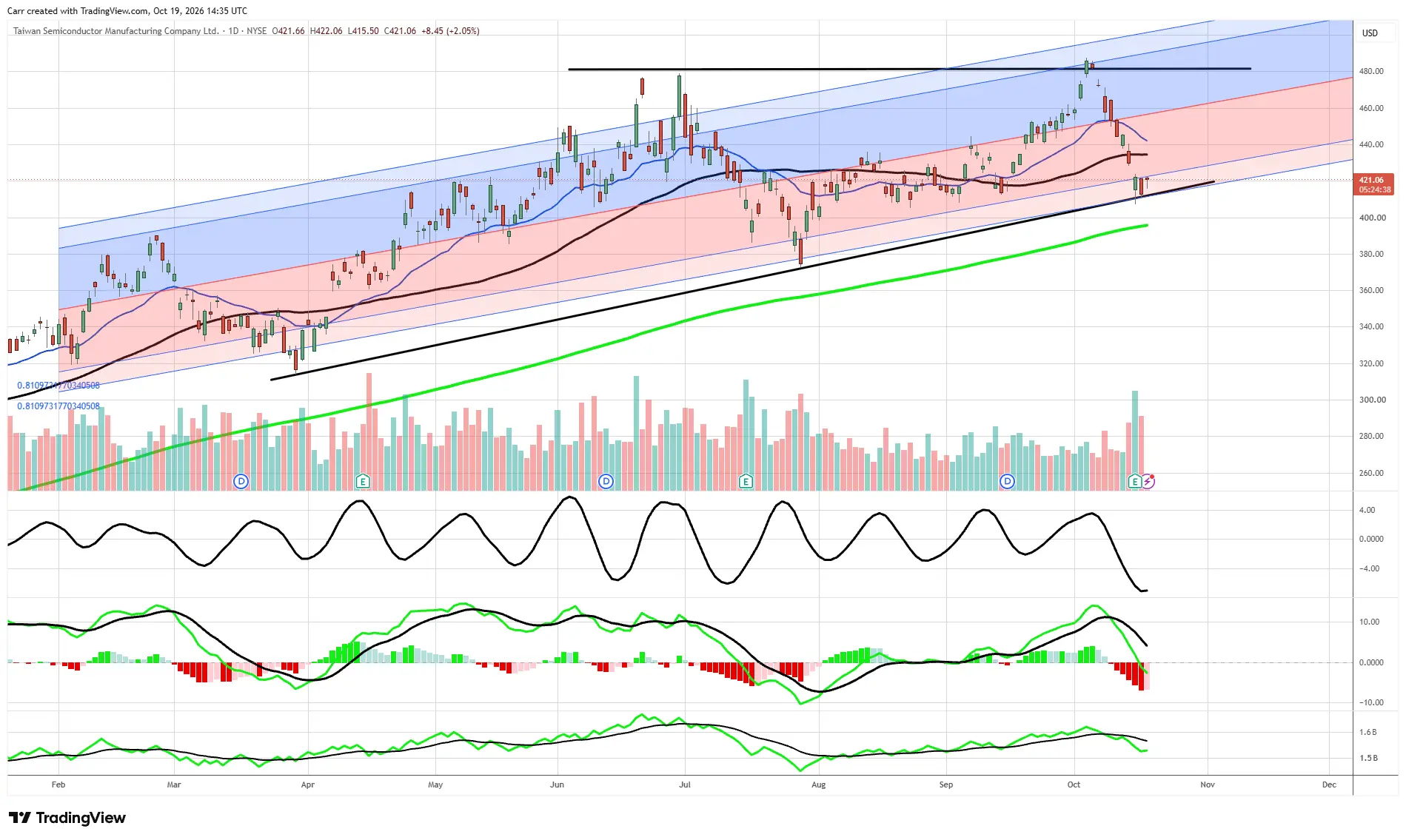
TSMC is a good buy right now due to its projected 44% revenue growth for 2026, driven by strong demand for AI chips, and a current price of $412.61, which is significantly below analyst price targets. The RSI is at 15.409, indicating that the stock is oversold, presenting a potential buying opportunity. The main risk is the recent 5-day price change of -8.98%, suggesting short-term volatility.
Citi
—
2026-10-07
Citi
2026-10-07
目標價
—
Stifel
—
2026-09-01
Stifel
2026-09-01
目標價
—
Needham
$530
2026-07-27
Needham
2026-07-27
目標價
$530
TD Cowen
$440
2026-07-17
TD Cowen
2026-07-17
目標價
$440
DA Davidson
$500
2026-07-17
DA Davidson
2026-07-17
目標價
$500
情境價格取自當年最後一個月度預測區間。機率為固定的模型權重(25 / 50 / 25),不構成保證。
TSMC Reports Strong Q3 Results Driven by AI Demand

TSMC Reports Record Revenue Amid AI Chip Demand Surge

AI Stocks Plummet Amid Rising Interest Rates and Revenue Concerns
Investment Analysis: Micron vs. TSMC
TSMC Plans $60-$64 Billion Investment for Growth
Taiwan Semiconductor Manufacturing Co Ltd is a Taiwan-based integrated circuit foundry service provider. The Company is primarily engaged in integrated circuit manufacturing services. It offers advanced process technologies, specialised process solutions, advanced photomask and silicon stacking, and packaging-related technologies, while supporting a comprehensive design ecosystem. The Company's products serve diverse electronic sectors including artificial intelligence, high-performance computing, wired and wireless communications, automotive and industrial equipment, personal computing, information applications, consumer electronics, smart internet of things, and wearable devices. It operates in the Technology sector.
TSMC is a good buy right now due to its projected 44% revenue growth for 2026, driven by strong demand for AI chips, and a current price of $412.61, which is significantly below analyst price targets. The RSI is at 15.409, indicating that the stock is oversold, presenting a potential buying opportunity. The main risk is the recent 5-day price change of -8.98%, suggesting short-term volatility.
6 analysts cover TSM: 1 rate it Buy, 5 Hold and 0 Sell. The average price target is 313.46.

$TSM: I'm not sure my C&H pattern is correct, but the trendline with its 6 touches certainly is. It doesn't get any cleaner or firmer technically. This is the 2nd biggest chip maker on the planet, 2nd only to $NVDA. Both trade at peer-relative low valuations, both have excellent growth, but $TSM has more than doubled $NVDA's YTD and 12-month returns. #IBDPartner @MarketSurge @InvestorsBusinessDaily Find more like this one yourself using @Marketsurge scanning and alert tools. Try the new "beta" version under $1/day here:
展開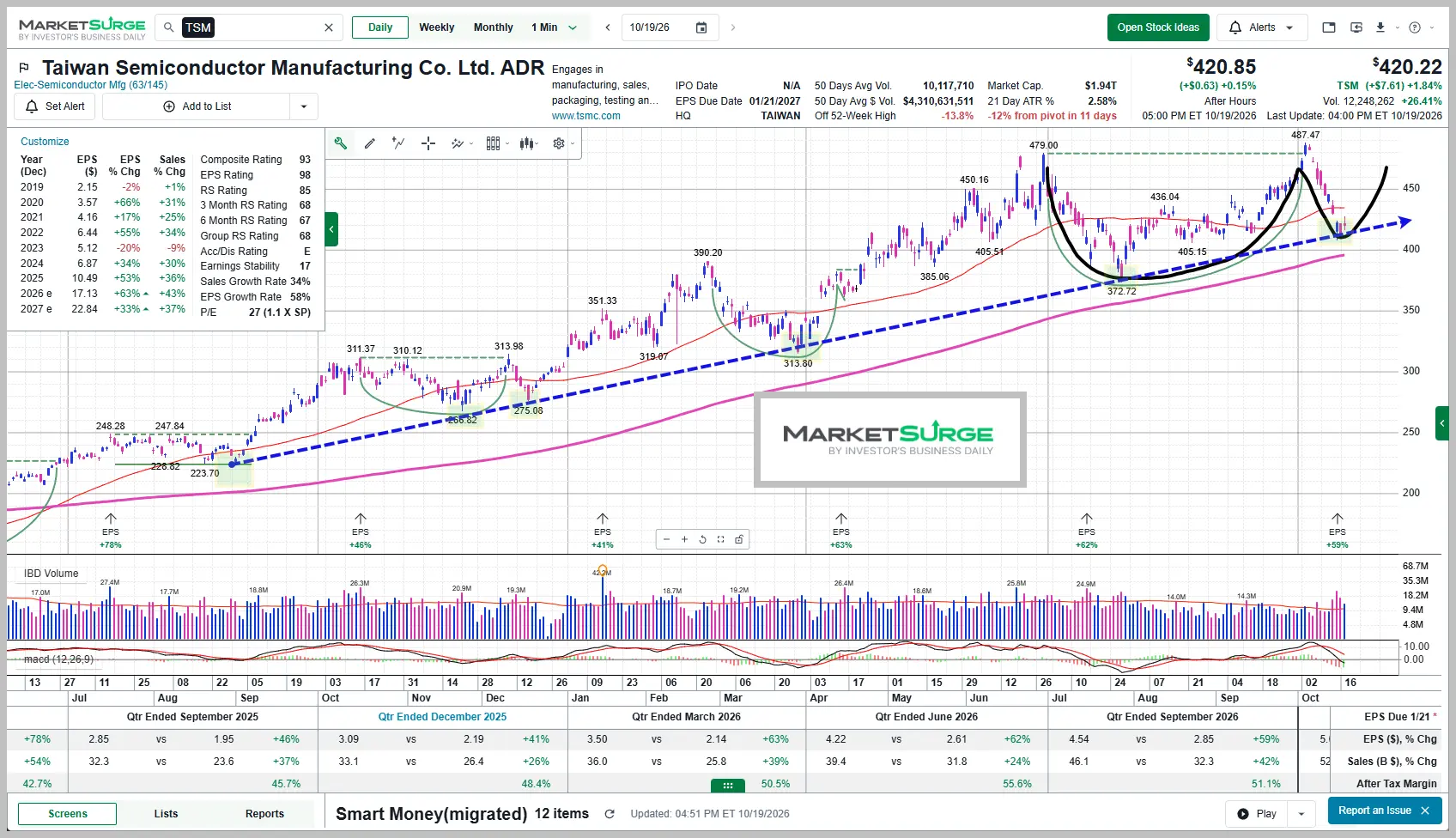

#BitcoinTops$82K Good morning, new week, same question: will this rebound hold, or is it just a temporary calm? Monday opened higher, but the details matter more than the headlines. I went through the overnight data and mapped out a three-path plan so the week has structure before volatility arrives. Overnight snapshot BTC is back near $82,500. Up 0.7% since UTC midnight and 1.3% over the past 24 hours; Nasdaq futures are up more than 1% after tech led last week's decline. The driver was macro: stronger-than-expected China economic data and falling oil prices lifted risk appetite. China Q3 GDP rose 4.5% year over year, above the 4.4% estimate; retail sales rose 1.1%, above the 0.5% expected. Brent crude fell about 1.8% to around $107.87. Asian tech remains shaky. The Nikkei fell 0.8% to 64,799.03, Tokyo Electron dropped 2.1%, and SoftBank fell 3.6%. Taiwan's weighted index fell 1%, TSMC dropped 0.6%; despite China's CXMT expecting strong nine-month profit, its shares still fell more than 7%. Korea was the bright spot: KOSPI rose 1.1% to 5,729.58, but it is still down more than 18% over the past month, far below its June peak of 9,000. So the rebound is real, but it is a rebound inside a damaged tech structure. Can BTC hold key levels BTC is at a decision point. Based on my chart analysis, resistance is at $82,538, followed by $84,049 to $84,250. Support is at $81,000, then $80,443 near the 50-day EMA, and $79,694 near the sweep low. With BTC at $82,500, it is one step from the first resistance, so the next daily close matters more than today's candle. My view is simple. Only a daily close above $82,538 starts to make this rebound a bottom. Before that, it is a retest of a resistance level that has already rejected price twice. Will US tech pressure keep hitting crypto Last week gave a useful answer. Nasdaq fell nearly 5%, KOSPI fell more than 14%, and bitcoin closed down about 1% over five sessions. Crypto showed relative strength, not weakness. But relative strength has limits, and if the AI stock selloff runs another week, it will be tested, especially with the Fed in its quiet period ahead of the October 27-28 meeting. A dense catalyst calendar this week: - Tuesday: SpaceX Q3 results after the close, webcast at 4:30 p.m. ET. - Wednesday: Tesla earnings and the Solana Alpenglow upgrade. - Thursday: Western Digital earnings, a read on storage demand. - Next week: the Fed meets October 27-28, then SanDisk reports October 29. Three paths for this week Path one, add exposure. I only add after confirmation: a daily close above $82,538, then holding that level on a retest. My first target is $84,250, and I will scale in rather than buy all at once. Path two, reduce. If BTC closes below $80,443, or if Nasdaq drops sharply again on earnings-related factors, I will reduce. Below that level, $79,694 and then $78,000 could come into play. The principle is to reduce first and discuss later. Path three, wait. If BTC ranges between $80,400 and $82,500, I stay put. A range with no trigger means preserving energy rather than forcing trades. My own choice this week is path three, while staying ready to execute path one. The data does not yet show a firm bottom, and the best entries often come after the market proves itself. Indicators to keep on one screen Oil, because the drop in crude helped this rebound, and a reversal could end it. The dollar and yields, because the dollar index was near a 10-day low last week. KOSPI and Nikkei, which have been early warning signs of AI pressure. And the market reaction to SpaceX and Tesla on Tuesday and Wednesday. Risk rules I will stick to Fixed risk per trade, stop-loss set before entry, no leverage on losing positions, no new positions in the minutes around earnings releases. The market can move sharply, but the plan should stay the same. #BTC #ETH #NewWeek
展開

AI and semiconductor stocks lost over $1 trillion in a week. Is this pullback just a correction after a big run, or is the AI trade starting to change? As of October 15, the 20 largest AI and semiconductor companies by market cap lost more than $1 trillion combined over four trading days this week. The Philadelphia Semiconductor Index fell about 12% from its early October high, declining for 7 straight sessions. Nvidia fell about 5% over two days, with its market cap shrinking by about $291 billion for the week. There are three main reasons for this selloff: 1. Rate pressure is outweighing AI expectations again U.S. September CPI rose 3.7% year over year, above the 3.6% estimate. Rates may keep rising, and high-valuation tech stocks are naturally hit first. 2. The market is starting to worry about where the money for AI is coming from Funding costs are rising for cloud computing companies like CoreWeave, and investors are concerned about pressure on funding chains, which eventually feeds through to GPU and data center orders. Even with strong fundamentals, Nvidia can hardly avoid this layer of risk entirely. 3. Competition in China's memory chip sector is intensifying Progress in CXMT technology has raised market concerns about memory chip competition and margins, putting pressure on companies like Samsung, SK Hynix, and Micron. I think this is the AI trade shifting from chasing growth to calculating returns, rather than AI demand suddenly disappearing. TSMC still delivered record profits for a sixth straight quarter, showing that industry demand is still there, but strong results no longer necessarily support stock prices. If U.S. Treasury yields keep rising, AI stocks may still face valuation pressure. If rates stabilize and earnings show that capital expenditure can convert into revenue, this correction will be more likely to end. I will focus on cloud provider funding, chip orders, and the next round of earnings guidance rather than rushing to buy the dip. $NVDA $TSM $SKHY $MU DYOR
展開

$TSM Taiwan Semiconductor delivered another record quarter Thursday, but even the world’s largest chip foundry could not outrun the AI selloff. Why the beat was not what the market cared about, and the number that decides what comes next:
展開
本頁僅供研究參考,不構成投資建議。模型可能出錯。過往表現不代表未來結果。