樂
樂觀
樂觀 · 25%NVDA
$275.47
情境價格
$212.210
-9.337 (-4.40%)收盤時
NVIDIA Corporation is an artificial intelligence (AI) infrastructure company. The Company is engaged in accelerated computing to help solve the challenging computational problems. Its segments include Compute & Networking and Graphics. The Compute & Networking segment includes its Data Center accelerated computing and networking platforms and AI solutions and software, and automotive platforms and autonomous and electric vehicle solutions, including software. The Graphics segment includes GeForce GPUs for gaming and personal computers (PCs), and Quadro/NVIDIA RTX GPUs for enterprise workstation graphics. Its technology stack includes the foundational NVIDIA CUDA development platform that runs on all NVIDIA GPUs, as well as hundreds of domain-specific software libraries, frameworks, algorithms, software development kits (SDKs), and application programming interfaces (APIs). Its platforms address four markets, which include Data Center, Gaming, Professional Visualization, and Automotive.
Currently, NVIDIA Corp (NVDA) is not a strong buy due to its low RSI of 19.822, indicating it is oversold, and the significant insider selling activity which increased by 1856.07% over the last month. However, its strong revenue growth, with an expected total revenue of $96 billion for 2026, supports a long-term bullish outlook. The primary risk is the recent decline in stock price, with a 5-day change of -6.61%, suggesting potential volatility in the near term.
BNP Paribas
$345
2026-10-05
BNP Paribas
2026-10-05
目標價
$345
Barclays
$275
2026-10-01
Barclays
2026-10-01
目標價
$275
Truist
$346
2026-08-27
Truist
2026-08-27
目標價
$346
Needham
$300
2026-08-27
Needham
2026-08-27
目標價
$300
RBC Capital
$330
2026-08-27
RBC Capital
2026-08-27
目標價
$330
情境價格取自當年最後一個月度預測區間。機率為固定的模型權重(25 / 50 / 25),不構成保證。
NVIDIA Corporation is an artificial intelligence (AI) infrastructure company. The Company is engaged in accelerated computing to help solve the challenging computational problems. Its segments include Compute & Networking and Graphics. The Compute & Networking segment includes its Data Center accelerated computing and networking platforms and AI solutions and software, and automotive platforms and autonomous and electric vehicle solutions, including software. The Graphics segment includes GeForce GPUs for gaming and personal computers (PCs), and Quadro/NVIDIA RTX GPUs for enterprise workstation graphics. Its technology stack includes the foundational NVIDIA CUDA development platform that runs on all NVIDIA GPUs, as well as hundreds of domain-specific software libraries, frameworks, algorithms, software development kits (SDKs), and application programming interfaces (APIs). Its platforms address four markets, which include Data Center, Gaming, Professional Visualization, and Automotive. It operates in the Technology sector (SEMICONDUCTORS & RELATED DEVICES industry).
Currently, NVIDIA Corp (NVDA) is not a strong buy due to its low RSI of 19.822, indicating it is oversold, and the significant insider selling activity which increased by 1856.07% over the last month. However, its strong revenue growth, with an expected total revenue of $96 billion for 2026, supports a long-term bullish outlook. The primary risk is the recent decline in stock price, with a 5-day change of -6.61%, suggesting potential volatility in the near term.
38 analysts cover NVDA: 21 rate it Buy, 15 Hold and 2 Sell. The average price target is 264.97.


$NVDA tested the top of the buy zone yesterday and it held. We'll likely see a dip into that zone, into the August gap, for a lower-risk accumulation opportunity.
展開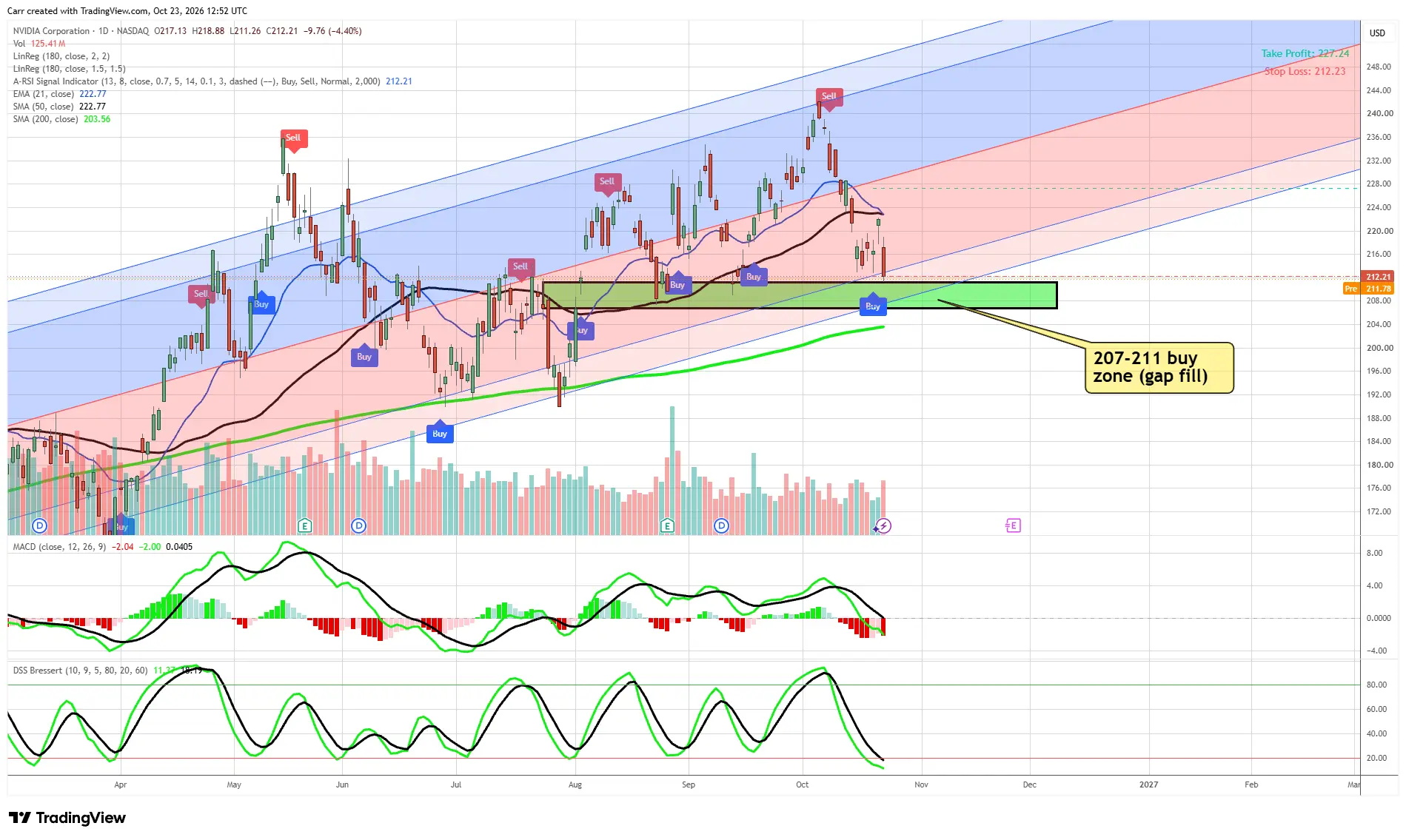

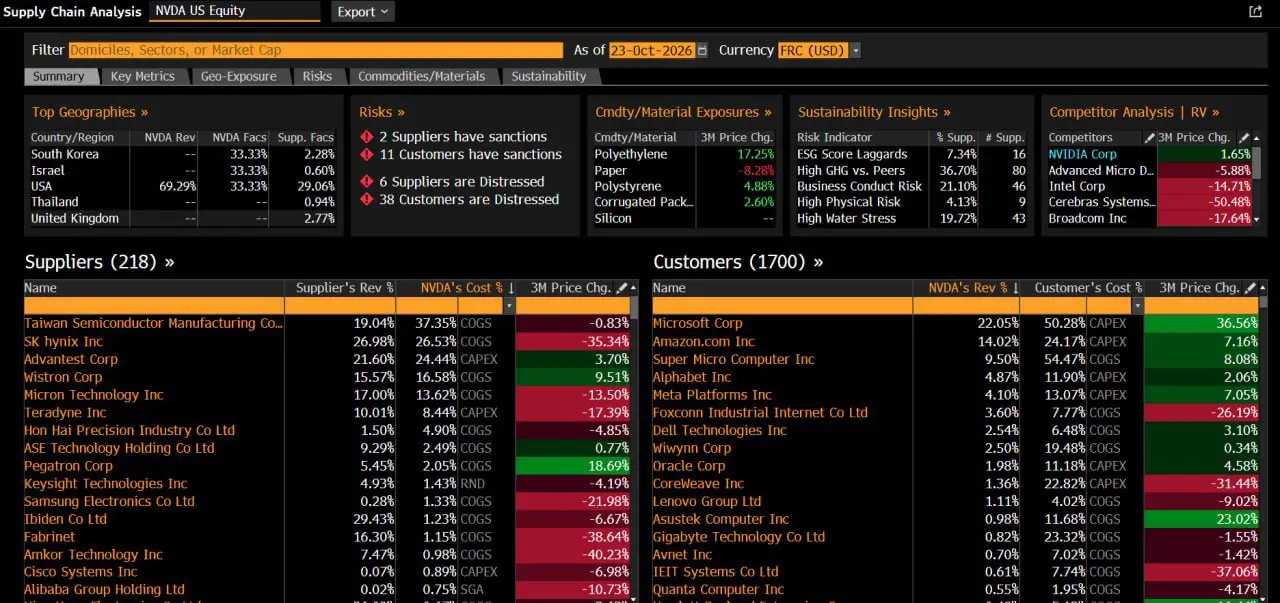
Is the second half of AI investing about to shift? From chasing chips to chasing power, the winners may be changing. In the first half of AI infrastructure, the focus was on who could secure the most advanced chips. In the second half, the focus may be on who can actually power those chips up and keep generating returns. Why? Because compute is not an art piece sitting in a server room. Once servers are powered on, they consume electricity, generate heat, and incur depreciation. Without enough power, customers, and workload demand, even the most expensive equipment can turn into an expensive heater. This means the value center of the AI supply chain may gradually spread. Chips remain important, but grid equipment, transformers, energy storage, cooling systems, and data center operating efficiency may also attract more attention. Still, there is no need to rush to declare the chip era over. Advanced chips still determine how much compute can be delivered per unit of power, and improvements in model efficiency may also reduce the compute needed per task. Growth in power demand and growth in chip demand are not a simple zero-sum tradeoff. The real dividing line is whether supply can match demand. If power buildout cannot keep up with data center expansion, the scarcity of power infrastructure may become more prominent. If compute buildout exceeds customer demand, the market may instead ask whose equipment utilization is higher. So what matters going forward is not which concept is hottest, but who has real orders, deliverable execution capacity, and sustainable returns. **AI investing is not simply a switch from chips to power. It is a shift from competing on expansion to competing on efficiency.** In this race, who do you think will be first to turn a profit? $NVDA #DataCentersMayFaceOversupplyIn2028
展開


Hello everyone. Looking at today's market, as Big Tech earnings season is in full swing, it is clear that the market is at a particularly sensitive juncture. Tesla and Meta's results offer important clues not only for these two companies but also for the future of the entire AI ecosystem. Let us examine this situation with a calm mind from an investor's perspective. First, let us answer the question everyone is asking: do earnings beats always drive stock prices higher? The short answer is: no, absolutely not. In fact, according to recent Zacks research, nearly half (47.3%) of stocks that beat expectations still closed lower on the following trading day. Meta is a recent example. Although the company's revenue reached $64.6 billion, beating expectations and growing 26%, its stock price still faced downward pressure due to rising AI investment costs (2026 capex is projected at $135-145 billion) and one-time legal expenses. The market is no longer just asking "how much did you earn?" but "how effectively are you spending those earnings?" Tesla's situation is slightly different. Although both revenue and EPS beat expectations, its stock fell 3% in after-hours trading. The main reasons are fluctuations in automotive business margins and the fact that the autonomous driving (Robotaxi) narrative has not yet been materially reflected in the company's financial statements. So can AI investment deliver sustainable long-term growth? Over the past few weeks, this question is precisely what has kept the market volatile. Gartner analysts raised a compelling point: mathematically, the AI-related capital expenditure (capex) planned from 2027 to 2030 appears difficult to fully cover with the AI revenue expected from these investments. Meta's stock recently fell more than 7%, and Nvidia fell 4%, essentially because investors are asking: "So much money has been spent—when will it pay off?" However, let us not forget that the AI transformation is a marathon, not a sprint. Short-term profit-taking does not mean the long-term trend is over. Now to the core question: which tech giant am I most optimistic about? For me, the star of this earnings season will be the cloud business segment. Microsoft, Alphabet, and Amazon are scheduled to report results on October 28-29. CFRA analysts expect Google Cloud's growth rate to be between 85% and 90%, a clear sign that AI investment is beginning to translate into tangible revenue. If cloud revenue meets or exceeds expectations, market confidence in AI spending may recover. Apple and Nvidia also deserve special attention. Apple will report on November 2, which will reveal consumer demand for AI and hardware margins. Meanwhile, Nvidia will report on November 18, when we will get the clearest picture of the chip demand underpinning all these investments. In short, friends, the market is currently in a "digestion" phase. The AI narrative remains compelling, but investors now want to see actual financial returns from that narrative. Do not be intimidated by short-term volatility. What matters is being able to see traces of AI investment in these companies' balance sheets. I personally am eagerly awaiting the data the cloud giants will release next week. Do not make decisions based on headlines alone; be sure to do your own research. This article does not constitute investment advice. #ShareWeekly #USEarningsSeason
展開
本頁僅供研究參考,不構成投資建議。模型可能出錯。過往表現不代表未來結果。