
乐
乐观
乐观 · 25%WDC
$80.21
情景价格
$343.670
-10.207 (-2.97%)收盘时
Western Digital Corporation is a developer, manufacturer and provider of data storage devices and solutions on hard disk drives (HDD) technologies. The Company manufactures, markets, and sells data storage devices and solutions through its sales personnel, dealers, distributors, retailers, and subsidiaries. Its portfolio of technology and products addresses end markets: Cloud, Client, and Consumer. Cloud is comprised primarily of products for public or private cloud environments and enterprise customers. Through the Client end market, the Company provides its original equipment manufacturer (OEM) and channel customers with a broad array of high-performance HDD solutions across desktops and notebooks. The Consumer end market offers a range of retail and other end-user products. Its product portfolio includes Internal HDD, Data Center Drives, Data Center Platforms, External Drives, Portable Drives, network-attached storage (NAS) for Home and Office, and Accessories.
Western Digital Corp is currently not a strong buy due to its low RSI of 12.55, indicating oversold conditions, and a significant recent price drop of 16.43% over the past 5 days. However, the company has shown strong revenue growth, with Q4 2026 revenue reaching $3.747 billion and a gross margin of 54.12%. The main risk is the insider selling activity, which has increased by 11088.46% over the last month, signaling potential concerns among insiders about the stock's future performance.
UBS
$470
2026-10-12
UBS
2026-10-12
目标价
$470
Citi
$800
2026-08-07
Citi
2026-08-07
目标价
$800
Morgan Stanley
$676
2026-08-06
Morgan Stanley
2026-08-06
目标价
$676
Baird
$630
2026-08-06
Baird
2026-08-06
目标价
$630
Rosenblatt
$800
2026-08-06
Rosenblatt
2026-08-06
目标价
$800
情景价格取自当年最后一个月度预测区间。概率为固定的模型权重(25 / 50 / 25),不构成保证。
Western Digital Reports 55% Revenue Growth in Q1 FY2027
Western Digital Reports 55% Revenue Growth in Q1 2027

Energy Stocks Surge as Oil Prices Exceed $100 Amid Middle East Tensions

Market Update: Pre-Market Insights for October 23
Moderna Vaccine Data Leak Causes Stock Drop
Western Digital Corporation is a developer, manufacturer and provider of data storage devices and solutions on hard disk drives (HDD) technologies. The Company manufactures, markets, and sells data storage devices and solutions through its sales personnel, dealers, distributors, retailers, and subsidiaries. Its portfolio of technology and products addresses end markets: Cloud, Client, and Consumer. Cloud is comprised primarily of products for public or private cloud environments and enterprise customers. Through the Client end market, the Company provides its original equipment manufacturer (OEM) and channel customers with a broad array of high-performance HDD solutions across desktops and notebooks. The Consumer end market offers a range of retail and other end-user products. Its product portfolio includes Internal HDD, Data Center Drives, Data Center Platforms, External Drives, Portable Drives, network-attached storage (NAS) for Home and Office, and Accessories. It operates in the Technology sector (COMPUTER STORAGE DEVICES industry).
Western Digital Corp is currently not a strong buy due to its low RSI of 12.55, indicating oversold conditions, and a significant recent price drop of 16.43% over the past 5 days. However, the company has shown strong revenue growth, with Q4 2026 revenue reaching $3.747 billion and a gross margin of 54.12%. The main risk is the insider selling activity, which has increased by 11088.46% over the last month, signaling potential concerns among insiders about the stock's future performance.
29 analysts cover WDC: 22 rate it Buy, 7 Hold and 0 Sell. The average price target is 189.74.

#EarningsSeason #USStockEarnings Revenue rose 55%, EPS came in at $4.64 (consensus was 4.09), and next-quarter guidance also came in above expectations. With results like that, where do you think the stock went? The answer is down. $WDC fell 6.4% in yesterday's regular session first, and dropped another five or six points after hours once the earnings came out. I see two reasons: first, AI-related stocks were already being sold off that same day; second, management mentioned rising costs and higher capital spending, and the good news had already been priced in beforehand. Binance's WDC perpetual contract touched a low of 322.5 overnight and has now recovered to around 351. I'm watching two levels: if 322 breaks again, it means the panic isn't over; if it reclaims 375, that's when it can finally catch its breath. That's how the storage names (including $SNDK) look right now — no matter how good the numbers are, it still comes down to whether people are willing to pay this price. Do you think "good earnings but a drop" is a buying opportunity, or does it mean the stock had already run up too much? Personal view, not advice.
展开

$WDC Q1 '27 Earnings Results & Recap • Reported GAAP EPS of $4.64, up 160.67% YoY • Reported revenue of $4.38B, up 55.46% YoY • Western Digital expects Q2FY27 revenue of $5.1B +/- $100M, non-GAAP gross margin of 60%–61%, and diluted net income per common share of $5.80 +/- $0.20.
展开
$WDC reports Q1/FY2027 earnings on October 22nd. WS analysts expect earnings per share of $4.08 on revenue of $4.14B.
展开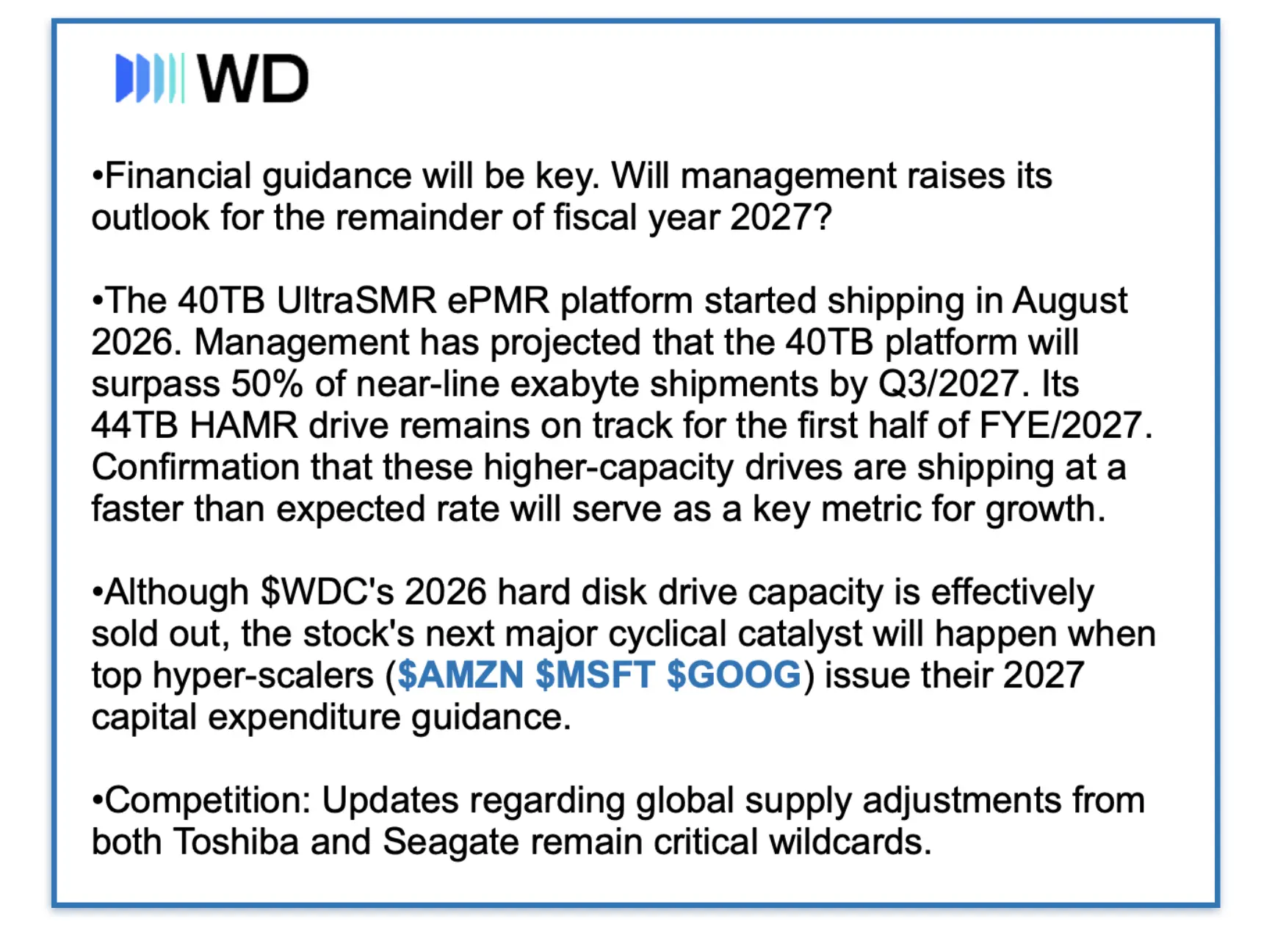

#U.S. Memory Stocks Extend Losses #ShareWeekly AI memory stocks under pressure: the market is reassessing growth, competition, and profitability 💾 AI demand keeps growing, but the memory sector is facing a tougher test. On Friday, October 16, investors' concentrated bets on the AI infrastructure theme ran into another warning. Seagate Technology fell 4.9% to $657.41; Western Digital fell 4.6% to $339.84; Micron fell 5.6%. The Nasdaq Composite dropped 2.1%, reflecting broad pressure on tech stocks. The important shift is that investors are no longer focused only on AI demand forecasts. They are starting to ask a harder question: **if competition intensifies and market expectations cool, which companies can defend their margins?** Three developments driving the selloff 1. Valuations are being tested by higher expectations Memory stocks have benefited from expectations of strong AI-related spending, tight supply, and improving profitability. But after a large rally, if investors believe future growth is already reflected in valuations, even positive business news may not be enough to support the share price. The recent tech selloff has also heightened concerns about the financing and eventual returns of large-scale AI infrastructure investment. 2. Competition could challenge pricing power Reports that China's CXMT has made progress on higher-density DRAM designs have added to concerns about future memory chip competition. Meanwhile, reports that Toshiba plans to expand hard drive capacity have put the HDD supply outlook under scrutiny. These developments do not prove an imminent direct shock to the industry, but they raise new questions about long-term pricing and market share. 3. Different products carry different risks The memory industry is not a homogeneous sector. Micron is involved in DRAM, high-bandwidth memory, and NAND flash; SanDisk focuses on flash storage; Western Digital and Seagate focus on hard drives. Their earnings react differently to memory pricing, enterprise SSD demand, data center orders, and production capacity. 🔬 Where the next wave of opportunity may lie | Company | Key metrics to watch | |---|---| | **Micron (MU)** | HBM demand, memory pricing, and competition | | **SanDisk (SNDK)** | NAND pricing and enterprise SSD adoption | | **Western Digital (WDC)** | HDD supply, pricing, and customer demand | | **Seagate (STX)** | High-capacity HDD shipments and margins | The upcoming earnings reports from Western Digital and Seagate are especially important, because management guidance will help investors assess whether AI-related demand remains strong enough to support current supply and pricing expectations. ⚖️ Bull case and bear case Bull case AI workloads continue to grow, data center operators need more storage, and disciplined production helps support pricing power. As a result, the share price decline may reflect a valuation reset rather than a deterioration in underlying demand. Bear case New capacity, intensifying competition, and rising financing costs squeeze margins, while elevated expectations leave little room for error on performance. In this scenario, even if the memory market keeps growing, shareholder returns could be uneven. 🎯 Signals to watch next Rather than judging the entire sector based on a single trading day, investors may want to track four fundamental indicators: - Pricing: Are the economics of DRAM, HBM, NAND, and HDD continuing to improve? - Demand: Are cloud service and enterprise customers maintaining storage spending? - Margins: Is revenue growth translating into stronger operating profitability? - Supply: Is capacity expansion outpacing demand absorption? If these fundamentals remain healthy while prices stabilize and sentiment improves, confidence in a sustained recovery would be higher. Final view: the opportunity in AI storage has not disappeared, but the market demands stronger evidence that growth can translate into durable profits. The next leaders may be companies that combine technological relevance, pricing discipline, efficient production, and stable cash generation.
展开
本页仅供研究参考,不构成投资建议。模型可能出错。过往表现不代表未来结果。