$10.510
+0.131 (+1.25%)終値時点
XNDU のニュース
XNDU のイベント
D-Wave Quantum CFO Markovich Retires, Greg Golkov Takes Over
Welcome to the latest edition of "Quantum Leap" where The Fly decodes news and activity in the quantum computing space.CFO TRANSITION:D-Wave Quantumannounced that John Markovich is retiring and thus resigning from his position as CFO, effective September 2. Greg Golkov, the company's senior vice president of finance, will become the company's acting CFO and principal financial and principal accounting officer.BOARD ADDITIONS:IonQannounced the appointment of two new board members: technology finance expert Eric Ball, and former SkyWater Technology chairman and SamsungNorth America CEO Timothy Baxter.EXTREME ULTRAVIOLET LITHOGRAPHY:Xanadu Quantumhas announced the next phase of its collaboration with Mitsubishi Chemical to advance semiconductor fabrication technologies using quantum computing algorithms. This next phase is supported by national innovation programs from both the Canadian and Japanese governments, aiming to scale Xanadu and Mitsubishi's previous work in simulating a process in next-generation semiconductor fabrication: extreme ultraviolet lithography. In phase one of Xanadu and Mitsubishi's collaboration, the two companies demonstrated that quantum algorithms can accurately model key aspects of EUV lithography, specifically the optical properties of the photoresists used to etch lithographic patterns. The next phase of the collaboration aims to develop a production-ready workflow that will take parameters derived from Xanadu's quantum computing simulations and integrate them directly into Mitsubishi's multi-scale models to predict blur. Xanadu plans to provide a demonstration and roadmap for how quantum computing can contribute to the development of EUV resist materials through this collaboration. This second phase of the collaboration is being advanced with support from the National Research Council of Canada Industrial Research Assistance Program and Japan's Strategic Innovation Promotion Program. The relevant SIP project is led by the National Institute of Advanced Industrial Science and Technology and the Global Research and Development Center for Business by Quantum-AI Technology. Xanadu has previously received advisory services and more than $800,000 in funding from NRC IRAP, supporting its R&D in quantum computing across several projects.QUANTUM MOONSHOT:Infleqtionsaid it has helped Japan reach a major quantum milestone, supporting a research team led by Professor Kenji Ohmori at the Institute for Molecular Science, part of the National Institutes of Natural Sciences, in launching the country's first operational neutral-atom full-stack quantum computer. Infleqtion was also the only foreign quantum partner selected by the Japan Science and Technology Agency for its Quantum Moonshot program. "This milestone marks a pivotal moment for Japan's quantum ambitions as well as Infleqtion's role in advancing production-ready quantum platforms at scale," said Pranav Gokhale, Chief Technology Officer at Infleqtion. "Bringing a full-stack quantum system into production operation is a meaningful step toward fault-tolerant quantum computing that also serves as strong validation of neutral-atom architecture. Our quantum processing unit delivers the programmability, scalability and fidelity control that next-generation systems demand." As part of the next phase of the Ohmori Moonshot project that has just started in April 2026, the IMS team will focus on improving system integration, stability, and scalability, with the goal of realizing a high-performance neutral-atom fault-tolerant quantum computer with up to 10,000 physical qubits and quantum error detection and correction capabilities. The system is also expected to be made available to external users to support the development of applications and advance quantum error correction research across academia and industry.OCT DEPLOYMENT:Skyloom Global, an IonQ company specializing in the development of space-based optical technology, announced that dozens of additional optical communication terminals, OCTs, have been successfully deployed on orbit. The OCTs were aboard York Space Systems satellites supporting the Space Development Agency's, SDA, Proliferated Warfighter Space Architecture, PWSAERROR CORRECTION PROGRAM:Quantum X Labsannounced new results from its AI-driven quantum error-correction program. The company said, "Quantum computers are highly sensitive to noise, and quantum error correction is widely viewed as a necessary foundation for scaling quantum systems from experimental demonstrations toward reliable, useful computation. QXL's work is focused on one of the central challenges in this transition: developing AI-assisted decoders that can interpret quantum syndrome data efficiently and accurately, and that can continue improving as quantum hardware advances. The latest results were generated using Google'spublic surface-code dataset from a real quantum-hardware experiment. QXL evaluated its updated decoder on a public surface-code configuration using the same cross-validation approach used for Google's published decoder comparisons. In this test, QXL's updated decoder demonstrated improved performance against matching-family benchmarks, including Google's published correlated-matching and PyMatching benchmark results for the same configuration. Importantly, QXL's model was trained exclusively on synthetic samples and was not trained on real hardware shots from the Google dataset. The result supports a key principle behind QXL's technical roadmap: quantum error-correction decoders should not only perform well in controlled simulations, but should also be able to generalize toward real experimental syndrome data. This synthetic-to-real transition is a critical step toward practical QEC workflows that can support future low-latency and eventually real-time decoding. QXL's updated decoder combines quantum-code structure, syndrome information and AI-based error weighting to improve decoder performance while preserving a practical path toward efficient implementation. The latest result supports the relevance of this approach for real-hardware syndrome data and scalable QEC workflows. The AI component is designed for GPU acceleration and integration into broader QEC workflows, supporting QXL's roadmap toward low-latency and eventually real-time decoding. This roadmap includes real-hardware data evaluation, workflows with Nvidiaaccelerated computing and Nvidia CUDA-Q and planned IQCC syndrome experiments to advance more reliable and scalable quantum-computing systems."REGISTERED DIRECT OFFERING:Qtrex Quantumannounced that it has entered into a definitive securities purchase agreement with an existing institutional investor as well as a new global institutional investor for the purchase and sale of 11,111,111 ordinary shares in a registered direct offering. The gross proceeds to the company from the offering are expected to be approximately $10M, before deducting placement agent fees and other estimated offering expenses. The closing of the offering is expected to occur on or about August 21. A.G.P./Alliance Global Partners is acting as the sole placement agent for the offering.ANALYST COMMENTARY:Ascendiant raised the firm's price target on Quantum Computingto $32 from $30 and keeps a Buy rating on the shares. The company reported strong growth in Q2 and issued a strong 2026 outlook, the analyst tells investors in a research note. The firm sees Quantum's revenue growth in 2026 and 2027 being a positive for the stock.Citi increased its price target on Infleqtion to $22 from $20 and keeps a Buy rating on the shares.BMO Capital initiated coverage of D-Wave Quantum with an Outperform rating and $35 price target. The firm told investors that the company is a revolutionary quantum computing company and one of the few in the world that currently has true commercial revenues. BMO Capital believes D-Wave is best positioned in the quantum space to have commercial success given industry first-mover advantage and dual-pronged technology approach.
Significant Increases in Indicative Borrow Rates for Liquid Options
Latest data shows the largest indicative borrow rate increases among liquid option names include: GRANITESHARES 2X LONG PLTR DAILY ETF (PTIR) 8.40% +3.46, Blaize Holdings Inc (BZAI) 11.30% +2.16, Rumble (RUM) 5.80% +1.32, Xanadu Quantum Technologies Limited Class B (XNDU) 11.13% +0.88, Fundrise Innovation Fund, LLC (VCX) 21.79% +0.84, DEFIANCE DAILY TARGET 2X LONG SMCI ETF (SMCX) 13.00% +0.56, Tradr 2X Long QBTS Daily ETF (QBTX) 26.18% +0.42, Trulieve Cannabis Corp (TRLV) 4.59% +0.39, ProShares UltraShort DJ-UBS Natural Gas (KOLD) 10.38% +0.38, and TSLR ETF (TSLR) 10.68% +0.34.
Xanadu Quantum Collaborates with Mitsubishi Chemical to Advance Semiconductor Technology
Xanadu Quantum has announced the next phase of its collaboration with Mitsubishi Chemical to advance semiconductor fabrication technologies using quantum computing algorithms. This next phase is supported by national innovation programs from both the Canadian and Japanese governments, aiming to scale Xanadu and Mitsubishi's previous work in simulating a process in next-generation semiconductor fabrication: extreme ultraviolet lithography. In phase one of Xanadu and Mitsubishi's collaboration, the two companies demonstrated that quantum algorithms can accurately model key aspects of EUV lithography, specifically the optical properties of the photoresists used to etch lithographic patterns. The next phase of the collaboration aims to develop a production-ready workflow that will take parameters derived from Xanadu's quantum computing simulations and integrate them directly into Mitsubishi's multi-scale models to predict blur. The result will be a fault-tolerant quantum computing-ready software pipeline designed to identify materials that prevent blurring and secure a competitive advantage in semiconductor manufacturing. Xanadu plans to provide a concrete demonstration and roadmap for how quantum computing can contribute to the development of EUV resist materials through this collaboration. This second phase of the collaboration is being advanced with support from the National Research Council of Canada Industrial Research Assistance Program and Japan's Strategic Innovation Promotion Program. The relevant SIP project is led by the National Institute of Advanced Industrial Science and Technology and the Global Research and Development Center for Business by Quantum-AI Technology. Xanadu has previously received advisory services and more than $800,000 in funding from NRC IRAP, supporting its R&D in quantum computing across several projects, which helped lay the groundwork for this advancement.
Quantinuum Partners with Oracle for Quantum Computing
Welcome to the latest edition of "Quantum Leap" where The Fly decodes news and activity in the quantum computing space.HYBRID QUANTUM-AI INFRASTRUCTURE:Quantinuumand Oracleentered a multi-year strategic partnership to bring quantum computing to Oracle Cloud Infrastructure. Under the partnership, OCI customers will be able to directly access Quantinuum's Helios through OCI's quantum service, alongside OCI's high-performance computing and GPU infrastructure. Together, Quantinuum and Oracle plan to explore how hybrid quantum-AI infrastructure could address some challenges facing enterprises and broaden access for universities and research institutions advancing scientific discovery and education. The partnership reflects a shared vision that the future of enterprise computing will be built on the convergence of AI, classical supercomputing, and quantum computing.ANNEALING QUANTUM COMPUTERS:D-Wave Quantumhas been awarded up to C$300,000 in funding from the National Research Council of Canada's Applied Quantum Computing Challenge program to advance annealing quantum computing software for commercial applications. In collaboration with the NRC, D-Wave's team located at its Quantum Centre of Engineering Excellence in Burnaby, British Columbia, will develop next-generation software and algorithms to help organizations solve larger, more complex optimization problems on D-Wave's Advantage annealing quantum computers. The project will create new graph minor-embedding algorithms for D-Wave's Zephyr topology and integrate them into the company's open-source Ocean software development kit.GRID CONTINGENCY:Infleqtionnoted that Eatonselected the company to support new research evaluating how quantum computing can improve the resilience of the U.S. electrical grid. As part of an Eaton award from the Air Force Research Laboratory, Infleqtion received a subcontract to apply quantum computing hardware to support grid contingency analysis. Infleqtion and Eaton aim to advance reliability analysis used by utilities to predict and prevent cascading power outages.LAWSUIT:Quantum Cyberannounced that it has filed a complaint in the Supreme Court of the State of New York, County of New York, against White Diamond Research, Adam Gefvert and Stocktwits. The complaint asserts causes of action for market manipulation and conspiracy to commit market manipulation under New York General Business Law Section 339, and for defamation, seeking damages over $5.69M, together with exemplary damages. The company said, "As alleged in the complaint, on or about June 29, 2026, White Diamond published a report concerning the Company that contained false, misleading, and disparaging statements about the Company's business and its Chief Executive Officer. The complaint alleges that White Diamond markets itself publicly as "an Independent institutional-grade research" firm, while burying on a tertiary webpage on its own site it discloses that White Diamond "along with its clients, affiliates, and related entities, may have a short position in the securities discussed and stand to realize significant gains in the event that the price of the stock declines." The complaint further alleges, that both White Diamond and Mr. Gefvert likely profited from the effects of the report through short positions in QUCY. The complaint further alleges that Stocktwits, which the Company had retained to disseminate its business and press releases, made a deliberate editorial decision to publish and amplify the White Diamond report through the "News" section of its platform to its more than five million registered users, and subsequently pushed the content onto Apple Stocks and Yahoo! Finance, making it available to hundreds of millions of additional readers. According to the complaint, at no point in its publication, dissemination, or accompanying commentary did Stocktwits or its staff writer include any disclaimer regarding White Diamond's position as a proprietary short-selling market participant. The complaint alleges that this omission led readers to the false impression that White Diamond was an independent research firm with no financial interest in a decline in QUCY's share price, and that Stocktwits published the report with reckless disregard for its truth or falsity."GOVERNMENT CONTRACTS:IonQwas awarded a $28M contract extension through the Defense Advanced Research Projects Agency, or DARPA, It's About Time program. Under the program, IonQ will advance its scalable clock production capabilities for its Evergreen-05 optical atomic clocks and deliver 125 units to U.S. government customers. The clocks are designed for mission-critical applications including radar, secure communications, and precision geolocation. Originally developed under DARPA's Robust Optical Clock Network program, IonQ's Evergreen-05 is a compact, fully integrated optical atomic clock with a 5-liter, shoe box-sized form factor. It delivers timing stability of 50 femtoseconds at one second and nanosecond holdover over 10 days-projecting to a timing error of less than one second over 30M years. The company also reported that Capella, an IonQ company, has been awarded a contract under the National Reconnaissance Office's, or NRO, Radar Commercial Augmentation program. Under the contract, the company will provide commercial synthetic aperture radar imagery and data services in support of U.S. national security missions. Through the RCA program, Capella will provide commercial radar imagery and data services.ANALYST COMMENTARY:Bernstein raised the firm's price target on Quantinuum to $95 from $94 and reiterated an Outperform rating on the shares. The company reported Q2 earnings after the market closed on Tuesday beating consensus on revenue and EPS and raising full year revenue guidance but missing slightly on Adjusted EBITDA. The results also included the IPO related costs including SBC that was triggered by the IPO. The stock was down slightly in the aftermarket. But the Quantinuum story is less about the near term numbers and more about the company's ability to deliver their fourth and fifth generation quantum computers on schedule, Bernstein added.Jefferies lowered the firm's price target on Rigetti Computingto $18 from $20 and maintained a Hold rating on the shares following Q2 results. The firm remains constructive on long-term progress, but maintained a Hold rating as execution against near-term fidelity targets is still needed, the analyst told investors in a post-earnings note.Roth Capital cut its price target on D-Wave Quantum to $30 from $40 and kept a Buy rating on the shares. D-Wave Quantum noted growing commercial traction in its QCaaS business and expanding system sales pipeline, with performance advantages and a broad annealing and gate-model offering supporting its competitive positioning, the analyst noted.Morgan Stanley boosted its price target on IonQto $49 from $48.50 and affirmed an Equal Weight rating on the shares. Q2 results showed strong commercial momentum, with Tempo deployments driving upside and RPO expanding, the analyst told investors.Canaccord lowered the firm's price target on Xanadu Quantumto $34 from $45 and backed a Buy rating on the shares. The firm noted they posted their second quarter since going public and said its revenue growth was driven primarily by DARPA Stage B program revenue, though it declined sequentially from $2.8M on lower grant revenue in the quarter. Canaccord said its long-term thesis on Xanadu remains intact. Xanadu is the only public pure-play photonic quantum computing company.
Xanadu Reports Q2 Revenue of $1.51M, Below Consensus
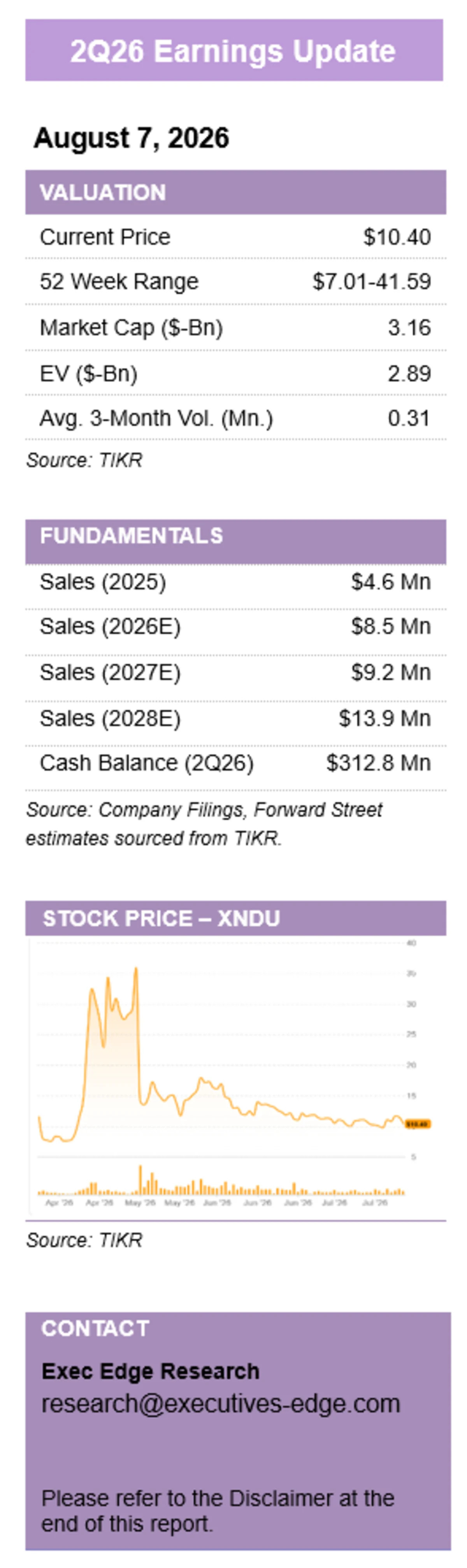
Reports Q2 revenue $1.51M, consensus $2M. "Every decision at Xanadu comes back to one mission: building quantum computers that are useful and available to people everywhere," said Christian Weedbrook, Founder and Chief Executive Officer of Xanadu. "This quarter, we made real progress on that mission. We set new performance records across some of our core photonic components, and we're pairing that hardware progress with software breakthroughs that we believe make quantum algorithms more efficient today."
本ページは調査目的であり、投資助言ではありません。モデルは誤ることがあります。過去の実績は将来の成果を保証しません。