
強
強気
強気 · 25%BZ
$20.59
シナリオ価格
$16.460
+0.049 (+0.30%)終値時点
Kanzhun Ltd is a holding company principally engaged in the provision of recruitment and job hunting services. The Company connects job seekers and enterprise users mainly through its interactive BOSS Zhipin mobile app. The Company provides enterprise users with direct recruitment services that allow enterprise users to post jobs, receive personalized candidate recommendations, engage in direct communication and receive resume upon mutual consent. The Company provides job seekers with job seeking services that allow job seekers to receive job recommendations, initiate direct chats and deliver resumes upon mutual consent.
Kanzhun Ltd appears to be a good buy right now, supported by a strong RSI of 90.34 indicating overbought conditions, which suggests momentum, and a forward P/E of 9.93, indicating the stock is relatively undervalued compared to its earnings potential. The company has shown significant revenue growth of 14.1% year-over-year in Q2 2026, with net income soaring by 173.1%, although this was primarily driven by investment income. The main risk is the decline in operating cash flow by 10.2% due to increased spending, which could affect future profitability.
シナリオ価格は本年の最終月次予想レンジです。確率はモデルの固定ウェイト(25 / 50 / 25)であり、保証ではありません。

KANZHUN Limited Announces Resignation of Non-Executive Director
BOSS Zhipin Reports Strong Q2 2026 Earnings Growth
Kanzhun Limited Announces Executive Rotation to Enhance Governance Structure

Key Wall Street Calls on Friday

Kanzhun Reports Strong Q2, Profit Growth Driven by Investment Gains
Kanzhun Ltd is a holding company principally engaged in the provision of recruitment and job hunting services. The Company connects job seekers and enterprise users mainly through its interactive BOSS Zhipin mobile app. The Company provides enterprise users with direct recruitment services that allow enterprise users to post jobs, receive personalized candidate recommendations, engage in direct communication and receive resume upon mutual consent. The Company provides job seekers with job seeking services that allow job seekers to receive job recommendations, initiate direct chats and deliver resumes upon mutual consent. It operates in the Industrials sector.
Kanzhun Ltd appears to be a good buy right now, supported by a strong RSI of 90.34 indicating overbought conditions, which suggests momentum, and a forward P/E of 9.93, indicating the stock is relatively undervalued compared to its earnings potential. The company has shown significant revenue growth of 14.1% year-over-year in Q2 2026, with net income soaring by 173.1%, although this was primarily driven by investment income. The main risk is the decline in operating cash flow by 10.2% due to increased spending, which could affect future profitability.

Can Bitcoin be longed now? When will the decline stop? Rising oil prices, pressure on gold, and pressure on US stocks are all factors contributing to the drop in Bitcoin and gold. Currently, Bitcoin has good support at 80000 and 78000, and gold also has decent support at 4000. Let's start with oil. When oil prices rise, inflation expectations follow, and the Fed's rate cut plans get pushed back. Seeing this, capital shifts away because the opportunity cost of holding non-yielding assets like Bitcoin and gold becomes higher. When gold loses momentum, Bitcoin loses its reference point too — the two are strongly correlated, and if one can't hold, the other struggles as well. Now look at US stocks. When US stocks come under pressure, institutions' first reaction is to reduce risk exposure, selling liquid assets for cash. Bitcoin has a relatively small market cap and high volatility, so it often gets treated as an ATM and sold first. That's why bearish signals from US stocks transmit to crypto faster than many people expect. So when will the decline stop? Watch two key signals. First, whether oil prices can stabilize and stop climbing — once inflation expectations ease, capital will dare to come back. Second, US stocks need to stabilize first, with institutions no longer panic selling, before Bitcoin gets a chance to breathe. The 80000 level is the dividing line between bulls and bears — if it holds, there's a rebound; if it breaks, 78000 will have to absorb another round. Same logic for gold at 4000 — if this psychological threshold isn't broken, precious metals and crypto can still support each other for a while. As I said, patience matters more than anything. Entering at key levels offers much better risk-reward. $BTC $BZ
もっと見る

Bitcoin Falls Below $81,000: Oil Hits 7-Month High, Macro Pressure Returns Market recap: As of 13:00 on October 24, BTC traded around $80,940 (24h -0.44%), slipping back below the $81,000 level. Overnight, Brent crude closed up 3.14% at $116.72 per barrel, a 7-month high. The three major New York stock indices all closed lower, with the Nasdaq posting its largest single-day drop since June, and risk-asset pressure spilling over into crypto markets. Bull and bear logic: - Bears in control: International oil prices surged on Middle East tensions and supply disruption concerns (WTI +3.82% to $103.27), raising inflation expectations and narrowing room for rate cuts; gold fell about 4% this week, with safe-haven assets adjusting in tandem, pointing to an overall tightening liquidity environment; after spot Bitcoin ETFs saw $635 million in single-day net outflows last week, fund sentiment still needs time to recover. - Bull defense line: BTC's 90-day return remains positive (about +25%), and the medium- to long-term trend is intact; selling pressure has not notably increased after the drop below $81,000, and short-term oversold conditions suggest some technical repair demand. Key levels: - Support: $80,900 (recent low zone) → $80,000 round number; a break below opens the way to $78,400 (prior heavy-volume area); - Resistance: $81,500 → $82,560 (technical confirmation level); rebound momentum is limited until that level is reclaimed on volume. Risk note: The above is a midday market snapshot for October 24. Middle East tensions and oil price swings carry high uncertainty. All analysis is for reference only and does not constitute investment advice.
もっと見る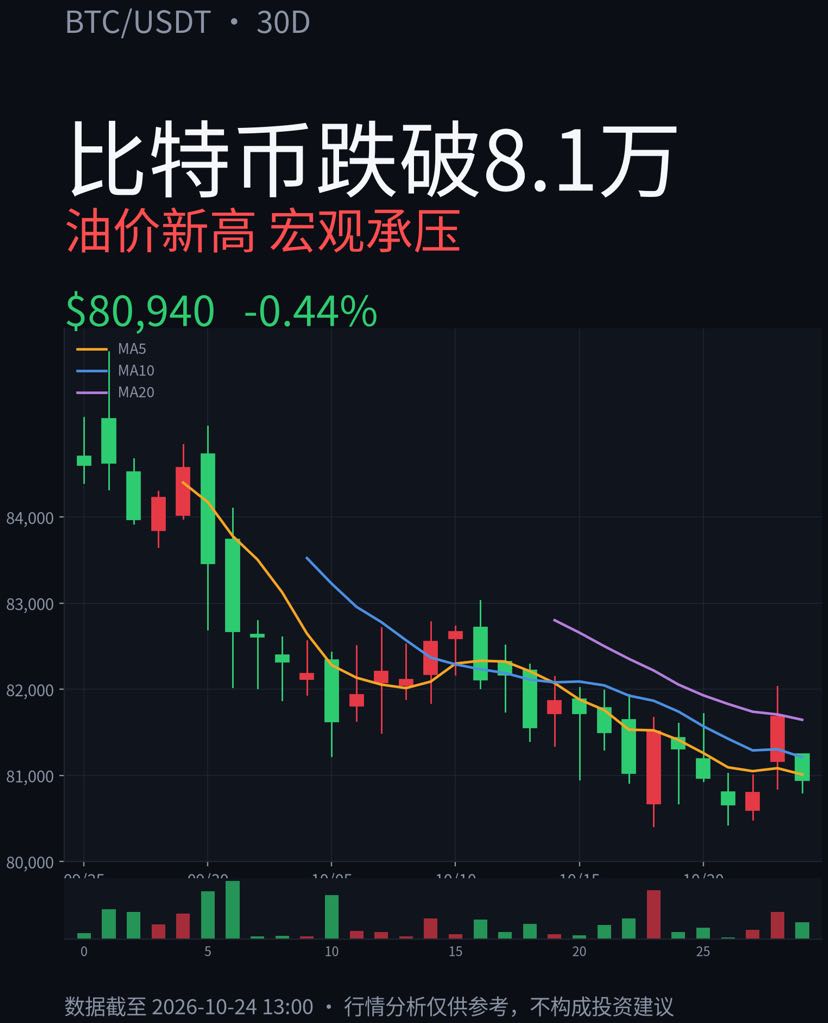

In the past, you only needed to remember one line: "The government steps in to suppress oil prices, so the bulls should run." On October 22, Trump tore up that line — he didn't come to push prices down, he came to spend money: invoking the Defense Production Act, designating oil production, refining, pipelines, and reserves as "critical national defense resources." Don't rush to declare the supply crisis over. Look at three accounts: actual funding is only $150 million — a new refinery takes at least five years from approval to operation; the memo names no specific projects and sets no funding scale; the U.S. produces 13.6 million barrels per day, the world's largest — what's missing isn't capacity, it's the ability to refine diesel: diesel has surged to a record $6.32 per gallon. The truth is hidden in the calendar. November 3 midterm elections, gasoline at $4.26 per gallon, economic approval at just 36%. On the surface it's national defense; in reality it's votes. What truly prices oil is the missiles in Hormuz — the U.S. and Israel have already drawn up plans for post-election airstrikes on Iran, and Brent has climbed to $114. In plain terms: The DPA is a placebo written for voters, not a supply plan written for the market. More than $20 of geopolitical premium is already baked into oil prices, and paper and physical markets continue to diverge — the premium enters on missiles and exits on headlines. So I am clearly bearish on oil in the medium term. Huatai has already laid out the playbook: Sell rallies, buy call options for protection. Meanwhile Saudi exports rose 7.9% month-on-month in August, and Middle East loadings have recovered to 80% of pre-war levels. If the airstrike scenario doesn't materialize, the giveback will be much faster than the rally. There is only one line for admitting I'm wrong: If after the election the U.S. and Israel really do launch large-scale airstrikes on Iran and the strait is effectively shut, the logic gets reset entirely. Verification point: November 3 — either the votes or the missiles will land first. He isn't expanding oil capacity — he's buying insurance for the midterm elections. Direction is set: oil price bearish correction, verdict on November 3. (CLUSDT) (BZUSDT) #TrumpInvokesDefenseProductionActToExpandOilCapacity
もっと見る
Micron Technology fell 6.26% to $856.49 on October 22, as rising oil prices and concerns about AI spending weighed on technology stocks. The Nasdaq Composite dropped 2.6%, while the S&P 500 fell 1.2%. The wider sell-off suggests investors are becoming more cautious, particularly about companies that depend on continued growth in AI investment. Brent crude climbed above $112 a barrel, raising concerns about further disruptions to oil supplies. Before the conflict began, oil traded around $72. Higher oil prices can push inflation up and make it harder for central banks to cut interest rates. Although Treasury yields fell on Thursday, they remain above their prewar levels. For Micron, the concern is whether these conditions could eventually affect demand for its memory chips. Building AI infrastructure requires significant spending on data centres, computing equipment and electricity. If borrowing remains expensive, some companies may take longer to expand or reconsider how much they can afford to spend. Meta Adds to Investor Concerns Meta Platforms offers another reason for investors to pay attention. The company remains committed to AI investment, but its latest results showed negative free cash flow for the first time since 2012. It also outlined plans to raise money through a new class of stock. Negative free cash flow does not necessarily mean a company is in trouble. It can happen when a business spends heavily on future growth. However, it does show how demanding AI investment can be, even for large technology companies. Meta's plan to raise equity may also reflect a desire to manage its financing needs, although the available information does not show that lenders are becoming less willing to provide credit. What This Means for Micron The AI investment boom is not necessarily slowing down. Meta's plans suggest that major technology companies still want to expand. The question is whether they can maintain their current spending pace. If oil prices ease and AI investments continue to deliver results, demand for Micron's chips could remain strong. But if energy costs and financing pressures persist, companies may become more careful with future spending. For now, Micron's decline highlights a growing concern among investors: AI demand may remain strong, but the cost of supporting that growth matters just as much. $rMU $BZ
もっと見る

Will oil prices rise after the Shaybah oil field was hit? Let me be direct: with the Trump election coming up, Brent crude at $105 looks high. To win re-election, Trump needs more support, and the easiest place to gain votes is among the American public. To win that support, he has to address prices and inflation. High oil prices are bad for the broader economy and for Trump's election prospects. On the 19th, the Houthis announced six strikes within 48 hours, targeting the Shaybah oil field, the Yanbu oil facilities, and the Aramco headquarters complex in Dhahran. They claimed hits caused fires and warned of continued strikes on Saudi oil facilities. Clearly, this round of strikes did not move oil prices higher. Note: Saudi officials have not confirmed a large-scale shutdown of the field's main production wells, and this point is very important.
もっと見る
本ページは調査目的であり、投資助言ではありません。モデルは誤ることがあります。過去の実績は将来の成果を保証しません。