
A
Alcista
Alcista · 25%CSCO
$65.54
Precio del escenario
$97.040
+2.921 (+3.01%)Al cierre
Cisco Systems, Inc. designs and sells a range of technologies that power the Internet. The Company is integrating its product portfolios across networking, security, collaboration, applications and cloud. The Company's segments include the Americas; Europe, Middle East, and Africa (EMEA), and Asia Pacific, Japan, and China (APJC). Its Networking product category represents its core networking technologies of switching, routing, wireless, fifth generation (5G), silicon, optics solutions and compute products. Its Security product category consists of its cloud and application security, industrial security, network security, and user and device security offerings. Its Collaboration product category consists of its meetings, collaboration devices, calling, contact center and platform as a service (CPaaS) offering. Its Observability product category consists of its full stack observability offerings.
Cisco Systems Inc is a good buy right now, trading at $97.04, which is significantly below the analyst price targets of $125 and $133. The stock has shown a year-to-date increase of 27.62%, indicating strong performance. The forward P/E ratio of 16.64 suggests that the stock is reasonably valued compared to its growth prospects. However, the main risk is the recent downgrade from Evercore ISI, which lowered its price target to $130, indicating potential volatility ahead.
HSBC
$133
2026-11-17
HSBC
2026-11-17
Precio objetivo
$133
DZ Bank
$125
2026-11-17
DZ Bank
2026-11-17
Precio objetivo
$125
Truist
$127
2026-11-13
Truist
2026-11-13
Precio objetivo
$127
Rosenblatt
$140
2026-11-13
Rosenblatt
2026-11-13
Precio objetivo
$140
Piper Sandler
$112
2026-11-13
Piper Sandler
2026-11-13
Precio objetivo
$112
Los precios por escenario son la última banda de previsión mensual del año en curso. Las probabilidades son pesos fijos del modelo (25 / 50 / 25), no garantías.
Huawei Convicted on Multiple Federal Charges in New York
Nvidia CFO Adjusts Financing Strategy to Protect Shareholders

Nvidia CFO Kress Steers Company During CEO Transition
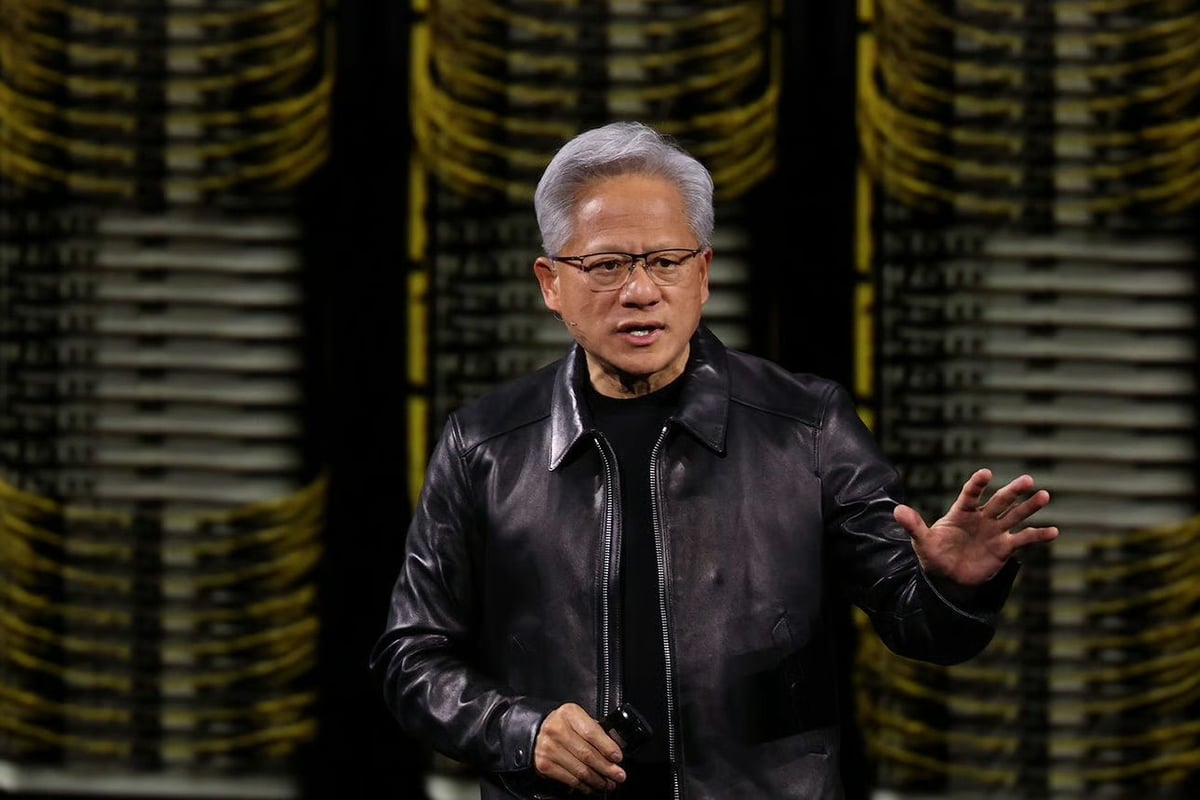
Jensen Huang's Return to Nvidia Raises Concerns
CrowdStrike Acquires Zscaler for $43.9 Billion in All-Stock Deal
Cisco Systems, Inc. designs and sells a range of technologies that power the Internet. The Company is integrating its product portfolios across networking, security, collaboration, applications and cloud. The Company's segments include the Americas; Europe, Middle East, and Africa (EMEA), and Asia Pacific, Japan, and China (APJC). Its Networking product category represents its core networking technologies of switching, routing, wireless, fifth generation (5G), silicon, optics solutions and compute products. Its Security product category consists of its cloud and application security, industrial security, network security, and user and device security offerings. Its Collaboration product category consists of its meetings, collaboration devices, calling, contact center and platform as a service (CPaaS) offering. Its Observability product category consists of its full stack observability offerings. It operates in the Technology sector (COMPUTER COMMUNICATIONS EQUIPMENT industry).
Cisco Systems Inc is a good buy right now, trading at $97.04, which is significantly below the analyst price targets of $125 and $133. The stock has shown a year-to-date increase of 27.62%, indicating strong performance. The forward P/E ratio of 16.64 suggests that the stock is reasonably valued compared to its growth prospects. However, the main risk is the recent downgrade from Evercore ISI, which lowered its price target to $130, indicating potential volatility ahead.
27 analysts cover CSCO: 19 rate it Buy, 8 Hold and 0 Sell. The average price target is 91.30.

Cisco just raised the AI networking bar: fiscal Q1 revenue $18.5B, up 24% y/y, EPS $1.40 up 40%, full year guide raised to $74.8B to $75.8B, and AI infrastructure revenue from hyperscalers now seen at $9B. $CSCO $NVDA
Mostrar más
$CSCO | Wells Fargo Maintains Cisco at Overweight with $130 PT on AI Networking Growth and Campus Upgrade Cycle Wells Fargo stays bullish as AI networking momentum, strong guidance, and campus refresh tailwinds support continued upside. Follow @tenet_research for more analyst insights on other tickers.
Mostrar más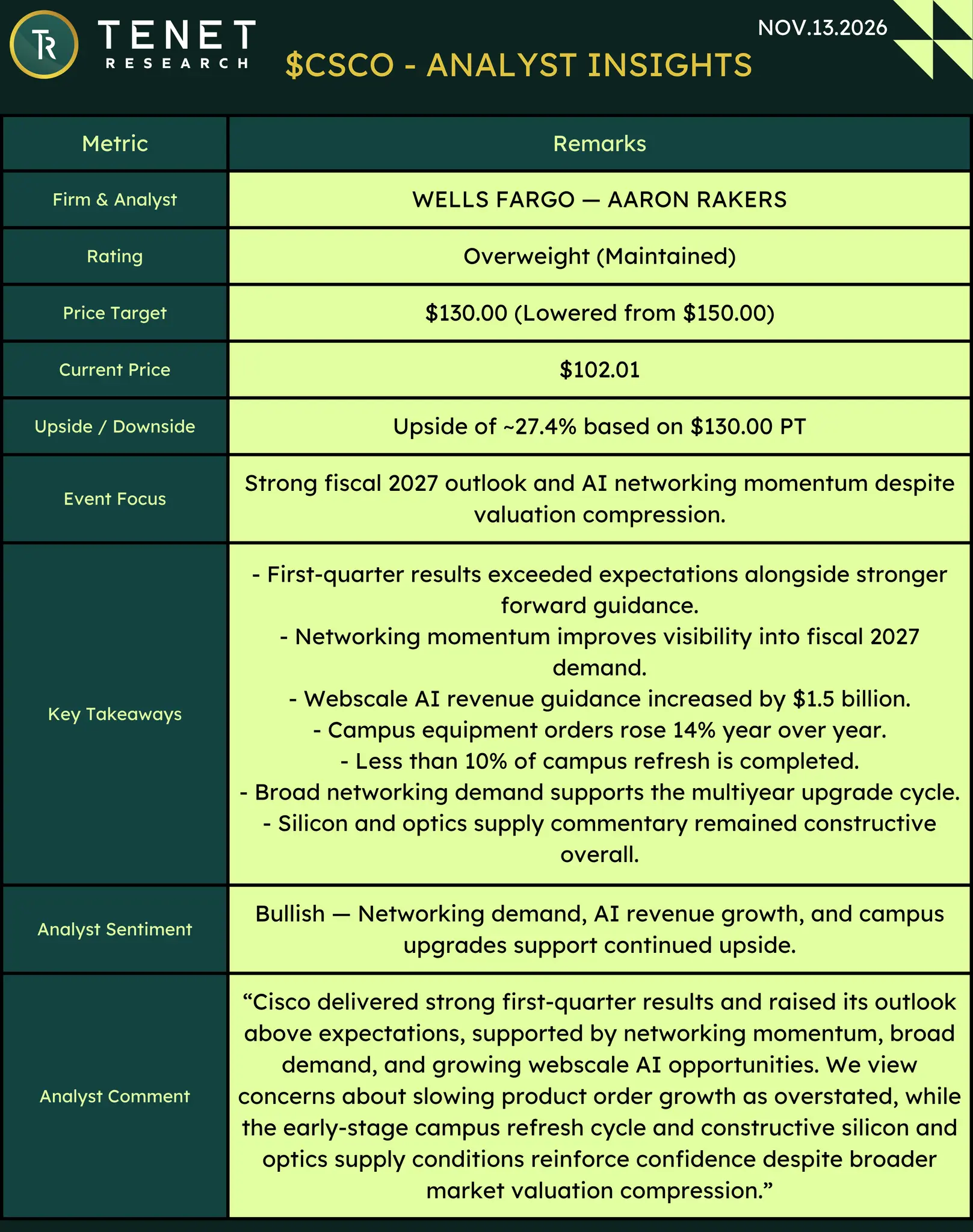

I remember the Nasdaq bubble—from 1995 to 2000 it rose more than tenfold. Cisco was the "infrastructure star" back then, and now Nvidia stands in that position. The most dangerous moment is when you're heavily positioned with unrealized gains: people become conservative and don't dare add when they should. I plan to enter in batches and trim if it breaks below key levels. Maybe I'm wrong—I'll wait to be proven wrong. Worth watching for those following the Nasdaq.
Mostrar más

US stocks face a key week: can inflation data and major tech earnings restore market confidence? With investors facing growing uncertainty around inflation, interest rates, and AI infrastructure spending, US equities are heading into another important week. Tech stocks have struggled recently, with the Nasdaq down for four consecutive weeks. Despite a small rebound on Friday, the broader market remains under pressure. 📊 Three key events to watch next week: 1️⃣ CPI and PPI inflation data: Strong jobs data has heightened concerns that inflation remains elevated and the Fed may adopt tighter policy. Softer inflation readings could help revive bullish sentiment. 2️⃣ CoreWeave earnings: Investors will closely watch AI infrastructure spending, financing conditions, capital expenditure, and GPU deployment. Strong guidance could boost confidence in the broader AI sector. 3️⃣ Applied Materials and Cisco earnings: Semiconductor demand and AI networking revenue will be key indicators to help judge whether massive AI investments are translating into sustainable business growth. ⚠️ What could go wrong? - Higher-than-expected inflation could increase rate pressure. - Rising financing costs could hurt AI infrastructure companies. - Weak guidance could trigger further pullbacks in tech stocks. - Semiconductor valuations could face risk if earnings expectations are revised lower. 🚀 Bullish scenario: Cooling inflation, strong earnings, and improving AI infrastructure demand could drive a tech rebound. 🐻 Bearish scenario: Persistent inflation, growing financing concerns, and disappointing corporate guidance could extend the current market pullback. My view: The coming week could be a major test for the AI and semiconductor rally. Investors should focus not only on earnings figures but also on forward guidance, financing conditions, and actual AI demand. The market needs more than promises about AI growth — it needs real revenue, sustainable profitability, and stronger confidence. Stay cautious, manage risk, and let the data guide your decisions. What do you think? Will US tech stocks rebound next week, or are we in for another pullback? 📉📈
Mostrar más

Next week, can AI trades emerge from the gloom? US tech stocks suffered a sharp selloff this week, and the AI investment boom is facing a dual test from changes in the policy environment and wavering confidence in capital markets. Although chip stocks rebounded on Friday, the Nasdaq remains in a technical correction range, and doubts about returns on AI infrastructure investment, financing capacity, and future growth prospects have not dissipated. Looking ahead to next week, US October CPI, PPI, and earnings from companies including CoreWeave, Applied Materials, and Cisco will be important factors affecting market direction. At the same time, whether the US-Iran conflict can avoid further escalation and whether shipping through the Strait of Hormuz can resume will also affect international oil prices and global inflation expectations. CPI to test December rate hike bets Next Tuesday, the US will release October CPI, and on Friday it will release October PPI. With expectations for Federal Reserve monetary policy clearly shifting, the two inflation readings will be important evidence for judging the future path of interest rates. US inflation pressure is still being affected by factors including energy prices and tariff costs. Meanwhile, the latest nonfarm payrolls data came in strong, further weakening market expectations for the Fed to shift toward easing in the near term. After the employment report, bets in interest rate futures markets on a 25 basis point Fed rate hike in December increased noticeably. According to the CME FedWatch tool, market expectations for a December hike are now close to 80%. Economists generally expect US headline and core CPI to both rise 0.3% month over month in October. ING believes such an increase would be enough to make a December hike a relatively high-probability event. Nick Rees, head of macro research at Monex, said that unless next Tuesday's CPI is clearly below expectations or November nonfarm payrolls show a major downside surprise, expectations for a 25 basis point Fed hike in December may be largely priced in by the market before the policy meeting. For investors, if inflation reaccelerates, the market may further raise rate hike expectations. With tech valuations under pressure and rising sensitivity to financing costs, this would add further pressure on growth stocks. AI investment logic faces repricing The political landscape after the midterm elections is bringing new uncertainty to the AI supply chain. Energy consumption, environmental issues, and community impact caused by data center construction have become important election issues, and investors are beginning to worry that related projects may face stricter regulation and local approval limits in the future. This concern intensified on Thursday, with the S&P 500 information technology sector falling 7.3% in a single day and the Philadelphia Semiconductor Index plunging 12.2%, both marking their largest one-day drops in more than six years. The Nasdaq fell 5.5% that day and was nearly 12% below its record high set in October, entering a technical correction range. The pressure on tech stocks is not only regulatory risk. The previously continuous expansion of AI investment has already raised market concerns about return on capital, financing capacity, and cash flow. As data center construction costs continue to rise, investors are paying closer attention to whether massive capital expenditure can actually translate into real revenue and profit. Keith Lerner, chief investment officer at Truist Advisory Services, noted that the performance gap between tech stocks and the S&P 500 over the past month has reached its largest level since May 2002, suggesting investors appear to be collectively avoiding tech stocks, with market buying clearly insufficient.
Mostrar más
Esta página es solo para investigación y no constituye asesoramiento de inversión. Los modelos pueden equivocarse. El rendimiento pasado no garantiza resultados futuros.