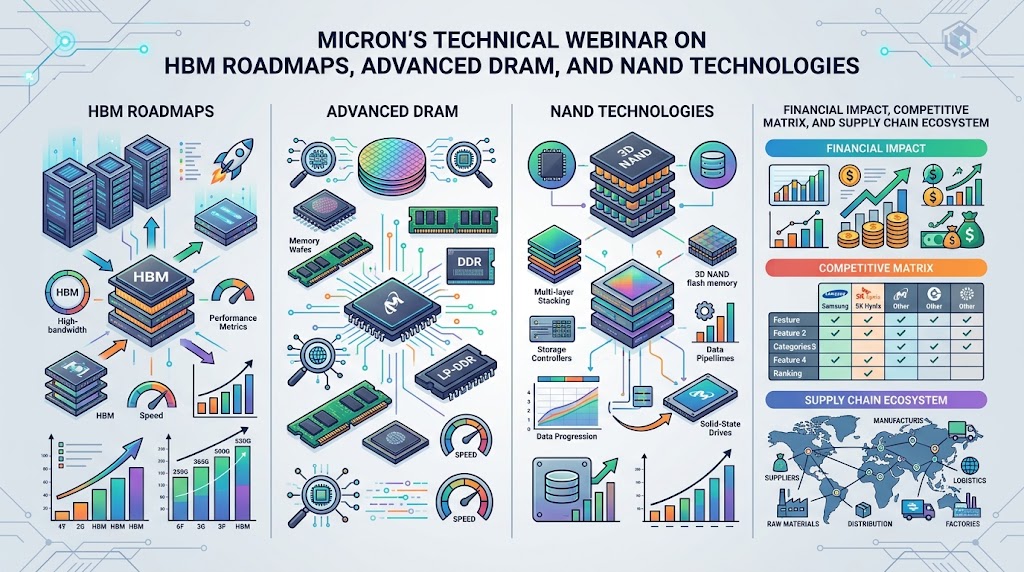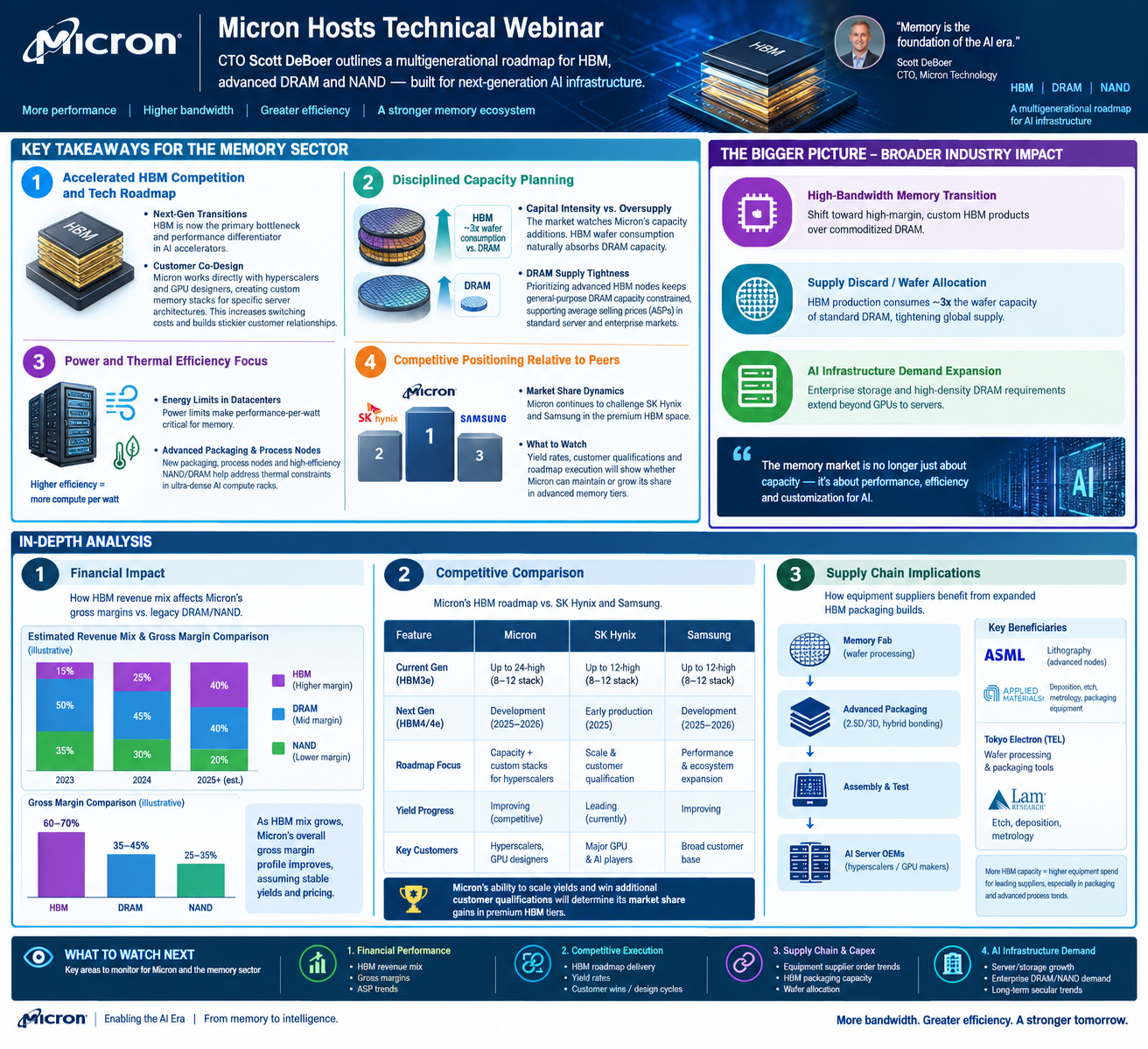



#MicronHostsTechnicalWebinar Micron Technology CTO Scott DeBoer hosted a technical webinar highlighting a key inflection point for the memory industry. The presentation focused on a multi-generation roadmap, including high-bandwidth memory (HBM), advanced DRAM, and NAND technologies designed to support next-generation AI infrastructure. Here is what this signals for Micron and the broader memory market: Memory Industry Takeaways 1. HBM Competition Accelerates Alongside the Technology Roadmap * Next-Generation Transition: The emphasis on HBM innovation underscores that high-bandwidth memory has become the primary bottleneck and performance differentiator for AI accelerators. * Customer Co-Design: Micron's focus on co-designing hardware directly with major hyperscalers and GPU designers indicates the market is moving away from commoditized memory. Memory stacks tailored to specific server architectures are creating higher switching costs and stronger customer relationships. 2. Disciplined Capacity Planning * Capital Intensity and Oversupply: The market is scrutinizing Micron's capacity expansion. Higher HBM wafer consumption naturally absorbs DRAM capacity. * Tight DRAM Supply: Prioritizing advanced HBM nodes keeps general-purpose DRAM capacity constrained across the industry, which helps support average selling prices in the standard server and enterprise memory markets. 3. Focus on Energy and Thermal Efficiency * Data Center Power Constraints: Power limits in data centers make performance-per-watt a key metric for memory. Advances in advanced packaging, process nodes, and energy-efficient NAND/DRAM help address thermal constraints in ultra-high-density AI racks. 4. Competitive Positioning Relative to Peers * Market Share Dynamics: Micron continues to challenge incumbents SK Hynix and Samsung in high-end HBM. Technical updates on yields, customer qualification, and roadmap execution will indicate whether Micron can maintain or grow its share in advanced memory. Broader Industry Implications High-Bandwidth Memory Transition Shifting toward higher-margin custom HBM products rather than commoditized DRAM. Supply Displacement / Wafer Allocation HBM production consumes roughly 3x the wafer capacity of standard DRAM, tightening global supply. AI Infrastructure Demand Expansion Enterprise storage and high-density DRAM demand extends beyond GPUs into servers. Questions for Further Discussion For further discussion, consider analyzing: 1. Financial Impact: How the HBM revenue mix affects Micron's gross margins compared with traditional DRAM/NAND. 2. Competitive Comparison: A detailed comparison of Micron's HBM roadmap versus SK Hynix and Samsung. 3. Supply Chain Impact: How equipment suppliers (such as ASML or Applied Materials) benefit from HBM packaging capacity expansion. $HBM $DRAM $SKHY $SAMSUNG
Mehr anzeigen