

Semiconductor Stocks After Nvidia Earnings: Why Chips Are Falling and How to Invest Now
Nvidia beat with $115.8B in revenue, yet chip stocks sit 34% below their June peak. Why semiconductor stocks fell, memory risk, valuations, how to invest.

Key Takeaway
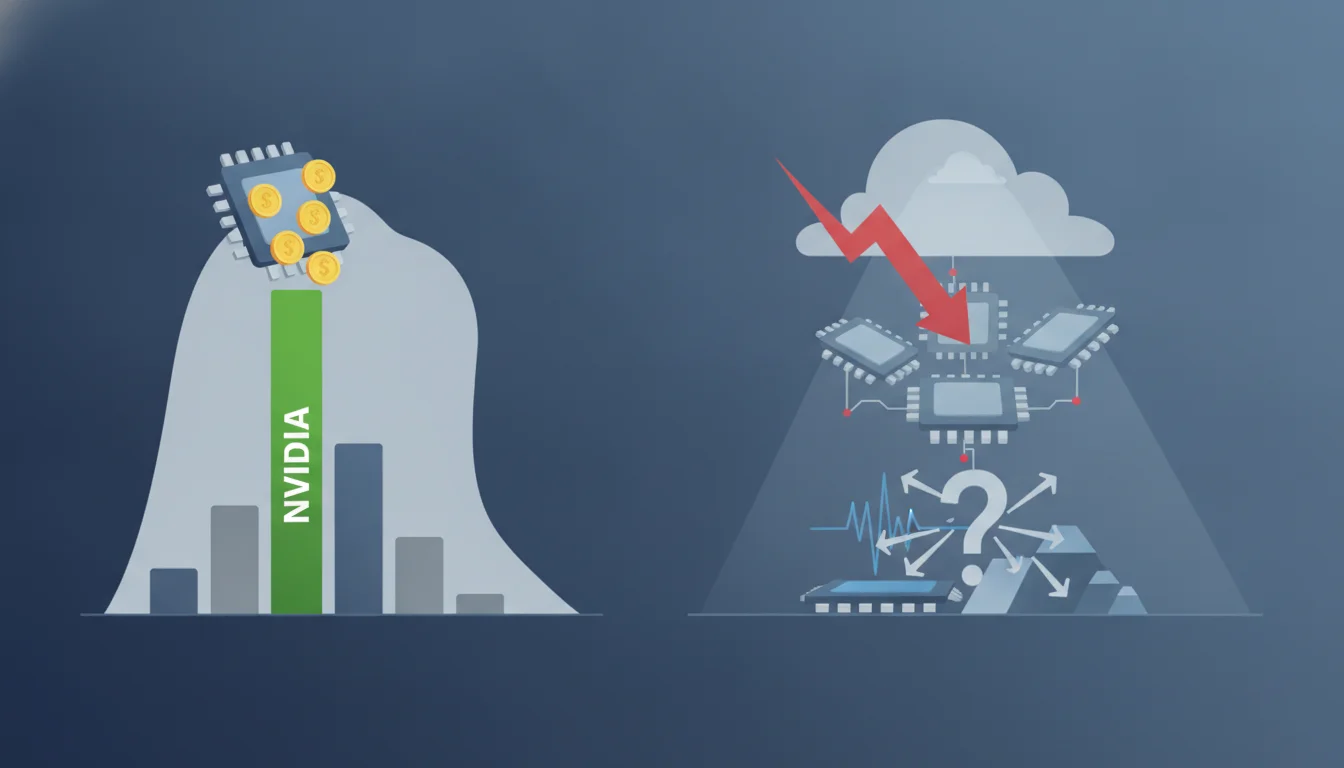
Semiconductor stocks enter the second half of November 2026 in a strange position. Nvidia just reported fiscal third-quarter revenue of $115.8 billion, up 103% from a year earlier, and guided to about $130 billion for the next quarter, according to the company's November 17 earnings release. Yet the chip sector is deep in a correction. Reuters reported on November 16 that the Philadelphia Semiconductor Index (SOX) more than doubled this year through late June, then fell about 34% from its peak, even though it was still up more than 35% year to date. On November 16 alone, the index dropped 5.28% and closed below 10,000 for the first time since November 10, according to Seoul Economic Daily.
That gap between blowout fundamentals and falling prices is the central puzzle for anyone researching semiconductor stocks right now. The selling has had several drivers at once: doubts about the return on AI capital spending, the abrupt resignation of Nvidia chief executive Jensen Huang on November 12, a Federal Reserve that has turned back toward rate hikes, tighter export rules, and heavy supply of new AI equity ahead of Anthropic's expected Nasdaq debut. None of these factors is the same as a collapse in chip demand, and the reported numbers from Nvidia, TSMC, Broadcom, AMD and Micron all show demand is still extremely strong.
This guide explains what Nvidia's results do and do not tell investors about the whole chip sector, how the different parts of the semiconductor value chain behave, why the memory cycle and Fed policy matter more than most stock-pick lists admit, and how to build a position with risk controls. Market data are as of the November 17, 2026 close (America/New_York) unless noted. This is general education, not personalized investment advice.
What Nvidia's Earnings Say About the Chip Sector
The headline numbers beat the bar
Nvidia's release showed data center revenue of $107.6 billion, up 110% year over year, and a non-GAAP gross margin of 74.9%. Non-GAAP earnings per share came in at $2.68, against a Bloomberg consensus of $2.47 cited by Yahoo Finance, and revenue topped the Bloomberg consensus of roughly $109 billion. The company also added $150 billion to its share repurchase authorization, leaving about $227.3 billion available at quarter end. On the earnings call, interim CEO Colette Kress raised the company's fiscal 2028 revenue growth outlook to about 75% from 70%, according to Yahoo Finance's live coverage, and said "Our momentum is real." The stock had closed the regular session at $155.46, down 0.44%, per Motley Fool data, then traded higher after hours.
What the guidance assumes
The fourth-quarter guide of $130 billion, plus or minus 3%, includes an extra week in the quarter, and Nvidia expects gross margins of 71% to 72%, a step down from the third quarter. Both the third-quarter results and the fourth-quarter outlook assume zero data center compute revenue from China, according to the release. That matters for the rest of the sector because it means Nvidia's growth is being generated almost entirely by U.S. hyperscalers, sovereign AI projects and other non-China buyers. Investors should read the margin step-down as a reminder that even the strongest chip franchise is not immune to mix shifts and ramp costs as new platforms such as Vera Rubin scale.
Why one company's beat no longer lifts every chip
For most of 2023 through mid-2026, a strong Nvidia report tended to pull the whole semiconductor complex higher. That relationship has loosened. After the November 17 report, Yahoo Finance noted that AMD and Broadcom rose more than 1% after hours and TSMC gained about 2%, a muted response compared with the size of the beat. The market is now asking a more specific question: which chip companies will keep earning these margins in 2027 and 2028, and which are riding a cyclical peak? That shift from a single "AI trade" to a stock-by-stock debate is the most important thing for investors to understand.
Why Semiconductor Stocks Sold Off Despite Strong Demand
AI capex doubts and concentration
The bull case for chips rests on hyperscaler spending. Barclays expects hyperscaler capital expenditures to reach about $1.3 trillion in 2027, according to Reuters. The problem is that a handful of buyers account for a large share of that spend, and investors increasingly want proof that AI services will generate enough revenue to justify it. Whenever a large customer hints at slowing data center builds, the whole supply chain reprices. That concentration risk explains why chip stocks can fall sharply even while the latest quarter looks spectacular.
Key-person risk and governance at the sector leader
Nvidia announced on November 12 that Jensen Huang had resigned as president, CEO and director, effective immediately, while an independent board committee was investigating personal-conduct matters reported by the media. The company did not give a reason in its filing. Colette Kress became interim CEO while remaining CFO, and former Synopsys CEO Harvey C. Jones became board chair. On the November 17 call, Jones said the board would not reinstate Huang and had formed a national security and export control oversight committee, per Yahoo Finance. According to the SF Standard, the stock closed at $173.73 on November 11 and opened at $151.00 on November 12. Because Nvidia is the largest weight in most semiconductor ETFs, leadership uncertainty there spills directly into the sector.
Rates, regulation and supply of new AI stock
The Federal Reserve raised its target range by a quarter point to 3.75% to 4.00% on September 16, its first hike since 2023, and held there on October 28 with two dissenters favoring another increase. St. Louis Fed President Alberto Musalem said on November 17 that several more hikes may be needed before spring, according to CNBC. Higher discount rates hit long-duration growth stocks hardest, and chips are priced on earnings expected years out. Reuters also cited worries that Democrats' strong midterm results could bring stricter data center regulation, while Anthropic's large IPO is pulling capital away from existing AI holdings. Each factor is a valuation headwind rather than a demand signal.
Understanding the Semiconductor Value Chain
Designers, foundries and equipment makers
"Semiconductor stocks" covers very different businesses. Fabless designers such as Nvidia, AMD and Broadcom create chips but outsource production. Foundries, led by TSMC, manufacture chips for others and earn returns tied to utilization and leading-edge process leadership. Equipment makers such as ASML sell the machines that make chips, and their revenue follows customer capex budgets with a lag. Integrated manufacturers such as Intel do both design and production. When investors buy a broad chip ETF, they own all of these models at once, each with a different cycle.
TSMC as the sector's real-time gauge
TSMC publishes monthly sales, which makes it the best high-frequency read on chip demand. Its October revenue was NT$586.89 billion, up 59.7% from a year earlier, and January-to-October revenue was up 43.3%, according to its November 10 filing. In the third quarter, TSMC reported revenue of $46.72 billion, up 41.2% in U.S. dollar terms, a gross margin of 66.4%, and guided fourth-quarter revenue to $52.3 billion to $54.3 billion. Leading-edge nodes are doing the heavy lifting, with 3-nanometer accounting for 33% of wafer revenue and 2-nanometer already at 8%. As long as these figures keep rising, the demand story remains intact regardless of daily price swings.
Custom silicon and the second-source story
Not every AI dollar goes to Nvidia. Broadcom reported fiscal third-quarter revenue of $29.6 billion, up 86%, with AI semiconductor revenue of $16.7 billion, up 221%, and guided to about $21.7 billion of AI revenue in the fourth quarter. Much of that comes from custom accelerators designed with hyperscalers. AMD reported third-quarter revenue of $13.38 billion, up 45%, with data center revenue nearly doubling to $8.55 billion, and guided fourth-quarter revenue to about $17 billion. These results show that large buyers are actively diversifying suppliers, which spreads the AI opportunity but also caps the pricing power of any single vendor.
The Memory Cycle: Biggest Upside and Biggest Risk
Record margins at Micron
Memory is where the semiconductor cycle is most extreme. Micron reported fiscal fourth-quarter revenue of $54.23 billion with a non-GAAP gross margin of 87.0%, and guided the next quarter to $61.5 billion, plus or minus $1.5 billion, with a non-GAAP gross margin of about 86.25%, according to its September 30 release. Margins at that level are unprecedented for a memory maker. Secondary reports from the earnings call said much of Micron's 2027 high-bandwidth memory (HBM) supply was already contracted at higher prices. That visibility is a genuine change from past cycles, when memory pricing could swing within a single quarter.
Why memory has always been boom and bust
History still deserves respect. DRAM and NAND are closer to commodities than logic chips, and prices are set by the balance of supply and demand across a small group of producers. When margins are this high, every producer has an incentive to add capacity, and that capacity tends to arrive just as demand growth cools. Micron shares were down 31% from the Nasdaq's October 6 record high, Reuters reported, despite the company's guidance. The market is effectively pricing in the possibility that today's margins are a peak. Investors who buy memory stocks should size positions for that volatility.
What would signal the cycle turning
The signs to watch are fairly concrete. A slowdown in contract price increases, rising inventory days at producers or customers, capex budgets that grow faster than demand forecasts, and any softening in HBM qualification news would all suggest the peak is near. Micron's next earnings report, expected in mid-December based on its usual calendar but not yet confirmed by the company, will be the key checkpoint. Until then, memory stocks are likely to trade with the highest beta in the sector.
Are Semiconductor Stocks Cheap Now?
Forward multiples near multi-year lows
On paper, the sector looks inexpensive. Reuters reported that the S&P 500 semiconductor group's forward price-to-earnings ratio was near its lowest level in at least six years, using LSEG Datastream data. A Motley Fool analysis in early November put Nvidia around 13 times forward earnings and Broadcom around 17 times, compared with about 19 times for the S&P 500. Those numbers are striking for companies growing revenue at 80% to 100% a year.
The earnings-estimate trap
Low multiples only help if the "E" holds. LSEG data cited by Reuters showed analysts expecting semiconductor earnings to grow about 125% in 2026 and about 65% in 2027. That second number is the one doing the work in every cheap-looking forward P/E. If 2027 growth comes in at half the forecast, today's 13 times quickly becomes something closer to 20 times. Cyclical stocks often look cheapest at the top of the cycle precisely because peak earnings are in the denominator. Investors should test valuations against a lower-growth scenario before concluding a stock is a bargain.
Comparing chip ETFs with single stocks
The two most popular chip ETFs, VanEck Semiconductor (SMH) and iShares Semiconductor (SOXX), both give broad exposure, but their methodologies produce meaningfully different concentrations in Nvidia, TSMC and Broadcom. Investors should check current holdings on each issuer's website before choosing. An ETF removes the risk of picking the wrong company, but it does not remove sector cyclicality, and it still leaves a large weight in the leaders. Single stocks give more control over exposure to memory, equipment or custom silicon, at the cost of company-specific risk such as Nvidia's leadership change.
Policy, China and Export Controls
The new remote-compute rule
On November 16, the Commerce Department's Bureau of Industry and Security issued an interim final rule extending controls on advanced AI chips to overseas data centers that provide remote compute to Chinese companies, according to CNBC and Digitimes. Facilities above a set performance threshold need a license, existing providers have 90 days to apply, and U.S.-headquartered firms are exempt but must report monthly. The rule also formally rescinded the earlier AI Diffusion Rule. Export policy has become a recurring source of headline risk for the entire sector.
Zero China in the guidance cuts both ways
Because Nvidia's guidance already assumes no China data center compute revenue, further restrictions may have limited direct impact on its near-term numbers. The bigger exposure sits elsewhere in the chain. Equipment makers and some analog and mobile chip companies still rely on China for a significant share of revenue, so policy escalation can hit them harder than the AI leaders. Any easing, by contrast, would be pure upside to Nvidia's current outlook. Investors should check each holding's geographic revenue mix in its latest annual report.
Watch for retaliation and supply chain responses
Policy risk is not only about U.S. rules. Chinese responses, including controls on critical minerals or procurement guidance for domestic buyers, have hit chip stocks in previous years. Taiwan concentration is another long-running risk given TSMC's role in leading-edge production. These are not reasons to avoid the sector entirely, but they argue for keeping position sizes moderate and avoiding the assumption that any single region's demand is guaranteed.
How to Invest in Semiconductor Stocks Now
Map the catalyst calendar
The next four weeks are dense with events that could set the sector's direction into year-end. Key dates confirmed by companies or the Fed, plus one estimate, include:
- November 19: Anthropic's expected Nasdaq debut, a test of appetite for new AI supply
- December 8–9: FOMC meeting with a new Summary of Economic Projections, per the Federal Reserve
- December 9: Broadcom fourth-quarter results after the close, per Broadcom investor relations
- Around December 10: TSMC's November monthly revenue
- Mid-December (estimate): Micron's fiscal first-quarter report
Stage entries and size by sub-sector
Given the volatility, buying in stages over several weeks or around these events is usually more forgiving than one large purchase. A practical approach is to decide in advance how much of a portfolio belongs in semiconductors in total, then split that allocation by sub-sector according to how much cyclicality you can tolerate. Foundries and diversified designers have historically been steadier than memory and equipment. Writing down an exit rule, such as a maximum drawdown or a fundamental trigger like falling monthly TSMC sales, keeps decisions from being driven by the next headline.
Use tools to stay disciplined
Monitoring monthly sales data, earnings dates and Fed decisions is tedious, which is where automation can help. Alphio Scheduled Task lets investors set up recurring checks, such as a weekly summary of semiconductor price moves or an alert ahead of each catalyst, so the research process keeps running even when markets are noisy.

Conclusion
Nvidia's latest quarter confirmed that AI chip demand is still growing at an extraordinary pace, and the numbers from TSMC, Broadcom, AMD and Micron point the same way. The sell-off in semiconductor stocks is mostly about everything around that demand: concentrated customer spending, leadership turmoil at the sector's largest company, a Federal Reserve leaning toward higher rates, export controls and the risk that 2027 earnings forecasts are too optimistic. The SOX's roughly 34% drawdown from its June peak shows how fast sentiment can turn, even while the index remains well ahead for the year.
For investors, the right response is neither panic nor blind dip-buying. Separate the sector into designers, foundries, memory and equipment, stress-test valuations against slower growth, and let December's catalysts inform the next step. Investors who want help putting a plan into practice can use Alphio Conversational Trading to ask plain-English questions about chip holdings and earnings dates, or explore Autonomous Trading to run a rules-based strategy within risk limits they set themselves. Whatever approach you choose, define position size and exit rules before the next headline moves the tape.
FAQs
Why are semiconductor stocks falling in November 2026?
Chip stocks have fallen on doubts about the return on AI capital spending, Jensen Huang's resignation as Nvidia CEO on November 12, a Federal Reserve leaning toward more rate hikes, new export controls and heavy supply of new AI equity. Reuters reported the Philadelphia Semiconductor Index was about 34% below its June peak as of mid-November, though still up more than 35% for the year.
What did Nvidia report for its fiscal third quarter of 2027?
Nvidia reported revenue of $115.8 billion, up 103% year over year, data center revenue of $107.6 billion and non-GAAP EPS of $2.68. It guided fourth-quarter revenue to about $130 billion, plus or minus 3%, and added $150 billion to its buyback authorization.
Are semiconductor stocks cheap right now?
Forward price-to-earnings ratios for the S&P 500 semiconductor group are near their lowest in at least six years, according to LSEG data cited by Reuters. However, those multiples rely on analysts' forecast of roughly 65% earnings growth in 2027, so valuations would look much higher if growth disappoints.
Should I buy a semiconductor ETF or individual chip stocks?
ETFs such as SMH and SOXX spread company-specific risk but still carry heavy weights in leaders like Nvidia, TSMC and Broadcom, and they do not remove sector cyclicality. Individual stocks let you choose exposure to memory, foundry or custom silicon, but require more research and carry single-company risk.
What semiconductor catalysts should investors watch next?
Key events include Anthropic's expected Nasdaq debut on November 19, the Fed's December 8–9 meeting, Broadcom's earnings on December 9, TSMC's November sales around December 10 and Micron's report expected in mid-December. Monthly TSMC sales and hyperscaler capex commentary are the most useful real-time demand signals.
Related articles
- How to Hedge a Stock Portfolio in the 2026 Sell-Off: Puts, Collars, Cash and What WorksLearn how to hedge a stock portfolio in the November 2026 sell-off with puts, put spreads, collars, inverse ETFs and T-bills, plus how to size and time hedges.
- Thanksgiving Week Stock Market 2026: What History Says and How to Trade a Holiday in a CorrectionDoes the stock market rise Thanksgiving week? History, the fading Almanac trade, 2026 holiday hours, and how to use seasonality in a Fed-driven correction.
- Software Stocks Sell-Off: Are AI Agents Breaking the SaaS Model or Creating a Buying Chance?Software stocks slid again as Salesforce fell 9% on AI agent fears and the Anthropic IPO. Why SaaS is selling off, valuations, and how to pick winners.
- AI Penny Stocks: Top 10 Artificial Intelligence Stocks to Watch in 2026Discover the best AI penny stocks under $5 for 2026. From defense drones to quantum computing, explore top picks like RCAT, RKLB, BBAI, and more.
- Stocks to Watch: How to Build a Winning Watchlist for 2026Master the art of building a winning stock watchlist for 2026. Learn how to find momentum stocks, manage your watchlist, and discover top stocks to watch including quantum computing and AI chip leader
- Day Trading Scanners: How to Find Winning Stocks in Real-TimeDiscover how day trading scanners help you find high-probability trades in real-time. Learn key parameters, scanner types, and strategies for consistent profits.