

Risk Checklist Before Copying an AI Trading Strategy
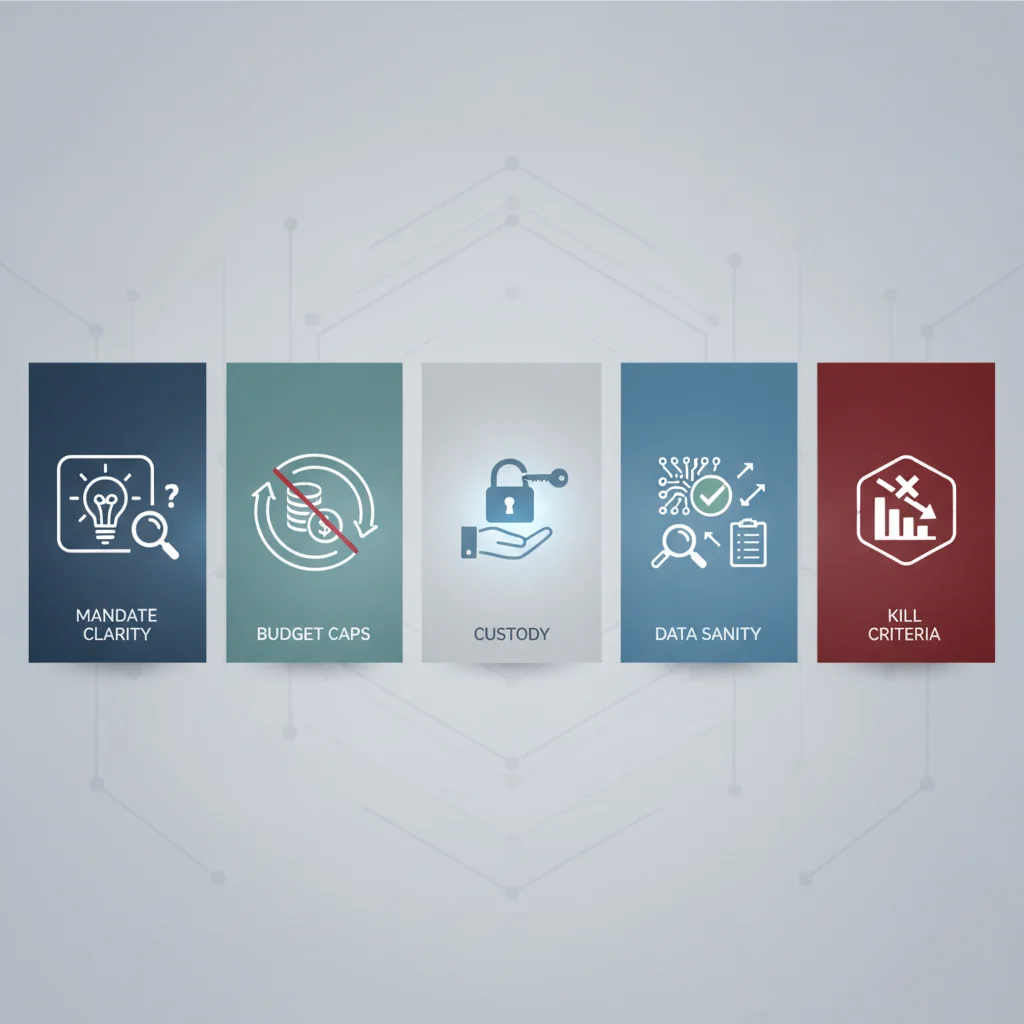
A practical risk checklist before copying an AI trading strategy: mandate clarity, external budget caps, custody, data sanity checks, and kill criteria.

Key Takeaway
Copying an AI strategy feels different from copying a human whale because the pitch is about process, not personality. That difference can be clarifying—or it can be a costume. An AI strategy can still overfit, still silently raise risk, still depend on stale inputs, and still spend your sleeve into a hole if guardrails live only in prose. Before you allocate, you need a risk checklist that treats the model as untrusted for enforcement purposes and treats the runner as the real risk engine.
This article is a pre-allocation checklist for AI trading strategies and agentic systems: mandate clarity, external budget caps, data and execution sanity checks, custody posture, monitoring cadence, and kill criteria. It is written for retail users who want education-grade caution without pretending AI removes market risk.
Mandate clarity before model mystique
What job is the strategy hired to do?
Demand a plain-language mandate: markets traded, time horizon, whether leverage is allowed, maximum inventory, and what “success” means beyond a backtest screenshot. If the provider cannot describe the job without buzzwords, you cannot write unfollow rules. AI branding does not replace a job description. A strategy that “trades crypto opportunities with cutting-edge models” is not yet evaluable.
What would falsify the mandate?
Every serious allocation needs falsifiers: drawdown beyond X, slippage beyond Y, style drift into new instruments, or a change in data vendors that the operator cannot explain. Write them down. AI strategies love to narrate why a breach is temporary. Your capital should not take narration as collateral.
Guardrails that must live outside the model
Spend and loss caps
Modern agent-safety guidance is blunt: prompts are not guardrails. Require per-trade notional caps, daily spend or loss caps, max concurrent positions, and a drawdown circuit breaker that halts the loop until a human re-enables it. If the product only “encourages” risk limits inside chat, size at dust or walk away. Prefer systems where a runner rejects invalid orders even when the model argues.
Custody and key scope
Prefer owner-controlled wallets or exchange balances with trade-only keys. Never grant withdrawal to an autonomous agent. Confirm revoke paths. Confirm that conversation cannot widen permissions silently. Pair this with a hard sleeve size so even a compromised trade key has a bounded blast radius.
Explore how Alphio frames capped autonomy on Alphio Autonomous Trading and how copy-like follows still bind budgets on Alphio Copy Trade.
Review agent controls on Alphio
Data, execution, and sanity checks
Stale inputs and quote-before-write
Ask how the strategy handles stale marks, missing order books, and discontinuous feeds. Serious runners include quote-before-write checks, price-deviation limits, and refusals when data is invalid. An AI that is eloquent on bad data is more dangerous than a quiet broken script, because eloquence invites trust.
Rate limits and overtrading
Cap trades per hour and per day. Overtrading burns fees and invents activity that looks like intelligence. Venue rate limits are a backstop, not a strategy. If the agent regularly brushes venue limits, your frequency guardrail is too soft.
Monitoring like an owner, not like a fan
Logs beat vibes
Require decision logs: why entered, why sized, why blocked. Review weekly. A strategy that cannot show rejects is hiding half its behavior. Use scheduled reviews via Alphio Scheduled Task and write the keep-or-kill note in Alphio Conversational Trading.
Paper, dust, then sleeve
Test guardrails in paper by feeding edge cases. Then run dust live. Only then promote capital under the same written caps. Promotion should require evidence on fills, downtime behavior, and unchanged custody posture—not a good week of PnL.
Special risks when AI strategies are socially distributed
Backtest theater and survivor bias
AI decks love equity curves. Ask for out-of-sample logic, live track length, fee assumptions, and whether failed experiments are shown. Short live histories with perfect curves are red flags whether or not a model is involved. If performance depends on a private data edge you cannot verify, you are buying faith.
Correlation with your other crypto risk
An AI book that is long crypto beta is not diversifying your Hyperliquid vaults or your COIN/MSTR sensitivity. Cap the combined automation sleeve. When liquid crypto proxies swing hard, assume agents and human leads can fail together.
Kill criteria you should not negotiate live
Write three automatic kills: custody regression, breaker trip without a satisfactory post-mortem, and mandate breach into new instruments or leverage tiers. Write two discretionary reviews: persistent slippage deterioration and rising trade frequency without improving expectancy. Automatic kills stop debates. Discretionary reviews happen on a schedule, not in the middle of a candle.
If a provider pressures you to disable breaks “so the AI can work,” treat that as disqualifying. Strategies that require unbounded authority are not strategies. They are requests for sponsorship.
Field notes from followers who learned the hard way about risk checklist before copying ai strategy
The most expensive lessons in crypto automation rarely come from a single bad tick. They come from missing controls that looked optional during a calm onboarding. Someone funded a hot sleeve without a revoke drill. Someone raised a budget after three green days. Someone treated a leaderboard as a due-diligence report. Someone kept a lead through style drift because lifetime ROI still sparkled. Each story is specific; the pattern is identical: evidence was replaced by narrative at the moment capital scaled.
You can interrupt that pattern with ceremony that feels almost bureaucratic. Before every increase in size related to risk checklist before copying ai strategy, require two artifacts: a one-page note of what changed since the last review, and a dust-sized test that proves the control you think you have still works. If either artifact is missing, the increase does not happen. Alphio’s Scheduled Task surface exists to make the ceremony recur, and Conversational Trading exists to make the note attach to the same place you act.
How this checklist connects to Alphio workflows
Checklists fail when they live only in blog tabs. They work when they become defaults in the product path you actually click. For followers, that usually means evaluating a lead, binding a budget, then mirroring—not mirroring first. For agent users, it means external caps before autonomy theater. Use Alphio Copy Trade when the object is a vault, whale, or followable strategy, and Alphio Autonomous Trading when the object is an agent loop that must be fenced.
Apply the checklist in Alphio Copy Trade
Fence agents in Alphio Autonomous Trading
Keep liquid market context honest while you do it. Crypto-sensitive equities such as
and
will not manage your risk for you, but they will remind you that beta clusters. If your notes on risk checklist before copying ai strategy ignore that clustering, your diversification claims are probably cosmetic.
A thirty-day adoption plan you can actually finish
Week one: write the one-pager and run dust drills only. No scaling. Week two: allow a tiny live sleeve under the strictest caps you wrote, and log every reject or skip. Week three: compare your fills and drawdowns to the thesis; demote anything that drifted. Week four: decide whether to promote, hold, or kill—then schedule the next monthly review before you celebrate. The plan is deliberately slow. Speed is how social trading apps sell. Slowness is how educational capital survives.
If you skip weeks, do not “catch up” by jumping to week four size. Restart at the last honest week. Ambition is cheap; repaired process is not. Store the week-four decision where you will see it again, ideally beside an Alphio reminder via Scheduled Task.
Questions to ask support before you increase size
Ask where funds sit overnight, how to revoke trading permissions, what happens on engine outages, how skipped copies are surfaced, whether profit share and fees are netted in displayed ROI, and how to flatten without the happy-path UI. Write the answers into your risk checklist before copying ai strategy file. If support cannot answer without delay or deflection, treat that as a soft veto on scaling. Good teams are boringly specific. Vague poetry is a risk factor.
Also ask what changed in the last ninety days: custody model, fee schedule, margin defaults, or authorization scope. Quiet changes are where yesterday’s checklist becomes today’s false comfort. A quarterly diff review is as important as the initial review.
Closing synthesis before the formal conclusion
By now the through-line should be obvious. Whether the page title centers on risk checklist before copying ai strategy or on a neighboring evaluation theme, durable copy and agent trading is a stack: custody, budgets, sizing, stops, fees, and unfollow rules. Removing one layer does not make you agile; it makes you leveraged to a single point of failure. Prefer products and habits that make the stack visible. Prefer Alphio paths that bind capital to limits before narratives get loud.
If a friend forwards a perfect curve tomorrow, you already know the response: open the checklist, run the drills, and only then discuss size. That response is the entire educational edge available to most retail followers.
Another practical reminder on risk checklist before copying ai strategy: after any platform incident in the wider market—an exchange outage, a bridge failure, a sudden venue rule change—re-run your revoke and withdraw drills even if your own stack seemed fine. Contagion often shows up as stuck exits and confused support queues. Cap size first, ask questions second.
Another practical reminder on risk checklist before copying ai strategy: after any platform incident in the wider market—an exchange outage, a bridge failure, a sudden venue rule change—re-run your revoke and withdraw drills even if your own stack seemed fine. Contagion often shows up as stuck exits and confused support queues. Cap size first, ask questions second.
Another practical reminder on risk checklist before copying ai strategy: after any platform incident in the wider market—an exchange outage, a bridge failure, a sudden venue rule change—re-run your revoke and withdraw drills even if your own stack seemed fine. Contagion often shows up as stuck exits and confused support queues. Cap size first, ask questions second.
Another practical reminder on risk checklist before copying ai strategy: after any platform incident in the wider market—an exchange outage, a bridge failure, a sudden venue rule change—re-run your revoke and withdraw drills even if your own stack seemed fine. Contagion often shows up as stuck exits and confused support queues. Cap size first, ask questions second.
Another practical reminder on risk checklist before copying ai strategy: after any platform incident in the wider market—an exchange outage, a bridge failure, a sudden venue rule change—re-run your revoke and withdraw drills even if your own stack seemed fine. Contagion often shows up as stuck exits and confused support queues. Cap size first, ask questions second.
Another practical reminder on risk checklist before copying ai strategy: after any platform incident in the wider market—an exchange outage, a bridge failure, a sudden venue rule change—re-run your revoke and withdraw drills even if your own stack seemed fine. Contagion often shows up as stuck exits and confused support queues. Cap size first, ask questions second.
Another practical reminder on risk checklist before copying ai strategy: after any platform incident in the wider market—an exchange outage, a bridge failure, a sudden venue rule change—re-run your revoke and withdraw drills even if your own stack seemed fine. Contagion often shows up as stuck exits and confused support queues. Cap size first, ask questions second.
Another practical reminder on risk checklist before copying ai strategy: after any platform incident in the wider market—an exchange outage, a bridge failure, a sudden venue rule change—re-run your revoke and withdraw drills even if your own stack seemed fine. Contagion often shows up as stuck exits and confused support queues. Cap size first, ask questions second.
Conclusion
Before copying an AI strategy, hire it with a mandate, cage it with external caps, verify custody, test sanity checks, and monitor with logs. Eloquence is not a control. Live dust is. Promote slowly.
Use Alphio Autonomous Trading for capped agent workflows and Alphio Copy Trade when the strategy is distributed as a followable lead. AI can automate decisions. It should not automate unbounded trust.
FAQs
What is the first risk check for an AI trading strategy?
Mandate clarity: markets, leverage policy, horizon, and falsifiers. If the job cannot be stated plainly, you cannot manage or unfollow it.
Why aren’t chat-based risk instructions enough?
Because models can reinterpret them. Hard caps and circuit breakers must be enforced by the trading runner and key policy outside the model.
Should an AI agent ever have withdrawal permission?
No. Keep withdrawal with the owner. Agents should be limited to trade scope inside a capped sleeve.
How long should I dust-test before scaling?
Long enough to observe fills, downtime behavior, and at least one guardrail rejection under live conditions. A single green week is not enough evidence.
How does Alphio support AI strategy risk controls?
Alphio emphasizes budget-binding for agents and copy leads, plus scheduled and conversational review workflows so kill criteria stay explicit.
Related articles
- Stock Market Surges After 2026 Midterms: What the Democratic Sweep Means for Your PortfolioThe stock market rallied after Democrats won the 2026 midterms. Discover what the election means for investors, tech stocks, and the S&P 500 outlook.
- Stock Market Surges After 2026 Midterms: What the Democratic Sweep Means for Your PortfolioThe stock market rallied after Democrats won the 2026 midterms. Discover what the election means for investors, tech stocks, and the S&P 500 outlook.
- Oil Prices Surge Above $105 Amid US-Iran Conflict: Energy Investment Opportunities in November 2026Oil prices climb past $105 as US strikes Iran's Qeshm Island. Discover energy investment opportunities, top oil stocks, and market outlook for November 2026.
- Nvidia Earnings August 2026: Will NVDA Stock Soar After the August 26 Report?Nvidia reports Q2 earnings on August 26, 2026. Get expert analysis on NVDA stock, revenue forecasts of $91B, AI chip demand, and price targets before the big announcement.
- SMCI Stock Analysis August 2026: Margins Double, Guidance Soars to $72 BillionSuper Micro Computer (SMCI) stock analysis for August 2026. Q4 earnings beat expectations with margins doubling to 17.5%. Fiscal 2027 guidance hits $72 billion.
- Super Micro Computer (SMCI) Q4 2026 Earnings: AI Infrastructure Powerhouse Rallies on Strong GuidancSuper Micro Computer SMCI Q4 2026 earnings analysis. Explore AI server demand, SpaceX xAI partnership, and investment outlook for this data center infrastructure leader.