

Oil Prices Surge to $117 a Barrel: What It Means for Energy Stocks and the Broader Market
Brent crude hits $117 as Middle East tensions escalate. Explore how surging oil prices impact the Dow, inflation, and top energy stocks like XOM and CVX.

Key Takeaway
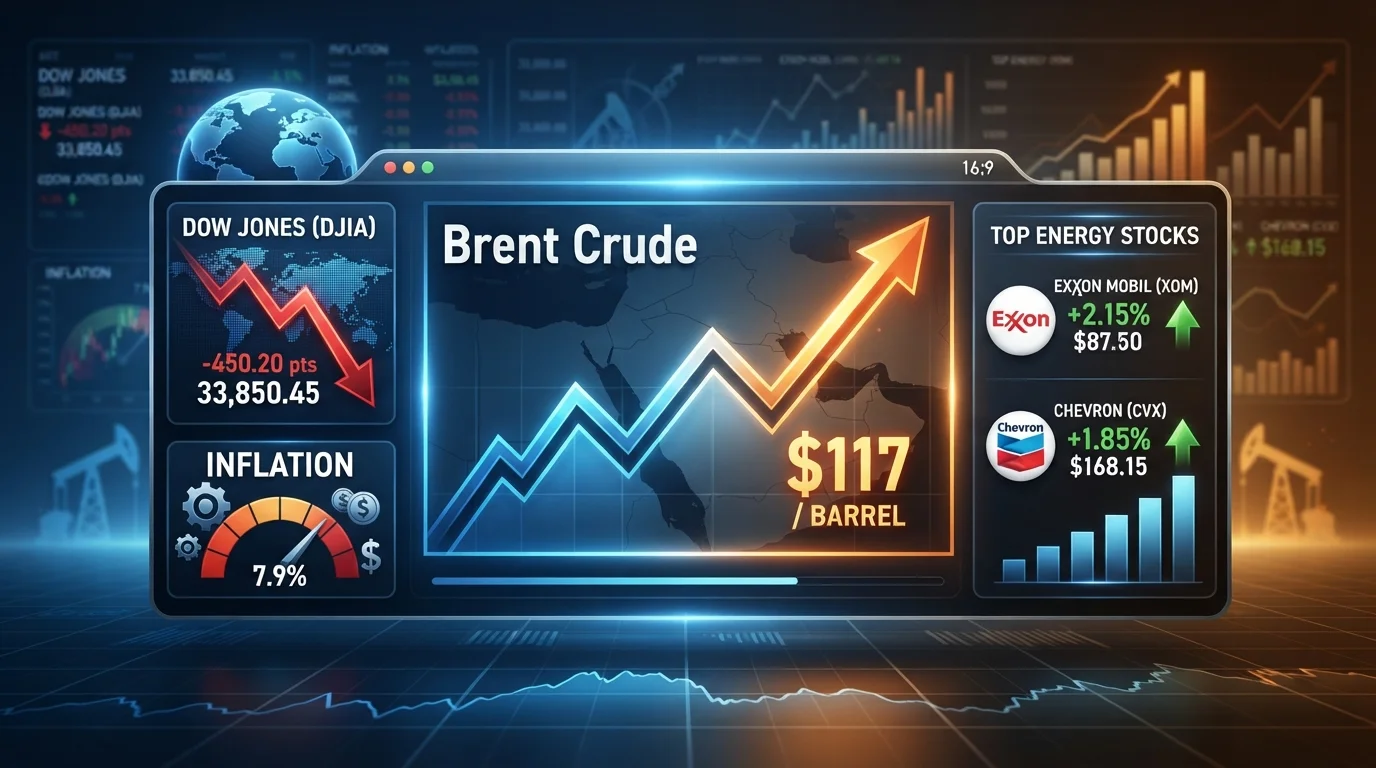
Brent crude oil surged to approximately $117 per barrel on October 23, 2026, reaching its highest level since April as escalating geopolitical tensions in the Middle East stoked fears of supply disruptions. The sharp rally in energy prices sent shockwaves through global equity markets, pushing the Dow Jones Industrial Average down more than 650 points and delivering a second consecutive weekly decline for both the S&P 500 and the Nasdaq Composite. For investors, this episode underscores the enduring vulnerability of financial markets to oil price shocks and highlights the renewed attractiveness of energy sector equities at a time when broader market sentiment is deteriorating.
The drivers behind this latest oil price spike are multifaceted, combining genuine supply concerns with heightened geopolitical risk premia. Attacks on Saudi Arabian infrastructure, renewed tensions between the United States and Iran, and ongoing disruptions to shipping routes through the Red Sea have all contributed to a tighter-than-expected global oil balance. At the same time, major oil producers have maintained relatively disciplined output levels, refusing to flood the market with additional barrels even as prices climb. This combination of constrained supply and elevated geopolitical risk has created a potent recipe for price volatility that is likely to persist in the near term.
For energy investors, the current environment presents both opportunities and risks. Companies like ExxonMobil and Chevron have already benefited handsomely from the oil price rebound, with both stocks rallying approximately 11-12% over the past month alone. However, the broader macroeconomic implications of sustained triple-digit oil prices could weigh on consumer spending, corporate margins, and inflation expectations, potentially forcing the Federal Reserve to maintain higher interest rates for longer than previously anticipated.
Why Oil Prices Are Surging: Supply, Demand, and Geopolitics
The Middle East Powder Keg
The immediate catalyst for oil's dramatic ascent has been the sharp escalation of hostilities across the Middle East. Reports of renewed fighting between the United States and Iran have rekindled fears that the Strait of Hormuz, through which roughly one-fifth of global oil shipments pass, could face disruptions. Additionally, Houthi attacks on Saudi Arabian energy infrastructure and commercial vessels in the Red Sea have forced shipping companies to reroute tankers around the Cape of Good Hope, adding both time and cost to global oil deliveries.
These geopolitical developments have injected a significant risk premium into oil prices. Even though actual supply disruptions have so far been relatively limited, the mere possibility of a major outage has been sufficient to drive speculative buying and force short-covering in futures markets. Historical precedents, including the 2022 energy crisis following Russia's invasion of Ukraine, demonstrate how quickly oil prices can spike when markets price in tail-risk scenarios involving major supply interruptions.
Supply Discipline from OPEC+
Compounding the geopolitical tensions, OPEC and its allies have maintained a disciplined approach to production quotas throughout 2026. Saudi Arabia, the world's largest oil exporter, has kept output well below its maximum capacity, while Russia has continued to manage its export flows in coordination with OPEC+ agreements. This supply restraint has prevented the market from becoming oversupplied, even as demand growth in China and other emerging economies has shown signs of moderation.
The decision by major producers to hold back supply rather than capitalize on higher prices reflects a strategic shift that began during the pandemic-induced demand collapse of 2020. Having learned painful lessons about the dangers of a price war, OPEC+ members have prioritized market stability and price support over short-term volume gains. This disciplined approach has given the cartel significant leverage over global oil prices and has made the market more sensitive to any disruptions, whether geopolitical or weather-related.
Resilient Global Demand
Despite concerns about slowing economic growth in China and recession risks in Europe and North America, global oil demand has proven remarkably resilient through the first three quarters of 2026. Jet fuel consumption has continued its post-pandemic recovery, supported by strong international travel volumes. Petrochemical demand has also held up well, driven by ongoing industrial activity in Asia and the Middle East. Even gasoline demand in the United States, while showing some signs of demand destruction at the margin, has remained relatively robust by historical standards.
The combination of disciplined supply and steady demand has tightened the global oil balance considerably. Inventory levels in the OECD countries have drawn down to below five-year averages, removing the buffer that had previously kept prices in check. With spare production capacity concentrated in a handful of OPEC members, the market is now operating with minimal slack, amplifying the price impact of any supply shock.
Market Impact: How $117 Oil Is Rattling Wall Street
The Dow's Worst Week in Months
The surge in oil prices has delivered a bruising blow to U.S. equity markets, with the Dow Jones Industrial Average plunging more than 600 points on October 23 alone to close near 52,215. The S&P 500 shed 0.5% on the day, capping its second consecutive weekly decline, while the Nasdaq Composite surrendered an early gain to finish modestly lower. For investors who had grown accustomed to the market's steady upward grind through much of 2026, the sudden reversal has been a stark reminder that exogenous shocks can upend even the most bullish narratives.
The market's reaction reflects a complex web of concerns that extend far beyond the energy sector itself. Higher oil prices act as a tax on consumers, reducing disposable income and squeezing household budgets that were already strained by elevated borrowing costs. They also raise input costs for a wide range of industries, from airlines and shipping companies to chemical manufacturers and plastics producers. Perhaps most importantly, surging energy prices threaten to reignite inflationary pressures at a time when the Federal Reserve has only recently begun to consider the possibility of eventual rate cuts.
Inflation Fears Resurface
The renewed spike in oil prices comes at a particularly sensitive moment for inflation dynamics. After more than a year of gradual disinflation, price pressures had appeared to be moderating toward the Fed's 2% target. However, the latest energy price surge threatens to push headline inflation higher in the coming months, complicating the central bank's policy calculus and potentially delaying the timing of any interest rate reductions.
Consumer sentiment, as measured by the University of Michigan survey released on October 23, changed little in October from historically low levels, with inflation continuing to weigh heavily on household economic outlooks. If oil prices remain elevated through the winter heating season, the inflationary impulse from energy could feed through to broader price indices, undermining the progress that has been made in bringing inflation under control. This scenario would likely force the Fed to maintain its current restrictive stance for longer than financial markets have been pricing in.
Treasury Yields Climb
Reflecting these inflation and monetary policy concerns, Treasury yields have risen alongside oil prices. Higher energy costs feed directly into headline inflation measures, which in turn influence bond market pricing of the Fed's future policy path. The yield on the benchmark 10-year Treasury note has climbed back toward recent highs, putting additional pressure on growth-oriented equities and reducing the relative attractiveness of risk assets.
For fixed-income investors, the interplay between oil prices, inflation expectations, and Treasury yields creates a challenging environment. If energy-driven inflation proves persistent, the bond market may need to price in a higher terminal rate for the federal funds rate, extending the duration of the current hiking cycle and potentially pushing yields even higher from current levels.
Energy Stocks: The Bright Spot in a Bleak Market
ExxonMobil (XOM): Riding the Refining Windfall
While the broader market has struggled under the weight of rising oil prices, energy stocks have emerged as clear beneficiaries of the commodity rally. ExxonMobil, the largest U.S. oil major, has seen its shares climb approximately 12% over the past month, dramatically outperforming the flat S&P 500 over the same period. The company enters its October 30 earnings report with significant tailwinds, including strong refining margins, elevated oil prices, and expanding production from its Guyana operations.
Analysts have taken note of ExxonMobil's improving fundamentals, with the consensus fair value estimate recently revised higher to $175.41 from $170.91. The company's diversified business model, which spans upstream exploration and production, downstream refining and chemicals, and low-carbon solutions, provides a degree of resilience even if oil prices were to moderate from current levels. The Permian Basin remains a key growth driver, with production volumes continuing to expand, while the company's Guyana assets have delivered exceptional returns and are poised for further development.
For investors considering ExxonMobil at current levels, the valuation argument remains compelling. The stock trades at approximately 13.5 times 2026 earnings estimates, a reasonable multiple given the company's improving cash generation and disciplined capital allocation. The refining segment, in particular, has benefited from wider crack spreads driven by Middle East supply disruptions, potentially delivering a quarterly windfall that could surprise to the upside when third-quarter results are reported.
Chevron (CVX): Earnings Momentum Building
Chevron has similarly enjoyed a strong run, with shares rising approximately 11% over the past month as investors anticipate robust third-quarter earnings. The company is scheduled to report on October 30, before the market opens, and consensus estimates suggest earnings could rise by nearly 150% compared to the prior year. This dramatic earnings acceleration reflects the combined impact of higher oil and gas realizations, improved downstream margins, and the company's ongoing cost-reduction initiatives.
Chevron's strategic positioning has strengthened considerably over the past year. The company's acquisition of Hess Corporation has added significant high-quality assets in Guyana and the Bakken shale, enhancing Chevron's production growth profile and diversifying its geographic footprint. At the same time, management has maintained a disciplined approach to capital spending, prioritizing projects with the highest returns and shortest payback periods rather than chasing volume growth at any cost.
From a valuation standpoint, Chevron appears attractively priced relative to its historical averages and to the broader market. The stock trades at a modest premium to book value and offers a dividend yield that remains competitive with fixed-income alternatives. With earnings momentum building and the commodity price outlook remaining constructive, Chevron could continue to outperform as investors rotate toward the relative safety and income potential of the energy sector.
Sector Rotation: Is It Time to Overweight Energy?
Defensive Characteristics in a Volatile Market
The recent market turmoil has reignited discussions about portfolio positioning and sector allocation. Energy stocks have historically exhibited defensive characteristics during periods of commodity price strength, as their earnings and cash flows tend to improve precisely when other sectors are struggling with higher input costs. This negative correlation with the broader market makes energy an attractive diversifier for balanced portfolios, particularly when macroeconomic uncertainty is elevated.
The current environment may be particularly favorable for an energy overweight. Unlike previous commodity rallies that were driven primarily by speculative flows or transient supply disruptions, the fundamental backdrop for oil appears genuinely supportive. Supply growth is constrained by years of underinvestment in new production capacity, while demand continues to grow, albeit at a moderating pace. This structural tightness in the oil market could support prices for an extended period, providing a durable tailwind for energy sector earnings.
For investors seeking to capitalize on the energy sector's outperformance, consider using Alphio AI's copy trading feature to mirror successful traders and smart money wallets who are positioning for continued commodity strength.

The Dividend Advantage
Beyond capital appreciation potential, energy stocks offer an attractive income component that has become increasingly valuable in a higher-interest-rate environment. Both ExxonMobil and Chevron have demonstrated long track records of dividend growth, with ExxonMobil maintaining its status as a Dividend Aristocrat through multiple commodity price cycles. These reliable income streams provide a cushion during periods of market volatility and offer a compelling alternative to low-yielding fixed-income instruments.
The free cash flow generation of the major oil companies has improved dramatically over the past several years, driven by a combination of higher commodity prices, cost reductions, and disciplined capital allocation. This enhanced cash generation has enabled companies to return record amounts of capital to shareholders through dividends and share repurchases, while simultaneously reducing debt and strengthening balance sheets. The resulting improvement in financial flexibility positions these companies well to weather potential commodity price volatility while continuing to reward shareholders.
Macroeconomic Implications: A Double-Edged Sword
Consumer Spending at Risk
While energy stocks are benefiting from higher oil prices, the broader economy faces significant headwinds from the commodity rally. The United States remains a net importer of crude oil, meaning that a meaningful portion of the additional spending on petroleum products flows to foreign producers rather than being recycled within the domestic economy. This represents a direct drain on U.S. household purchasing power, with estimates suggesting that every $10 increase in the price of a barrel of oil costs American consumers approximately $40 billion annually in higher gasoline and heating costs.
The timing of the oil price surge is particularly problematic, coming as households are already grappling with elevated mortgage rates, higher credit card debt service costs, and stubbornly high prices for food and other necessities. If gasoline prices climb back toward $4 per gallon nationally, as appears increasingly likely, consumer discretionary spending could come under significant pressure during the crucial holiday shopping season. Retailers, restaurants, and travel-related businesses would be among the most directly affected, potentially triggering downward revisions to fourth-quarter GDP growth estimates.
Federal Reserve Policy Dilemma Deepens
The Federal Reserve faces an increasingly complex policy landscape as oil prices surge. At its late September meeting, the central bank raised the federal funds rate by 25 basis points to a range of 3.75% to 4.00%, and market expectations had been coalescing around the view that the hiking cycle was nearing its end. However, the renewed inflationary impulse from energy threatens to upend this narrative, potentially forcing the Fed to maintain its restrictive stance for longer than previously anticipated.
Current market pricing suggests an 84% to 87% probability that the Fed will hold rates steady at its October 27-28 meeting, with only about a 13% chance of an additional hike. However, if oil prices remain elevated and begin to feed through to core inflation measures, the central bank may find itself with little choice but to tighten further, even at the risk of tipping the economy into recession. This policy dilemma underscores the challenge of maintaining price stability in an environment where external supply shocks can quickly overwhelm domestic demand management efforts.
Global Spillover Effects
The impact of higher oil prices extends far beyond the United States, with particularly severe consequences for energy-importing emerging markets. Countries in Europe and Asia that rely heavily on imported oil and natural gas are facing a renewed terms-of-trade shock, with their import bills rising sharply while export revenues stagnate. This dynamic is already putting downward pressure on currencies such as the euro, yen, and various emerging market units, further complicating the inflation picture for these economies.
China, the world's largest oil importer, is especially vulnerable to the commodity price surge. The Chinese economy has been struggling to regain momentum following its post-pandemic reopening, with persistent weakness in the property sector and subdued consumer confidence weighing on growth. Higher oil prices add another headwind to an already challenging macroeconomic environment, potentially necessitating additional policy stimulus from Beijing to prevent a more pronounced growth slowdown.
Investment Strategies for the Current Environment
Direct Energy Exposure
For investors seeking direct exposure to the energy sector, individual stocks such as ExxonMobil and Chevron offer a combination of upside potential, dividend income, and relative defensiveness. Both companies have demonstrated their ability to generate substantial free cash flow across a range of commodity price environments and have returned significant capital to shareholders through dividends and buybacks. Their integrated business models provide natural hedges against volatility in any single segment of the energy value chain.
Alternatively, investors can gain diversified exposure through sector ETFs such as the Energy Select Sector SPDR Fund (XLE) or the Vanguard Energy ETF (VDE). These funds provide instant diversification across the energy sector, reducing company-specific risk while maintaining sensitivity to oil price movements. For those with a more tactical orientation, leveraged and inverse energy ETFs offer the potential for amplified returns, albeit with significantly higher risk and volatility.
Alternatively, explore Alphio's agentic trading to automate your portfolio management with AI-powered strategies that can dynamically adjust energy allocations based on market conditions.

Commodity-Focused Plays
Beyond the integrated oil majors, investors can consider more targeted commodity plays that offer leveraged exposure to oil price movements. Exploration and production companies, which typically have higher operating leverage than their integrated counterparts, tend to outperform when oil prices rise sharply. Companies with production concentrated in low-cost basins such as the Permian and Eagle Ford shale formations may be particularly well positioned.
Oilfield services companies, which provide the equipment and expertise necessary for drilling and completion activities, also stand to benefit from higher commodity prices as upstream operators increase capital spending. While the services sector has historically been more cyclical and competitive than the upstream segment, the current environment of supply-constrained markets may support a more sustained recovery in drilling activity and pricing power.
Hedging Strategies
For investors concerned about the negative impact of higher oil prices on their broader portfolios, several hedging strategies are available. Short positions in oil-sensitive consumer discretionary stocks, or put options on sector ETFs, can provide downside protection if the commodity rally begins to weigh on household spending. Similarly, long positions in Treasury bonds or the U.S. dollar may benefit if the Fed is forced to maintain higher rates for longer in response to energy-driven inflation.
Another approach is to use Alphio's automations feature to set conditional workflows that automatically rebalance your portfolio when oil prices or energy sector volatility crosses predefined thresholds.

Outlook: Will Oil Prices Stay Elevated?
Near-Term Headwinds and Tailwinds
Predicting the near-term direction of oil prices is notoriously difficult, given the multitude of factors that can influence supply and demand dynamics on any given day. In the immediate term, much will depend on the evolution of the geopolitical situation in the Middle East. A de-escalation of tensions between the U.S. and Iran, or a successful diplomatic initiative to secure shipping lanes through the Red Sea, could remove the risk premium that has been built into current prices and trigger a sharp correction.
Conversely, any further escalation, including direct attacks on major production or export infrastructure, could send prices significantly higher. The market is already operating with minimal spare capacity, meaning that even a relatively modest supply disruption could have an outsized price impact. For investors, this asymmetric risk profile suggests maintaining a degree of caution even as energy stocks outperform.
Longer-Term Structural Factors
Looking beyond the immediate geopolitical noise, several structural factors suggest that oil prices may remain well supported even if the current risk premium dissipates. Years of underinvestment in new production capacity, driven by a combination of low prices, shareholder pressure for capital discipline, and ESG-related constraints on funding, have left the market with limited ability to respond to demand growth with additional supply. Major oil discoveries have become increasingly rare, and the projects that are being developed tend to be technically complex and capital intensive.
At the same time, the energy transition, while undeniably underway, is proceeding more gradually than many had anticipated. Electric vehicle adoption, while growing rapidly, still represents a small fraction of the global vehicle fleet. Aviation and shipping remain overwhelmingly dependent on petroleum-derived fuels, with viable alternatives still years away from commercial scale. Petrochemical demand, which accounts for a significant and growing share of oil consumption, is essentially immune to electrification efforts. These demand-side realities suggest that oil will remain a critical component of the global energy mix for decades to come.
Conclusion
The surge in oil prices to $117 per barrel represents a significant inflection point for global financial markets, with far-reaching implications for equities, bonds, currencies, and economic growth. While energy stocks such as ExxonMobil and Chevron have emerged as clear beneficiaries of the commodity rally, the broader market has suffered as investors price in the negative consequences of higher energy costs for consumers, corporations, and central bank policy.
For investors navigating this complex environment, a balanced approach that incorporates both direct energy exposure and careful risk management appears warranted. The fundamental backdrop for oil remains supportive, with constrained supply growth and resilient demand creating a structural tightness that could persist for an extended period. However, the geopolitical catalysts driving the current price spike introduce significant uncertainty and the potential for sharp reversals if tensions ease.
Ultimately, the key takeaway is that oil price volatility is here to stay, and investors who fail to account for its impact on their portfolios do so at their peril. Whether through direct energy sector investments, commodity hedges, or dynamic portfolio management tools, ensuring adequate preparation for a range of oil price scenarios has never been more important.
For investors looking to stay ahead of commodity-driven market movements, try Alphio's conversational trading to execute trades via chat and receive real-time insights on energy market developments.

Additionally, explore Alphio AI's copy trading feature to mirror successful traders who are capitalizing on the current energy market dynamics, or use agentic trading to automate your commodity exposure with AI-powered strategies.
FAQs
Why did oil prices surge to $117 per barrel in October 2026?
Oil prices surged due to a combination of escalating geopolitical tensions in the Middle East, including renewed U.S.-Iran hostilities and Houthi attacks on Saudi infrastructure, combined with OPEC+ supply discipline and tight global inventories. Brent crude rose approximately 3.5% on October 23 to reach its highest level since April.
How do rising oil prices affect the stock market?
Rising oil prices create a mixed impact on the stock market. Energy stocks like ExxonMobil and Chevron typically benefit from higher commodity prices. However, the broader market often declines because elevated oil acts as a tax on consumers, raises corporate input costs, and can reignite inflation fears that pressure the Federal Reserve to maintain higher interest rates for longer.
Are ExxonMobil and Chevron good investments at current oil prices?
Both ExxonMobil and Chevron have rallied approximately 11-12% over the past month as oil prices climbed. ExxonMobil trades at roughly 13.5x 2026 earnings with strong refining margins and expanding Guyana production. Chevron is expected to report earnings growth of nearly 150% year-over-year. Analysts have revised fair value estimates higher for both companies, though investors should be mindful of valuation levels after the recent run-up.
Will the Federal Reserve raise interest rates because of higher oil prices?
Currently, markets assign an 84-87% probability that the Fed will hold rates steady at its October 27-28 meeting. However, if elevated oil prices feed through to broader inflation measures and persist into the winter, the central bank may be forced to tighten further. The Fed faces a difficult balancing act between controlling inflation and avoiding an economic slowdown.
What is the outlook for oil prices through the end of 2026?
The near-term outlook depends heavily on geopolitical developments in the Middle East. A de-escalation could trigger a price correction, while further escalation might push prices even higher. Structurally, years of underinvestment in production capacity and the gradual pace of the energy transition suggest that oil prices may remain well supported even after the current risk premium dissipates.
Related articles
- Stock Market Surges After 2026 Midterms: What the Democratic Sweep Means for Your PortfolioThe stock market rallied after Democrats won the 2026 midterms. Discover what the election means for investors, tech stocks, and the S&P 500 outlook.
- Stock Market Surges After 2026 Midterms: What the Democratic Sweep Means for Your PortfolioThe stock market rallied after Democrats won the 2026 midterms. Discover what the election means for investors, tech stocks, and the S&P 500 outlook.
- Oil Prices Surge Above $105 Amid US-Iran Conflict: Energy Investment Opportunities in November 2026Oil prices climb past $105 as US strikes Iran's Qeshm Island. Discover energy investment opportunities, top oil stocks, and market outlook for November 2026.
- Crude Oil Price Forecast August 2026: Supply Constraints Drive Brent Toward $85-86 TargetExpert analysis of crude oil price forecast for August 2026. Discover Brent oil targets, supply-demand dynamics, and top energy stocks to watch including XOM and CVX.
- Nvidia Earnings August 2026: $89B Data Center Revenue Signals AI Boom ContinuesNvidia's Q2 FY2027 earnings beat expectations with $89B data center revenue. Analysis of NVDA stock outlook, AI chip demand, and investment strategy for August 2026.
- NVIDIA Earnings August 2026: AI Chip Giant's Q2 Results & Investment OutlookNVIDIA reports Q2 FY2027 earnings with expected $92-95B revenue. Analyze the AI chip leader's growth, Blackwell ramp, and investment outlook for August 2026.