

Crude Oil Price Forecast August 2026: Supply Constraints Drive Brent Toward $85-86 Target
Expert analysis of crude oil price forecast for August 2026. Discover Brent oil targets, supply-demand dynamics, and top energy stocks to watch including XOM and CVX.

Key Takeaway
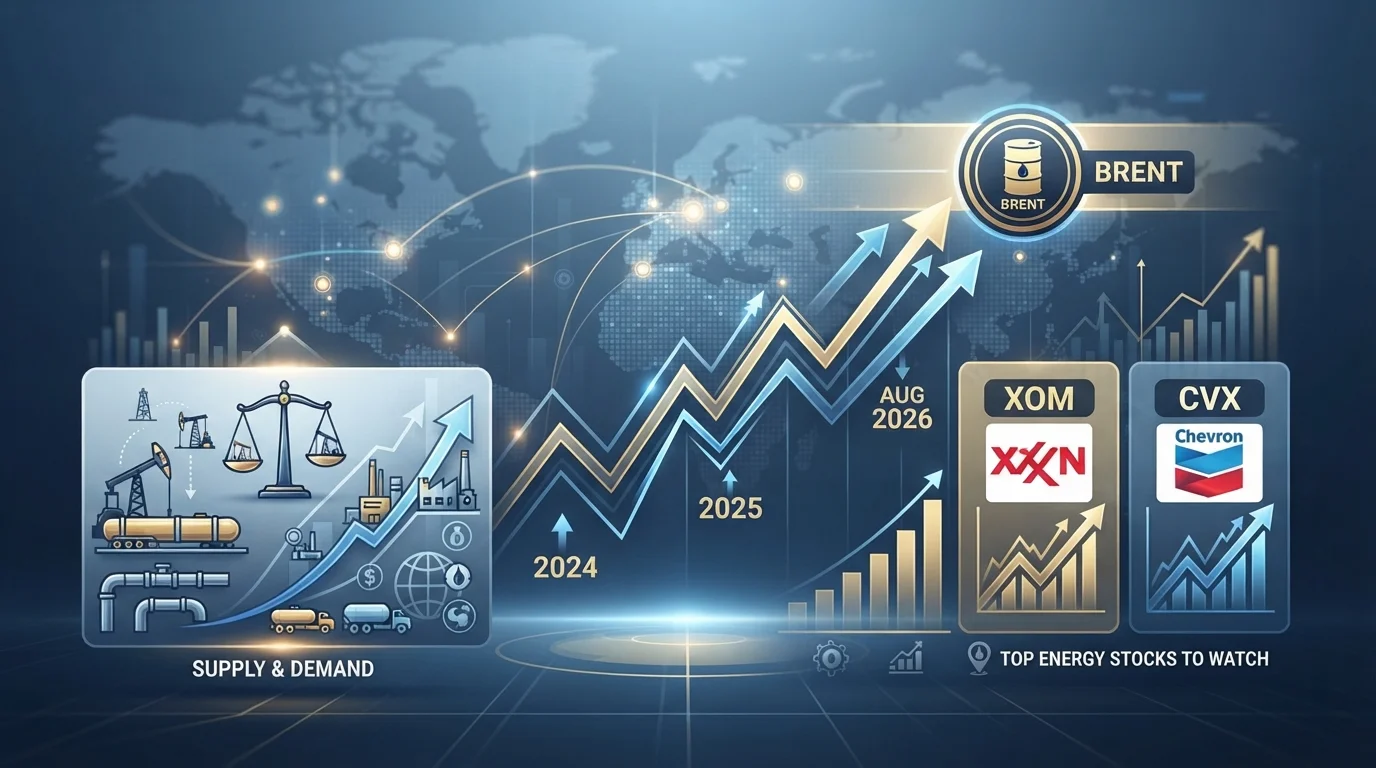
Global crude oil markets are entering a critical phase in August 2026, with Brent crude prices trading around $88 per barrel and analysts projecting sustained strength through the third quarter. The Energy Information Administration (EIA) forecasts Brent to average approximately $85 per barrel in Q3 2026, while J.P. Morgan Global Research maintains a slightly more optimistic target of $86 per barrel for the same period. These projections reflect a complex interplay of supply constraints, geopolitical tensions, and evolving demand patterns that are reshaping the energy landscape.
The current oil market dynamics are characterized by significant supply-side pressures. According to the International Energy Agency (IEA), global oil supply is forecast to fall by 4.3 million barrels per day in 2026, bringing total supply to 102 million barrels per day. This decline stems primarily from production losses in the Middle East and Russia, which are only partially offset by growth of 1.4 million barrels per day from the Americas. Meanwhile, global oil inventories fell by an average of 4.2 million barrels per day in Q2 2026, with an expected additional drawdown of 3.8 million barrels per day in Q3 2026.
For investors seeking exposure to the energy sector, the current environment presents both opportunities and risks. The Energy Select Sector SPDR Fund (XLE) has delivered impressive year-to-date returns of over 32%, significantly outperforming the broader market. This performance reflects the sector's resilience amid geopolitical pressures and the fundamental supply-demand imbalance supporting oil prices. However, investors should remain cognizant of potential demand headwinds and the possibility of price volatility as markets adjust to changing conditions.
Understanding the Current Oil Market Dynamics
Supply-Side Constraints and Production Challenges
The global oil supply landscape in 2026 is marked by unprecedented constraints that are fundamentally altering market dynamics. The IEA's forecast of a 4.3 million barrel per day decline in global supply represents one of the most significant contractions in recent memory, driven by a combination of geopolitical disruptions, production challenges, and strategic decisions by major producers.
Middle East production disruptions have emerged as a primary factor constraining supply. Regional tensions and operational challenges have reduced output from key producers, creating supply gaps that are difficult to fill through alternative sources. Similarly, Russian production has faced significant headwinds, with sanctions and logistical challenges limiting the country's ability to maintain historical output levels. These supply losses are structural rather than temporary, suggesting that market tightness could persist well beyond the immediate forecast period.
The Americas have emerged as the primary source of supply growth, contributing 1.4 million barrels per day of additional production. U.S. shale producers have demonstrated remarkable resilience, leveraging technological improvements and operational efficiencies to maintain output despite volatile price environments. However, this growth is insufficient to fully offset losses from other regions, resulting in a net supply contraction that is supporting higher prices.
Demand Patterns and Economic Implications
Global oil demand remains robust despite concerns about economic growth and energy transition initiatives. The IEA and OPEC maintain divergent views on long-term demand trajectories, with OPEC's World Oil Outlook projecting demand continuing to rise through 2050, while the IEA anticipates a peak by 2030. This divergence reflects fundamental uncertainties about the pace of energy transition and the continued reliance on hydrocarbons in developing economies.
In the near term, demand is supported by economic activity in major consuming regions. The U.S. economy continues to demonstrate resilience, with industrial activity and transportation demand supporting oil consumption. Similarly, emerging market demand remains strong, particularly in Asia where economic growth continues to drive energy consumption. These demand factors, combined with supply constraints, are creating a fundamentally supportive environment for oil prices.
For investors considering energy sector exposure, understanding these demand dynamics is crucial. While long-term energy transition trends are undeniable, the transition timeline remains uncertain, and hydrocarbons are likely to play a significant role in the global energy mix for decades to come. This reality supports the investment case for well-positioned energy companies that can navigate the transition while capitalizing on current market conditions.
Analyst Price Targets and Forecasts
EIA and Major Bank Projections
The consensus among major forecasting institutions points to sustained oil prices in the $80-86 per barrel range through the remainder of 2026. The EIA's forecast of $85 per barrel for Q3 2026 reflects expectations of continued inventory drawdowns and supply constraints. This projection represents an $11 per barrel increase from previous estimates, highlighting the rapid evolution of market conditions.
J.P. Morgan Global Research maintains a similar outlook, forecasting Brent crude at $86 per barrel in Q3 2026, moderating to $80 per barrel in Q4 2026 and $78 per barrel by year-end. This trajectory suggests a gradual easing of supply constraints as markets adjust and alternative supply sources come online. However, the bank notes that the oil market has rebalanced through larger-than-expected demand losses, introducing uncertainty into longer-term forecasts.
Goldman Sachs and other major institutions generally align with these projections, though forecast ranges remain wide. Some analysts suggest Brent could end the year anywhere between $60 and $95 per barrel, reflecting the significant uncertainties surrounding geopolitical developments, OPEC+ policy decisions, and global economic conditions. This uncertainty underscores the importance of maintaining a diversified approach to energy sector investing.
For investors seeking to automate their trading strategies in response to these market forecasts, consider using Alphio AI's copy trading feature to mirror successful traders and smart money wallets.

OPEC+ Policy and Market Management
OPEC+ continues to play a pivotal role in managing global oil markets, with the cartel maintaining production restrictions of approximately 5.86 million barrels per day. These cuts represent a significant portion of global supply and demonstrate the organization's commitment to supporting prices through supply management.
The effectiveness of OPEC+ production policies has been evident in market responses to policy announcements. When the organization signals continued restraint, prices typically respond positively, while hints of production increases can trigger sell-offs. This dynamic creates both opportunities and risks for investors, as policy decisions can drive significant price movements independent of fundamental supply-demand factors.
Looking ahead, OPEC+ faces the challenge of balancing price support with market share preservation. As non-OPEC supply grows and demand patterns evolve, the organization must carefully calibrate its policies to maintain influence without triggering demand destruction or accelerating the energy transition. This balancing act will remain a key factor influencing oil prices through 2026 and beyond.
Energy Sector Investment Opportunities
XLE ETF and Sector Performance
The Energy Select Sector SPDR Fund (XLE) has emerged as a standout performer in 2026, delivering year-to-date returns exceeding 32% and leading all S&P 500 sectors. This performance reflects the fundamental strength of the energy sector amid supportive oil prices and disciplined capital allocation by major producers.
XLE's portfolio is heavily weighted toward large integrated energy companies, with ExxonMobil (XOM) comprising approximately 23% of holdings and Chevron (CVX) representing roughly 17%. These positions provide exposure to diversified operations spanning upstream production, downstream refining, and integrated marketing activities. The fund also includes significant allocations to ConocoPhillips (COP) and other major producers, creating a comprehensive energy sector exposure.
The ETF's performance in 2026 represents a continuation of trends established in 2025, when XLE gained 7.8% despite a 20% decline in oil prices. This resilience reflects the sector's improved cost structure, disciplined capital allocation, and focus on returning cash to shareholders through dividends and buybacks. The current dividend yield of approximately 3.12% provides an attractive income component that differentiates energy investments from more cyclical alternatives.
Individual Stock Opportunities
Beyond broad sector exposure through XLE, individual energy stocks offer targeted investment opportunities. ExxonMobil remains a top choice for investors seeking quality and stability, with the company's integrated operations providing resilience across commodity price cycles. The company's strong balance sheet and disciplined capital allocation have positioned it to weather market volatility while continuing to return cash to shareholders.
Chevron offers compelling dividend reliability, with a track record of consistent payments and growth that appeals to income-focused investors. The company's global asset base and operational efficiency provide competitive advantages that support long-term value creation. For investors seeking maximum leverage to rising oil prices, Occidental Petroleum (OXY) offers a more concentrated play on commodity price movements.
Other notable opportunities include natural gas-focused producers like Expand Energy, formed from the combination of Chesapeake and Southwestern. As the energy transition progresses, natural gas is likely to play an increasingly important role as a transition fuel, supporting demand and pricing for gas-focused producers. This thematic opportunity complements traditional oil-focused investments and provides diversification within the energy sector.
Geopolitical Factors and Risk Considerations
Middle East Tensions and Supply Security
Geopolitical tensions in the Middle East remain a persistent source of risk for oil markets, with the potential to disrupt supply and trigger price spikes. The ongoing US-Iran conflict and regional instability create uncertainty around supply security, particularly for shipments through the Strait of Hormuz, which handles approximately 20% of global oil trade.
Recent developments have highlighted these risks, with reduced oil shipments through the Strait of Hormuz contributing to inventory drawdowns and price support. The EIA has specifically noted these disruptions as a factor in their revised price forecasts, suggesting that geopolitical risk premiums are likely to persist in oil prices through the remainder of 2026.
For investors, these geopolitical factors create both opportunities and risks. While supply disruptions can drive short-term price gains, they also introduce volatility and uncertainty that can complicate investment decisions. Maintaining a long-term perspective and focusing on companies with diversified asset bases can help mitigate these risks while capturing upside potential.
Energy Transition and Long-Term Demand Outlook
The global energy transition represents a structural challenge for the oil industry, with increasing adoption of electric vehicles, renewable energy, and energy efficiency measures gradually reducing oil demand growth. However, the pace of this transition remains uncertain, and hydrocarbons are likely to remain essential to the global economy for decades.
OPEC and the IEA maintain divergent views on long-term demand trajectories, with OPEC projecting demand growth continuing through 2050 while the IEA anticipates a peak by 2030. This divergence reflects different assumptions about economic development, technology adoption, and policy implementation across regions. For investors, the key insight is that oil demand is not disappearing overnight, and well-positioned companies can generate significant returns even as the transition progresses.
The most successful energy companies are those adapting to this transition while capitalizing on current market conditions. Integrated majors like ExxonMobil and Chevron are investing in lower-carbon technologies and diversifying their energy portfolios, positioning themselves for long-term relevance even as the energy mix evolves. This adaptability is a key factor in evaluating energy sector investments.
For investors looking to automate their portfolio management during this transition period, explore Alphio AI's agentic trading feature to implement AI-powered trading strategies.

Investment Strategies for the Current Environment
Balancing Risk and Opportunity
The current oil market environment presents a compelling case for energy sector exposure, but investors must balance this opportunity against inherent risks. The supportive supply-demand fundamentals and strong sector performance suggest continued upside potential, while geopolitical uncertainties and energy transition risks warrant caution.
A diversified approach to energy investing can help manage these risks while capturing upside potential. Combining broad sector exposure through vehicles like XLE with targeted positions in high-quality individual stocks provides diversification while maintaining focus on the most attractive opportunities. Additionally, considering the income component through dividend-paying energy stocks can provide a buffer against price volatility.
Investors should also consider their time horizon and risk tolerance when evaluating energy investments. While short-term traders may focus on momentum and technical factors, long-term investors should emphasize fundamental quality, financial strength, and adaptability to changing market conditions. The energy sector's transformation creates both risks and opportunities, and the most successful investments will likely be those positioned for long-term relevance.
Technical Analysis and Entry Points
From a technical perspective, Brent crude oil has established support around the $83-85 per barrel range, with resistance near $90 per barrel. Current prices around $88 per barrel suggest a balanced market with potential for movement in either direction depending on fundamental developments. Traders should monitor key technical levels and be prepared to adjust positions as market conditions evolve.
For energy stocks, technical indicators suggest the sector remains in a strong uptrend, with XLE trading above key moving averages and maintaining positive momentum. However, the significant gains achieved year-to-date suggest that new positions should be entered with caution, and investors may want to consider dollar-cost averaging or waiting for pullbacks to establish positions.
Risk management remains essential in the current environment. Setting appropriate stop-loss levels, maintaining position sizes within risk tolerance, and avoiding overconcentration in any single position can help protect capital while maintaining exposure to potential upside. The energy sector's volatility requires active monitoring and willingness to adjust positions as conditions change.
Conclusion
The crude oil market in August 2026 presents a compelling investment thesis supported by fundamental supply constraints, robust demand, and geopolitical risk premiums. With Brent crude trading around $88 per barrel and analyst forecasts targeting the $85-86 range for Q3 2026, the near-term outlook remains constructive for energy sector investments.
The Energy Select Sector SPDR Fund (XLE) and individual stocks like ExxonMobil and Chevron offer attractive opportunities for investors seeking exposure to these trends. The sector's impressive year-to-date performance, combined with attractive dividend yields and improving fundamentals, supports the case for continued investment.
However, investors must remain cognizant of risks, including potential demand headwinds, geopolitical developments, and the long-term energy transition. A balanced approach emphasizing quality, diversification, and risk management offers the best path to capturing opportunities while protecting against downside risks.
For those looking to enhance their energy sector investment strategy, consider leveraging Alphio AI's automation features to set conditional workflows and execute trades based on market conditions. Additionally, Alphio's conversational trading interface allows you to execute trades and manage positions through natural language commands.


As always, investors should conduct their own due diligence and consider their individual circumstances before making investment decisions. The energy sector offers significant opportunities, but success requires careful analysis, disciplined execution, and a long-term perspective.
FAQs
What is the crude oil price forecast for August 2026?
Analysts forecast Brent crude oil to average around $85-86 per barrel in Q3 2026, according to projections from the EIA and J.P. Morgan. Current prices are trading near $88 per barrel, supported by supply constraints and inventory drawdowns.
Why are oil prices expected to remain elevated in 2026?
Oil prices are supported by significant supply constraints, with the IEA forecasting a 4.3 million barrel per day decline in global supply. Geopolitical tensions in the Middle East, production challenges in Russia, and OPEC+ production cuts are all contributing to market tightness.
What are the best energy stocks to invest in for 2026?
Top energy stocks include ExxonMobil (XOM) for stability and quality, Chevron (CVX) for dividend reliability, and the XLE ETF for broad sector exposure. Occidental Petroleum (OXY) offers leverage to rising oil prices for more aggressive investors.
How is the energy transition affecting oil investments?
While the energy transition presents long-term challenges, oil demand remains robust and hydrocarbons will play a significant role for decades. The most successful energy companies are adapting to the transition while capitalizing on current market conditions.
What risks should oil investors consider in 2026?
Key risks include geopolitical disruptions, potential demand headwinds from economic slowdown, OPEC+ policy changes, and the long-term energy transition. Diversification and focus on quality companies can help mitigate these risks.
Related articles
- Stock Market Surges After 2026 Midterms: What the Democratic Sweep Means for Your PortfolioThe stock market rallied after Democrats won the 2026 midterms. Discover what the election means for investors, tech stocks, and the S&P 500 outlook.
- Stock Market Surges After 2026 Midterms: What the Democratic Sweep Means for Your PortfolioThe stock market rallied after Democrats won the 2026 midterms. Discover what the election means for investors, tech stocks, and the S&P 500 outlook.
- Oil Prices Surge Above $105 Amid US-Iran Conflict: Energy Investment Opportunities in November 2026Oil prices climb past $105 as US strikes Iran's Qeshm Island. Discover energy investment opportunities, top oil stocks, and market outlook for November 2026.
- Nvidia Earnings August 2026: $89B Data Center Revenue Signals AI Boom ContinuesNvidia's Q2 FY2027 earnings beat expectations with $89B data center revenue. Analysis of NVDA stock outlook, AI chip demand, and investment strategy for August 2026.
- NVIDIA Earnings August 2026: AI Chip Giant's Q2 Results & Investment OutlookNVIDIA reports Q2 FY2027 earnings with expected $92-95B revenue. Analyze the AI chip leader's growth, Blackwell ramp, and investment outlook for August 2026.
- Nvidia Earnings August 2026: AI Chip Demand Analysis & Stock ForecastNvidia reports Q2 FY2027 earnings with 3-95B revenue expected. Analysis of AI chip demand, Blackwell architecture ramp, and NVDA stock price forecast for investors.