

Are You Buying NVIDIA’s Earnings or Its CEO’s Perfect Image?
An Alphio analysis of NVIDIA’s share-price timeline, operating results, governance uncertainty and upcoming earnings.

When a CEO faces personal controversy, how much should that change the value of the company they lead?
Investors have good reasons to care about leadership, judgment and integrity. But a change in public perception needs to be connected to a change in the business before we can assess what it means for valuation.
Has customer demand weakened? Have earnings expectations changed? Is there a credible threat to leadership continuity, regulatory access or company information?
Using the research framework in Alphio AI’s analysis, we checked NVIDIA’s price timeline, reported results and official disclosures. Our view: personal controversy should affect an investment thesis through its implications for the business—not through an assumption that every negative headline explains every price move.
1. Check the timeline before assigning a cause
A negative headline and a falling share price can form a compelling story. The order of events still matters.
From October 30 to November 6, NVIDIA’s closing price fell from $204.64 to $186.64, a decline of approximately 8.80% across five trading sessions. Within that period, the stock dropped 9.26% on November 5, then rebounded 2.78% on November 6. Historical closing-price data
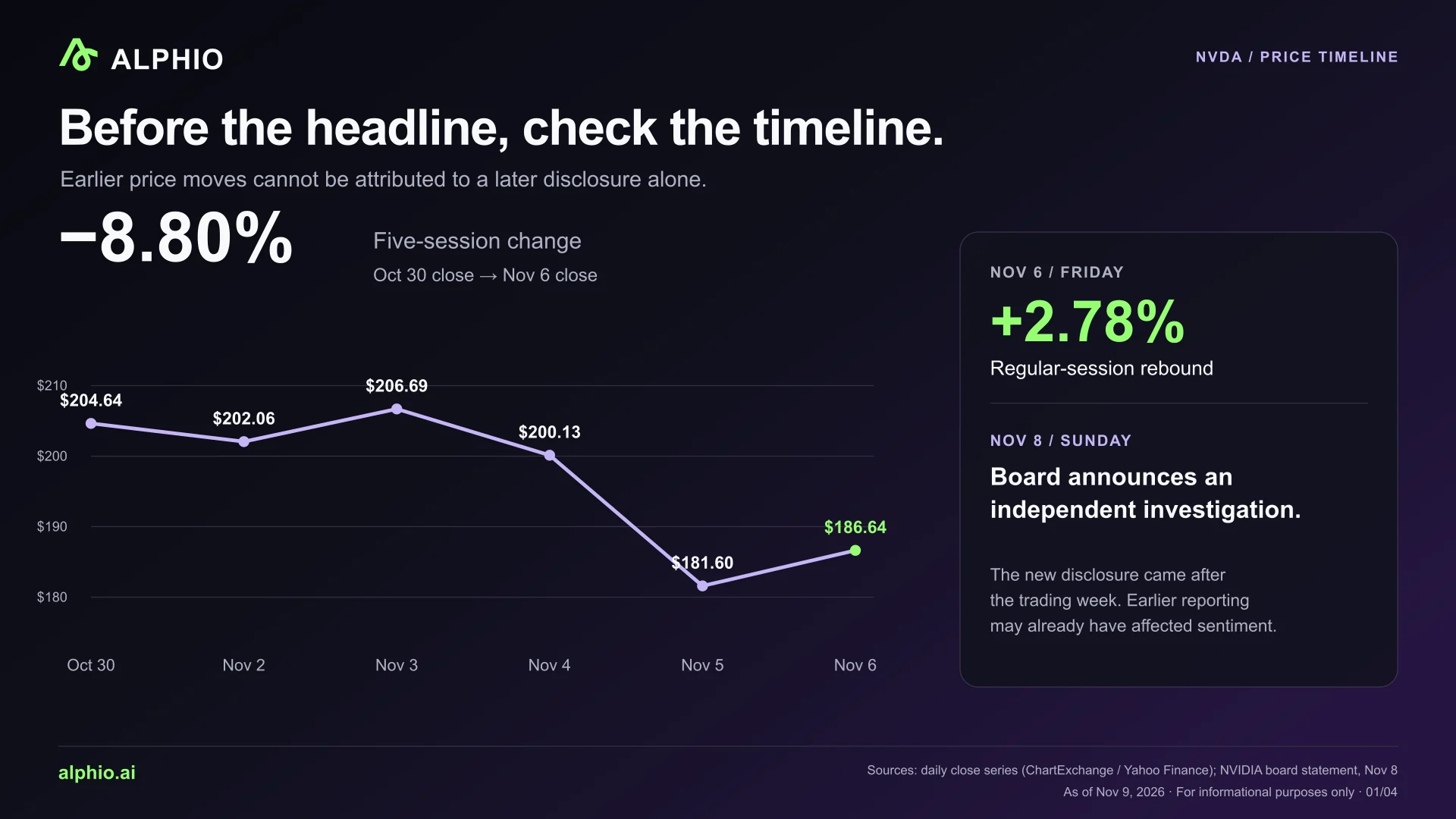
NVIDIA’s board announced its independent investigation on Sunday, November 8, after those trading sessions had ended. NVIDIA board statement
That later disclosure cannot, by itself, establish the cause of the preceding week’s decline. At the same time, the board referred to earlier reporting, so it would also be too strong to assume the market had previously priced in none of these concerns.
The useful distinction is between an observed price move and a demonstrated explanation for it. The timeline challenges a simple narrative; it does not tell us exactly how much each risk contributed to the sell-off.
This is a valuable starting point for AI-assisted research: organize the events, check the numbers and identify what the evidence can actually support.
2. Put the operating business back into the discussion
Investors should scrutinize management while continuing to examine the company’s ability to generate earnings.
NVIDIA’s latest reported quarter, Q2 FY27 ended July 26, 2026, showed revenue of $96.2 billion, up 106% year over year. Data Center revenue reached $89.0 billion, up 117%. GAAP gross margin was 75.0%, and GAAP diluted EPS was $2.46. NVIDIA’s official earnings release
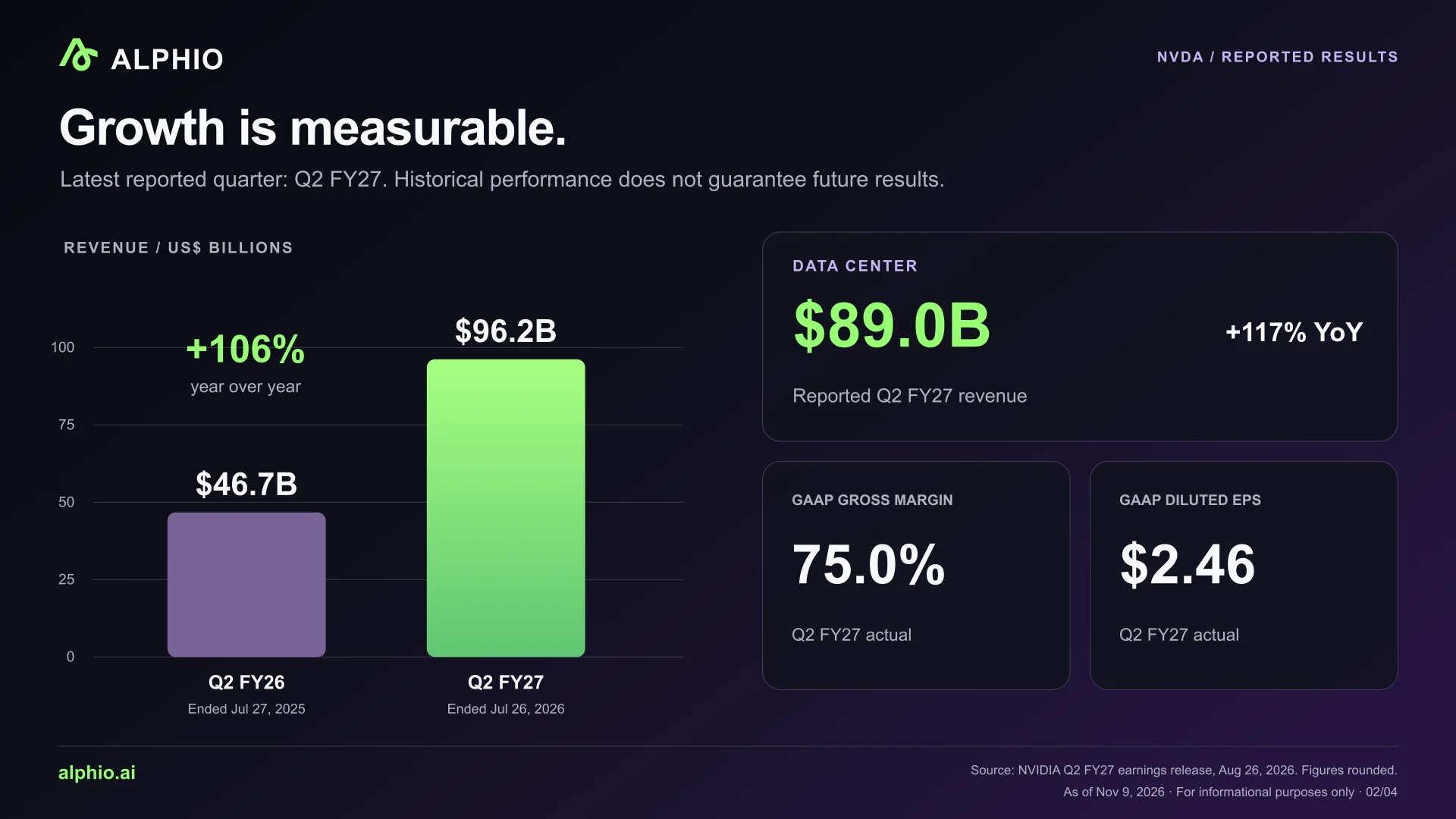
Those results describe a business that had been growing rapidly. They do not establish that today’s share price is cheap, or guarantee that the same growth will continue.
A strong company can still experience a valuation reset if future growth falls short of expectations, customers reassess spending, or investors demand a larger return for taking risk.
That makes the next research question specific: which assumption about future revenue, profitability or risk has changed?
A bullish argument should explain why earnings can support the valuation. A bearish argument should explain what is deteriorating, or what the price already assumes. Neither case is complete without that connection.
3. When does personal controversy become a company risk?
Leadership behavior can have financial consequences. The task is to identify the route by which those consequences could reach shareholders.
Could the situation disrupt important decisions or leadership continuity? Could it expose the company to information-security, compliance or conflict-of-interest issues? Could customers or regulators change how they engage with the business?
These are research questions, not established outcomes.
In its November 8 statement, NVIDIA said an independent board committee, assisted by outside independent counsel, would oversee the investigation. The board said it had no reason to believe national security or company secrets had been compromised, and expressed confidence in Jensen Huang and his leadership team. Official board statement
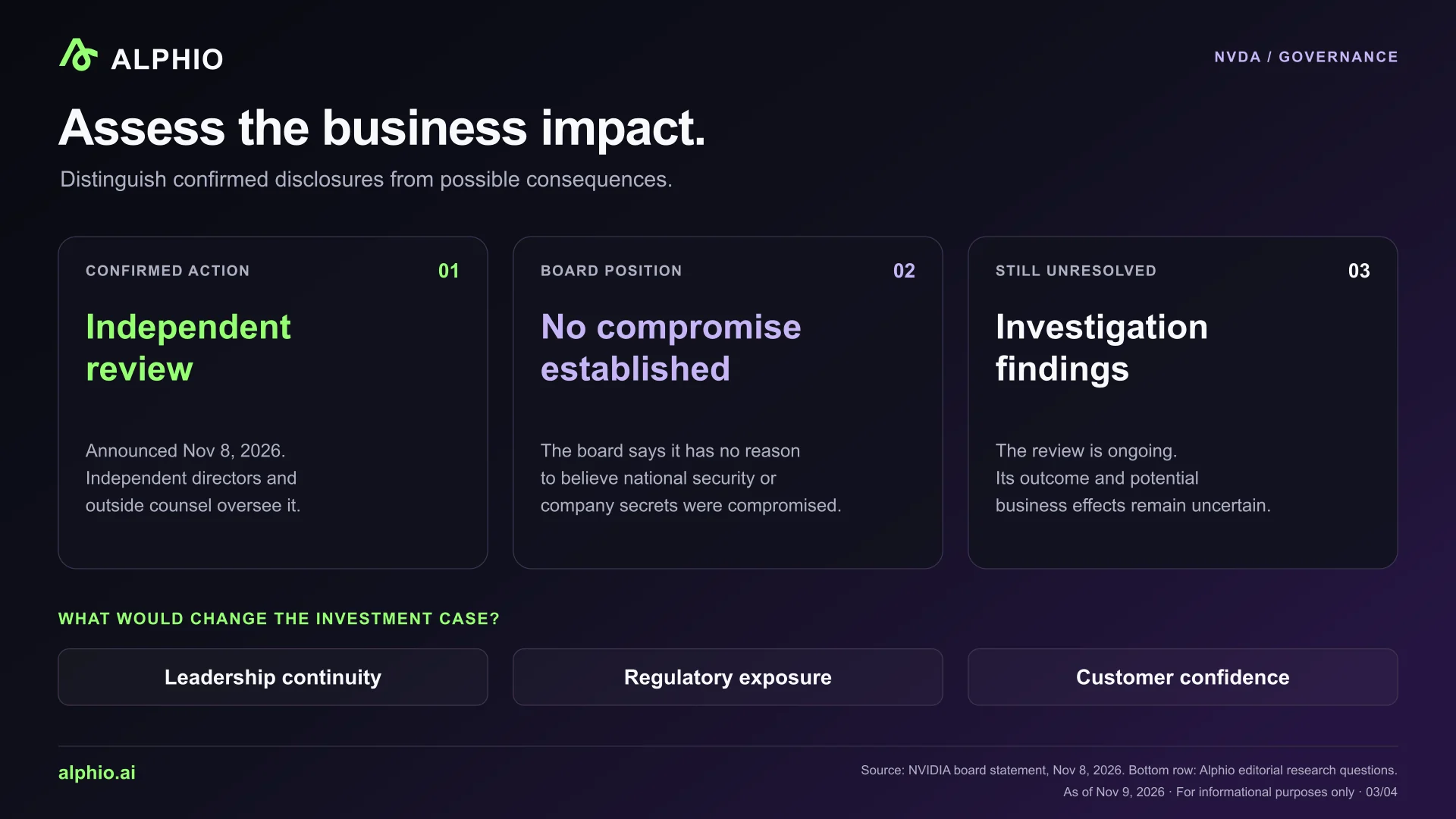
The investigation remains unresolved. The statement should not be treated as proof of business damage or as the final result of the review.
Our approach is to track new evidence and ask whether it changes the probability or scale of a business consequence. Markets can price uncertainty before an outcome is known; investors should still distinguish that uncertainty from a confirmed loss.
A judgment about someone’s conduct and a valuation of a company answer different questions. Both require care.
4. The next earnings report provides another test
NVIDIA is scheduled to release Q3 FY27 results on November 17, after the U.S. market close. Official earnings schedule
Its previously issued outlook called for $108.0 billion in revenue, plus or minus 2%, and GAAP and non-GAAP gross margins of 74.0%, plus or minus 0.5 percentage points. That revenue outlook assumed no Data Center compute revenue from China. These are prior company guidance figures, not reported Q3 results. Official outlook
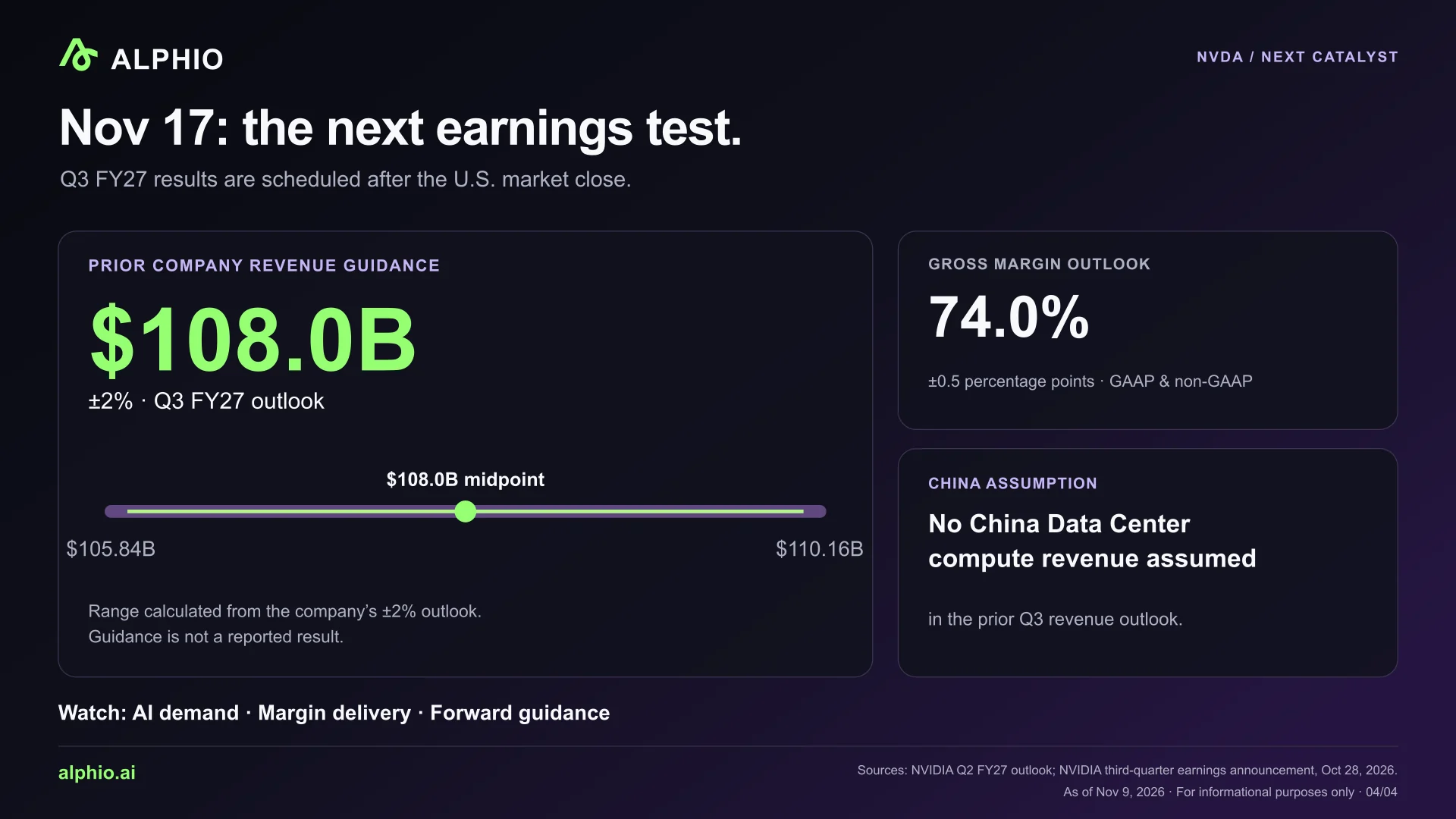
We will be watching whether revenue delivers against that outlook, whether margins support the quality of growth, and what the next guidance says about demand and delivery.
The governance review belongs alongside that financial work. New findings that materially affect leadership, customers or regulatory exposure would deserve a fresh assessment.
What evidence would change your view?
The title asks a provocative question. The investment process should lead to concrete ones.
If a headline changes your view of NVIDIA, identify the assumption you are changing. If it leaves your view unchanged, explain why the business can absorb the associated risk. That reasoning is more useful than treating either outrage or loyalty as a valuation model.
In Alphio, you can take the research further with a prompt such as:
“Compare NVIDIA’s latest disclosures, reported earnings and share-price timeline. Separate confirmed facts from speculation. Which developments could change future earnings? Include sources and evidence against the main thesis.”
Use AI to organize the information, cross-check the evidence and develop your own judgment.
If operating performance has not yet changed, would a CEO’s personal controversy change your investment decision? What evidence would make you reconsider?
Prepared using Alphio AI analysis and public sources. Price data runs through the November 6, 2026 close; event information reflects materials reviewed on November 9. For research and discussion only, not investment advice.
Related articles
- CPI Report and the Stock Market: How to Read October 2026 Inflation Data Before the Fed DecidesOctober 2026 CPI lands Nov 10 with no year-over-year number and Fed hike odds near 80%. Learn how to read CPI, which stocks react, and how to plan for it.
- Stock Market After the 2026 Midterms: What a Democratic Congress Means for InvestorsDemocrats swept Congress in the 2026 midterms. See how stocks reacted, what history says about post-midterm returns, and which sectors face new risks.
- How to Rebalance a Concentrated Stock Portfolio in 2026: Mag7 Drift, Tax-Aware Trims, and Practical Rebalance a concentrated stock portfolio in 2026: Mag7 drift risk, 5pp bands, tax-aware trims, RSP/IWM diversifiers, and single-name caps.
- TSMC Stock Analysis July 2026: Record Profits, AI Dominance & $100B ExpansionTSMC reports record Q2 2026 earnings with 77% profit surge. Analysis of AI chip demand, $100B Arizona expansion, and investment outlook for Taiwan Semiconductor.
- Gold Price Forecast July 2026: Will Gold Break $4,000?Gold prices approach record highs in July 2026. Discover expert analysis on whether gold will break $4,000 and what factors are driving the precious metal rally.
- Fed Interest Rate Forecast 2026: Navigating the Shift from Cuts to Potential HikesGet the latest Fed interest rate forecast for 2026. Analysis of Fed policy, inflation data, and market expectations. Discover what rate changes mean for your investments.